Why Did Megalodon Go Extinct? — Cooling Seas, Whales and Great Whites
Nobody knows for certain why megalodon went extinct, but most scientists think several pressures combined. As the Pliocene oceans changed, megalodon faced shifting climate and sea levels, fewer warm, shallow coastal habitats, changes in the whales and other prey it relied on, and new competition from the great white shark. Its own biology made those pressures harder to survive: a 2023 study found it was partly warm-blooded, with a body temperature of about 27°C, which meant it needed a great deal of food. The species disappeared about 3.6 million years ago.
Climate change, habitat loss, prey change and competition, acting on a huge predator with high energy needs. No single cause has been proven, and the leading ideas are not mutually exclusive.
Why did megalodon go extinct?
Megalodon, Otodus megalodon, was the largest predatory shark that ever lived, with the biggest individuals estimated at up to around 20 m long. It patrolled the world’s warm and temperate seas for roughly 20 million years and fed at the very top of the food chain. Then, about 3.6 million years ago, it was gone. The question of why has occupied palaeontologists for decades.
The honest answer is that there is no single proven cause. Extinction is rarely the result of one event, especially for a species spread across many oceans. Instead, scientists have identified several pressures that came together in the Pliocene epoch, and they continue to argue about how much weight each deserves. This article sets out the main hypotheses and the evidence for and against them. For the detailed story of the great white shark’s role, see our companion article on what killed megalodon, and for how the date of the extinction was worked out, see when did megalodon go extinct?
What was the world like when megalodon disappeared?
To understand the hypotheses, it helps to picture the Pliocene ocean. The epoch began about 5.33 million years ago, with a climate warmer than today’s. Over the following few million years, Earth gradually cooled, and by about 2.58 million years ago large ice sheets were growing in the Northern Hemisphere, marking the start of the ice ages.
As the climate changed, so did sea level, which rose and fell as ice grew and melted. Every drop in sea level drained areas of shallow continental shelf, and every rise flooded them again. Ocean circulation was also shifting. The gap between North and South America was gradually closing, which changed how water moved between the Atlantic and Pacific and contributed to the reorganisation of currents and upwelling zones that still shape the oceans today.
Marine life responded to all of this. A 2017 study led by Catalina Pimiento identified an extinction of large marine animals at the end of the Pliocene that had gone largely unnoticed. About a third of marine megafauna disappeared, including more than half of marine mammal diversity, along with many sea turtles and seabirds. Sharks were less affected, losing around 9% of their diversity. The study linked the losses to climate change and the loss of productive coastal habitats as sea levels fluctuated. Megalodon’s extinction, a million years or so earlier, may have been an early sign of the same upheaval.
Did cooling oceans kill megalodon?
Climate cooling was one of the first explanations proposed, and it is easy to see why. Megalodon fossils are found mostly in rocks formed in warm and temperate waters, and the species disappeared as the world headed towards the ice ages. A large predator adapted to warm seas would, on this view, have been squeezed into a shrinking area of suitable habitat.
The timing complicates this idea. If megalodon was extinct by about 3.6 million years ago, it disappeared before the most dramatic cooling and the onset of major Northern Hemisphere glaciation. The early Pliocene was still relatively warm. Cooling may have played a part, but it is hard to argue that cold water alone wiped out a species that had survived earlier climate swings during its long history.
A more subtle version of the hypothesis focuses not on temperature itself but on what temperature does to food. Changes in ocean temperature and circulation alter where plankton blooms occur, which in turn determines where fish, whales and seals gather. A predator that depended on a particular kind of prey in a particular kind of habitat could be hit hard by such shifts, even if the water itself never became too cold for it.
Was megalodon warm-blooded, and did that matter?
One of the most important recent findings concerns megalodon’s body temperature. In 2023, a team led by Michael Griffiths of William Paterson University, working with researchers including Kenshu Shimada, Robert Eagle and Sora Kim, published a study in the Proceedings of the National Academy of Sciences. They used two geochemical techniques, clumped isotope thermometry and phosphate oxygen isotope thermometry, which estimate the temperature at which minerals in teeth formed.
Their results gave megalodon an average body temperature of about 27°C, significantly higher than that of cold-blooded sharks. For comparison, the modern mako and great white sharks, which are regionally warm-blooded, have reported body temperatures of about 22 to 26.6°C, which can be 10 to 21°C above that of the water around them. The conclusion was that megalodon was at least partly warm-blooded, keeping parts of its body warmer than the sea.
Warm blood brings real advantages. It lets muscles work faster, supports long-distance swimming and allows a predator to hunt in cooler water. But it is expensive. An animal that keeps itself warm burns far more energy than a cold-blooded one of the same size, and a shark many metres long that generates its own heat would need a constant, large supply of food. The researchers suggested that this high metabolic demand may have made megalodon especially vulnerable when its prey became scarcer or harder to find. In their view, the very trait that made it a formidable hunter may have contributed to its downfall.
Did megalodon lose its nursery grounds?
Many modern sharks give birth in sheltered, shallow coastal waters, where the young can find food and avoid larger predators. Fossil evidence suggests megalodon did the same. Palaeontologists have identified ancient nursery areas, such as deposits in Panama, where the teeth come almost entirely from young megalodon, indicating places where juveniles grew up in warm, shallow water.
Nursery areas like these depend on shallow continental shelves. When sea levels fall, shelves are exposed and the warm shallow waters shrink. When the coastline shifts, nursery areas may move or vanish altogether. Pimiento’s 2017 study of the end-Pliocene extinction emphasised the loss of coastal habitat as a key driver of marine megafauna losses, and the same pressure may have acted on megalodon. A species that cannot reliably raise its young will decline even if adults are thriving.
This hypothesis is attractive because it links climate change directly to the most vulnerable stage of megalodon’s life. It is also difficult to test. Nursery sites are only recognisable in the fossil record under unusual circumstances, and nobody yet has a detailed map of how they changed through the Pliocene.
Did megalodon run out of prey?
Megalodon fed on large animals. Bite marks on fossil whale bones, together with its size and teeth, show that it attacked whales, and it probably also took seals, sea cows, large fish and other sharks. Changes in this prey base are one of the most widely discussed explanations for its extinction.
The whale fauna of the Pliocene was very different from that of the Miocene. During megalodon’s heyday, the oceans were full of small and medium-sized baleen whales. Over the following millions of years, many of these groups declined, while the ancestors of today’s giant baleen whales became larger and increasingly concentrated in cold, productive waters at high latitudes. In their 2014 paper on megalodon’s extinction, Pimiento and Clements noted that the modern role and gigantic size of the great filter-feeding whales became established around the same time that megalodon disappeared.
There are two ways to read that coincidence. Megalodon may have lost the medium-sized whales it was best suited to hunt, while the new giants were either too big to tackle easily or lived in cold waters it could not exploit as effectively. Or the disappearance of megalodon, a major predator of whales, may itself have helped whales to grow larger and spread into new habitats. Both processes may have reinforced each other. Pimiento and Clements suggested that future research should test whether megalodon’s extinction played a part in the evolution of these new kinds of whales.
Did great white sharks outcompete megalodon?
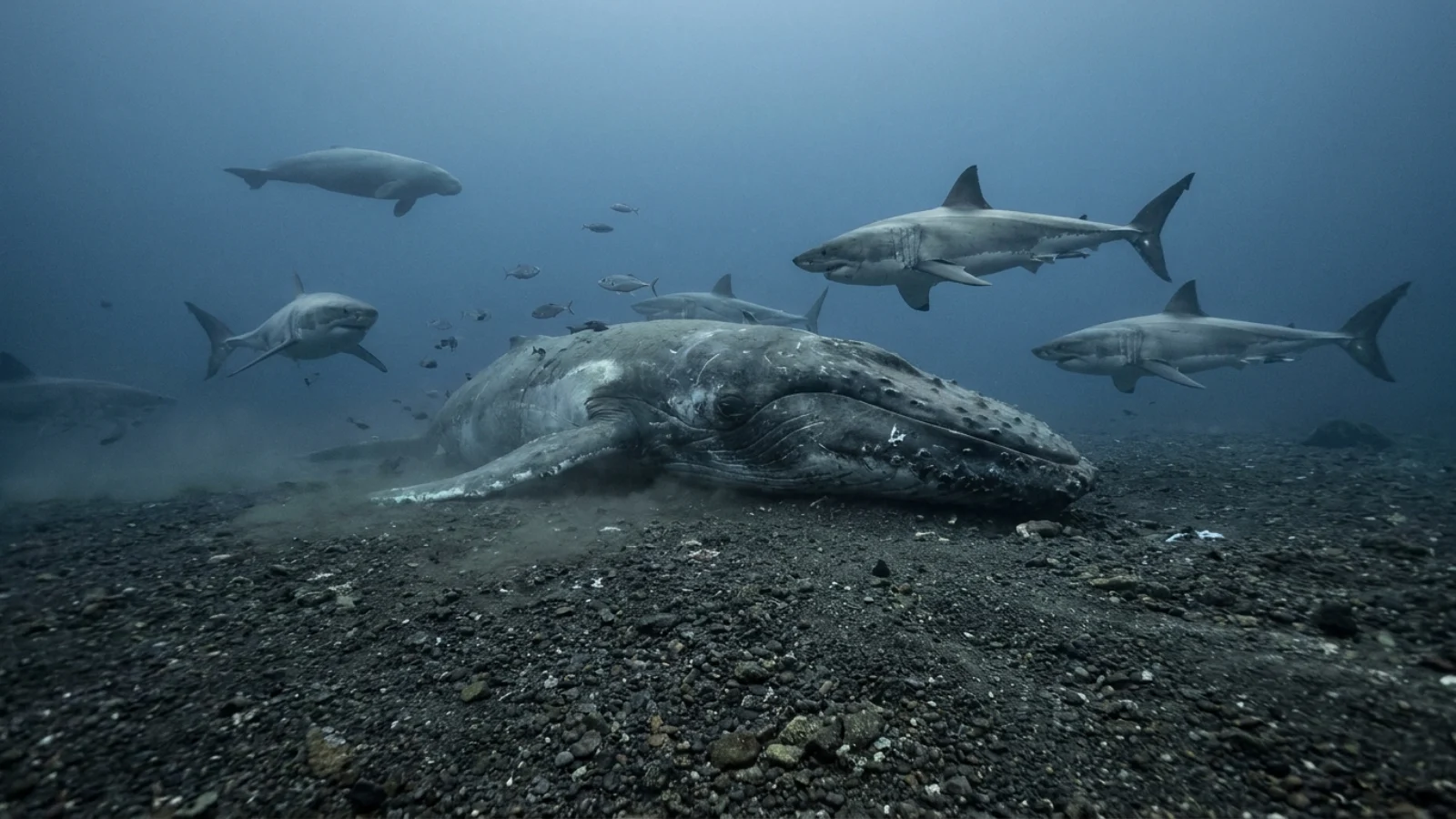
The great white shark is the hypothesis that captures the most attention, and for good reason. According to Robert Boessenecker and colleagues, whose 2019 study revised megalodon’s extinction date to about 3.6 million years ago, great whites spread through the world’s oceans around 4 million years ago. As Boessenecker put it, that short overlap was “sufficient time for great white sharks to spread worldwide”.
Great whites were smaller than megalodon, with the largest modern individuals at about 6 m long, but competition does not require a competitor to be bigger. A 2022 study in Nature Communications, led by Jeremy McCormack, used zinc isotopes in tooth enameloid to estimate how high in the food chain different sharks fed. It found that early Pliocene great whites from North Carolina fed at trophic levels largely overlapping with those of megalodon, suggesting that the two hunted at least some of the same prey.
The authors were careful to say that their results show overlapping diets, not proof that competition caused megalodon’s extinction, and that more research is needed. But together, the timing and the dietary overlap make competition one of the strongest candidate contributors. The details are explored in our article on what killed megalodon.
Was megalodon too big to survive?
Some researchers have suggested that megalodon’s size and life history left it with little room for error. Very large animals tend to grow slowly, mature late and produce relatively few young, so their populations recover slowly after a decline. Large predators also need large hunting ranges, which makes them sensitive to the fragmentation of their habitat.
This is not a cause of extinction in itself, but it changes how a species responds to other pressures. A smaller, faster-breeding shark can bounce back from a few bad decades. A giant, slow-breeding one may not. Combined with its high energy needs, megalodon’s size may have made it unusually sensitive to the changes in climate, prey and competition described above.
The contrast with the great white is instructive. Great whites are also large, warm-bodied predators, but they are smaller, feed on a wider range of prey, including fish, seals and scavenged whale carcasses, and range into cooler water. They survived the Pliocene and the ice ages that followed, while megalodon did not.
Which megalodon extinction theories have been ruled out?
Some popular explanations do not stand up to scrutiny. The most common is that megalodon did not go extinct at all and survives in the deep sea. There is no fossil, photograph or physical evidence of megalodon in the last 3 million years, and a giant warm-bodied predator could not live unnoticed in the cold, food-poor deep ocean. Our article is megalodon still alive? explains why.
Another idea is that radiation from a nearby supernova about 2.6 million years ago harmed large marine animals and contributed to megalodon’s extinction. Whatever its effects on other life, it cannot have killed megalodon if, as the 2019 study concluded, the shark was already gone a million years earlier. Studies that tested the supernova idea against the fossil record of marine life have also found little support for it.
Finally, it is sometimes said that killer whales hunted megalodon to extinction. Orcas are known today to kill great white sharks, but there is no evidence that killer whales of the modern type existed alongside megalodon or preyed on it. The large predatory whales of the Miocene, such as Livyatan, are a different story: they may have competed with megalodon for prey, but they also declined and disappeared around the same time.
What is the most likely explanation?
Most palaeontologists now favour a combination of factors. A plausible story runs like this. As the Pliocene climate began to cool and sea levels fluctuated, warm coastal habitats became less reliable, affecting both megalodon’s nursery areas and the medium-sized whales and other animals it fed on. At the same time, the great white shark spread around the world, feeding high in the same food webs and competing for the same prey. Megalodon, a giant with a warm body and enormous food requirements, was less able than smaller, more flexible predators to adjust.
None of these pressures alone would necessarily have been fatal, but together they may have been more than the species could withstand. The details will change as new fossils are found and new techniques, such as isotope analysis of teeth, reveal more about how megalodon lived. For now, it remains one of the great mysteries of the fossil record, and a reminder that even the largest and most powerful predators can be vulnerable when their world changes around them.
What can megalodon’s extinction teach us about sharks today?
The researchers behind the 2023 temperature study drew a modern lesson from their results. Megalodon went extinct around a time of major changes in climate and sea level, and they suggested that today’s large, warm-bodied predators, such as great white sharks, may also be vulnerable to climate-related stress. The same features that make them successful hunters, high energy demands and dependence on rich hunting grounds, could make them sensitive to changes in where their prey lives.
Today’s sharks face pressures that megalodon never did: overfishing, bycatch and habitat loss caused by people, on top of a changing climate. Many large shark species have declined sharply in recent decades. Megalodon’s story shows how a top predator can disappear when several pressures act together, and why protecting habitat and prey matters as much as protecting the sharks themselves. For more on the giant shark’s place in the history of life, see our guide to prehistoric sharks.
Why did megalodon go extinct?
Probably a combination of climate and sea-level change, loss of coastal habitat, changes in its prey and competition from great white sharks, acting on a giant predator with high energy needs.
When did megalodon go extinct?
About 3.6 million years ago, according to a 2019 study. An earlier study put it at about 2.6 million years ago.
Did great white sharks kill megalodon?
They may have contributed through competition for prey. Great whites spread worldwide about 4 million years ago and fed at similar trophic levels.
Did the ice age kill megalodon?
Not directly. Megalodon was gone before the main ice ages began about 2.58 million years ago, though gradual cooling may have played a part.
Was megalodon warm-blooded?
Partly. A 2023 study estimated its body temperature at about 27°C, higher than cold-blooded sharks, which raised its food requirements.
Did megalodon run out of food?
Possibly. The small and medium-sized whales it hunted declined, while the largest filter-feeding whales grew bigger and moved into cold waters.
Could megalodon have survived in the deep sea?
No. There is no evidence of it in the last 3 million years, and a giant warm-bodied predator could not live unnoticed in the cold deep ocean.
What other animals went extinct with megalodon?
At the end of the Pliocene, about a third of marine megafauna was lost, including more than half of marine mammal diversity.
- Griffiths, M.L. et al. (2023), “Endothermic physiology of extinct megatooth sharks”, PNAS 120(27): e2218153120; William Paterson University news release.
- McCormack, J. et al. (2022), “Trophic position of Otodus megalodon and great white sharks through time revealed by zinc isotopes”, Nature Communications; Max Planck Institute news release.
- Boessenecker, R.W. et al. (2019), “The Early Pliocene extinction of the mega-toothed shark Otodus megalodon“, PeerJ.
- Pimiento, C. et al. (2017), “The Pliocene marine megafauna extinction and its impact on functional diversity”, Nature Ecology & Evolution.
- Pimiento, C. & Clements, C.F. (2014), “When did Carcharocles megalodon become extinct?”, PLoS ONE.
Blane Perun has been exploring Earth’s oceans and marine life for over 25 years. Founder of TheSea.Org in 1999, underwater photographer, coral aquaculture pioneer, and explorer of 80+ countries.
About Blane Perun →