Megalodon vs Great White Shark — Size, Bite and Teeth Compared
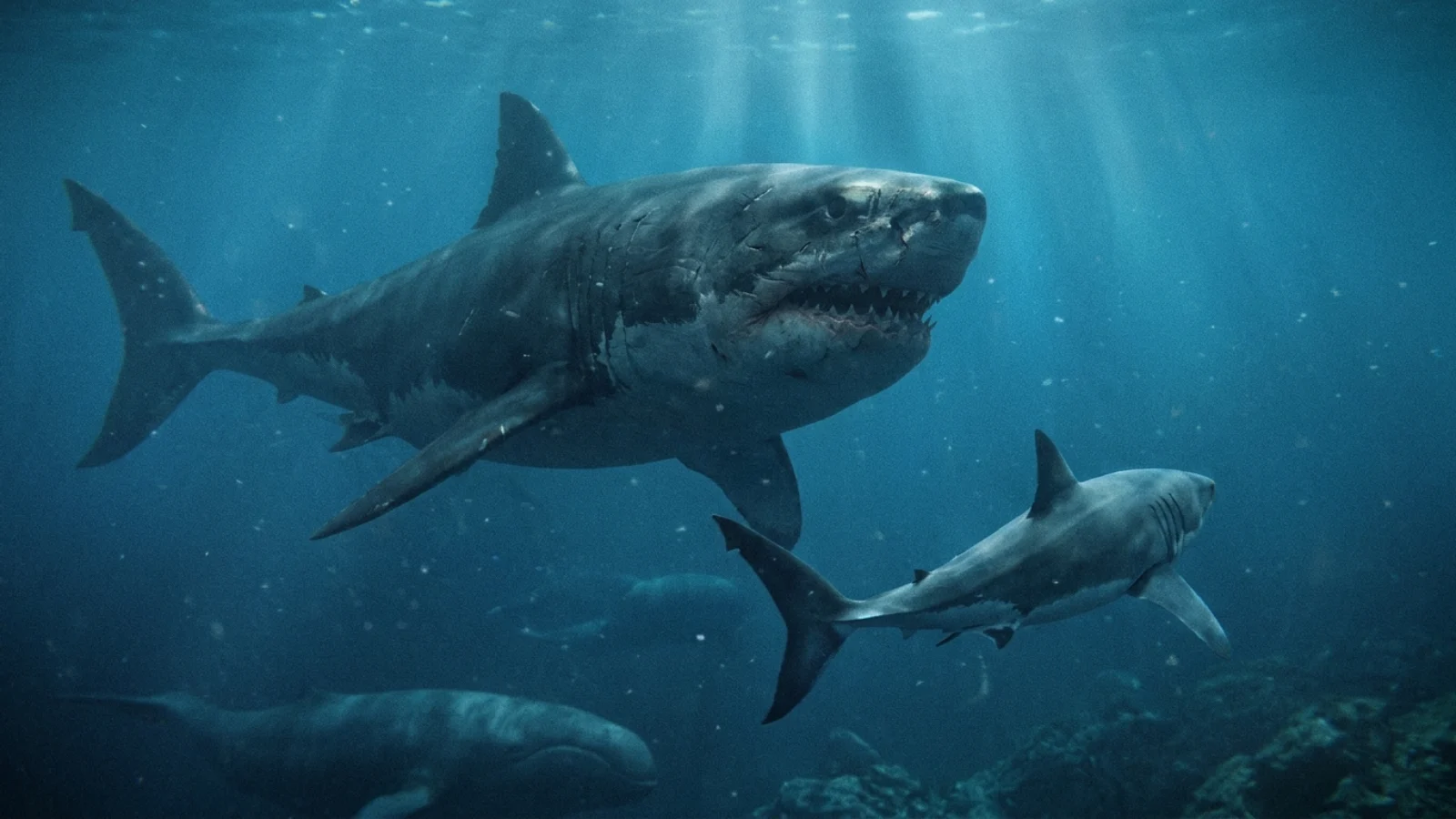
Megalodon was far bigger than the great white shark: probably around 14 to 20 m long at its largest, against about 6 m for the biggest great whites, and dozens of times heavier. Its estimated bite force was roughly six to ten times that of the largest great white, and its teeth could exceed 18 cm. But the two are not as closely related as they look. Megalodon belonged to an extinct family, the Otodontidae, while the great white is a mackerel shark more closely related to the makos. Megalodon died out about 3.6 million years ago; the great white is still here.
Megalodon was the larger, heavier, harder-biting shark, built to tackle whales; the great white is smaller, more flexible and still alive, which in evolutionary terms is the contest that counts.
Megalodon vs great white: which was bigger?
The size gap between these two sharks is enormous, and it is the first thing most people want to know. Megalodon, Otodus megalodon, is known almost entirely from teeth and a few sets of vertebrae, so its size has to be estimated by comparing those fossils with living sharks. Different methods give different answers, but most modern estimates place the largest individuals somewhere between about 14 and 20 m long. A large study of fossil teeth from around the world found that the most common adult length was about 10.5 m, and that animals from the Southern Hemisphere and the Pacific tended to be larger than those from the North Atlantic.
The great white shark, Carcharodon carcharias, is the largest predatory fish alive today, but it is small by comparison. Females, which grow larger than males, usually measure about 4.6 to 4.9 m as adults, and males about 3.4 to 4.0 m. The largest preserved specimen, a female held in the Museum of Zoology in Lausanne, measures 5.83 m. The ichthyologist John Randall considered a 5.94 m shark from Ledge Point, Western Australia, in 1987 to be the largest reliably measured. Older reports of 10 or 11 m great whites have not stood up to scrutiny.
Put simply, an average adult megalodon was roughly twice the length of a big great white, and the largest megalodon may have been three times as long. A great white would have been about the size of a large megalodon’s head and gill region. Our full article on how big megalodon was explains how those length estimates are made and why they vary.
| Feature | Megalodon | Great white shark |
|---|---|---|
| Scientific name | Otodus megalodon | Carcharodon carcharias |
| Family | Otodontidae (extinct) | Lamnidae (mackerel sharks) |
| Typical adult length | About 10.5 m | 3.4–4.9 m |
| Largest estimates | About 14–20 m | About 6 m (reliable) |
| Weight | Tens of tonnes | Usually under 1 tonne; record about 2 tonnes |
| Largest teeth | Over 18 cm slant height | A few centimetres |
| Time range | About 23–3.6 million years ago | About 5 million years ago to today |
How much heavier was megalodon?
Because weight increases with the cube of length, a shark twice as long is roughly eight times heavier, and the difference between these two species is even more dramatic by weight than by length. Adult great whites usually weigh about 520 to 770 kg, with mature females averaging somewhat more. The heaviest great white recognised by the International Game Fish Association was caught by Alf Dean off South Australia in 1959 and weighed 1,208 kg, and the Lausanne female is estimated to have weighed about 2,000 kg.
For megalodon, a 2022 study by Jack Cooper and colleagues built a three-dimensional model of the whole shark, using a partial vertebral column from Belgium and the proportions of living lamnid sharks. For a 16 m individual, they estimated a body mass of about 61.5 tonnes, heavier than many earlier estimates. On that basis, a large megalodon weighed about 30 times as much as the biggest great white ever recorded, and perhaps 80 times as much as an average adult great white.
That weight came with an enormous appetite. The same study calculated that a 16 m megalodon would have needed about 98,000 kilocalories a day, roughly 20 times the requirement of an adult great white. A shark with that kind of energy budget had to find and kill large, fatty prey regularly, which shaped almost everything about how it lived.
Whose bite was stronger?
Bite force in extinct animals cannot be measured directly, but it can be estimated from living relatives. In 2008, a team led by Stephen Wroe built a computer model of the skull and jaw muscles of a 2.5 m great white and scaled it up. They estimated that the largest great white could produce a bite of about 18,216 newtons at the back of the jaw. Applying the same approach to megalodon’s estimated body mass gave a bite of about 108,514 to 182,201 newtons, roughly six to ten times stronger.
Those figures depend on assumptions about body size and on the idea that megalodon’s jaws worked like a scaled-up great white’s, so they should be treated as rough guides rather than measurements. They are nonetheless the most widely cited estimates, and they place megalodon among the hardest-biting animals known. Wroe’s team also pointed out that sharks shake their heads from side to side while feeding, so the force felt by the prey would have been greater than the bite alone.
Fossil evidence suggests megalodon put that bite to use on bone. Whale ribs, vertebrae and flipper bones with deep tooth gashes have been found in Miocene and Pliocene rocks, and a whale tooth from North Carolina carries bite marks on its root, suggesting the shark broke the whale’s jaw. The great white, by contrast, is a slicing predator: it typically takes a large bite from a seal or sea lion and waits for the prey to weaken before feeding.
How do their teeth compare?
Teeth are where most people meet megalodon, because they are the fossils found on beaches, in rivers and in phosphate mines. The two species’ teeth look superficially alike, which is why scientists long assumed they were closely related. Both are broad, triangular and serrated along the edges. But megalodon teeth are thicker, more robust and far larger, with slant heights that can exceed 18 cm. They also have a distinctive V-shaped band, called the bourlette, between the crown and the root, which great white teeth lack.
Megalodon had more than 250 teeth in its jaws at any one time, arranged in about five rows, and like all sharks it shed and replaced them continually throughout life. That is why its teeth are so abundant as fossils even though the rest of its skeleton, made of cartilage, almost never survives. Great white teeth also come in rows and are replaced constantly; our guide to megalodon teeth in Florida explains how to tell the two apart in the field.
The serrations on megalodon teeth are finer and more regular than the coarse saw edge of a great white tooth. Both designs are built for cutting flesh, but megalodon’s thick crowns were better suited to withstanding the stress of biting into bone.
Were megalodon and great whites related?
For more than a century, megalodon was placed in the same genus as the great white, as Carcharodon megalodon, on the strength of their triangular, serrated teeth. That view has largely been abandoned. Most palaeontologists now place megalodon in the genus Otodus and the extinct family Otodontidae, a lineage of mega-toothed sharks that can be traced back through species such as Otodus obliquus to the Cretaceous shark Cretolamna.
The great white belongs to a different branch. The prevailing view is that it is more closely related to the mako sharks, and that it evolved from a broad-toothed, unserrated ancestor, Carcharodon hastalis, sometimes called the broad-toothed mako. A transitional species, Carcharodon hubbelli, described in 2012 from Peru, shows serrations gradually appearing on the teeth between about 8 and 5 million years ago. Some researchers still question parts of this picture, but nearly all agree that the great white is not megalodon’s descendant.
The similarity in their teeth is therefore an example of convergent evolution: two separate shark lineages arriving at a similar tool for a similar job, slicing the flesh of large marine animals. Both families belong to the order Lamniformes, the mackerel sharks, so they are distant cousins rather than strangers, but their last common ancestor lived long before either species existed.
What did each shark eat?
Megalodon was an apex predator of marine mammals. Fossil evidence shows it preyed on dolphins, small whales, cetotheres (small extinct baleen whales), sperm whales, bowhead whales and rorquals, as well as seals, sea cows and sea turtles. Young megalodon living in warm coastal nurseries ate more fish and smaller prey, and moved on to larger animals as they grew. Off Peru, adults appear to have concentrated on whales of about 2.5 to 7 m, prey smaller than themselves.
The great white also shifts its diet with age. Young great whites eat mainly fish, including rays and other sharks, and adults add seals, sea lions, dolphins and the carcasses of dead whales. Its diet is broader and more flexible than megalodon’s appears to have been, and it can survive in places where large marine mammals are scarce.
Chemistry in their teeth gives a more precise picture. A study of calcium isotopes found that megalodon fed at a higher trophic level, higher up the food chain, than the great whites that lived alongside it. A 2022 study of zinc isotopes by Jeremy McCormack and colleagues found that early Pliocene great whites from North Carolina fed at largely overlapping trophic levels with megalodon, suggesting that by then the two were competing for some of the same prey. Bite marks on fossil whale bones, described below, fill in the rest of the picture.
How did they hunt?
Great whites are ambush predators. Off South Africa and California they often attack seals from below, striking at speed and sometimes launching themselves clear of the water. They typically target the soft underside and then wait for the prey to bleed and weaken before feeding, which reduces the risk of injury from a struggling animal.
Megalodon seems to have taken a different approach. Analysis of a 9 m Miocene baleen whale with bite marks suggested that megalodon attacked the rib cage, biting through bone to reach the heart and lungs. Some small whale fossils show compression fractures consistent with being rammed from below with great force. By the Pliocene, when larger whales had appeared, fossil flipper bones and tail vertebrae with megalodon bite marks suggest it may have disabled big prey by attacking the flippers and tail before killing it.
These reconstructions are based on a limited number of bitten bones, and some marks could come from scavenging rather than hunting. But they consistently point to a predator that used sheer power and robust teeth to tackle prey that a great white would avoid.
Were they warm-blooded?
Both sharks were, or are, regionally endothermic: they keep parts of their bodies warmer than the surrounding sea by retaining heat from their muscles. In the great white and the makos, body temperatures of about 22 to 26.6°C have been recorded, which can be 10 to 21°C above the water.
A 2023 study led by Michael Griffiths in PNAS used isotopes in fossil teeth to estimate megalodon’s body temperature at about 27°C, warmer than that of cold-blooded sharks that lived at the same time and places. Being warm let megalodon swim and hunt actively over a wide range of water temperatures, but it was expensive. A giant warm-bodied shark needed vast amounts of food, and the researchers suggested this may have made it vulnerable when its environment changed.
Who would win a fight?
This is the question that fills online forums, and the honest answer is that a fair fight between a healthy adult megalodon and an adult great white would not have been close. A megalodon two or three times longer and dozens of times heavier, with a bite many times stronger, could have killed a great white in a single bite. There is no direct fossil evidence of megalodon eating great whites, but it ate other sharks, and a large adult could certainly have done so.
But this framing misses what actually happened. Megalodon and the great white overlapped in time for a relatively short period, and when they did meet, the most important contest between them was probably over food rather than fighting. The great white, smaller, more adaptable and less energy-hungry, survived the cooling seas and changing food webs of the Pliocene. Megalodon did not. Our article on what killed megalodon explores the theory that competition from great whites contributed to the giant’s extinction.
Did they live at the same time?
They did, but only briefly in geological terms. Megalodon appeared in the Early Miocene, about 23 million years ago, although some researchers argue for a later start, and it disappeared about 3.6 million years ago according to a 2019 reassessment of the youngest fossils. Modern great whites with serrated teeth became widespread in the early Pliocene, around 4 to 5 million years ago.
That leaves an overlap of a few hundred thousand years to perhaps a million years or more, depending on which dates are used. In that window, great whites spread through the world’s oceans while megalodon’s range was shrinking. When people today imagine megalodon as a supersized great white patrolling modern seas, they are merging two animals that shared the ocean only at the very end of megalodon’s long reign. For the full dating story, see when did megalodon go extinct?
Why does the comparison matter?
Comparing megalodon with the great white is more than a contest of numbers. The great white is the best living model for understanding megalodon, and almost everything scientists estimate about the extinct giant, from its length and weight to its bite and body temperature, is scaled from the living shark. That makes the comparison a scientific tool as well as a curiosity.
It is also a reminder of how fragile even the most powerful predators can be. Megalodon dominated the oceans for roughly 20 million years, yet it disappeared while a smaller, more flexible relative endured. Today the great white is itself listed as Vulnerable by the IUCN, and its future depends on how well we protect the coastal seas where it hunts and breeds.
Is megalodon bigger than a great white?
Yes, much bigger. Megalodon’s largest estimates are about 14 to 20 m, against about 6 m for the largest reliably measured great whites.
How much stronger was megalodon’s bite?
Roughly six to ten times stronger. A 2008 study estimated about 108,000 to 182,000 newtons for megalodon and about 18,000 newtons for the largest great white.
Is the great white descended from megalodon?
No. Most scientists now place megalodon in the extinct family Otodontidae; the great white descends from a mako-like lineage.
Did megalodon eat great white sharks?
There is no direct fossil evidence, but megalodon ate other sharks and a large adult could easily have killed a great white.
Did megalodon and great whites live at the same time?
Yes, briefly. Great whites spread worldwide in the early Pliocene, shortly before megalodon died out about 3.6 million years ago.
How big are megalodon teeth compared with great white teeth?
Megalodon teeth can exceed 18 cm in slant height; great white teeth are a few centimetres. Megalodon teeth are also thicker, with a V-shaped band above the root.
Was megalodon warm-blooded like the great white?
Partly. A 2023 study estimated its body temperature at about 27°C, similar to or slightly above the great white and mako.
Could a great white survive a megalodon attack?
Almost certainly not. The size and bite difference was too great for a fair fight.
- Wroe, S. et al. (2008), “Three-dimensional computer analysis of white shark jaw mechanics: how hard can a great white bite?”, Journal of Zoology 276.
- Cooper, J.A. et al. (2022), “The extinct shark Otodus megalodon was a transoceanic superpredator: inferences from 3D modelling”, Science Advances 8.
- McCormack, J. et al. (2022), zinc isotopes and trophic position of Otodus megalodon and great white sharks, Nature Communications.
- Griffiths, M.L. et al. (2023), “Endothermic physiology of extinct megatooth sharks”, PNAS 120(27).
- Boessenecker, R.W. et al. (2019), “The Early Pliocene extinction of the mega-toothed shark Otodus megalodon“, PeerJ.
- Wikipedia, “Megalodon” and “Great white shark” (summaries of size records incl. De Maddalena et al. 2003, Randall 1987, IGFA; Ehret et al. 2012 on C. hubbelli).
Blane Perun has been exploring Earth’s oceans and marine life for over 25 years. Founder of TheSea.Org in 1999, underwater photographer, coral aquaculture pioneer, and explorer of 80+ countries.
About Blane Perun →