Prehistoric Fish — 12 Ancient Fish That Still Haunt the Fossil Record
Prehistoric fish span more than 500 million years, from finger-length jawless swimmers of the Cambrian to the giants of the age of dinosaurs. Highlights include Haikouichthys, one of the earliest fish-like animals at about 518 million years old; Dunkleosteus, an armoured Devonian predator with self-sharpening bony jaws; Tiktaalik, the fish that began to walk; Helicoprion, with its spiral tooth whorl; Leedsichthys, a plankton-eating giant of about 16.5 m, the largest ray-finned fish known; and Xiphactinus, a fanged Cretaceous hunter found with a 1.9 m fish in its stomach.
The first vertebrates were fish, and the fossil record of fish is the story of how jaws, bones, live birth and even legs first appeared.
What were the first prehistoric fish?
Fish were the first vertebrates, the first animals with a backbone, and every amphibian, reptile, bird and mammal alive today descends from them. The earliest fish had no jaws. During the Ordovician period, armoured jawless fish known as ostracoderms appeared, and most of these jawless fish are now extinct; the living lampreys and hagfish may approximate what those early fish were like.
Jaws came later. The earliest jawed vertebrates probably evolved during the late Ordovician and are first represented in the fossil record from the Silurian by two groups: the armoured placoderms and the acanthodians, or “spiny sharks”. The two groups of jawed fish that survive today, the cartilaginous fish such as sharks and rays and the bony fish, also appeared in the late Silurian.
The Devonian period, from 419 to 359 million years ago, is often called the Age of Fishes. It saw early sharks, armoured placoderms and lobe-finned fishes, including the species that led to the first four-legged animals. Then the Late Devonian extinction wiped out the ostracoderms and placoderms. The 12 fish below follow that story in order, from the first finger-length swimmers to the giants of the dinosaur age.
1. Haikouichthys: one of the first fish
Haikouichthys ercaicunensis lived about 518 million years ago, during the Cambrian explosion, when most major animal groups first appear in the fossil record. It was tiny, about 2.5 cm long, and was found among the Chengjiang fauna near Haikou in Yunnan, China, one of a series of sites where thousands of soft-bodied animals are preserved in extraordinary detail.
Haikouichthys had a defined skull, which led palaeontologists to call it a true craniate and popularly one of the earliest fishes. Formally described in 1999, it is still debated: analyses suggest it was a basal chordate or a basal craniate, but it lacks enough features to be placed with certainty in either group. Either way, it shows that the basic fish body plan, a head with sense organs and a long body made for swimming, was in place more than half a billion years ago.
2. Guiyu: the ghost fish
Guiyu oneiros is one of the earliest articulated bony fish ever discovered. Its fossils come from late Silurian marine rocks in Qujing, Yunnan, China, about 425 million years old. Described by Zhu Min and colleagues in 2009 from a nearly complete specimen, its name comes from the Mandarin for “ghost fish” and the Greek for “dream”.
The holotype is about 26 cm long, and the living fish is estimated at around 30 cm. What makes Guiyu remarkable is its mixture of features. It is a bony fish, but it carries several primitive features seen in placoderms and missing in modern bony fish, such as dermal bone in its pelvis. It shows that the boundaries between early fish groups were blurred, and that bony fish were already diverse well before the Devonian.
3. Entelognathus: the primordial jaw
Entelognathus primordialis, whose name means “primordial complete jaw”, lived about 419 million years ago in the same region of Yunnan. The holotype, discovered by a team led by Zhu Min at the Xiaoxiang reservoir, is the uncrushed front half of an animal about 11 cm long, from a fish estimated to have been over 20 cm.
In general shape Entelognathus looks like an armoured placoderm. But its jaws contain the same marginal bones found in bony fish and in land vertebrates, including humans: the premaxilla, maxilla and dentary. Most placoderms had simple beak-like jaws made of bone plates. Entelognathus suggests that the bones of our own jaws first appeared in an armoured fish more than 400 million years ago.
4. Materpiscis: the first live birth
Materpiscis attenboroughi, the “mother fish”, was a small placoderm about 28 cm long from the Late Devonian Gogo Formation of Western Australia. It is known from a single specimen found in 2005 by Lindsay Hatcher on an expedition led by John Long, and named in honour of David Attenborough, who drew attention to the Gogo fossil sites in his 1979 series Life on Earth.
Gogo fossils are preserved in limestone nodules, and dissolving the rock in dilute acetic acid reveals them in three dimensions. Inside this one was an unborn embryo, with a mineralised feeding structure resembling an umbilical cord. That makes Materpiscis the oldest known vertebrate to show viviparity, or giving birth to live young, and pushes internal fertilisation back to the Devonian.
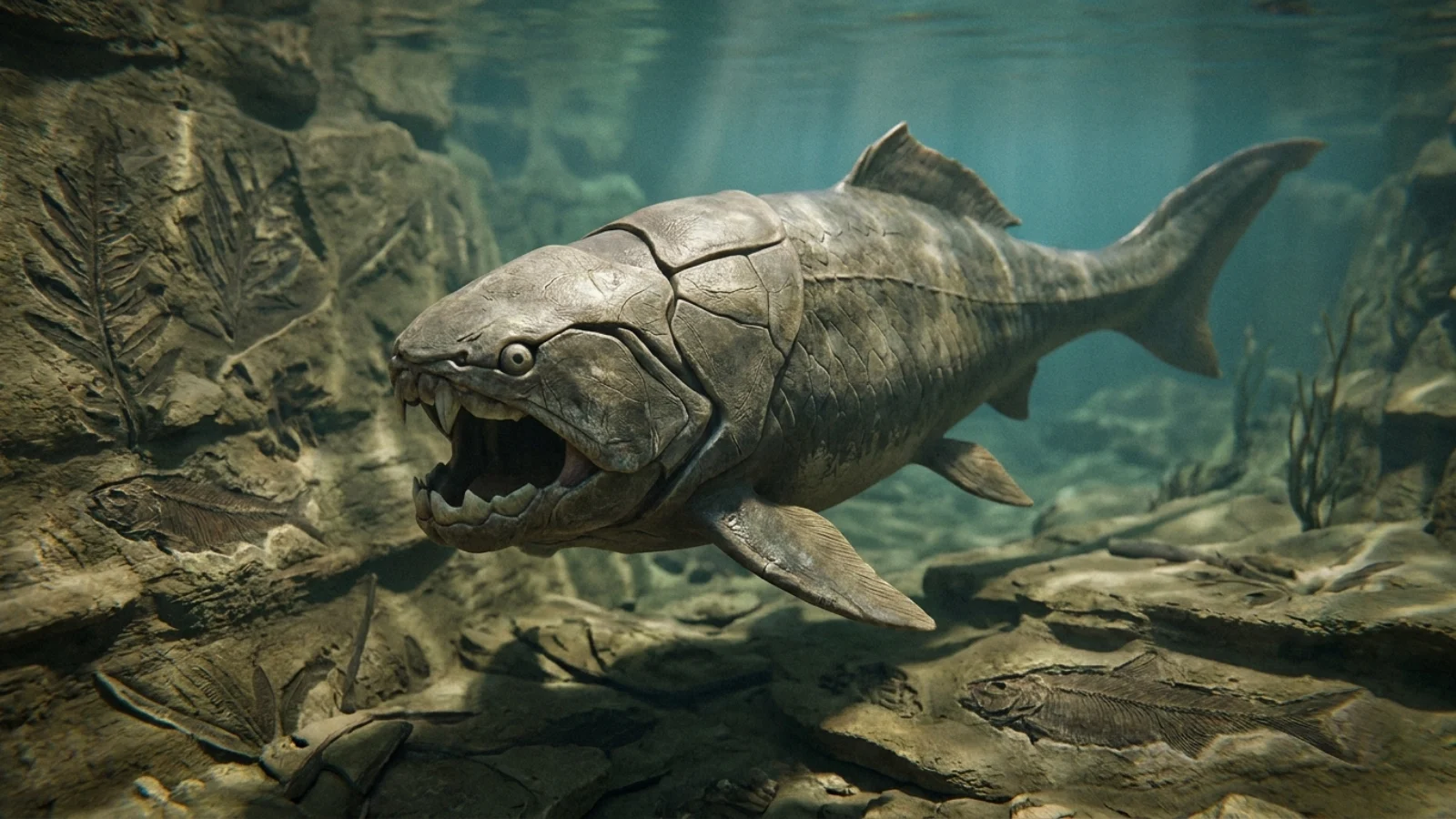
5. Dunkleosteus: the armoured giant
Dunkleosteus is the most famous prehistoric fish of all, an arthrodire or “jointed-neck” placoderm that lived during the Late Devonian, about 382 to 358 million years ago. It was a pelagic fish of open waters and one of the first apex predators of any ecosystem. Its fossils were first found in 1867 by Jay Terrell, a hotel owner and amateur fossil collector, in the cliffs along Lake Erie near Sheffield Lake, Ohio.
Dunkleosteus had no true teeth. Instead its jaws were edged with self-sharpening bony blades, and it could open and close them quickly, creating suction as well as a powerful bite. Size estimates have been controversial. Older reconstructions suggested up to 10 m, but a 2023 study by Russell Engelman estimated typical adults at about 3.4 m and 950 to 1,200 kg, with the largest individual at about 4.1 m. Our full profile of Dunkleosteus covers the bite and the size debate in detail.
6. Tiktaalik: the fish that walked
Tiktaalik roseae lived about 375 million years ago and is one of the most important transitional fossils ever found. Discovered in 2004 on Ellesmere Island in Nunavut, Canada, by Edward Daeschler, Neil Shubin and Farish Jenkins, it was published in Nature in 2006.
Tiktaalik was a lobe-finned fish with scales and gills, estimated at 1.25 to 2.75 m long. But its head was flat and triangular, like a crocodile’s, and its fins contained sturdy internal bones that would have let it prop itself up in shallow water, much as four-legged animals support themselves on their limbs. It is a link between swimming fish and the first tetrapods, the ancestors of amphibians, reptiles, birds and mammals.
7. Hyneria: the Devonian river monster
Hyneria was a large predatory lobe-finned fish that lived in fresh water during the Famennian, the final stage of the Devonian. It is named after the village of Hyner in Pennsylvania, near where the first specimen was found, and was described by Keith Stewart Thomson in 1968.
H. lindae is estimated at about 2.5 to 3 m long, and an unpublished specimen suggests it may have reached 3.5 m. A second species, H. udlezinye, was described by Gess and Ahlberg in 2023, with the largest specimen from an animal of about 2.7 m. Hyneria had a heavy, ornamented skull and stout teeth, and it was among the top predators of Devonian rivers, sharing them with early tetrapods.
8. Rhizodus: the fanged giant of the swamps
Rhizodus, the “root tooth”, was a giant tetrapodomorph fish of the Early Carboniferous, named by Richard Owen in 1840. Its best-known species, R. hibberti, comes from the United Kingdom, and is estimated at 5.14 to 5.63 m long and 1 to 1.5 tonnes. A second species has been described from Russia.
Its most striking feature was a pair of fangs about 22 cm long at the front of its jaws. Rhizodus lived in freshwater lakes, rivers and large swamps and fed on small to medium-sized amphibians, using its teeth to kill prey and tear it apart rather than swallowing it whole. Ironically, it belonged to the same broad group as the ancestors of those amphibians.
9. Helicoprion: the buzz-saw shark
Helicoprion is one of the strangest animals ever to have lived. It was a shark-like eugeneodont fish of the Permian, known from a span of about 20 million years, whose closest living relatives are the chimaeras or ratfish. Almost all its fossils are spiral clusters of teeth called tooth whorls, which for decades puzzled scientists, who argued over where on the body the spiral belonged.
The answer came in 2013, when Leif Tapanila and colleagues CT-scanned a specimen from Idaho and revealed a nearly complete jaw apparatus with the whorl set in the lower jaw. The largest teeth may have exceeded 10 cm. More than half of all Helicoprion fossils come from the Phosphoria Formation of Idaho. The whorl may have been used to feed on soft-bodied prey or to strip the shells off nautiloids and ammonoids. Read more in our profile of Helicoprion.
10. Leedsichthys: the biggest bony fish ever
Leedsichthys problematicus lived in the oceans of the Middle to Late Jurassic, and it is the largest ray-finned fish, and among the largest fish of any kind, ever known. It is named after Alfred Nicholson Leeds, a gentleman farmer who collected its fossils from pits near Peterborough, England, in the 1880s. Remains have since been found in England, France, Germany and Chile.
Like a whale shark or a baleen whale, Leedsichthys was a filter-feeder. Its gill arches carried rakers with delicate bony plates that sieved plankton from the water. Much of its skeleton was cartilage, so size estimates have varied wildly, from 9 m early in the twentieth century to claims of over 30 m by its end. Recent research has settled on about 16.5 m for the largest individuals. Some of its fragmentary remains were once mistaken for the bones of stegosaur dinosaurs.
11. Xiphactinus: the fish that ate a fish
Xiphactinus, whose name means “sword ray”, was a large predatory bony fish that lived from the late Albian to the late Maastrichtian, through most of the Late Cretaceous. It grew to 5 to 6 m long and looked like a gigantic, fanged tarpon. Its fossils come from the chalk and shale of Kansas, from the US East Coast and from Europe, Canada, Venezuela, Argentina and Australia.
Xiphactinus was a voracious predator, and at least a dozen specimens have been found with large prey in their stomachs. The most famous, collected by George F. Sternberg and displayed at the Sternberg Museum of Natural History in Hays, Kansas, is a 4.2 m Xiphactinus with a nearly perfectly preserved 1.9 m fish, Gillicus arcuatus, inside it. The predator apparently died soon after swallowing its meal, probably because the struggling prey ruptured an organ.
12. Megapiranha: a piranha the size of a dog
Not all prehistoric fish are hundreds of millions of years old. Megapiranha paranensis lived in the Late Miocene, about 8 to 10 million years ago, in what is now Argentina, and it was described in 2009 from a piece of upper jaw with a zigzag row of teeth found in the Ituzaingó Formation near Paraná. The specimen had sat in the collection of the Museo de La Plata for decades before Alberto Luis Cione recognised it.
Megapiranha is estimated at about 71 cm long and 10 kg. Its teeth are intermediate between the double row of pacus and the single row of modern piranhas, suggesting it was a transitional form. Its bite force has been estimated at between 1,240 and 4,749 newtons.
What about prehistoric sharks?
Sharks have a fossil record stretching back about 450 million years, largely known from teeth and scales because their cartilage skeletons rarely fossilise. The most famous prehistoric fish of all is a shark: megalodon, Otodus megalodon, which lived from roughly 20 million to 3.6 million years ago and reached at least 15 m, with some estimates around 20 m or more. A 2008 study estimated its bite at 108,514 to 182,201 newtons, compared with 7,495 newtons for Dunkleosteus.
Megalodon was a cartilaginous fish, while most of the giants above were bony fish or placoderms, which is why megalodon is known mainly from teeth and Leedsichthys from fragments of bone. Our guide to prehistoric sharks covers the whole shark family tree, and how big was megalodon? covers the largest of them.
Are any prehistoric fish still alive?
The best-known survivor is the coelacanth. Coelacanths are an ancient group of lobe-finned fish whose oldest fossils are more than 410 million years old. They were thought to have died out in the Late Cretaceous, around 66 million years ago, until a living coelacanth was caught off South Africa in 1938 and recognised by the museum curator Marjorie Courtenay-Latimer, after whom the genus Latimeria is named. A second species was discovered in Indonesia, after Mark Erdmann saw one in a fish market in North Sulawesi in 1997.
Coelacanths were long called “living fossils”, but recent studies show that their body shapes were far more diverse in the past than once thought, and the living species are not unchanged copies of their ancestors. As lobe-finned fish, coelacanths are more closely related to lungfish and to land vertebrates than to ray-finned fish. See our full profile of the coelacanth.
Other ancient lineages survive too. Lampreys and hagfish may approximate the earliest jawless fish, and sharks, chimaeras, sturgeons and lungfish all belong to groups with deep fossil roots.
Why do prehistoric fish matter?
The fossil record of fish is the record of how vertebrates came to be. Jaws, teeth, bone, paired fins, live birth and the limbs that eventually carried animals onto land all first appear in fish. Entelognathus shows the origin of the bones in our own jaws, Materpiscis the oldest known live birth in a vertebrate and Tiktaalik the move towards land.
Prehistoric fish also show how fragile success can be. The placoderms dominated Devonian seas for millions of years and then vanished in the Late Devonian extinction. The giant filter-feeding pachycormids, the lineage of Leedsichthys, swam the Mesozoic seas for over 100 million years before disappearing at the end of the Cretaceous. Their niche was later filled by baleen whales and filter-feeding sharks. For the bigger picture of ancient ocean life, explore our largest prehistoric sea creatures.
What is the oldest prehistoric fish?
Haikouichthys, about 518 million years old from the Cambrian of China, is among the earliest fish-like animals known.
What was the biggest prehistoric fish?
Among bony fish, Leedsichthys at about 16.5 m. Among all fish, the shark megalodon was likely larger, at 15 to 20 m or more.
Was Dunkleosteus a fish?
Yes. It was an armoured placoderm, a group of jawed fish that died out at the end of the Devonian.
What prehistoric fish are still alive today?
The coelacanth, rediscovered in 1938, is the most famous. Lampreys, hagfish, sturgeons and lungfish also have ancient roots.
When was the Age of Fishes?
The Devonian period, from 419 to 359 million years ago, when sharks, placoderms and lobe-finned fish diversified.
Which prehistoric fish could walk?
Tiktaalik, about 375 million years ago, had sturdy fin bones that let it prop itself up in shallow water.
What prehistoric fish had a spiral of teeth?
Helicoprion, a Permian relative of the chimaeras, with a tooth whorl set in its lower jaw.
Did prehistoric fish give birth to live young?
Some did. Materpiscis, from the Late Devonian of Australia, is the oldest known vertebrate preserved with an embryo.
- Wikipedia (Kiwix 2023 snapshot): “Evolution of fish”, “Haikouichthys”, “Guiyu oneiros”, “Entelognathus”, “Materpiscis”, “Dunkleosteus”, “Tiktaalik”, “Hyneria”, “Rhizodus”, “Helicoprion”, “Leedsichthys”, “Xiphactinus”, “Megapiranha”, “Coelacanth”.
- Engelman, R.K. (2023), size and body mass of Dunkleosteus terrelli; Tapanila, L. et al. (2013), Helicoprion CT study; Daeschler, E.B., Shubin, N.H. & Jenkins, F.A. (2006), Nature.
- Wroe, S. et al. (2008), Journal of Zoology (bite force comparisons).
Blane Perun has been exploring Earth’s oceans and marine life for over 25 years. Founder of TheSea.Org in 1999, underwater photographer, coral aquaculture pioneer, and explorer of 80+ countries.
About Blane Perun →