When Did Megalodon Go Extinct? — About 3.6 Million Years Ago
Megalodon (Otodus megalodon) went extinct about 3.6 million years ago, in the early Pliocene epoch. That date comes from a 2019 study led by Robert Boessenecker, which re-examined the youngest megalodon fossils and found that teeth said to be younger were poorly dated or had been washed out of older rock. A widely quoted 2014 study by Catalina Pimiento and Christopher Clements had estimated about 2.6 million years ago. Either way, megalodon lived for roughly 20 million years, vanished long after the dinosaurs and well before the first humans of the genus Homo.
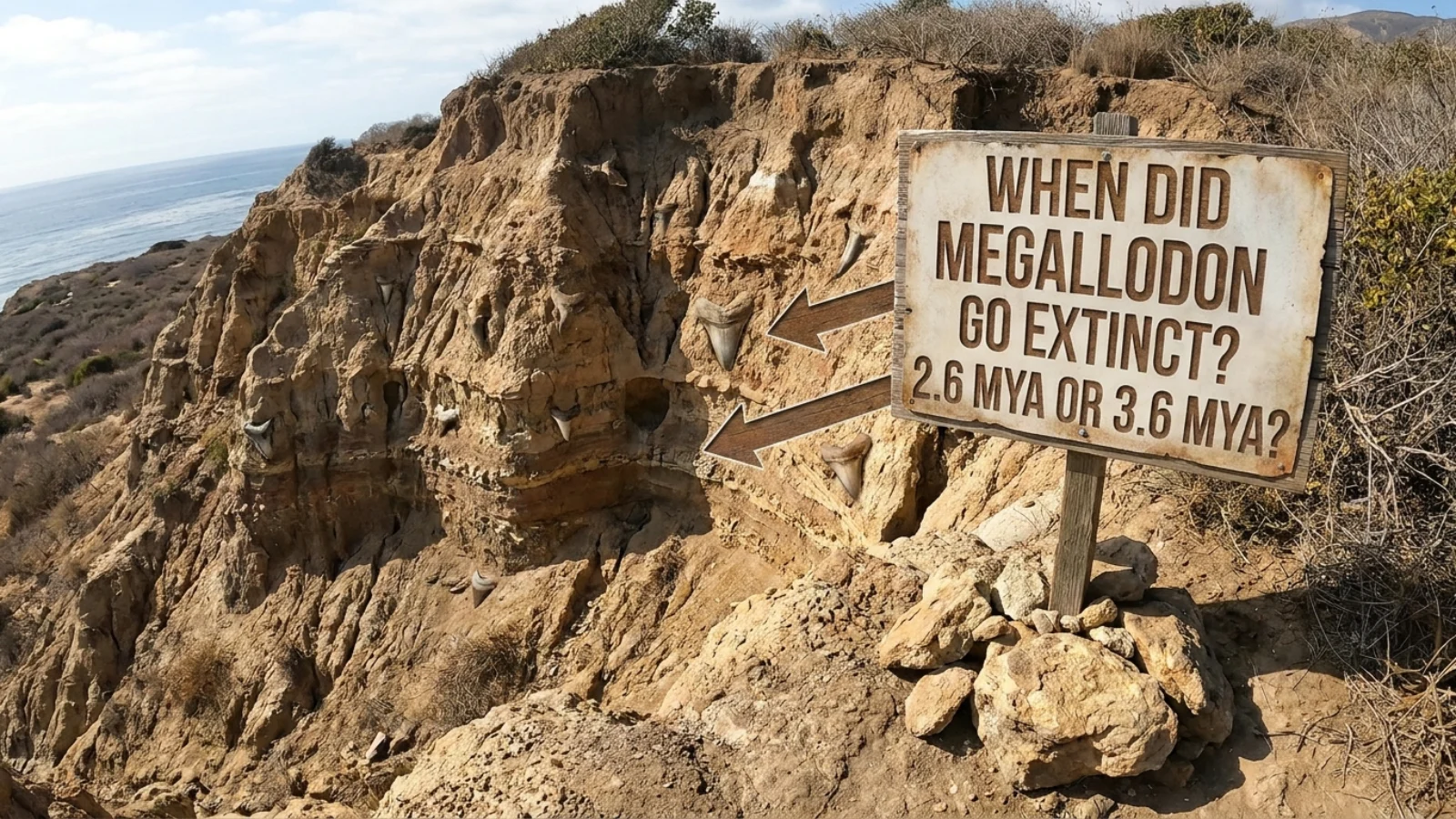
2.6 million years (Pimiento & Clements, 2014, statistical model of the youngest records) and 3.6 million years (Boessenecker et al., 2019, after throwing out unreliable records). Most researchers now favour the older date.
When did megalodon go extinct?
The best current answer is about 3.6 million years ago. Megalodon, the giant shark now known as Otodus megalodon, disappeared during the early part of the Pliocene epoch, a warm period of Earth history that ran from about 5.33 to 2.58 million years ago. That puts its extinction about 62 million years after the end of the dinosaurs and roughly 800,000 years before the first members of our own genus, Homo, appear in the fossil record.
You will still see the figure of 2.6 million years quoted in books, museum signs and documentaries. That date was the scientific consensus for several years after 2014, and it is not wrong in the sense of being made up: it was the output of a careful statistical analysis of the youngest fossils known at the time. The problem, as later work showed, was with some of the fossils themselves. When the questionable records were removed, the last appearance of megalodon moved back by about a million years.
This article focuses on the timeline: how palaeontologists decide when a species vanished, why the date for megalodon changed, and what was happening in the oceans around it. For the size of the animal itself, see how big was megalodon?, and for the claim that it might still be swimming in the deep sea, see is megalodon still alive?.
How do scientists work out when a species went extinct?
No fossil comes with a date stamped on it. To date an extinction, palaeontologists first have to date the youngest fossils of the species, and then decide how confident they can be that no younger ones exist. Both steps are harder than they sound.
Most megalodon fossils are teeth found in marine sediments: sands, clays, limestones and phosphate deposits that were laid down on ancient sea floors. The age of a tooth is the age of the layer it was buried in. Geologists estimate that age in several ways. Where there are layers of volcanic ash, minerals in the ash can be dated by measuring the decay of radioactive elements such as potassium and argon. Many marine layers can be dated by the microfossils they contain, tiny shells of plankton such as foraminifera and diatoms whose species came and went at known times. Shells can also be dated by strontium isotopes, because the ratio of two forms of strontium in seawater has changed over time in a well-mapped way. The magnetic signature of the rock, which records flips in Earth’s magnetic field, adds another check.
Each method has its own uncertainty, and different labs and different decades have used different methods. A tooth reported as “Pliocene” in a museum catalogue from the 1960s may have been assigned that age because of the rock unit it came from, without any precise dating. Combining hundreds of such records into a single extinction date means sorting good dates from rough guesses.
Why is the youngest fossil not the extinction date?
Even with perfect dating, the youngest fossil of a species almost certainly is not from the last individual that lived. Fossilisation is rare, and as a species declines towards extinction it becomes rarer still, so the final stretch of its history is the least likely to be preserved. Palaeontologists call this the Signor–Lipps effect, after the two scientists who described it in 1982: extinctions look more gradual and slightly earlier in the fossil record than they really were.
To deal with this, researchers use statistical methods that look at the spacing of the youngest records and estimate how far beyond the last fossil the species probably survived. Pimiento and Clements used one of these, called optimal linear estimation, in their 2014 study published in PLoS ONE. The method had previously been used for recent, historically documented extinctions, such as that of the dodo, and they applied it to the much deeper past. Their analysis of the youngest megalodon records from the literature and museum collections produced an estimated extinction date of around 2.6 million years ago.
The weakness of any such method is that its answer can only be as good as the records fed into it. If a few of the youngest records are actually older than reported, or are not megalodon at all, the estimated extinction date is pulled too late. That is exactly what the next study argued had happened.
Why did the extinction date change from 2.6 to 3.6 million years?
In 2019, Robert Boessenecker of the College of Charleston and colleagues published a re-examination of the megalodon fossil record from California and Baja California in the journal PeerJ. This region has a rich record of Pliocene marine fossils and had supplied several of the youngest reported megalodon teeth.
They checked each record one by one: where exactly the tooth was found, what the dating of that layer was based on, and whether the tooth could have been moved after it was first buried. They found that every record younger than about 3.6 million years had a problem. Some had imprecise or outdated dates. Others came from layers where older fossils had been eroded and redeposited, so a tooth could be millions of years older than the sediment around it. Some identifications were uncertain. When those records were set aside, none of the remaining megalodon fossils from the region were reliably younger than the early Pliocene, and the team concluded that the species had died out by about 3.6 million years ago.
Boessenecker also pointed out that the apparent coincidence between megalodon’s disappearance and a wave of extinctions 2.6 million years ago, which had led some to look for a single catastrophic cause, may simply be an artefact of the poorly dated records. Remove them, and megalodon’s extinction stands on its own, about a million years earlier.
What is a reworked megalodon tooth?
Reworking is one of the main traps in dating fossil teeth, and anyone who collects megalodon teeth in Florida has seen it in action. Shark teeth are hard and durable. When an old sea-floor layer is eroded by currents, rivers or waves, the soft sediment washes away but the teeth survive. They can then be swept along and buried again in a much younger layer, alongside fossils of entirely different ages.
The beaches of Venice, Florida, and the rivers of central and southwestern Florida are good examples. The teeth found there come from phosphate-rich deposits of different ages that have been mixed together by erosion, which is why a single afternoon of sifting can turn up teeth from megalodon, ancient great whites and modern species side by side. That is wonderful for collectors, as described in our guide to megalodon teeth in Florida, but it is a headache for anyone trying to date the last appearance of a species. A tooth found in a 3-million-year-old layer only shows that the tooth existed by then, not that a living megalodon did.
Megalodon timeline: from the Miocene to extinction
Putting the best estimates together gives a timeline of megalodon’s existence. Dates are approximate and some, such as the first appearance, are still debated.
| When (million years ago) | Event |
|---|---|
| ~23–20 | Megalodon appears in the Early Miocene, descended from earlier megatooth sharks such as Otodus chubutensis |
| ~17–15 | Middle Miocene Climatic Optimum: warm seas; megalodon widespread |
| ~10–5 | Late Miocene: baleen whales diversify; megalodon present on most coastlines |
| 5.33 | Start of the Pliocene epoch |
| ~5–4 | Modern great white shark spreads through the world’s oceans |
| ~3.6 | Youngest reliable megalodon fossils (Boessenecker et al., 2019) |
| ~2.8 | First fossils of the genus Homo |
| ~2.6 | Earlier extinction estimate (Pimiento & Clements, 2014) |
| 2.58 | Start of the Pleistocene epoch and the ice ages |
Megalodon belonged to a line of giant “megatooth” sharks, the family Otodontidae, which had already existed for tens of millions of years before it. Our article on prehistoric sharks traces that lineage from its origins.
How long did megalodon exist?
If megalodon appeared around 20 to 23 million years ago and vanished around 3.6 million years ago, it existed for roughly 17 to 20 million years. That is a long run for any large animal. By comparison, our own species has existed for around 300,000 years, and the great white shark for perhaps 4 to 5 million.
Long survival is typical of successful top predators that are spread across many oceans. A species with a global range is protected against local disasters, because a decline in one ocean can be offset by populations elsewhere. That makes megalodon’s eventual disappearance more striking: whatever caused it must have affected the species across its whole range.
The fossil record also suggests that megalodon was not unchanging during its long history. Its teeth became broader and more finely serrated over time compared with those of its ancestors, and some researchers think average body size may have varied with climate and prey. Those changes are part of the reason scientists argue about exactly where to draw the line between megalodon and its predecessors, which in turn affects the date of its first appearance.
Did megalodon disappear everywhere at the same time?
Probably not exactly. Extinctions of widespread species often happen as a series of local disappearances, with the species hanging on longest where conditions suit it best. Researchers have suggested that megalodon may have declined earlier in some regions than in others, but the patchiness of the fossil record makes regional dates hard to pin down.
The 2019 study only examined the record from the eastern North Pacific in detail, and its authors noted that the same careful checking should be applied to records from other regions. Some teeth from the Atlantic and elsewhere are still reported as late Pliocene. If any of those can be securely dated, megalodon’s final date could shift again, at least for one ocean. For now, the best-documented evidence points to extinction by about 3.6 million years ago, with no reliable record of megalodon in the Pleistocene anywhere in the world.
What else was happening in the oceans when megalodon disappeared?
The Pliocene was a time of major change. Global temperatures during the early Pliocene were warmer than today, but the planet was gradually cooling towards the ice ages that began around 2.58 million years ago. Sea levels rose and fell, changing the area of shallow coastal seas, and the slow closing of the Central American Seaway between North and South America altered ocean circulation.
A 2017 study led by Catalina Pimiento, published in Nature Ecology & Evolution, identified a previously unrecognised extinction of marine megafauna, the large animals of the sea, at the end of the Pliocene. About a third of marine megafauna were lost, including more than half of marine mammal diversity, while sharks were hit much less hard, at around 9%. The study linked the losses to climate change and the loss of productive coastal habitats as sea levels fluctuated.
Whether megalodon was an early casualty of the same changes, or disappeared for its own reasons a million years before the main extinction pulse, is part of the debate covered in our companion articles on why megalodon went extinct and what killed it. What the timeline shows is that the oceans megalodon left behind were changing fast, and that the world’s largest filter-feeding whales grew to their present enormous sizes only after it was gone.
Did megalodon live at the same time as humans or dinosaurs?
Neither, in the way people usually mean. The last non-bird dinosaurs died about 66 million years ago, more than 40 million years before megalodon appeared. Megalodon is sometimes drawn alongside marine reptiles such as mosasaurs, but they too were extinct long before it evolved.
Megalodon also vanished before humans existed. The earliest known fossils of our genus, Homo, are about 2.8 million years old, and Homo sapiens appeared only around 300,000 years ago. There is one twist, though. Earlier members of the human family tree, such as Ardipithecus and the first australopiths, were walking in East Africa around 4.4 to 4 million years ago, so megalodon did share the planet for a time with distant human relatives, though they lived thousands of kilometres from the sea and would never have met it.
This gap is one of the reasons scientists are confident megalodon is extinct today. No megalodon tooth has ever been found in sediments formed during the time of modern humans, even though shark teeth are among the most durable fossils of all and megalodon shed thousands of them in its lifetime.
Could the extinction date change again?
Yes, and that is normal in palaeontology. The 3.6-million-year date rests on the best-documented records available in 2019. New finds, better dating of known fossils or a re-examination of records from other oceans could push it forward or backward.
Some proposed explanations for megalodon’s extinction depend on the date. For example, a nearby supernova about 2.6 million years ago was once suggested as a possible factor in marine extinctions at the end of the Pliocene, because increased radiation could have affected large animals. If megalodon had already gone a million years earlier, such an event could not have been responsible for its disappearance. Similarly, the timing of megalodon’s extinction relative to the spread of the great white shark, which arrived in many oceans around 4 million years ago, is central to the idea that competition played a role.
For now, the safest summary is this: megalodon lived from roughly the Early Miocene to the early Pliocene, and the youngest fossils that can be trusted are about 3.6 million years old.
When did megalodon go extinct?
About 3.6 million years ago, in the early Pliocene, according to the most recent re-examination of its fossils (Boessenecker et al., 2019).
Why do some sources say 2.6 million years ago?
That was the estimate of a 2014 statistical study. A 2019 study found that the youngest records it used were poorly dated or reworked.
How long did megalodon live on Earth?
Roughly 17 to 20 million years, from the Early Miocene to the early Pliocene.
Did megalodon live with dinosaurs?
No. The dinosaurs died out about 66 million years ago, more than 40 million years before megalodon appeared.
Did megalodon live with humans?
No. Our genus Homo appeared about 2.8 million years ago, after megalodon was gone, though earlier human relatives did overlap with it in time.
What epoch did megalodon go extinct in?
The Pliocene, which ran from about 5.33 to 2.58 million years ago.
Are there megalodon fossils from the ice ages?
No reliably dated ones. Teeth reported from younger layers are usually reworked from older deposits.
Is megalodon still alive?
No. There is no fossil or living evidence of megalodon in the last 3 million years.
- Boessenecker, R.W. et al. (2019), “The Early Pliocene extinction of the mega-toothed shark Otodus megalodon: a view from the eastern North Pacific”, PeerJ 7: e6088.
- Pimiento, C. & Clements, C.F. (2014), “When did Carcharocles megalodon become extinct? A new analysis of the fossil record”, PLoS ONE 9(10): e111086.
- Pimiento, C. et al. (2017), “The Pliocene marine megafauna extinction and its impact on functional diversity”, Nature Ecology & Evolution 1: 1100–1106.
- Signor, P.W. & Lipps, J.H. (1982), “Sampling bias, gradual extinction patterns and catastrophes in the fossil record”.
- Live Science (Feb 2019), “Did great white sharks wipe out the giant megalodon?”
Blane Perun has been exploring Earth’s oceans and marine life for over 25 years. Founder of TheSea.Org in 1999, underwater photographer, coral aquaculture pioneer, and explorer of 80+ countries.
About Blane Perun →