How Big Was Megalodon? — Length, Weight, Teeth and the Fossil Evidence
Megalodon was probably 15–20 m (50–65 ft) long as a large adult, and the biggest may have reached about 24 m (80 ft). A 2022 3D model put a 16 m individual at about 61 tonnes; a 2025 study estimated the largest at 24.3 m and about 94 tonnes. Its teeth reached about 18 cm (7 in), and its pups were already 3.6–3.9 m long at birth, longer than many adult sharks. That makes Otodus megalodon the largest predatory shark known, and one of the largest predatory fish of all time. It was still smaller than a blue whale.
How long was megalodon?
Most scientific estimates for big adults fall between 15 and 20 metres. The number you see depends on which fossils and which modern shark the researchers scale from.
All lengths to the same scale. Megalodon figures from Cooper et al. 2022 (16 m model), Perez et al. 2021 (tooth-row method, ~20 m) and Shimada et al. 2025 (upper estimate, 24.3 m).
Because megalodon’s skeleton was cartilage, it almost never fossilised. Scientists have teeth by the hundreds of thousands, a handful of partial vertebral columns, and nothing else. Every length is therefore a calculation: measure a tooth or vertebra, pick a living shark whose proportions you trust, and scale up. For years the default model was the great white, its closest familiar relative in shape and diet, and that gave lengths around 16 m. Newer work questions that assumption and nudges the numbers higher.
| Study | Evidence used | Size estimate |
|---|---|---|
| Gottfried et al. (1996) | Tooth height, great-white proportions | ~16 m for the largest teeth |
| Perez et al. (2021) | Width of the whole tooth row | ~20 m (65 ft) |
| Cooper et al. (2022) | 3D model from the Belgian vertebral column | 16 m, ~61 t |
| Shimada et al. (2025) | Vertebrae vs 145 living and 20 extinct sharks | Belgian shark ~16.4 m; maximum ~24.3 m, ~94 t |
How much did megalodon weigh?
A 16 m megalodon weighed about 61 tonnes, roughly ten adult African elephants. The biggest may have reached around 94 tonnes.
The 2022 study led by Jack Cooper (Swansea University and the University of Zurich) is the most detailed weight estimate. The team scanned the Belgian vertebral column and a set of teeth, built a full 3D body around them using great-white and other lamnid proportions, and weighed the result: over 61 tonnes. The same model gave a stomach volume of almost 10,000 litres, enough to swallow prey about 8 m long, such as a whale the size of a modern orca, and a cruising speed of about 1.4 m/s. One large meal could have fuelled it across thousands of kilometres of ocean for around two months. The 2025 Shimada study argues the body was slimmer than that model assumed, which lowers weight for a given length but allows for longer animals: about 94 tonnes at the 24.3 m upper limit.
How big were megalodon’s teeth and jaws?
The biggest teeth have a slant height of about 18 cm (just over 7 inches), roughly three times the size of the largest great white teeth.
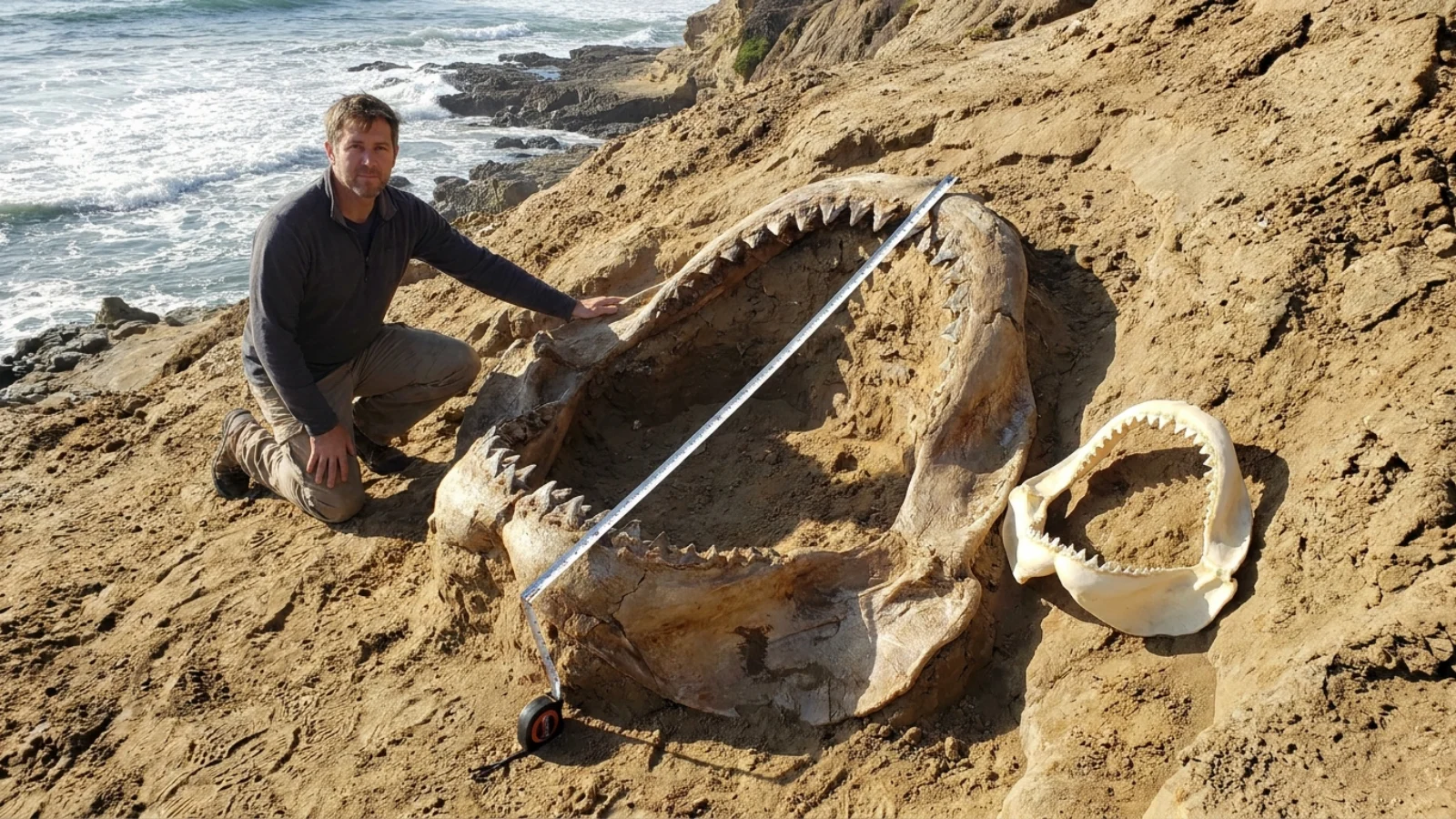
Megalodon teeth are broad, thick, triangular and finely serrated, with a dark band (the bourlette) between crown and root. They are the main evidence for its size, and Florida is one of the best places in the world to find them, from the Peace River to offshore dive sites near Venice; see megalodon tooth. The jaw held several rows of teeth, with the largest at the front. When the American Museum of Natural History first reconstructed a megalodon jaw in 1909, the team made every tooth as large as the front teeth, which made the jaw far too big and helped launch the myth of a 30 m megalodon. Modern reconstructions are smaller, but still large enough for an adult human to stand inside the open jaws.
Bite force came from those jaws and the muscles that drove them. A 2008 computer model by Stephen Wroe and colleagues estimated a large megalodon at about 108,500–182,200 newtons, six to ten times the modelled bite of a large great white and the highest of any animal known.
What did megalodon look like?
Not necessarily like a giant great white. The 2025 study suggests a longer, slimmer body, closer in build to a lemon shark.
The best skeleton is a column of 141 vertebrae from Belgium, about 11 m long. Shimada’s team estimated the full animal at 16.4 m, with a head about 16.6% of body length (around 1.8 m) and a tail about 32.6% (around 3.6 m). Sharks that grow to giant size tend to have more elongated bodies because a stocky body becomes hard to push through water at large sizes. Great whites top out at about 6–7 m partly for that reason. The same study estimated a cruising speed of 2.1–3.5 km/h, no faster than a great white’s cruise.
How does megalodon compare with other giants?
| Animal | Length | Weight |
|---|---|---|
| Blue whale | up to 33.6 m | up to 190 t |
| Megalodon | ~15–20 m typical; up to ~24 m | ~50–70 t typical; up to ~94 t |
| Whale shark | up to ~18.8 m | ~20 t or more |
| Livyatan (fossil sperm whale) | ~14–17 m | — |
| Mosasaurus | ~12–17 m | — |
| Great white shark | ~6–7 m max | ~2 t |
| Human | 1.8 m | 0.08 t |
For the blue whale match-up in detail, see megalodon vs blue whale. Megalodon is gone: it disappears from the fossil record about 3.6 million years ago (is megalodon still alive?). And yes, despite its size, megalodon was a shark, and sharks are fish.
How big was megalodon in feet?
Large adults were roughly 50–65 feet (15–20 m) long, and the largest may have reached about 80 feet (24.3 m).
How much did megalodon weigh?
About 61 tonnes for a 16 m shark, according to a 2022 3D model. The largest estimate is about 94 tonnes.
How big was a megalodon tooth?
The largest have a slant height of about 18 cm (7 inches or slightly more).
Was megalodon bigger than a blue whale?
No. Blue whales reach 33.6 m and 190 tonnes, larger than any megalodon estimate.
Was megalodon bigger than a T. rex?
Yes, much. T. rex was about 12 m long and perhaps 8–9 tonnes; megalodon was longer and many times heavier.
How big was a megalodon compared to a human?
A 16 m megalodon was about nine times as long as a 1.8 m person, and a newborn megalodon was about twice a person’s height.
Why are megalodon size estimates so different?
Only teeth and a few vertebrae survive, so size must be scaled from living sharks. Using great-white proportions gives ~16 m; slimmer body models and tooth-row methods give 20 m or more.
What is the largest megalodon ever found?
No complete megalodon has ever been found. The largest teeth and a 23 cm vertebra from Denmark point to individuals around 20–24 m.
Blane Perun has been exploring Earth’s oceans and marine life for over 25 years. Founder of TheSea.Org in 1999, underwater photographer, coral aquaculture pioneer, and explorer of 80+ countries.
About Blane Perun → More Prehistoric Sea Creatures →