Where Did Megalodon Live? — Nursery Grounds and Global Range
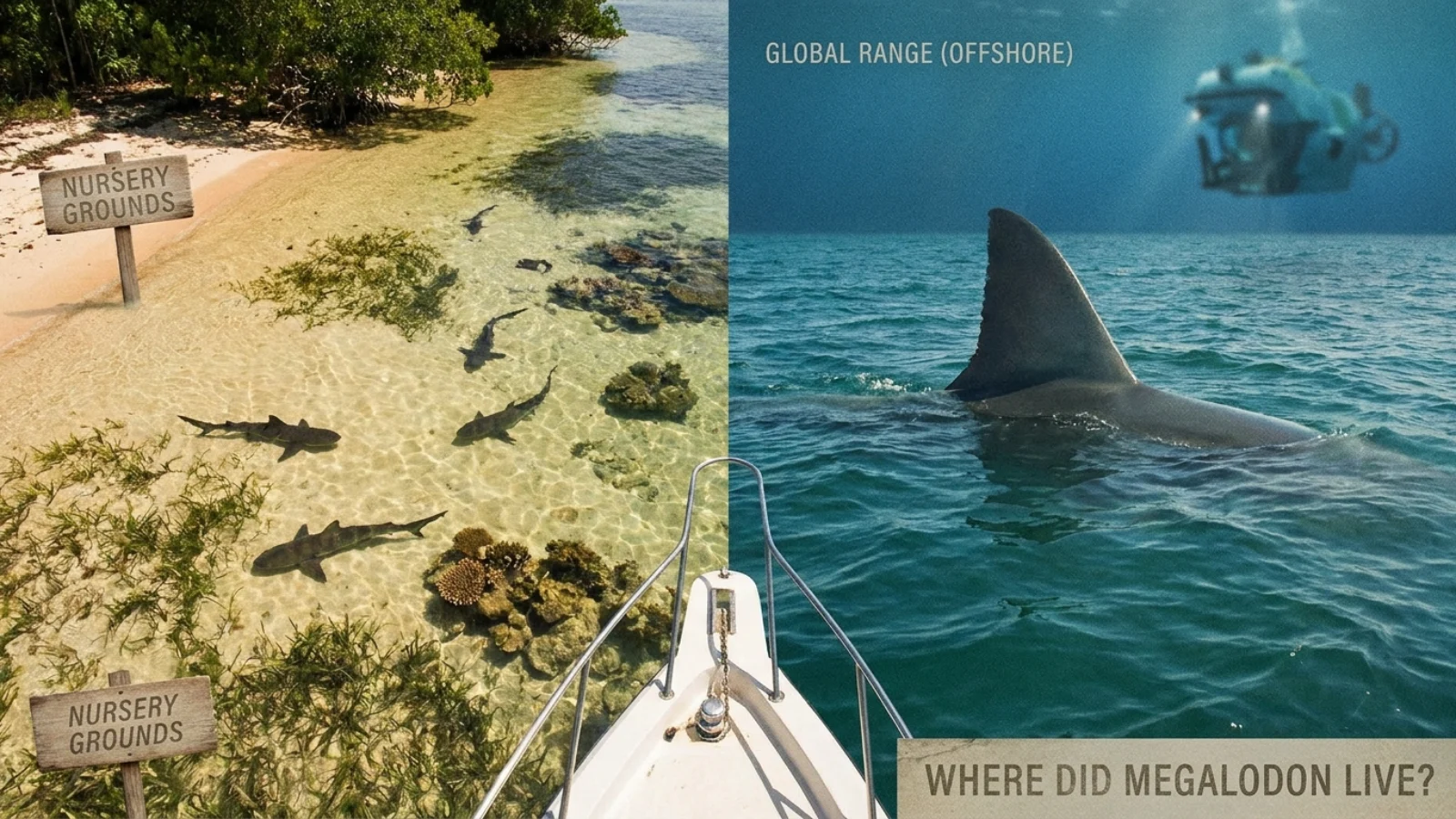
Megalodon lived worldwide. Its fossil teeth have been found in Europe, Africa, Asia, the Americas, Australia and New Zealand, in rocks bordering all the oceans of the Neogene, roughly 20 to 3.6 million years ago. It was most common in subtropical and temperate seas and has been found as far north as about 55°N. Adults lived mostly offshore and may have migrated across oceans, while pups were born in warm, shallow coastal nurseries such as the Gatún Formation of Panama, the Calvert Formation of Maryland and the Bone Valley Formation of Florida. Megalodon was not a deep-sea animal.
A cosmopolitan shark of warm and temperate seas: adults offshore and on the move, young in shallow coastal nurseries, absent from the cold deep sea.
Where did megalodon live?
Megalodon, Otodus megalodon, was one of the most widespread predators in the history of the oceans. Its fossil teeth have been excavated from Europe, Africa, Asia, North and South America, Australia and New Zealand, in rocks that bordered every ocean of the Neogene period. Scientists describe its distribution as cosmopolitan, meaning that it was found almost everywhere conditions suited it, rather than in one region.
That range covered a long span of time as well as space. Megalodon’s teeth are found in rocks from the Miocene and Pliocene epochs, from roughly 20 million years ago, or possibly earlier, until about 3.6 million years ago, when it disappeared. Over those millions of years the continents moved, sea levels rose and fell, and ocean currents changed, so the map of megalodon’s world looked somewhat different from the map of the oceans today.
Within that global range, megalodon was most common in subtropical to temperate latitudes, the warm and mild waters that also held the richest populations of the whales, dolphins and seals it fed on. Its young were born and raised in warm, shallow coastal waters, while adults spent much of their time offshore.
How do scientists know where megalodon lived?
Almost everything we know about megalodon comes from its teeth. Sharks shed teeth constantly throughout their lives, and megalodon teeth are large, hard and durable, so they survive well as fossils. Each tooth found in a dated rock layer is a record that a megalodon lived, or at least died or shed a tooth, in that place at that time.
Researchers gather these records into databases and map them. In a 2016 study in the Journal of Biogeography, Catalina Pimiento and colleagues, including MacFadden and Clements, compiled megalodon occurrence records from the Paleobiology Database, sorted them into geological time slices and plotted them on reconstructions of the ancient continents. That allowed them to measure how megalodon’s geographical range and global abundance changed from the Miocene into the Pliocene, and to compare its distribution with climate.
There are limits to this method. Fossils are found only where rocks of the right age are exposed and where people search, so heavily studied areas such as the eastern United States, Europe and Japan are overrepresented, and the open ocean floor is almost unsampled. A blank space on the map often means “no one has looked” rather than “no megalodon lived here”.
Which countries have megalodon fossils?
The list is long. In Europe, megalodon teeth come from Portugal, Spain, Italy, Malta, France, Belgium, the Netherlands, Germany, Denmark, Austria, the Czech Republic, Slovakia, Poland, Cyprus, Turkey and the United Kingdom. In Africa they are known from Egypt, Libya, Nigeria, Angola, South Africa and Madagascar. In Asia they come from India, Myanmar, South Korea and especially Japan, where they have been reported from more than a dozen geological formations.
In the Americas, megalodon fossils come from the United States, Mexico, Panama, Cuba, Jamaica, Puerto Rico, Grenada, Barbados, Antigua and Barbuda, Venezuela, Colombia, Ecuador, Peru, Chile, Argentina and Uruguay. In Oceania they are found in Australia, New Zealand, Fiji and French Polynesia.
Some of these sites have long histories. The fossil teeth of Malta, for example, were the glossopetrae or “tongue stones” of European folklore, and it was a Maltese megalodon tooth that the Italian naturalist Fabio Colonna illustrated in 1616 beside a great white tooth to argue that tongue stones were really shark teeth.
Where are megalodon fossils found in the United States?
The United States has some of the richest megalodon sites in the world. On the East Coast, teeth come from the Calvert Formation of Maryland, the Yorktown Formation, the Kirkwood Formation and the phosphate mines of North Carolina, where layers rich in marine fossils have yielded megalodon teeth alongside the bones of whales and other sharks.
Florida is famous for megalodon teeth, which come from the Bone Valley Formation in the phosphate district of central Florida and the Tamiami Formation of the southwest, and wash out of riverbeds and beaches across the state. Our guide to megalodon teeth in Florida explains where collectors look and the rules that apply.
On the West Coast, megalodon fossils come from many California formations, including the Monterey, Purisima, Santa Margarita, Temblor, Topanga and San Mateo formations. California also holds some of the youngest reliable megalodon records, which is why it featured so prominently in the 2019 study that dated the shark’s extinction to about 3.6 million years ago. That study also identified a number of supposedly younger records from California and Baja California as dubious.
How far north and south did megalodon live?
Megalodon has been found as far north as about 55°N, roughly the latitude of Denmark, where a partial vertebral column of 20 centra was excavated from the Gram Formation in 1983. In the Southern Hemisphere it ranged to southern Australia and New Zealand, and to southern South America, with fossils from Chile and Argentina.
Water temperature at its fossil sites varied widely. Pimiento and colleagues found that megalodon lived in places with a mean temperature of about 12 to 27°C, with a total range of 1 to 33°C. That tolerance for cool water is consistent with evidence that megalodon was warmer than the water around it. A 2023 study led by Michael Griffiths used isotope methods to show that megalodon’s body temperature was higher than that of its surroundings and of other sharks living alongside it, which would have helped it hunt in cooler seas.
The same 2016 study found no evidence that global temperature directly controlled megalodon’s distribution. Its range did not expand and contract in step with warming and cooling trends. Instead, the decline in its range during the Pliocene coincided mainly with a drop in the diversity of filter-feeding whales and the appearance of new competitors, including large predatory whales and the great white shark.
Did megalodon live near the coast or in the open ocean?
Both, depending on its age. Megalodon inhabited a wide range of marine environments, from shallow coastal waters and areas of coastal upwelling to swampy coastal lagoons, sandy shorelines and offshore deep-water environments. Adult megalodon were not abundant in shallow water and mostly lived offshore, while juveniles stayed in protected coastal areas.
Adults also appear to have travelled widely. In 2022, Jack Cooper, John Hutchinson, Catalina Pimiento and colleagues built a three-dimensional model of a 16 m megalodon and estimated that it could cruise at about 1.4 m per second, faster in absolute terms than any living shark. A single large meal, they suggested, could fuel the shark for about two months, allowing long migrations without feeding. They described megalodon as a “trans-oceanic super-apex predator”, one that could cross ocean basins following its prey.
Body size also varied across its range. Fossil teeth suggest that megalodon was larger on average in the Southern Hemisphere than in the Northern, with mean lengths of about 11.6 and 9.6 m respectively, and larger in the Pacific than in the Atlantic, at about 10.9 and 9.5 m. It is possible that different populations had different sizes and behaviour because they faced different ecological pressures. For the size story in full, see how big was megalodon?
What were megalodon nursery grounds?
Many living sharks give birth in nursery areas: warm, shallow, food-rich coastal waters where young sharks are relatively safe from large predators, including adults of their own species. In 2010 Pimiento, Ehret, MacFadden and colleagues described the first known megalodon nursery, in the Miocene Gatún Formation of Panama. Teeth from the site came mostly from small, young sharks, and the shallow, warm coastal setting matched the profile of a modern shark nursery.
A decade later, in 2020, a team led by J. L. Herraiz published a broader test in Biology Letters. They estimated body lengths from teeth at a newly described middle Miocene site in the Reverté and Vidal quarries of Castellet i La Gornal, Tarragona, in northeastern Spain, and compared it with eight previously known formations. Five areas showed a high proportion of animals in the size range of newborns and young juveniles: the Spanish quarries, the Calvert Formation of Maryland, the Gatún and Chucunaque formations of Panama, and the Bone Valley Formation of Florida.
The other sites, the Temblor Formation of California, the Pisco Formation of Peru, the Bahía Inglesa Formation of Chile and the Yorktown Formation of the eastern United States, were dominated by adults and may have been feeding or mating areas instead. The nurseries spanned the Langhian stage of the middle Miocene to the Zanclean stage of the early Pliocene, showing that megalodon used nursery grounds over very long periods and across ocean basins.
Why did megalodon need nurseries?
Megalodon pups were large at birth. Estimates range from about 2 m in a 2021 growth study to about 3.6 to 3.9 m in a 2025 reanalysis by Kenshu Shimada and colleagues, and the Herraiz study treated newborns as roughly 4 m long. Even so, a young megalodon was vulnerable. Fossils show that pups could fall prey to other sharks, including the great hammerhead and the extinct snaggletooth shark Hemipristis serra.
Megalodon also grew slowly and matured late, with growth slowing at around 25 years of age in one estimate. A species with few young and a long road to adulthood depends heavily on those young surviving. Nurseries reduced early mortality and helped maintain the adult population, which is why the loss of nursery habitat has been proposed as a factor in megalodon’s extinction.
Not everyone agrees on how essential nurseries were. Shimada’s 2025 reanalysis concluded that the large size at birth supported live birth with embryos feeding on unfertilised eggs in the womb, but made the need for nursery areas less likely. The debate shows how much depends on estimates drawn from a handful of fossil vertebrae.
What did megalodon’s world look like?
The oceans megalodon swam in were not quite the oceans of today. During much of its existence the Central American Seaway still connected the Atlantic and Pacific between North and South America, allowing warm water and marine animals to pass between the two oceans. Megalodon fossils in the Gatún and Chucunaque formations of Panama come from coastal seas along that seaway.
In Europe, megalodon teeth from Austria, the Czech Republic, Slovakia and Poland come from seas that once covered parts of central Europe and have long since vanished. A 2025 study of 18-million-year-old teeth from Sigmaringen and Passau in southern Germany described an ancient estuary less than 200 m deep that ran along the edge of the Alps, home to megalodon, sand tiger sharks, early dolphins and sea bream. Our article on what megalodon ate describes what that study found about its diet.
Over time, these seas changed. The closure of the Central American Seaway and changes in the Tethys region contributed to cooling of the oceans, and the large swings in sea level during the Plio-Pleistocene affected coastal environments. Lower sea levels would have shrunk the warm, shallow shelves where megalodon raised its young.
Did megalodon live in the deep sea?
No. Despite its popularity in fiction, there is no evidence that megalodon lived in the deep ocean, and good reasons to think it could not. Megalodon was a shark of warm coastal waters and the sunlit open ocean, where its prey lived. The deep sea is cold, dark and poor in food, and a giant, warm-bodied predator with a daily energy need of tens of thousands of kilocalories would have struggled to survive there.
The deep-sea myth owes much to a handful of teeth dredged from the seafloor by HMS Challenger in 1873, which a zoologist dated in 1959 to just 11,000 to 24,000 years old. Those claims have been discredited. The teeth were probably preserved by a thick crust of manganese dioxide, which slowed decomposition and kept them pale, and some fossil teeth are redeposited into younger layers. The argument that megalodon could hide in the depths, as the megamouth shark did until its discovery in 1976, does not hold up for an animal of warm coastal seas. Our article is megalodon still alive? covers the evidence in detail.
Where did megalodon live last?
Megalodon’s range did not vanish overnight. The 2016 mapping study found that its decline probably began in the late Miocene with a fall in global abundance, followed by a shrinking of its geographical range during the Pliocene. By the early Pliocene, megalodon was absent from regions where water temperatures had dropped significantly, even though it had tolerated cool water in the past.
The last reliable records date to about 3.6 million years ago. The precise date and the story of how it was worked out are told in when did megalodon go extinct? After megalodon disappeared, the great white shark spread into some regions where the giant had been, and the world’s oceans settled into the pattern of predators we know today.
Where did megalodon live?
Worldwide, in warm and temperate seas. Fossils are found on every continent except Antarctica, bordering all the oceans of its time.
Did megalodon live in the Mariana Trench?
No. Megalodon was a warm-water shark of coasts and the open ocean; there is no evidence it lived in the deep sea.
Did megalodon live in Florida?
Yes. Florida’s Bone Valley and Tamiami formations yield many teeth, and Bone Valley was a megalodon nursery.
Where were megalodon nurseries?
Confirmed nurseries include Tarragona in Spain, the Calvert Formation in Maryland, the Gatún and Chucunaque formations in Panama, and Bone Valley in Florida.
Did megalodon live in cold water?
It tolerated cool water, with fossil sites ranging from about 1 to 33°C, but it was most common in warm and temperate seas.
How far north did megalodon live?
Fossils are known up to about 55°N, including a vertebral column from the Gram Formation in Denmark.
Did megalodon migrate?
Probably. A 2022 3D model suggests it could cruise faster than any living shark and go two months between big meals.
Did megalodon live in lakes or rivers?
No. All known megalodon fossils come from marine rocks, including coastal lagoons and estuaries.
- Pimiento, C., MacFadden, B., Clements, C. et al. (2016), “Geographical distribution patterns of Carcharocles megalodon over time reveal clues about extinction mechanisms”, Journal of Biogeography.
- Herraiz, J.L. et al. (2020), “Use of nursery areas by the extinct megatooth shark Otodus megalodon“, Biology Letters.
- Pimiento, C. et al. (2010), “Ancient nursery area for the extinct giant shark megalodon from the Miocene of Panama”, PLoS ONE.
- Cooper, J.A. et al. (2022), Science Advances; Shimada, K. et al. (2025), Palaeontologia Electronica; McCormack, J. et al. (2025), Earth and Planetary Science Letters.
Blane Perun has been exploring Earth’s oceans and marine life for over 25 years. Founder of TheSea.Org in 1999, underwater photographer, coral aquaculture pioneer, and explorer of 80+ countries.
About Blane Perun →