Ichthyosaurs — The Dolphin-Shaped Reptiles That Gave Birth at Sea
An ichthyosaur is an extinct marine reptile with a streamlined, often dolphin-like body, a long toothed snout, flippers, a dorsal fin and a crescent-shaped tail fluke. The name, coined in 1817, means “fish reptile”. The earliest known ichthyosaur fossils are about 250 million years old, and the group died out around 94–90 million years ago, well before the dinosaurs. They gave birth to live young, were probably warm-blooded with blubber, and ranged from a few metres to giants estimated at up to 25 m.
Ichthyosaurs
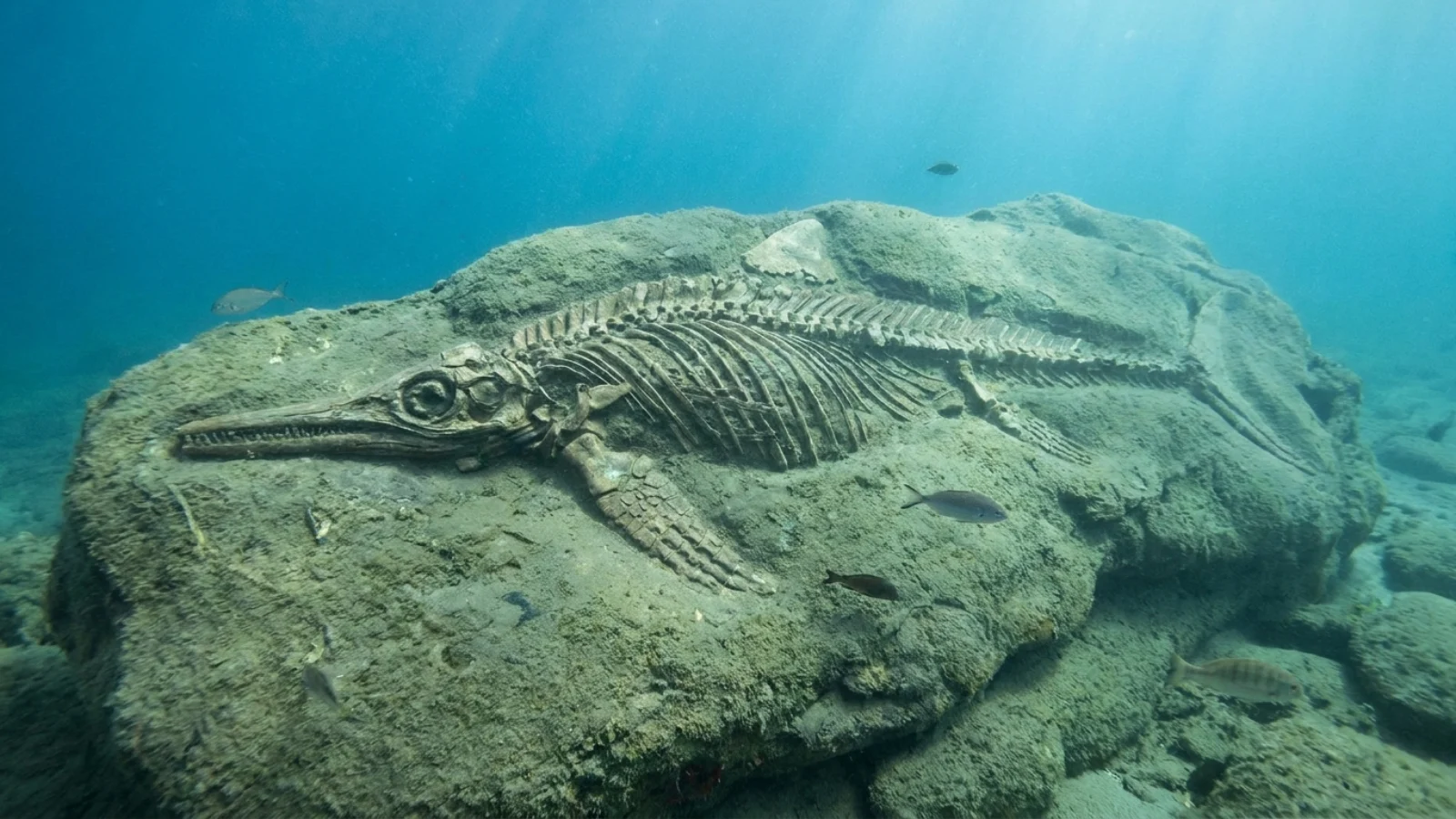
What did ichthyosaurs look like?
Like a reptile built to the same plan as a dolphin or a tuna: streamlined body, long snout, flippers, a dorsal fin and a vertical tail fluke.
That resemblance is a textbook case of convergent evolution. Ichthyosaurs were reptiles whose ancestors lived on land, yet they arrived at nearly the same shape that fast fish and, much later, dolphins evolved independently. The Natural History Museum in London notes that the later parvipelvian ichthyosaurs looked very much like dolphins.
The name Ichthyosaurus, meaning “fish reptile”, was coined by Charles Konig in 1817. An earlier name proposed by Sir Everard Home, Proteosaurus, never caught on.
How big were ichthyosaurs?
Anywhere from a few metres to the largest marine reptiles that ever lived. The current record contender, Ichthyotitan, is estimated at up to about 25 m from jaw bones, the length of an average blue whale.
The giants lived in the Late Triassic. Ichthyotitan severnensis was named in 2024 from jaw fragments found at Blue Anchor in Somerset, England, dated to about 200 million years ago, and estimated at about 25 m. Because that comes from partial jaw bones, it is an estimate rather than a measurement. The shastasaurids Shastasaurus and Shonisaurus reached about 15–21 m (see our Shastasaurus page for that contested range), and Cymbospondylus reached up to about 17 m. Later ichthyosaurs were smaller: the Rutland ichthyosaur, the largest found in the UK, is about 10 m, and Guizhouichthyosaurus about 5 m.
Did ichthyosaurs have the biggest eyes?
For their body size, yes. Ophthalmosaurus had eyes more than 22 cm across, the biggest relative to body size of any known animal.
Huge eyes suggest ichthyosaurs like Ophthalmosaurus hunted in dim light, either deep water or at night. For the living record holders, compare our pages on the colossal squid eye and giant squid eye, whose eyes are bigger in absolute terms.
Did ichthyosaurs give birth to live young?
Yes. Ichthyosaurs did not lay eggs. Fossils of pregnant females, and even of females caught in the act of giving birth, show they bore live young.
Ichthyosaurs could not have crawled onto beaches to lay eggs, and the fossils confirm live birth in open water. The oldest evidence comes from Chaohusaurus, about 248 million years old, from China: a 2014 study in PLoS ONE led by Ryosuke Motani described a mother with three young, one inside her, one emerging from the pelvis and one outside. That baby was coming out head-first, which the authors interpreted as a sign that live-bearing in this lineage evolved on land before ichthyosaurs became fully marine.
Were ichthyosaurs warm-blooded?
Probably. The Natural History Museum says all ichthyosaurs are thought to have been warm-blooded, and a fossil from Germany preserves evidence of blubber like a dolphin’s.
Some ichthyosaurs also preserve pigment. Evidence suggests some species had entirely black skin, while others were countershaded, dark on top and pale below, like many of today’s open-ocean hunters. Warm blood and blubber would have helped them dive deep and range into cold water, and their fossils are known from the Arctic to Antarctica.
When did ichthyosaurs live?
From at least 250 million years ago to about 94–90 million years ago. Their ancestors may even predate the end-Permian extinction.
In 2023 a team including Aubrey Roberts and Jørn Hurum reported ichthyosaur bones about 250 million years old from Flower’s Valley on Spitsbergen, Svalbard, published in Current Biology (Kear et al. 2023). That is only about two million years after the end-Permian extinction, and the animal was already a fully marine ichthyosaur. The implication is that the group’s ancestors may have evolved before that extinction, not after it.
Ichthyosaurs then rode out a series of crises. The end-Triassic event about 201 million years ago, driven by volcanic warming and acidification, wiped out the giant shastasaurids. The end-Jurassic, about 145 million years ago, hit them hard for reasons still unclear. The last ichthyosaurs died out around 94–90 million years ago, when undersea volcanism lowered ocean oxygen and tropical seas reached 35 °C or more. That was more than 20 million years before the asteroid that ended the mosasaurs and plesiosaurs.
| Time | Ichthyosaur story |
|---|---|
| — | — |
| ~250 Ma | *Earliest fossils, Svalbard |
| ~248 Ma | Chaohusaurus gives birth, China |
| Late Triassic | Giants: Shonisaurus, Shastasaurus, Ichthyotitan |
| ~201 Ma | End-Triassic event ends the giants |
| Jurassic | Dolphin-like forms; Mary Anning’s finds |
| ~94–90 Ma | Final extinction |
Who found the first ichthyosaur?
Joseph and Mary Anning of Lyme Regis. Joseph, aged 15, found a skull in 1811; Mary uncovered the rest of the skeleton in 1812, and by early 1813 it was the first largely complete ichthyosaur known.
The specimen, now known as Temnodontosaurus platyodon, was about 5 m long. Sir Everard Home studied it in 1814. The Jurassic Coast, about 150 km of English coastline, is still producing ichthyosaurs today; see our ammonite page for the local fossil collecting code. Other famous sites include Berlin-Ichthyosaur State Park in Nevada, plus China, Germany and Iraq.
Where did ichthyosaurs come from?
Ichthyosaurs were diapsid reptiles, part of a wider group called Ichthyosauromorpha that also includes the hupehsuchians, odd swimmers from the Early Triassic of China with pointed snouts, extra fingers and stiff bodies. Recent studies place this whole group close to the sauropterygians (the plesiosaurs and their kin) and the thalattosaurs, all of them reptiles that returned to the sea after the end-Permian extinction. An old idea from Friedrich von Huene in 1937, that ichthyosaurs descended directly from amphibians, has long been abandoned.
A key link is Cartorhynchus, announced in 2014 from China. It was small, with a short snout, large flippers and a rigid trunk, and it may have been able to move on land as well as in water. Ryosuke Motani placed it just outside true ichthyosaurs and named the wider group Ichthyosauriformes for it. Early ichthyosaurs proper, such as Chaohusaurus, Utatsusaurus and Grippia, were still far from the dolphin shape. Chaohusaurus had only a weak tail fluke, with a single upper lobe, so its tail worked more like a paddle. Bone tissue in Utatsusaurus described in 2012 grew fast, of a type usually linked with warm-blooded animals, which hints that high metabolic rates appeared very early in the lineage.
How fast could ichthyosaurs swim?
Early ichthyosaurs swam the way eels do, throwing the whole body into waves. Later forms, the parvipelvians, had shorter, stiffer bodies and drove themselves with a tall, nearly symmetrical tail, much like a tuna. Ichthyosaurs built that tail fin in an unusual way: the backbone bent down into the lower lobe, while the upper lobe was supported only by soft tissue.
Speed estimates are modest. Judy Massare calculated in 1994 that ichthyosaurs cruised at under 5 km/h, still the fastest of all marine reptiles. Ryosuke Motani corrected her formulas in 2002 and brought the cruising figure down to under 2 km/h, though ichthyosaurs kept their ranking. The long front flippers were once thought to help push the animal along, but a 2013 study concluded that broad flippers like those of Platypterygius worked as control surfaces for steering and lift. Whether ichthyosaurs floated or sank at rest has also flip-flopped: Christopher McGowan argued in 1973 that they were buoyant, Michael Taylor proposed in 1987 that they adjusted buoyancy by changing lung volume, and most researchers now think they were slightly heavier than water.
What do the Holzmaden fossils show?
The Posidonia Shale around Holzmaden in southern Germany, about 183 million years old, has produced more than 4,000 ichthyosaur specimens, and many keep traces of soft tissue. Dark body outlines, probably formed by mats of bacteria growing over the carcass, show the dorsal fin and tail fluke. David Martill questioned in 1987 whether these outlines could be trusted, but by 1993 he accepted that at least some were genuine. A specimen in Uppsala, catalogued R158, still shows a tuna-like outline complete with dorsal fin, and studies of fin tissue have found up to four layers of collagen fibres stiffening it.
In 2017 researchers reported collagen, cholesterol, platelets and red and white blood cells preserved in Stenopterygius vertebrae from the same shale. The red cells were a quarter to a fifth the size of a mammal’s. In 2018 another team reported blubber in Stenopterygius. The skin itself seems to have been smooth and scaleless, although one Aegirosaurus impression from the Solnhofen limestone may show tiny scales.
Colour has been argued over in stages. Johan Lindgren’s team reported pigment-bearing melanosomes in a Yorkshire specimen in 2014 and suggested an all-dark animal. A 2015 study questioned whether those structures were pigment at all. In 2018 Lindgren’s group used pigment cells in Stenopterygius to argue for countershading, dark above and light below. Both interpretations remain in the literature.
How good were ichthyosaur senses?
Ichthyosaurs had the largest eye sockets of any known backboned animal, relative to body size and in absolute terms. Temnodontosaurus had eyes about 25 cm across, large enough to see in the dim light at around 1,600 m. A leopard seal, by comparison, dives to about 1 km. A ring of bony plates, the sclerotic ring, protected each eyeball. Hearing was probably poor: the stapes, the small bone that carries sound to the inner ear, was thick and solid. Grooves in the roof of the mouth may point to a good sense of smell, or possibly to organs that sensed electric fields, though that idea is unproven.
What did ichthyosaurs eat?
Stomach contents give direct evidence. Cephalopods are by far the most common item, preserved as beaks and the tiny hooks from their arms. Fish come next, then other vertebrates, including smaller ichthyosaurs. William Buckland described a mass of half-digested fish from an ichthyosaur in 1835, and a 1968 study of such material identified the fish Pholidophorus along with cephalopod beaks and hooks. Fossil droppings attributed to ichthyosaurs contain the same mix of fish and cephalopod remains. A Cretaceous Platypterygius longmani from Australia, reported in 2003, had eaten fish, a turtle and even the bones of a land bird. Some ichthyosaurs were big-game hunters: Thalattoarchon had bladed teeth for cutting large prey, and Himalayasaurus and several Temnodontosaurus species show similar adaptations.
How they fed is also debated. A 2011 study suggested the toothless giants Shonisaurus and Guanlingsaurus sucked prey in, but a 2013 study of throat bones favoured ram feeding, where the animal simply swims onto its food. Stones found in a few stomachs, including Temnodontosaurus and Panjiangsaurus, were probably swallowed by accident.
What hunted ichthyosaurs?
Sharks and larger ichthyosaurs preyed on them in the Triassic. In the Jurassic, big plesiosaurs and marine crocodile relatives called thalattosuchians joined them. A plesiosaur described in 2009 had an ichthyosaur embryo in its gut, which hints that pregnant females or newborns were targets.
Did ichthyosaurs suffer from the bends?
Their bones say yes, at least sometimes. Bone death of the kind linked to decompression sickness appears in about 15 percent of Jurassic and 18 percent of Cretaceous ichthyosaur specimens, but is rare in Triassic ones. One reading is that early ichthyosaurs did not dive as deep. Another is that later ones faced more predators and had to flee to the surface more often. Some researchers point out that in living animals this damage builds up gradually over many ordinary dives rather than from single emergencies.
Why did ichthyosaurs gather in Nevada?
Berlin-Ichthyosaur State Park in Nevada holds the remains of at least 37 Shonisaurus popularis, each about 15 m long, which died there around 230 million years ago. Shonisaurus has been Nevada’s state fossil since 1977, and one quarry is kept under a barn-like shelter with the bones left in the rock. In a 2022 study in Current Biology, Neil Kelley, Nicholas Pyenson and colleagues tested the old explanations for the bone bed. The bones settled on a seafloor rather than a beach, which ruled out mass stranding, and mercury levels gave no sign of a volcanic disaster. Instead, CT scans identified embryonic and newborn Shonisaurus among the small bones, while juveniles were missing and other marine animals were scarce. The team concluded the site was a birthing ground used for hundreds of thousands of years, the same habit seen today in whales that migrate to calve in safer waters.
Why did ichthyosaurs go extinct?
The traditional story held that by the mid-Cretaceous only one genus, Platypterygius, was left and that it faded out through bad luck or competition with plesiosaurs. Newer work shows at least eight ichthyosaur lineages crossed from the Jurassic into the Cretaceous, so the group was more diverse than once thought. Valentin Fischer and colleagues argued in 2016 that the end came in two steps: an early Cenomanian loss of the generalists and soft-prey specialists, then a second blow at the Cenomanian–Turonian ocean anoxic event that left only Platypterygius hercynicus, gone by about 93 million years ago. Competition from mosasaurs is unlikely, because large mosasaurs appeared about 3 million years later. Polycotylid plesiosaurs may have taken over some roles, though they had shared the seas with ichthyosaurs for about 19 million years. The authors linked the extinction to rapid environmental swings that disrupted migration routes, food supply and breeding areas.
Who studied ichthyosaurs after Mary Anning?
Everard Home’s 1814 paper on the Annings’ skull was the first scientific publication on an ichthyosaur, and he went on to treat them as fish before suggesting the name Proteo-Saurus in 1819. Karl Koenig’s name Ichthyosaurus, from 1817, was not formally valid until 1825. Henry De la Beche and William Conybeare gave the first systematic description in 1821, comparing ichthyosaurs with the newly found plesiosaurs, and Conybeare named the type species Ichthyosaurus communis in 1822. The collector Thomas Hawkins sold his ichthyosaurs to the British Museum in 1834, after which curators discovered that much of one tail was plaster; the museum settled with him and painted the fake parts a lighter colour. In 1854 life-size ichthyosaur models went on show at the Crystal Palace in London.
How heavy were ichthyosaurs?
Most were 2 to 4 m long. Motani estimated that a 2.4 m Stenopterygius weighed about 163 to 168 kg and a 4 m Ophthalmosaurus icenicus about 930 to 950 kg. The giants are harder to judge. Lengths for Ichthyotitan severnensis range from about 20 to 25 m, with some estimates up to 26 m, and a Shastasaurus specimen found by Elizabeth Nicholls in 1992 has been put at about 21 to 23 m.
What is an ichthyosaur?
An extinct marine reptile with a streamlined, often dolphin-like body, a long snout, flippers, a dorsal fin and a vertical tail fluke. The name means “fish reptile”.
When did ichthyosaurs go extinct?
Around 94 to 90 million years ago, in the Late Cretaceous, linked to low ocean oxygen and very warm seas. That was more than 20 million years before the dinosaurs died out.
Were ichthyosaurs dinosaurs?
No. They were marine reptiles from a separate lineage. They lived alongside dinosaurs for much of their history.
How big were ichthyosaurs?
From a few metres to giants. Shastasaurus and Shonisaurus reached 15 to 21 m, and Ichthyotitan is estimated at up to 25 m from jaw bones.
Did ichthyosaurs lay eggs?
No. They gave birth to live young. A 248-million-year-old Chaohusaurus fossil from China shows a mother with three young, one being born.
What did ichthyosaurs eat?
Fish, squid and other marine reptiles. Some species with rounded teeth probably ate shelled animals such as ammonoids.
Which animal had the biggest eyes for its size?
Ophthalmosaurus, an ichthyosaur, with eyes more than 22 cm across, the biggest relative to body size of any known animal.
Who discovered the first ichthyosaur?
Joseph Anning found the skull in 1811 at Lyme Regis, and his sister Mary Anning excavated the rest of the skeleton in 1812.
Blane Perun has been exploring Earth’s oceans and marine life for over 25 years. Founder of TheSea.Org in 1999, underwater photographer, coral aquaculture pioneer, and explorer of 80+ countries.
About Blane Perun → All prehistoric sea creatures →