Tylosaurus — Kansas’s Giant Mosasaur With a Battering-Ram Snout
Tylosaurus was a giant mosasaur, a marine lizard related to Mosasaurus, that lived in the Late Cretaceous from about 90 million years ago, with its best-known species, Tylosaurus proriger, common in the Smoky Hill Chalk of western Kansas. By the Early Campanian, T. proriger reached about 13–14 m; the largest skeleton, “Bunker” at the University of Kansas, has been estimated at 12–15.8 m. Its name means “knob lizard”, after the long, toothless bony snout at the front of its jaws, which may have been used to ram prey. A Smithsonian specimen still holds the bones of a plesiosaur it swallowed.
Tylosaurus
How big was Tylosaurus?
The largest Tylosaurus proriger reached about 13–14 m, making it one of the biggest mosasaurs and a rival to Mosasaurus itself.
The size record rests on a University of Kansas skeleton nicknamed “Bunker” (KUVP 5033), estimated at 12–15.8 m depending on the method; the estimates trace to Mike Everhart’s work in 2002 and a 2016 abstract by Everhart and colleagues. Triebold Paleontology, which produces casts of the specimen, lists Bunker at 13.7 m (45 ft) and calls it the largest complete tylosaur skeleton known; their Texan specimen “Sophie” is 12.8 m. More typical adults were smaller. The Smithsonian’s famous plesiosaur-eater, USNM 8898, was about 9 m long with a 1.2 m skull and an estimated weight of about 1,100 kg.
Tylosaurus grew larger over time. The earliest North American tylosaurs, from about 90–86 million years ago, were smaller, and by the Early Campanian T. proriger had reached its giant size.
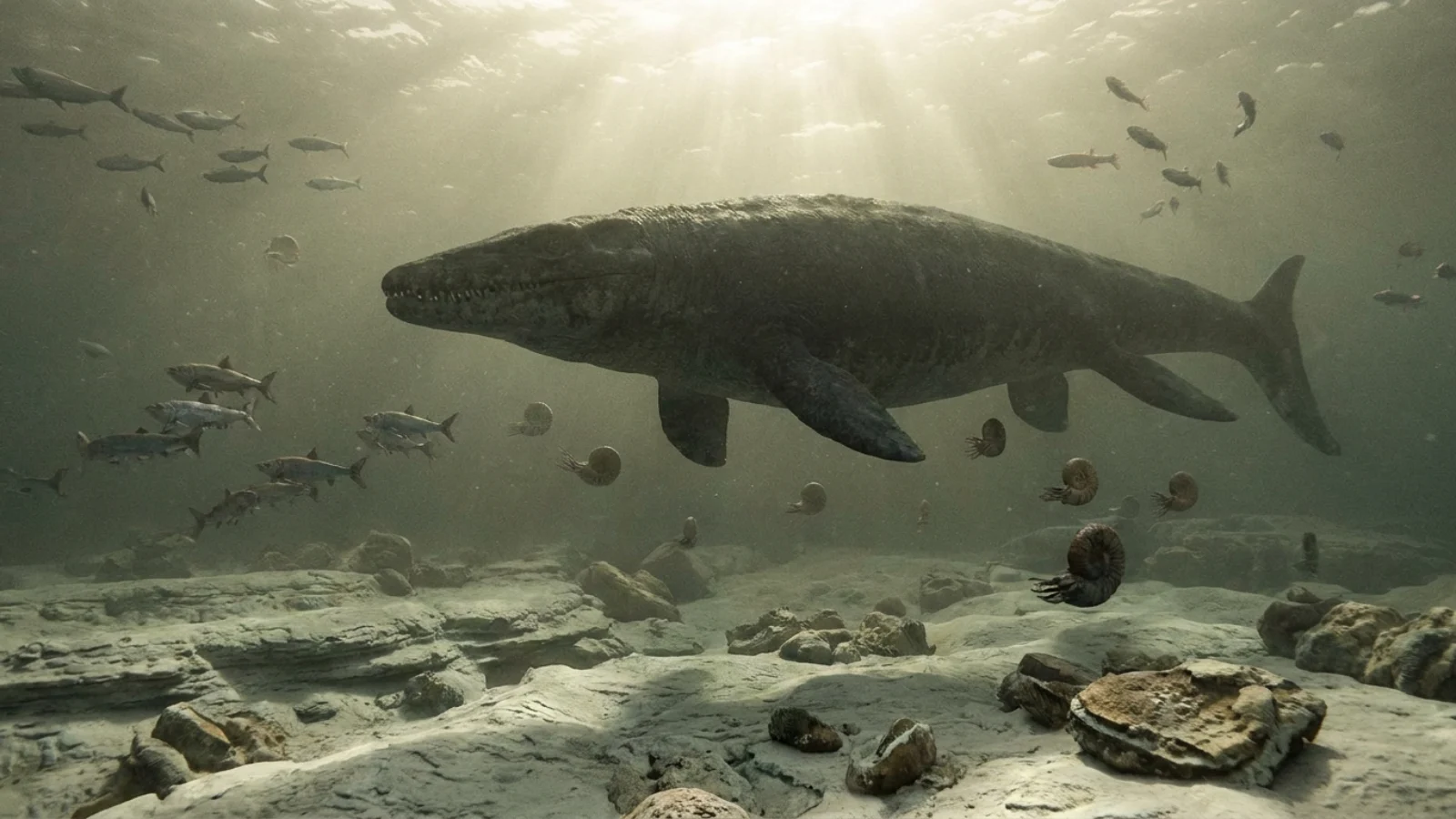
What was the Tylosaurus snout for?
The front of Tylosaurus’s upper jaw stretched into a long, cylindrical, toothless bony snout, the “knob” in its name. A 2018 study by Konishi and colleagues suggested it was used to ram prey, as killer whales sometimes do.
The name Tylosaurus comes from Greek tylos, a knob or protuberance, and sauros, lizard. Ramming is a plausible use for a reinforced, toothless snout on a big, fast animal, but it is a hypothesis rather than an observed behaviour.
What did Tylosaurus eat?
Almost anything: fish, sharks, diving birds, plesiosaurs and smaller mosasaurs. Some of the best stomach-content fossils of any mosasaur belong to Tylosaurus.
The most famous is USNM 8898, collected in 1918 by Charles H. Sternberg and his sons George and Levi from the Smoky Hill Chalk south of Twin Butte Creek in Logan County, Kansas, and now on display at the Smithsonian’s National Museum of Natural History. Sternberg’s field tag reads “Half digested plesiosaur bones between the ribs of No. 17.” The prey was a short-necked polycotylid plesiosaur, Dolichorhynchops osborni, under 3 m long, and twelve small stomach stones up to 28 mm long were found with its bones. Mike Everhart re-examined the specimen in 2001 and published the details in 2004.
Other Tylosaurus specimens record the vertebrae of the fish Cimolichthys, fish scales, and, in one South Dakota specimen from the Pierre Shale reported by Martin and Bjork (1987), the fish Bananogmius, the seabird Hesperornis, the small mosasaur Clidastes and possible shark teeth.
When and where did Tylosaurus live?
In the Late Cretaceous, from about 90 million years ago into the Campanian, in seas across North America, Europe and Africa.
Eight species are currently recognised: T. proriger and T. nepaeolicus from North America, T. pembinensis and T. saskatchewanensis from Canada, T. bernardi from Europe, T. gaudryi from France, T. ivoensis from Sweden and T. iembeensis from Angola. The classic hunting ground is the Western Interior Seaway, the shallow sea that split North America, whose chalk now forms the badlands of western Kansas. Major collections are held in Hays, at the Sternberg Museum, and in Lawrence, at the University of Kansas.
Tylosaurus vs Mosasaurus: which was bigger?
They were close. The largest Tylosaurus proriger reached about 13–14 m, while the best current figure for Mosasaurus hoffmannii is roughly 12 m, though older Mosasaurus estimates ran to 17 m or more.
They also peaked at somewhat different times: Tylosaurus proriger reached its giant size by the Early Campanian, while the Mosasaurus genus spans about 82 to 66 million years ago, right up to the end of the Cretaceous. For the full Mosasaurus size debate see our Mosasaurus page, and for how both compare with the biggest shark, megalodon vs Mosasaurus.
| Animal | Group | Length |
|---|---|---|
| — | — | — |
| Tylosaurus proriger | Mosasaur | 13–14 m |
| Elasmosaurus | Plesiosaur | ~10.3 m |
| Dolichorhynchops | Plesiosaur | under 3 m (prey specimen) |
Was the snout there from birth?
Apparently not. In 2018 Takuya Konishi and colleagues re-examined a handful of skull and jaw fragments, specimen FHSM VP-14845 at the Sternberg Museum of Natural History, that Mike Everhart had found in the Kansas chalk in 1991 and that had been filed under another mosasaur, Platecarpus. The skull would have been only about 30 cm long, roughly a sixth the size of an adult’s. The arrangement and spacing of the teeth at the very front of the upper jaw showed it was in fact a newborn Tylosaurus. The surprise was the snout itself: the deep, toothless “knob” that gives the genus its name had not yet developed.
That means the rostrum grew out as the animal matured rather than being present at hatching. The finding matters for how the snout is interpreted. If the knob were essential for feeding, a hatchling would need it from the start. A feature that develops later in life fits better with a role that only matters for a larger animal, such as ramming big prey or, in some proposals, fighting rivals. It also explains why baby Tylosaurus fossils were so hard to recognise. Without the snout, they looked like a different mosasaur altogether.
How did Tylosaurus swim?
With its tail. Early reconstructions showed mosasaurs as long, snake-like animals wriggling through the water with their whole bodies. Finds since about 2010 have changed that picture. Exceptionally preserved mosasaur fossils, including a Prognathodon from Jordan described by Johan Lindgren and colleagues in 2013, show a downturned tail ending in a two-lobed fin, similar in outline to the tail of a shark.
Mosasaurs probably swam by sweeping that tail fin from side to side while the front of the body stayed fairly stiff, an efficient way to cruise. The four limbs were turned into paddles used for steering and braking rather than propulsion. Tylosaurus, with a long body and a relatively long tail, was probably a good cruiser that could put on sudden bursts of speed, which is consistent with the ramming idea. It was not as specialised for speed as the sleekest later mosasaurs, though, and likely relied on surprise.
How did Tylosaurus swallow such large prey?
Like other mosasaurs, it had a skull built for swallowing big animals whole or in large pieces. Each lower jaw had a flexible joint about halfway along, so the jaws could bow outward slightly around a large meal. Rows of extra teeth on the roof of the mouth, called pterygoid teeth, pointed backward and gripped prey as it was worked down the throat.
Snakes use a similar system, which is one reason mosasaurs were once thought to be close relatives of snakes. Whether they are is still argued, but most researchers place mosasaurs among the squamates, near the monitor lizards. The arrangement explains how a 9 m Tylosaurus could take a plesiosaur almost 3 m long. Prey that size could not be bitten into neat pieces; it had to be gripped, shaken and swallowed in large sections, with the pterygoid teeth stopping it from slipping back out.
Did Tylosaurus get “the bends”?
Some evidence suggests it did. In 1987 Bruce Rothschild and Larry Martin examined mosasaur vertebrae from Kansas for avascular necrosis, a type of bone damage caused when nitrogen bubbles block blood vessels after rapid changes in pressure. Human divers who surface too quickly can suffer the same damage. The lesions were common in Tylosaurus and Platecarpus, but absent in the smaller Clidastes, which may have lived in shallower water.
The study was published in Science and suggested that Tylosaurus made repeated deep dives, perhaps chasing prey, and surfaced fast enough to injure its bones. Later work by Rothschild and colleagues found the same kind of damage in other marine reptiles, including plesiosaurs and ichthyosaurs, and showed that within mosasaurs it was present in supposed deep divers and absent in Clidastes, Ectenosaurus and Halisaurus. It is indirect evidence, and lesions like these can have other causes, but it gives a rare glimpse of how mosasaurs actually used the water column. Modern whales and seals avoid the problem through features of their lungs and blood, which mosasaurs may have lacked.
What colour was Tylosaurus?
We cannot be certain, but there are clues. In 2014 a team led by Johan Lindgren analysed fossil skin from a mosasaur, an ichthyosaur and a fossil leatherback turtle and found traces of melanin, the dark pigment that colours skin and hair. Their results suggested these marine reptiles were dark, at least on the back, and possibly dark all over, like the living leatherback turtle.
Dark skin may have helped large marine reptiles absorb heat at the surface, or it may have offered camouflage when seen from above. Many modern ocean predators are countershaded, darker on top and lighter underneath, and some mosasaur fossils hint at the same pattern. Mosasaur skin was covered in small, keeled scales similar to those of monitor lizards, which may have reduced drag. Artwork showing Tylosaurus in bright colours or bold stripes is guesswork. Pigment cells called melanosomes survive in some fossils because melanin is a tough molecule, but other pigments, such as the carotenoids that produce reds and yellows, break down. Even a well-preserved skin sample can therefore only tell us about dark and light shading, not the full range of colours the living animal may have shown.
What was the Western Interior Seaway like?
It was a long, shallow sea that split North America in two during much of the Late Cretaceous, running from the Gulf of Mexico to the Arctic. At its widest it covered a vast area of today’s Great Plains. The water in Kansas was probably a few hundred metres deep at most, warm, and rich in plankton.
The Smoky Hill Chalk is made largely of the microscopic plates of coccolithophores, single-celled algae that drifted at the surface and sank when they died. Their remains built up slowly on a quiet sea floor with little oxygen near the bottom, which helped preserve skeletons that would otherwise have been scavenged. That is why the chalk holds such a wealth of fossils: mosasaurs, plesiosaurs, sharks, giant fish such as Xiphactinus, flying reptiles, flightless diving birds, and enormous clams. Tylosaurus sat at the very top of this ecosystem. Kansas sits in the middle of the continent today, more than 1,000 km from the nearest coast, which makes the chalk’s marine fossils all the more striking to first-time visitors.
Where can you see a Tylosaurus?
Several museums in North America display good skeletons or casts. The University of Kansas Natural History Museum in Lawrence exhibits Bunker, the largest known specimen. Fort Hays State University’s Sternberg Museum, in Hays, is built around the fossils of the Smoky Hill Chalk and has extensive mosasaur displays. In Washington, D.C., the Smithsonian exhibits the plesiosaur-eating specimen USNM 8898.
Casts are shown in other museums across the United States and Canada. The chalk badlands themselves, such as Monument Rocks and Little Jerusalem Badlands State Park in western Kansas, let visitors see the rock where Tylosaurus was found. Monument Rocks, a group of chalk pillars rising from the prairie, is one of the best-known landmarks of the region and is on private land that the owners allow visitors to reach. Collecting rules vary by land ownership: much of the chalk is on private ranch land, and fossil collecting in state parks is not allowed.
Did anything threaten a full-grown Tylosaurus?
Very little, once it reached adult size. The largest predators sharing the seaway were other mosasaurs and big lamniform sharks. Cretoxyrhina mantelli, sometimes nicknamed the ginsu shark, grew to perhaps 7 m and is known from well-preserved skeletons in the same Kansas chalk. It could certainly kill young mosasaurs and probably attacked weakened adults.
The commonest evidence of sharks on mosasaur bones, though, comes from scavengers. Squalicorax, a medium-sized shark with serrated teeth, left bite marks and the occasional embedded tooth on the remains of many large marine reptiles. A dead Tylosaurus floating at the surface or lying on the sea floor would have attracted these sharks quickly. Sorting a predatory bite from a scavenging one is not easy. Paleontologists look for signs of healing: a wound that shows new bone growth means the animal survived the attack, while bites without any healing could have been made after death. For a young Tylosaurus a few metres long, the dangers were real, and only a fraction of hatchlings would ever have reached the sizes described on this page.
How big was Tylosaurus?
The largest Tylosaurus proriger reached about 13 to 14 m. The biggest skeleton, Bunker at the University of Kansas, has been estimated at 12 to 15.8 m.
Was Tylosaurus bigger than Mosasaurus?
They were similar. Tylosaurus proriger reached about 13 to 14 m; the leading estimate for Mosasaurus hoffmannii is around 12 m, though older estimates were higher.
What did Tylosaurus eat?
Fish, sharks, the seabird Hesperornis, plesiosaurs and smaller mosasaurs. A Smithsonian specimen contains a swallowed plesiosaur.
What does Tylosaurus mean?
“Knob lizard”, referring to its long, toothless bony snout.
When did Tylosaurus live?
In the Late Cretaceous, from about 90 million years ago into the Campanian stage.
Where are Tylosaurus fossils found?
Mainly the Niobrara Formation of Kansas, plus the Pierre Shale, Texas, Canada, Europe and Angola.
Was Tylosaurus a dinosaur?
No. It was a mosasaur, a giant marine lizard related to monitor lizards and snakes.
Did Tylosaurus ram its prey?
Possibly. A 2018 study by Konishi and colleagues proposed that its toothless snout was used to ram prey, much as killer whales sometimes do, but this has not been proven.
Blane Perun has been exploring Earth’s oceans and marine life for over 25 years. Founder of TheSea.Org in 1999, underwater photographer, coral aquaculture pioneer, and explorer of 80+ countries.
About Blane Perun → All prehistoric sea creatures →