Penguins — Every Species, Where They Live and How They Survive
Penguins are flightless seabirds of the family Spheniscidae, with between 17 and 20 living species depending on which authority is followed, grouped into six genera. All but one live in the Southern Hemisphere; only the Galapagos penguin is found north of the Equator. They range from the emperor penguin, the tallest and heaviest, which breeds on Antarctic sea ice in winter, to the little penguin of Australia and New Zealand, about 30 to 33 centimetres tall. Their wings are stiff flippers that drive them underwater, and they eat krill, fish and squid caught on dives. Most species have declining populations: the African penguin was listed as Critically Endangered in October 2024, and the emperor penguin as Endangered in April 2026.
Penguins are birds that gave up the sky for the sea. Their ancestors could fly, but over tens of millions of years their wings stiffened into flippers, their bones grew dense and their bodies became torpedoes. The result is a family of seabirds that walks awkwardly on land and flies through water.
The name “penguin” first belonged to the great auk, a flightless seabird of the North Atlantic. When European sailors met the Southern Hemisphere birds, they named them after the auk they resembled, although the two are not closely related. The great auk became extinct in the mid-19th century.
What is a penguin?
Penguins are a group of aquatic, flightless birds in the order Sphenisciformes and the family Spheniscidae. Highly adapted for life in the water, they have countershaded plumage, dark on the back and white on the belly, and flippers instead of flight wings. Most feed on krill, fish, squid and other sea life, which they catch with their bills and swallow whole while swimming. The family name comes from the genus Spheniscus, from the Greek word for a wedge, after the shape of the African penguin’s swimming flippers. Penguins are, in every sense, seabirds: the overview article penguins as seabirds looks at how they fit among the other birds of the open ocean, and the seabirds section covers their flying relatives.
The word itself has a tangled history. It first appears in literature at the end of the 16th century, and its origin is still debated. Some dictionaries derive it from the Welsh pen gwyn, “white head”, applied originally to the great auk; another theory links it to the Latin pinguis, “fat”, supported by the old Germanic name fettgans, “fat goose”.
How many species of penguin are there?
The number is genuinely disputed. Depending on which authority is followed, there are between 17 and 20 living species, and the South African seabird charity SANCCOB, for example, cites 18. The uncertainty comes from a few borderline cases: whether the white-flippered penguin is a separate species or a form of the little penguin, whether the royal penguin is a species or a colour form of the macaroni penguin, and how many rockhopper species there are. The types of penguins guide goes through them one by one. Grouped by genus, they are:
Great penguins (Aptenodytes). The emperor penguin and the king penguin, the two largest species, with bright yellow-orange neck patches. They lay a single egg and incubate it on their feet, and are the most ancient branch of living penguins.
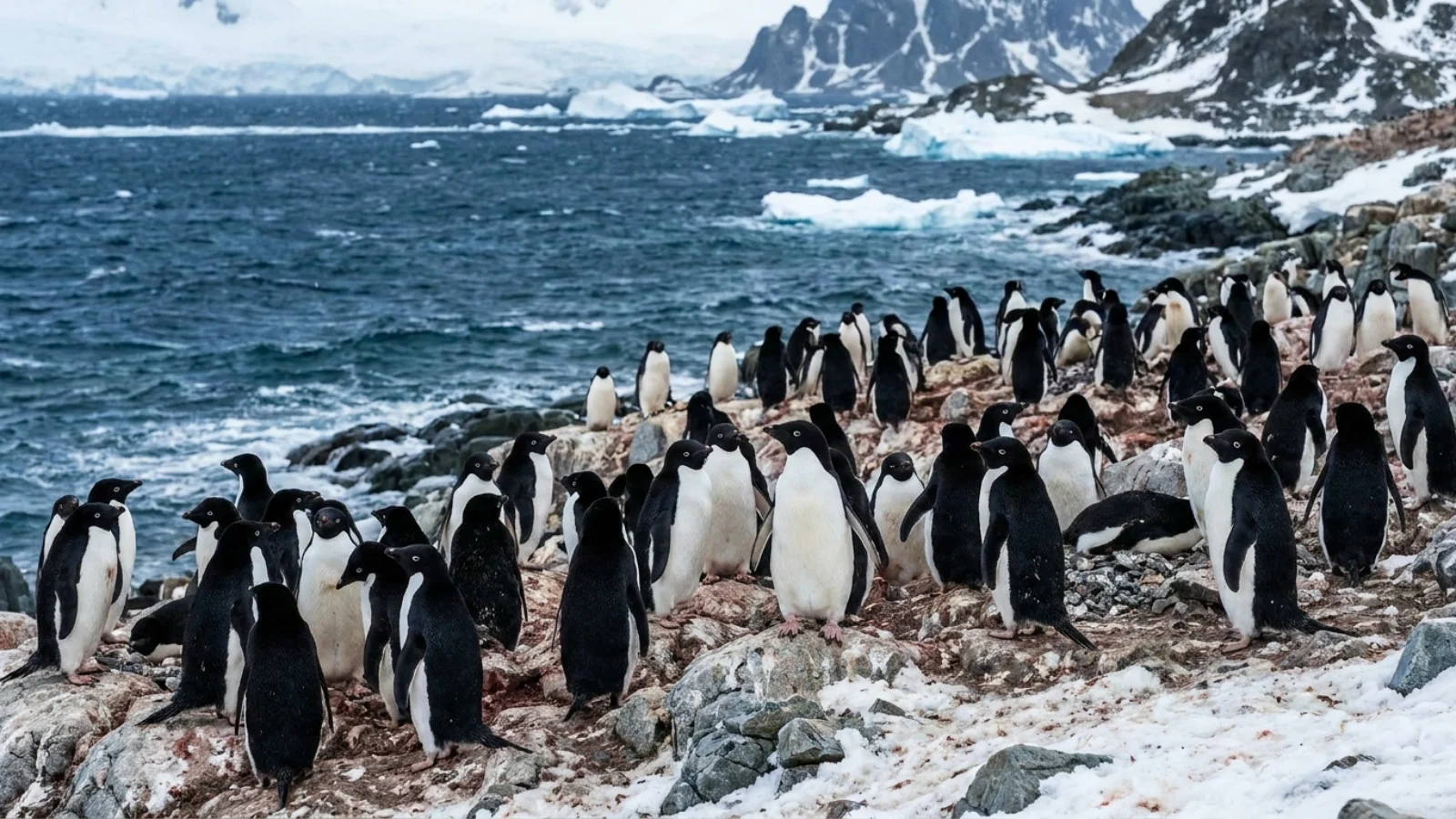
Brush-tailed penguins (Pygoscelis). The Adelie, chinstrap and gentoo penguins, simple black-and-white birds centred on the Antarctic coast and the islands to its north.
Crested penguins (Eudyptes). The macaroni, rockhopper, royal, Fiordland, Snares and erect-crested penguins, with yellow head plumes and partly red bills, most diverse around New Zealand.
Yellow-eyed penguin (Megadyptes). A single living species from New Zealand, the closest relative of the crested penguins.
Little penguins (Eudyptula). The smallest penguins, from southern Australia and New Zealand; some authorities split them into two species.
Banded penguins (Spheniscus). The African, Humboldt, Magellanic and Galapagos penguins, with banded head markings; with the little penguins they are the only living penguins that nest in burrows.
Where do penguins live?
Penguins live almost entirely in the Southern Hemisphere, but not only in the cold. Major populations are found in Antarctica, Argentina, Chile, Australia, New Zealand, South Africa, Namibia and Angola, and the Galapagos penguin lives on the Equator, kept cool by cold ocean currents. There are no penguins in the Arctic. In general, larger species live in colder regions and smaller species in temperate or tropical waters, though ocean currents and upwelling probably shape where they live as much as latitude. See where do penguins live for the full map.
How penguins evolved
Penguins are an old group. The oldest known fossil penguin, Waimanu manneringi, lived in New Zealand in the early Paleocene, about 62 million years ago. It was already flightless, a loon-like bird with short wings adapted for diving. A 2014 study of the whole genomes of 48 bird species found that penguins’ closest living relatives are the tubenoses, the order that includes albatrosses and petrels, and that the two lineages split about 60 million years ago. Some prehistoric penguins were enormous, as tall or heavy as an adult human, and around 10 species of penguin, from medium-sized to huge, lived side by side on Seymour Island in Antarctica about 35 million years ago. The giants disappeared as early toothed whales spread and competed with them for food.
How penguins are built for the sea
A penguin’s body solves the problems of diving in cold water. Dense, overlapping feathers trap a layer of air that insulates them, and all living penguins, even tropical ones, have a counter-current heat exchanger in their flippers, the humeral plexus, which limits heat loss. A gland above the eye, the supraorbital gland, filters excess salt from the blood so they can drink seawater, and the salt drips out through the nasal passages. Their eyes are adapted for underwater vision, their main means of finding prey and avoiding predators. Penguins can swim at up to about 36 km/h when chasing food or escaping danger. Small species usually feed near the surface in dives lasting a minute or two, but the emperor penguin has been recorded diving to 535 metres. On land they waddle, or slide on their bellies in a movement called tobogganing that saves energy on snow.
Penguins form monogamous pairs for a breeding season, though how often the same pair reunites varies widely. Most species lay two eggs, but the emperor and king penguins lay one, and their chicks gather in large groups called creches. Their main predators are at sea: leopard seals, orcas and sharks. On the question of seals, see do seals eat penguins?
What do penguins eat?
Penguins are predators of the upper ocean, and what they eat depends mostly on where they live.
Antarctic species such as the Adelie and chinstrap penguins rely heavily on Antarctic krill, small shrimp-like crustaceans that gather in enormous swarms around the sea ice. Penguins of warmer waters, including the African, Humboldt and Magellanic penguins, eat mainly small schooling fish such as anchovies and sardines, which is why the collapse of local fish stocks hits them so hard. The large emperor and king penguins take more fish and squid, much of it caught on long, deep dives. Penguins have no teeth. Instead, backward-pointing spines on the tongue and the roof of the mouth help them grip slippery prey, which they swallow whole while still underwater. See what do penguins eat for the diet of each group.
Most penguins hunt by sight, so they feed mainly in daylight and in the upper layers of the sea, where their prey is easiest to see. During the breeding season, food has to be carried back to the chicks, and parents may travel a long way to find it: an emperor or king penguin can spend days or even weeks at sea before returning to the colony with a stomach full of partly digested food to feed its chick.
How penguins breed
Penguins come ashore, or onto the sea ice, to breed, and most species nest in dense, noisy colonies.
Colonies range from a few pairs to many thousands of birds. Most species build simple nests: Adelie and gentoo penguins pile up small stones, while the banded penguins and little penguins nest in burrows or rock crevices. The emperor and king penguins build no nest at all; they carry their single egg on their feet, covered by a fold of feathered skin called the brood pouch. In most species both parents share incubation and chick-rearing, taking turns to sit on the nest while the other feeds at sea. The emperor penguin is the great exception: the male alone incubates the egg through the dark Antarctic winter, fasting for around two months while the female feeds at sea.
Parents and chicks recognise each other mainly by voice, which is how an adult returning to a crowded colony finds its own chick among thousands of others. Once the chicks have replaced their fluffy down with waterproof adult feathers, they head out to sea and fend for themselves. Many penguins do not breed until they are several years old, and in the wild they can live for well over a decade.
Are penguins endangered?
Most living penguin species have declining populations, and their IUCN Red List statuses range from Least Concern to Critically Endangered. In October 2024 the African penguin became the first penguin species to be listed as Critically Endangered, after losing an estimated 97% of its population, with fewer than 10,000 breeding pairs left; lack of food linked to climate change and competition from commercial fishing are the main causes. In April 2026 the IUCN moved the emperor penguin from Near Threatened to Endangered, citing the loss of the Antarctic sea ice on which it breeds. Each species page in this section covers its own status in detail.
All the living species, genus by genus.
Breeding through the Antarctic winter.
How the two giants differ.
The classic Antarctic penguin.
The fastest swimming penguin.
The penguin with a strap.
Golden plumes and huge colonies.
The hopping crested penguin.
A species in crisis.
The penguin on the Equator.
From Antarctica to the Equator.
Krill, fish and squid.
Flying underwater.
The hidden legs.
How penguins fit among ocean birds.
Leopard seals and others.
Including penguins.
Penguins’ closest living relatives.
The northern birds penguins were named after.
Albatrosses, petrels, gannets and more.
- Penguins are flightless seabirds of the family Spheniscidae, with 17 to 20 living species in six genera.
- All live in the Southern Hemisphere except the Galapagos penguin, which reaches the Equator.
- The oldest known penguin, Waimanu, lived about 62 million years ago and was already flightless.
- Their closest living relatives are albatrosses and petrels.
- The African penguin is Critically Endangered (2024) and the emperor penguin Endangered (2026).
How many species of penguins are there?
Between 17 and 20, depending on the authority; 18 is the figure most often quoted.
Where do penguins live?
Almost entirely in the Southern Hemisphere, from Antarctica to southern Africa, South America, Australia and New Zealand; the Galapagos penguin lives on the Equator.
Do penguins live in the Arctic?
No. There are no wild penguins in the Arctic.
What is the biggest penguin?
The emperor penguin, which weighs about 22 to 45 kg.
What is the smallest penguin?
The little penguin of Australia and New Zealand, about 30 to 33 cm tall and 1.2 to 1.3 kg.
Are penguins endangered?
Most species are declining. The African penguin is Critically Endangered and the emperor penguin was listed as Endangered in April 2026.
- Wikipedia contributors, “Penguin” and “Emperor penguin” (2023 snapshot via Kiwix mirror, accessed November 2026).
- SANCCOB, “African Penguin newly classified as critically endangered as breeding pairs fall below 10,000” (28 October 2024).
- IUCN Red List update of 9 April 2026, as reported by Mongabay and Gizmodo (April 2026).
Blane Perun has been exploring Earth’s oceans and marine life for over 25 years. Founder of TheSea.Org in 1999, underwater photographer, coral aquaculture pioneer, and explorer of 80+ countries.
About Blane Perun →