Macaroni Penguin — The Most Numerous Crested Penguin
The macaroni penguin (Eudyptes chrysolophus) is a medium-sized crested penguin of the sub-Antarctic and the Antarctic Peninsula, named for the drooping golden-orange plumes that sweep back from the centre of its forehead. Adults are about 70 cm long and weigh roughly 3.2 to 6.4 kg depending on sex and season. It feeds mostly on krill, breeds in some of the largest and densest colonies of any penguin, and lays two eggs of very different sizes but almost always raises only the chick from the second. It has long been counted among the most numerous penguins, with older estimates of about 18 million birds and a current figure of roughly 6.3 million breeding pairs, but steep declines at several colonies since the 1970s mean the IUCN lists it as Vulnerable.
The name was in use in the Falkland Islands by the early 19th century. English sailors are thought to have named the bird after the “macaronis”, the fashion-obsessed young men of 18th-century England known for extravagant, flamboyant hairstyles and dress. The scientific name chrysolophus means “golden crest” in Greek.
A crested penguin with a golden headdress
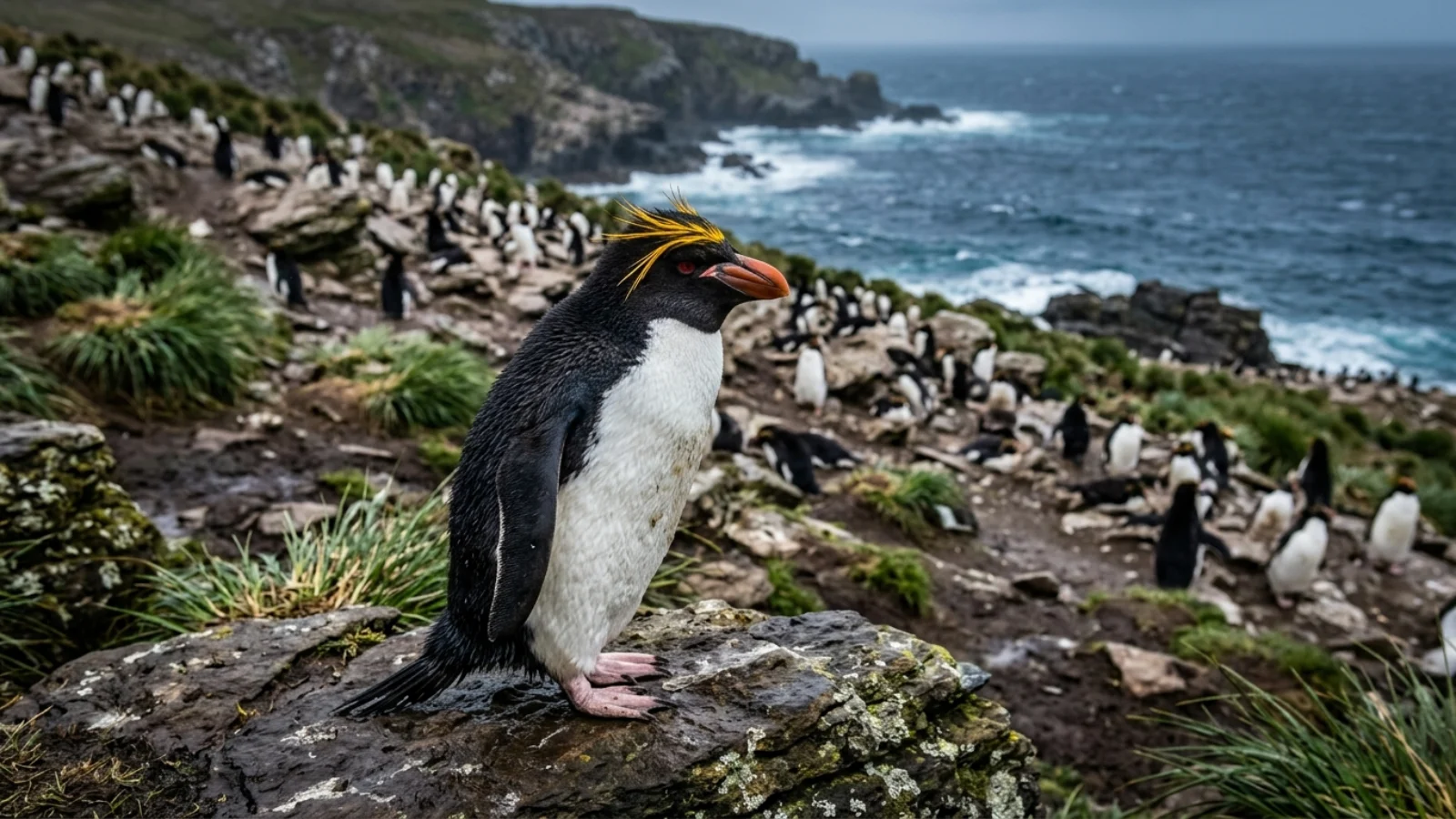
The macaroni penguin is one of the crested penguins, the genus Eudyptes, a group of six or seven species that also includes the rockhoppers, the royal, the Snares, the Fiordland and the erect-crested penguins. All of them carry some kind of yellow plumes on the head, but the macaroni’s crest is distinctive. Rather than starting above each eye, as in the rockhoppers, it rises from a single patch in the centre of the forehead and sweeps backwards and sideways towards the nape, a loose spray of golden-orange feathers that can look either flamboyant or slightly dishevelled depending on the weather.
The genus name comes from the Ancient Greek for “good diver”, and the species was formally described from the Falkland Islands in 1837 by the German naturalist Johann Friedrich von Brandt. The common name is older than the scientific one. It was already in use among English sailors in the Falklands in the early 1800s, and is generally explained as a nod to the “macaronis”, the 18th-century dandies who wore exaggerated wigs and clothes and whose name became a byword for showy fashion.
Of all penguins, the macaroni is closest to the royal penguin of Macquarie Island. Molecular clock studies suggest the two lineages split only about 1.5 million years ago, and their DNA is so similar that some ornithologists, among them the Australian authorities Les Christidis and Walter Boles, treat the royal penguin as a subspecies of the macaroni rather than a separate species. Most lists, including the IOC World Bird List, keep them apart. In the field the clearest difference is the face: the royal penguin’s face and throat are white, the macaroni’s are black. Hybrids between macaroni penguins and the Indo-Pacific form of the southern rockhopper have also been reported at Heard and Marion islands.
Size and identification
The macaroni is a fairly large crested penguin, averaging around 70 cm in length. Its weight changes a great deal through the year because, like all penguins, it fasts for long stretches while breeding and moulting. Measured averages for males run from about 3.3 kg just after incubating to 6.4 kg before the moult; females range from about 3.2 kg to 5.7 kg over the same cycle. Males are slightly larger and have noticeably bigger bills, averaging about 6.1 cm against 5.4 cm in females, and researchers use bill depth to sex birds in the hand.
Apart from the crest, the plumage follows the standard penguin pattern. The head, chin, throat and back are black, sharply divided from bright white underparts. Fresh black feathers have a bluish sheen, which fades to brown as they wear through the year. The flippers are blue-black above with a white trailing edge and largely white below. The heavy, bulbous bill is orange-brown, the eye is red, and a patch of bare pinkish skin runs from the base of the bill to the eye. The legs and feet are pink.
Young birds are easy to pick out once you know what to look for. Immatures are smaller, with a smaller and duller brownish bill, a dark grey chin and throat, and a crest that is absent or reduced to a scattering of yellow feathers. The full crest only develops when the bird is three or four years old, a year or two before it starts to breed.
Where macaroni penguins live
Macaroni penguins breed across a broad band of the Southern Ocean, from the sub-Antarctic islands south to the Antarctic Peninsula. At least 216 breeding colonies at about 50 sites have been recorded. In the South Atlantic sector they breed in southern Chile, the Falkland Islands, South Georgia, the South Sandwich Islands and the South Orkney Islands, and in smaller numbers on the South Shetland Islands and the northern Antarctic Peninsula. In the Indian Ocean sector the big strongholds are Bouvet Island, the Prince Edward and Marion islands, the Crozet Islands, the Kerguelen Islands, and Heard and McDonald Islands.
South Georgia and Kerguelen have historically held the largest populations. Colonies are often enormous, with some holding up to about 100,000 birds, and they are among the densest of any penguin: nests are packed roughly 66 cm apart in the middle of a colony and about 86 cm apart at the edges. Birds commonly nest on steep, rocky slopes and in tussock grass, and on South Georgia a nest may be little more than a scrape tucked into a tussock clump.
Outside the breeding season the species goes to sea for around six months. Wandering birds turn up far to the north, around the islands off Australia and New Zealand, southern Brazil, Tristan da Cunha and South Africa, but these are vagrants rather than residents. For a broader picture of how the different species divide up the Southern Hemisphere, see where penguins live.
Krill eaters on a vast scale
The macaroni penguin’s diet is dominated by crustaceans, with smaller amounts of fish and squid, and the balance shifts with place and season. During the breeding season, krill, especially Antarctic krill (Euphausia superba), can make up more than 90% of the food brought back to the colony. Small fish become more important while chicks are being raised, among them the marbled rockcod, the painted notie, lanternfishes and other small schooling species, along with cephalopods. Around some islands amphipods are taken in quantity: birds have been calculated to catch from 4 to 16 krill, or 40 to 50 amphipods, on a single dive.
Because the species is so numerous, those small mouthfuls add up to a remarkable total. Macaroni penguins have been described as the largest single consumer of marine resources among all seabirds, with one estimate putting their annual intake at about 9.2 million tonnes of krill. That figure is a modelled estimate rather than a measurement, and it depends on population figures that have since changed, but it shows why the species matters to the Southern Ocean food web and why changes in krill stocks are watched closely.
Like several other penguins, macaroni penguins deliberately swallow small stones of about 10 to 30 mm across. Researchers have suggested two explanations: the stones may act as ballast for diving, or they may help grind food, particularly the tough exoskeletons of krill and amphipods. Neither idea has been settled. The broader question of what different penguins live on is covered in what penguins eat.
How they dive and forage
Compared with the deep-diving emperor and king penguins, the macaroni is a shallow, fast worker. Foraging dives normally reach 15 to 70 metres and occasionally about 100 metres, and they rarely last more than two minutes. Every dive studied has been V-shaped: the bird descends, catches what it can, and comes straight back up without spending time at the bottom. About half of a foraging trip is spent diving. Some feeding happens at night, but those dives are much shallower, only about 3 to 6 metres, probably because the bird is hunting prey that rises towards the surface in the dark.
While birds have chicks to feed, foraging trips usually run from dawn to dusk, with overnight trips becoming more common as the chicks grow. During incubation and before the moult, adults go to sea for 10 to 20 days at a stretch. Feeding ranges depend on the colony. At South Georgia birds typically forage about 50 km offshore over the continental shelf, while birds from Marion Island have been tracked travelling anywhere from 59 to 303 km.
In winter the pattern changes. Macaroni penguins tend to dive deeper, for longer and more efficiently during their winter migration than in summer, although shorter days limit how much of each day they can spend hunting, because most foraging dives happen in daylight.
The winter journey
For a long time almost nothing was known about where macaroni penguins went for the half of the year they spend at sea. That changed when the French biologist Charles-André Bost and colleagues fitted 12 birds from Kerguelen with geolocation tags. During a study period of six to seven months, the tagged penguins dispersed eastwards over an area of more than 3 million square kilometres and travelled over 10,000 km each, without coming ashore once.
The birds spent most of that time within a band between about 47 and 49° south and 70 and 110° east in the central Indian Ocean, a region known as the Polar Frontal Zone. The surprise was that this area is notable for the absence of krill, the food that dominates the summer diet, which means the birds must switch to other prey such as small fish and other crustaceans during the winter. Results like this are one reason scientists caution against treating any penguin’s diet as fixed.
Colony life and displays
Living in dense colonies of tens of thousands of birds means constant social contact, and macaroni penguins have a large repertoire of visual and vocal displays to manage it. These peak early in the breeding season, and colonies become noticeably quieter when the males are away at sea.
Many displays are about conflict. Neighbours on adjacent nests often engage in “bill-jousting”, locking bills and wrestling as each tries to unbalance the other, while also battering with their flippers and pecking at the back of the opponent’s neck. Submissive displays help birds avoid fights: in the “slender walk”, a penguin moving through the colony flattens its feathers, holds its flippers forward and hunches its head and neck, signalling that it is just passing through.
Courtship displays are louder. In the “ecstatic display”, a bird bows forward with loud throbbing calls, then stretches its head and neck straight up until the bill points at the sky, and swings its head from side to side while braying. Pairs also bow to each other, trumpet and preen one another. Mates are fairly faithful: at South Georgia, about three-quarters of pairs breed together again the following year.
Two eggs, one chick
Females can begin breeding at around five years old, while males usually wait until they are at least six. The difference arises because males outnumber females in the population, so a female can choose an experienced partner as soon as she is ready to breed.
Adults arrive at the colonies in late October and lay their eggs in early November. The clutch is always two eggs, and it is one of the most lopsided in the bird world. The first egg weighs about 90 to 94 grams, only 61 to 64% of the weight of the second, which weighs about 145 to 155 grams. The first egg is extremely unlikely to produce a fledgling. What happens to it is still not fully understood, but in the closely related royal and erect-crested penguins the female has been seen tipping the first egg out of the nest once the larger second egg arrives. Together the two eggs weigh about 4.8% of the mother’s body weight. Each egg is roughly 20% yolk, 66% albumen and 14% shell; the thick shell resists breakage, and the large yolk means the chick hatches at an advanced stage, with some yolk left over to feed it for the first few days.
Incubation is split into three roughly equal shifts of about 12 days each over a five-week period. Both parents share the first shift, then the male goes back to sea and leaves the female alone with the egg; when he returns, she heads off and does not come back until the chick has hatched. The second egg hatches about 34 days after it is laid.
The fasts involved are long. A male goes without food for about 37 days after he arrives, returns to sea for around 10 days, and then fasts again for another 36 days while incubating and guarding the chick. The female fasts for about 42 days from her arrival. By the end, both adults have lost 36 to 40% of their body weight.
Raising the chick
After hatching, the male guards and broods the chick for about 23 to 25 days, keeping it warm while it has only down, and the female brings food every one to two days. Once the chick is old enough to be left, it joins a crèche with other chicks, which gives warmth and safety in numbers while both parents forage. The chick’s adult feathers grow in at about 60 to 70 days old, and it then goes to sea on its own. Adults leave the colonies by April or May and disperse into the ocean.
Before that, though, the adults must moult. Like all penguins, macaroni penguins replace their entire plumage at once, a process that takes three to four weeks ashore. Without a complete waterproof coat they cannot feed, so they spend about two weeks at sea fattening up beforehand and then sit out the moult on land. Survival between years is not well known: at South Georgia, the share of breeding adults returning varied from 49% to 78% over three years, and around 10% of those that did return skipped breeding the following season.
Predators
At sea, adult macaroni penguins are hunted by leopard seals, Antarctic and sub-Antarctic fur seals and killer whales. The colonies themselves suffer comparatively little predation as long as they are left undisturbed: predators mostly take eggs and chicks that have been left unattended or abandoned. Skuas, snowy sheathbills and kelp gulls take eggs, while skuas and giant petrels also take chicks and sick or injured adults. For more on the seals that prey on penguins, see which seals eat penguins.
How many macaroni penguins are there?
Population figures for this species are unusually uncertain, and sources disagree. A 1993 review estimated at least 11.8 million breeding pairs worldwide and called the macaroni the most abundant penguin of all. Later summaries put the population at around 18 million mature individuals. The current species list based on IUCN data gives about 6.3 million breeding pairs. The figures differ partly because many colonies are huge, remote and hard to count, and partly because some colonies really have shrunk.
The declines are well documented in places. The South Georgia population fell by about 50% between the mid-1970s and the mid-1990s, and the species has disappeared altogether from Isla Recalada in southern Chile. Because of this overall fall over the last three generations, the IUCN classifies the macaroni penguin as Vulnerable, even though it remains one of the most numerous penguins in the world. That combination, a very large population that is nonetheless shrinking, is exactly what the Vulnerable category is designed to capture.
Threats and protection
The causes of the declines are not fully pinned down. Changes in the availability of krill and other prey, linked to shifts in ocean conditions and to fishing for krill in the Southern Ocean, are the leading suspects. Because the species relies so heavily on krill in summer, any long-term drop in krill near the big colonies is a concern.
On the positive side, many of the islands that hold breeding colonies are protected reserves, and long-term monitoring programmes are under way at several of them, including South Georgia. Monitoring the macaroni penguin matters beyond the species itself: as a large-scale consumer of krill, its fortunes are one of the clearest signals of how the wider Southern Ocean ecosystem is changing.
Seeing macaroni penguins
For most people, the realistic place to see a macaroni penguin in the wild is South Georgia or the Falkland Islands on an expedition cruise. Macaroni colonies on South Georgia are often on steep, rocky slopes or among tussock grass, and the species’ range also reaches the northern Antarctic Peninsula and the South Shetland Islands, where Cooper Bay on South Georgia and Hannah Point on Livingston Island are among the sites where the birds are regularly photographed. Visitor guidelines in the region require keeping a set distance from wildlife and never blocking a penguin’s route between the sea and its nest. To compare the macaroni with the other crested penguins, see the rockhopper penguin and the full list in types of penguins.
Why is it called a macaroni penguin?
The name was used by English sailors in the Falklands by the early 1800s, apparently after the “macaronis”, flamboyantly dressed 18th-century dandies, because of the bird’s showy golden crest.
How big is a macaroni penguin?
About 70 cm long, weighing roughly 3.2 to 6.4 kg depending on sex and the time of year.
What do macaroni penguins eat?
Mainly Antarctic krill, which can make up over 90% of food in the breeding season, plus small fish, squid and amphipods.
Where do macaroni penguins live?
They breed from the sub-Antarctic islands, including South Georgia, Kerguelen, Crozet, Heard and the Falklands, south to the Antarctic Peninsula.
Are macaroni penguins endangered?
They are listed as Vulnerable by the IUCN because of large declines at several colonies, including about 50% at South Georgia between the 1970s and 1990s.
How many eggs do macaroni penguins lay?
Two. The first is much smaller and almost never produces a chick; the second, larger egg is the one that is raised.
What is the difference between a macaroni and a royal penguin?
The royal penguin has a white face and throat, while the macaroni’s are black. They are so closely related that some authorities treat them as one species.
- Wikipedia contributors, “Macaroni penguin” and “Penguin” (2023 snapshot via Kiwix mirror, accessed November 2026).
- Wikipedia contributors, “List of penguins” (current version, accessed November 2026), following the IOC World Bird List with IUCN statuses and population estimates.
- IUCN, “Emperor penguin and Antarctic fur seal now Endangered due to climate change” (press release, 9 April 2026); no change to macaroni penguin status reported.
Blane Perun has been exploring Earth’s oceans and marine life for over 25 years. Founder of TheSea.Org in 1999, underwater photographer, coral aquaculture pioneer, and explorer of 80+ countries.
About Blane Perun →