Emperor Penguin — Breeding Through the Antarctic Winter
The emperor penguin (Aptenodytes forsteri) is the tallest and heaviest of all living penguins and the only species that breeds during the Antarctic winter, raising its chicks on sea ice attached to the coast of Antarctica. Adults weigh about 22 to 45 kg; measured standing heights are roughly 81 to 97 cm, though bill-to-tail length is often quoted at 1.1 to 1.2 m. The female lays a single egg in May or early June, and the male incubates it on his feet for more than two months in temperatures that can fall to −40°C, fasting for about four months in all. Emperors dive deeper than any other bird, to at least 535 metres. Because they depend on stable sea ice, they are highly exposed to its loss: in April 2026 the IUCN moved the species from Near Threatened to Endangered.
The genus name Aptenodytes, coined by the English zoologist George Robert Gray when he described the species in 1844, comes from Ancient Greek for “without-wings-diver”. The species name honours Johann Reinhold Forster, the German naturalist on Captain James Cook’s second voyage.
The largest penguin
The emperor penguin is endemic to Antarctica and is the tallest and heaviest of all living penguin species. Males and females look alike and are similar in size. Weight varies with sex and season, from about 22 to 45 kg: at the start of the breeding season males average about 38 kg and females about 29.5 kg, and after the season both average about 23 kg.
Its height is often exaggerated. Published sizes are usually measured from bill to tail, and on that basis adults are 110 to 120 cm long, averaging about 115 cm according to a 1975 study, and some reported “heights” have reached 1.5 metres. Measurements of how tall the birds actually stand are smaller: a 1945 study of 22 wild birds gave standing heights of 83 to 97 cm, and a 2012 study of 11 complete skins at the American Museum of Natural History gave 81 to 94 cm. Either way, it is the giant among living penguins. Its relative the king penguin is the only other member of its genus, and fossils of a third, Ridgen’s penguin, have been found in New Zealand rocks about three million years old.
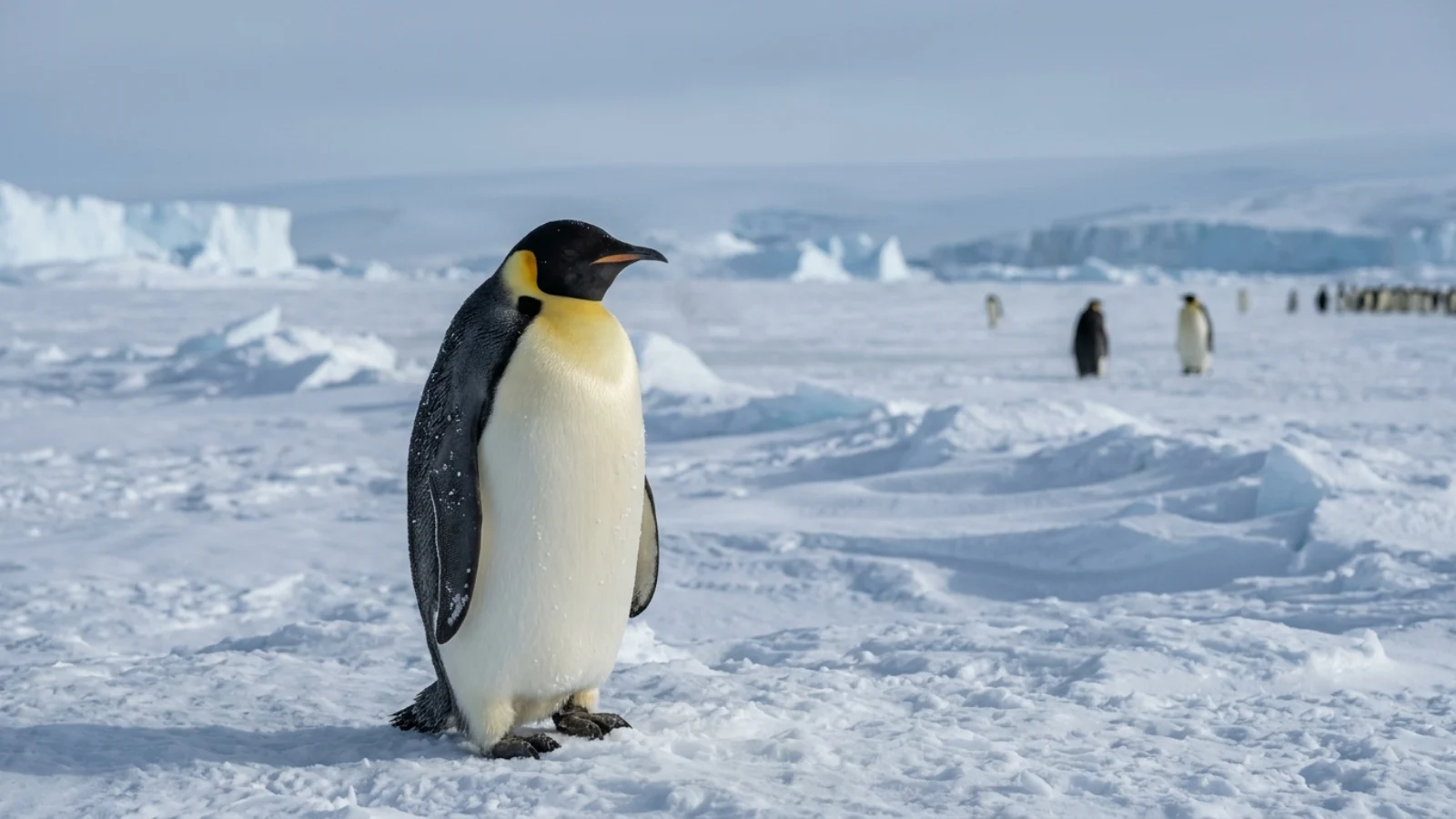
The adult’s head, chin, throat, back and the tops of its flippers are deep black, sharply divided from a white belly, a pale-yellow breast and bright-yellow ear patches. The bill is about 8 cm long, black above, with a lower mandible that can be pink, orange or lilac. Chicks are covered in silver-grey down, with black heads and white masks.
Built for the coldest place on Earth
The emperor penguin breeds in the coldest environment of any bird. Air temperatures at its colonies may reach −40°C, the sea is about −1.8°C, and the bird’s own body temperature averages 39°C. Wind speeds have been put at up to 144 km/h; other accounts give gusts of up to 200 km/h during the winter incubation.
Its insulation is layered. Feathers provide 80 to 90% of it, and a layer of fat under the skin can be up to 3 cm thick before breeding. Contour feathers are not especially dense, about 9 per square centimetre, but dense afterfeathers and down beneath them probably do much of the insulating work, and muscles allow the bird to hold its feathers erect on land, trapping a layer of air against the skin. New feathers grow before old ones are lost, to reduce heat loss, and the whole moult is fast, taking about 34 days.
The penguin’s comfortable temperature range, its thermoneutral zone, runs from about −10 to 20°C. Below that its metabolism increases; it can hold its core temperature even when the air is far colder, by swimming, walking, shivering and burning fat. Above 20°C it can become agitated as it struggles to shed heat.
Huddles
The emperor’s best defence against the cold is its neighbours. Colonies form compact huddles, sometimes called the turtle formation, of anywhere from ten to several hundred birds, each leaning forward on the next. Because the wind chill is lowest in the centre, birds take turns moving inward and outward, so that each gets time in the warm core. During incubation, huddling males rely on this rotation to survive the polar night.
Diving and hunting
The emperor penguin dives deeper than any other bird. The American physiologist Gerry Kooyman transformed the study of penguin foraging in 1971 by attaching automatic dive recorders to emperors; he found they reached 265 metres, with dives of up to 18 minutes. Later research recorded a small female diving to 535 metres near McMurdo Sound, and dives of around 20 minutes. It is possible the birds go deeper still, because recording devices become less accurate at depth.
At those depths the pressure is up to 40 times that at the surface, which would injure most land animals. The emperor copes partly by slowing its heart to as few as 15 to 20 beats a minute and shutting down non-essential organs, sharply reducing its oxygen use. Its average swimming speed is about 6 to 9 km/h. Birds hunting together may coordinate their diving and surfacing, and they may be active by day or night.
The diet is mainly fish, with crustaceans such as krill and cephalopods such as squid. The loss of sea ice reduces the supply of krill, one way in which a changing climate reaches the penguins through their food. More on penguin diets is in what do penguins eat.
Breeding through the Antarctic winter
The emperor penguin is the only penguin that breeds during the Antarctic winter. The cycle begins in March and April, at the start of winter, when mature birds walk 50 to 120 km over the ice from the edge of the pack ice to their colonies. They almost always breed on stable fast ice, sea ice attached to the coast, up to about 18 km offshore, usually where ice cliffs and icebergs give some shelter from the wind. Colonies can hold several thousand birds.
Courtship begins in March or April, when temperatures can be as low as −40°C. In May or early June the female lays a single pear-shaped, pale greenish-white egg weighing about 460 to 470 g and measuring around 12 by 8 cm. She passes it to the male, a delicate transfer in which an egg dropped on the ice can be lost to the cold; when that happens, the pair’s bond ends and both walk back to the sea. The female then returns to the ocean to feed.
The male balances the egg on the tops of his feet and covers it with a fold of loose skin and feathers, the brood pouch, for about 65 to 75 days until it hatches. He does not eat during this time. By the time the egg hatches he has fasted for around 120 days since arriving at the colony, and over the four months of travel, courtship and incubation he may lose up to 20 kg, falling from about 38 kg to 18 kg; other measurements put the typical loss during incubation at around 12 kg. Hatching itself can take two or three days, because the shell is thick.
If the chick hatches before its mother returns, the father feeds it a curd-like secretion of about 59% protein and 28% fat, produced by a gland in his oesophagus. This “crop milk” can sustain the chick for usually four to seven days until the female arrives from the sea with food. After that the parents take turns, one foraging at sea while the other guards the chick. Chicks weigh about 315 g after hatching and leave when they reach about half of adult weight. As they grow, chicks gather in creches. The adults disperse into the ocean from January to March.
Because emperors have no fixed nest site, they find their partners and chicks by voice alone. Chicks use a frequency-modulated whistle to beg for food and contact their parents.
Survival and lifespan
Emperor penguins typically live about 20 years in the wild, and some may reach 50. One study measured an average adult survival rate of 95.1% a year, giving an average life expectancy of 19.9 years, and estimated that 1% of chicks could reach 50. Early life is far more dangerous: only about 19% of chicks survive their first year, so about 80% of the population is made up of adults five years old or more.
Southern giant petrels are the main predator of chicks on land, responsible for more than a third of chick deaths at some colonies, and they also scavenge dead penguins. South polar skuas mainly scavenge dead chicks. At sea, only two mammals are known to attack healthy adults: the leopard seal, which takes adults and fledglings soon after they enter the water, and the orca, which mostly takes adults but will attack penguins of any age in or near the water. See which seals eat penguins.
How many emperor penguins are there?
Emperors are counted largely from space, because their colonies are remote and occupied in the dark. A 2009 estimate put the population at about 595,000 adult birds in 46 known colonies, with around 35% of them north of the Antarctic Circle; a British Antarctic Survey satellite survey that found additional colonies later raised the estimate by 5 to 10%, to around 278,000 breeding pairs. By December 2022, when satellite images revealed a colony at Verleger Point in West Antarctica, the number of known colonies had reached 66. The northernmost breeding population is on Snow Hill Island near the tip of the Antarctic Peninsula. A few colonies have been found on land, and since 2009 some colonies have moved onto floating ice shelves, in some cases in years when sea ice formed late.
Colonies shift and change. They often split into “suburbs” that drift apart, and some have vanished. The Cape Crozier colony in the Ross Sea shrank to a few hundred birds between the Discovery Expedition of 1902–03 and the Terra Nova Expedition of 1910–11, rebounded strongly by the 1960s, and was down to around 300 birds again by 2009. In 2026, researchers showed that Sentinel-1 satellite radar can track colonies through the polar night, revealing that colonies at Atka Bay, Coulman Island and Cape Washington move around in winter in different ways from year to year.
Why the emperor penguin is now Endangered
In 2012 the IUCN raised the emperor penguin from Least Concern to Near Threatened, a status it still held after its 2019 assessment. On 9 April 2026 it moved the species two steps further, to Endangered, citing the loss of the sea ice it needs to breed. The IUCN projects that populations will fall by about half within 50 years; reports of the decision also cited projections that, without deep cuts in greenhouse gas emissions, the population would halve by the 2080s.
The evidence has been building for years. A long-term study in Terre Adélie recorded a 50% population decline after an unusually long warm period in the late 1970s reduced sea ice and killed more adults, especially males, although too much sea ice can also hurt breeding success. Beginning in 2015, a strong El Niño, strong winds and record low sea ice caused almost total breeding failure for three years running at Halley Bay, then the second-largest colony in the world; many of its birds appear to have moved to the Dawson-Lambton colony 55 km to the south, which grew tenfold between 2016 and 2018.
In 2022, Antarctic sea ice reached record lows. A 2023 study in Communications Earth & Environment by Peter Fretwell and colleagues at the British Antarctic Survey showed that in the central and eastern Bellingshausen Sea, where some areas lost all their sea ice in November, four of the five emperor colonies suffered total breeding failure: the ice broke up before the chicks were old enough to fledge. It was the first recorded widespread breeding failure clearly linked to large-scale sea-ice loss.
Population studies agree on the direction but differ on the scale. A 2024 analysis of satellite images led by Michelle LaRue, covering the whole species from 2009 to 2018, found with 81% probability that there were fewer adults in 2018 than in 2009, with a median decline of 9.6%, about 1.3% a year, though with wide uncertainty and an apparent uptick near the end. A 2025 study by Fretwell and colleagues of the sector from 0° to 90°W, about a third of the global population, which included the sea-ice losses of 2020 to 2023, found a best-fit decline of 22%, about 1.6% a year, faster than models had predicted even for high-emission scenarios. Earlier modelling had forecast that by 2100 all colonies would be declining, mostly through loss of habitat, and a 2023 study warned that more than 90% of colonies could face “quasi-extinction” from catastrophic breeding failure as sea ice shrinks.
Other pressures add to the problem: reduced food as climate change and industrial fisheries affect krill and fish, disease, and disturbance at colonies, including from tourism. One study found that chicks in a creche became more apprehensive after a helicopter approached to within 1,000 metres. For the other penguins in this section and their status, see the penguins hub and types of penguins.
How big is an emperor penguin?
Adults weigh about 22 to 45 kg. Measured standing height is about 81 to 97 cm, while bill-to-tail length is 110 to 120 cm.
Where do emperor penguins live?
Only in Antarctica, breeding on sea ice attached to the coast; the northernmost colony is on Snow Hill Island near the Antarctic Peninsula.
How deep can an emperor penguin dive?
At least 535 metres, recorded near McMurdo Sound, with dives lasting up to about 20 minutes.
How long do emperor penguins live?
Typically about 20 years in the wild; some may reach 50.
How long does the male emperor penguin sit on the egg?
About 65 to 75 days, fasting the whole time; by hatching he has gone around 120 days without food.
What eats emperor penguins?
Leopard seals and orcas at sea; giant petrels and skuas take or scavenge chicks.
Are emperor penguins endangered?
Yes. The IUCN moved the species from Near Threatened to Endangered on 9 April 2026 because of sea-ice loss.
How many emperor penguins are left?
Estimates include about 595,000 adults (2009) and about 278,000 breeding pairs; recent satellite studies show declines of about 10% from 2009 to 2018 and 22% in one sector up to 2023.
- Wikipedia contributors, “Emperor penguin” and “Penguin” (2023 snapshot via Kiwix mirror, accessed November 2026).
- Fretwell, P. T., Boutet, A. and Ratcliffe, N. (2023). Record low 2022 Antarctic sea ice led to catastrophic breeding failure of emperor penguins. Communications Earth & Environment. doi:10.1038/s43247-023-00927-x.
- LaRue, M. et al. (2024). Advances in remote sensing of emperor penguins: first multi-year time series documenting trends in the global population. Proceedings of the Royal Society B. doi:10.1098/rspb.2023.2067.
- Fretwell, P. T., Bamford, C. and Skachkova, A. (2025). Regional emperor penguin population declines exceed modelled projections. Communications Earth & Environment. doi:10.1038/s43247-025-02345-7.
- Macdonald, G. J. et al. (2026). Year-round movement of emperor penguin colonies observed from space. Communications Earth & Environment. doi:10.1038/s43247-026-03906-0.
- IUCN Red List update of 9 April 2026, as reported by Mongabay and Gizmodo (April 2026).
Blane Perun has been exploring Earth’s oceans and marine life for over 25 years. Founder of TheSea.Org in 1999, underwater photographer, coral aquaculture pioneer, and explorer of 80+ countries.
About Blane Perun →