Galapagos Penguin — The Only Penguin North of the Equator
The Galapagos penguin (Spheniscus mendiculus) is the only penguin that lives north of the Equator and the rarest of all penguins, with around 1,200 mature birds estimated in 2018. It is found only in the Galapagos Islands of Ecuador, where about 90% of the population lives on Fernandina Island and the west coast of Isabela Island. At 48 to 50 cm tall and 2 to 4 kg, it is the second-smallest penguin. It survives in the tropics because the cold, nutrient-rich Humboldt and Cromwell currents bring food to the western islands, and it copes with the heat by panting, shading its feet and nesting in shady lava crevices. The IUCN lists it as Endangered, mainly because strong El Nino events cut off its food: the 1982-83 El Nino reduced the population by 77%.
The northern tip of Isabela Island crosses the Equator, so some Galapagos penguins live in the Northern Hemisphere. No other wild penguin does. Every other species breeds south of the Equator, and none lives in the Arctic.
The penguin that lives on the Equator
Penguins are usually pictured on ice, but most species live in temperate waters, and one lives on the Equator. The Galapagos penguin is endemic to the Galapagos Islands, about 600 miles off the coast of South America, and it is the only penguin found north of the Equator. Most of the population lives on Fernandina Island and along the west coast of Isabela Island, and the northern tip of Isabela crosses the line into the Northern Hemisphere. No other penguin breeds there, and there are no penguins at all in the Arctic.
The bird is also a record holder in a less happy sense. With an estimated 1,200 or so mature birds in 2018, it is the rarest penguin species, a title often wrongly given to the yellow-eyed penguin of New Zealand. It is listed as Endangered on the IUCN Red List, and it is one of two penguin species that the US Fish and Wildlife Service has listed as endangered.
The scientific name Spheniscus mendiculus was published by Sundevall in 1871. The genus name Spheniscus comes from the Greek word for “wedge”, a reference to the shape of the swimming flippers of the African penguin, and the same root gave the whole penguin family its name, Spheniscidae.
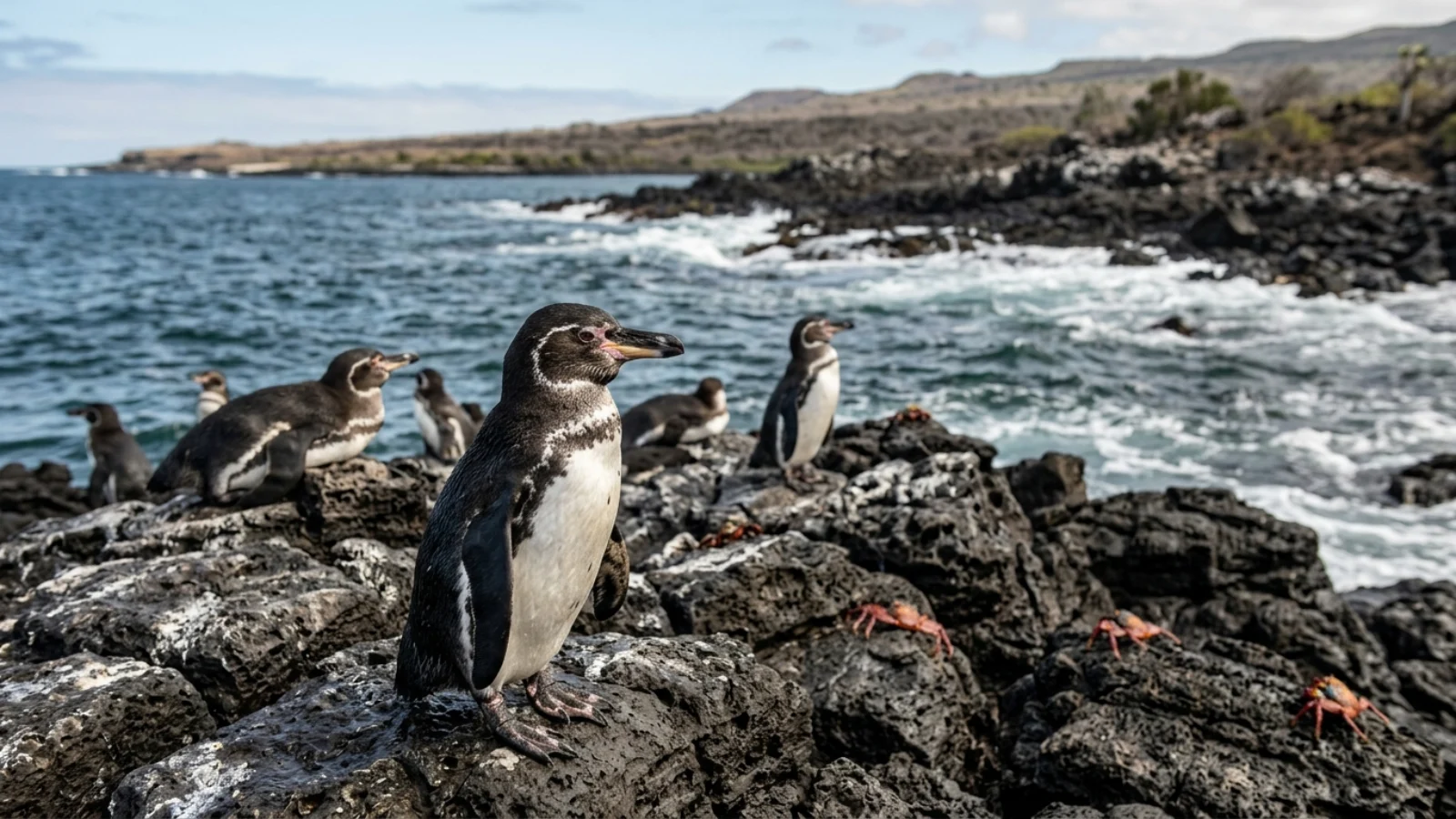
How a penguin survives in the tropics
The Galapagos penguin exists because of ocean currents. The cool waters of the Humboldt Current, flowing up from the south along the coast of South America, and the Cromwell Current, which reaches the western islands, keep the sea around Fernandina and western Isabela much colder and richer than the latitude suggests. The upwelling brings nutrients to the surface, the nutrients feed plankton, and the plankton feed the small schooling fish that the penguins eat.
That is why the penguins are concentrated in the west of the archipelago. They forage in the cool Cromwell Current during the day and return to land at night, normally ranging only a few kilometres from their breeding sites. They depend entirely on the cold, nutrient-rich water arriving close to shore. When it fails, as it does during El Nino years, the penguins have nowhere else to go.
Air temperatures in the Galapagos stay between about 15 and 28 °C. For a bird built to stay warm in cold water, the strong equatorial sun on land is a real problem, and much of the Galapagos penguin’s behaviour is about avoiding overheating.
Size and markings
The Galapagos penguin stands 48 to 50 cm tall and weighs about 2 to 4 kg, with females usually smaller than males. Only the little penguin of Australia and New Zealand is smaller. The size fits a broad pattern among living penguins: larger species generally live in colder regions and smaller ones in temperate or tropical climates, although researchers disagree about how strictly penguins follow this rule, and some fossil species contradict it.
Adults have a black head with a narrow white border that runs from behind the eye, around the black ear coverts and chin, and joins on the throat. The top of the bill is black, fading to pink on the bottom. Two black bands cross the white breast and connect to the back, and the lower band extends down the flanks to the thigh. Juveniles look different: they have a wholly dark head, greyer on the sides and chin, and no breast band. Their juvenile plumage is dark brown or grey above and white below.
Like all penguins, the Galapagos penguin is countershaded, with a dark back and a white front. A predator looking up from below struggles to pick out a white belly against the bright surface, and one looking down sees a dark back against dark water.
The banded penguins
The Galapagos penguin is one of four banded penguins in the genus Spheniscus. Its relatives are the African penguin of South Africa and Namibia, the Humboldt penguin of Peru and Chile, and the Magellanic penguin of Patagonia and the Falklands. All four are similar in shape, colour and behaviour, with white stripes on a dark face and dark bands across the chest, and they are best told apart by where they live.
Banded penguins, along with the little penguins, share some unusual features. They lack the yellow and orange carotenoid colours of other penguins, and they are the only living penguins that nest in burrows. Their ancestors probably spread eastwards with the Antarctic Circumpolar Current out of the ancestral range of modern penguins, starting about 28 million years ago, and the present-day species are the product of a later radiation between about 4 and 2 million years ago. The Galapagos penguin’s fossil record reaches back into the Pleistocene.
The contrast with the Magellanic penguin shows how unusual the Galapagos bird’s situation is. Magellanic penguins have a steady food supply on the Atlantic coast of South America, where a broad continental shelf lets them forage far from their colonies. Galapagos penguins have no such buffer. They live off a narrow band of upwelling water around a few volcanic islands. The Humboldt penguin, its nearest neighbour on the mainland, is Vulnerable with about 32,000 mature birds, so even that population dwarfs the Galapagos one.
Where Galapagos penguins live
About 90% of Galapagos penguins live on Fernandina Island and the west coast of Isabela Island, in the western part of the archipelago. Small populations also occur on Santiago, Bartolome, northern Santa Cruz and Floreana. The Las Marielas islets off western Isabela have been an important breeding area for more than 50 years, and they are among the sites surveyed in the national park’s regular penguin and cormorant counts. Researchers studying the species describe two geographic subpopulations, but enough birds move between them that they are treated as one population for conservation.
Adults stay near their breeding areas all year, with their mates. They nest on the shore, usually within 50 metres of the water, in caves, crevices and lava tubes. On the young volcanic coast of Fernandina and Isabela, with few trees or shrubs, shade comes mostly from the rocks themselves, although some mangroves grow along the coast.
For how the Galapagos penguin fits into the overall map of penguin ranges, from the Antarctic coast to Africa and the Equator, see where penguins live.
Keeping cool in the tropical sun
The Galapagos penguin’s main way of cooling down is simply to get into the water. When it has to stay on land, during incubation or while guarding chicks, it relies on behaviour. One technique is to stretch out the flippers and hunch forward so the bird’s own body shades its feet. Penguin feet lose and gain heat rapidly, because they have a high blood flow and no insulation, so keeping them out of the sun makes a difference. Another is panting, which uses evaporation to cool the throat and airways.
All penguins have a counter-current heat exchanger in their flippers, called the humeral plexus, in which at least three branches of the main artery let blood heading out to the flipper exchange heat with blood coming back. In cold-water penguins it limits heat loss. The Galapagos penguin has the same plumbing, but in the tropics its problem is usually too much heat rather than too little, which is why its behaviour on land is so focused on staying cool.
Eggs and chicks are protected from the sun by being kept in deep crevices in the rocks. Newly hatched chicks have downy feathers that do not become waterproof until they grow into juveniles, and the juvenile plumage, attained about 30 days after hatching, is mainly needed to protect the chicks from the strong sun rather than to keep them warm.
What Galapagos penguins eat
Galapagos penguins eat small schooling fish, mainly mullet, sardines, pilchards and anchovies, and sometimes crustaceans. Like other penguins, they catch prey with the bill and swallow it whole while swimming. The small penguins do not usually dive deep; they catch most of their prey near the surface in dives that normally last only one or two minutes.
The penguins’ diet ties them closely to the state of the ocean. In normal and La Nina years, the strong cold currents supply nutrients that support the small fish the penguins eat. In El Nino years, the currents weaken, upwelling slows, phytoplankton productivity drops and the fish disappear or move deeper. Galapagos penguins cannot follow them across open ocean, so they go hungry. For the bigger picture of how penguin diets change from the Antarctic krill-eaters to the fish-eating banded penguins, see what penguins eat.
Breeding all year round
Galapagos penguins are monogamous, and each pair usually mates for life. Unlike most penguins, they can breed in any month. Courtship includes bill dueling, flipper patting and mutual preening, after which the pair builds and maintains a nest. Most nests are seen between May and July, when food and climate conditions are usually best, but the birds breed whenever conditions allow.
The female lays one or two eggs in a cave or crevice that keeps them out of direct sunlight, which could overheat them. Both parents incubate, and the eggs hatch after 38 to 40 days. One parent always stays with the eggs or young chicks while the other may be away for several days to feed. A pair usually rears only one chick, and the chicks become independent after about 60 to 65 days. If there is not enough food, the parents may abandon the nest.
The Galapagos penguin has one more unusual habit. It moults before it breeds, and it is the only penguin that moults twice a year. Each moult takes up to 15 days, during which the bird cannot go to sea to feed. Moulting before breeding is thought to be a safety measure in a place where food supply is so unpredictable: a bird that has already replaced its feathers can put everything into raising a chick when food is plentiful.
In the wild, Galapagos penguins live about 15 to 20 years, although predation and environmental conditions reduce life expectancy. The first person to breed the species successfully in captivity was the Bermudian naturalist Louis L. Mowbray.
El Nino: boom and bust
The single biggest threat to the Galapagos penguin is El Nino. During an El Nino the cold upwelling weakens, the sea warms, and the bottom of the food chain collapses. The penguins defer breeding, because the chance of raising a chick successfully becomes poor compared with the risk of dying in the attempt. The penguins usually breed only when the sea surface temperature is below about 25 °C.
Two strong El Nino events show how severe the effects can be. The 1982-83 El Nino reduced the population by 77%, and the 1997-98 event by 65%. Weaker El Ninos in 1965-66, 1968-69, 1972-73, 1976, 1986-87, 1991-92 and 1993 were associated with slow recovery. In La Nina years, when the sea is cooler than normal, the population begins to recover.
The effects fall unevenly. Warm El Nino conditions are associated with poorer female condition and lower adult body weights, and food shortages lead to poor breeding success and a disproportionately high death rate among females. That leaves uneven sex ratios that slow the population’s recovery after the event has passed.
Climate change makes this more worrying. Research has linked human-caused warming to more frequent and more intense El Nino events, and predictive models suggest they will increase in frequency and severity over the coming century. One modelling study estimated that if the pattern of El Nino events seen between 1965 and 2004 continued, the Galapagos penguin would face a 30% chance of extinction; if the frequency of strong El Ninos doubled, that rose to 80%.
How many Galapagos penguins are there?
Counting Galapagos penguins is difficult, and the numbers depend heavily on the year and on what was counted. Published figures include about 1,200 mature birds in 2018, which is the estimate used for the IUCN listing; fewer than 1,000 breeding pairs; and a population of about 1,800. In 2010, the biologist who has studied the species longest said there were possibly fewer than 2,000 birds left.
The Galapagos National Park and the Charles Darwin Foundation carry out regular censuses of penguins and flightless cormorants on Isabela, Fernandina and the Marielas islets. In September 2020 they counted 1,940 penguins, up from 1,451 in 2019 and the highest count since 2006. The park credited La Nina conditions, which brought more food, and reduced tourism during the pandemic, which meant less disturbance at nesting areas.
Four years later the picture was very different. An eight-day census in October 2024 counted 413 Galapagos penguins. Of these, 96% were adults and only 1% were juveniles, which the park and foundation said suggested a drop in breeding, probably because of a shortage of food. The census also took blood samples from 57 birds to test for disease, and monitoring for avian influenza was under way. Because census effort and coverage vary, the counts are best read as a measure of good and bad years rather than a precise total, but the swing from one to the other shows how quickly this population can change.
Disease, predators and people
Disease is a growing concern for a population this small. A 2001 study found no evidence of avian malaria or Marek’s disease in Galapagos penguins, but the researchers urged continued monitoring, pointing to the deaths of 800 chickens on the islands from Marek’s disease, the presence of mosquitoes known to carry avian malaria, and the devastating effects of these diseases on native birds in Hawaii. A 2009 study then found a species of Plasmodium, the parasite that causes avian malaria, in Galapagos penguins. Later work suggests that parasites may pass between native Galapagos birds and migratory species such as the bobolink. The penguin’s low genetic diversity makes it especially vulnerable to disease and other shocks.
On land, native predators include crabs, snakes, rice rats, Galapagos hawks and short-eared owls. Introduced cats, dogs and rats, which have spread across Isabela, Floreana and other islands, attack penguins, destroy nests and spread disease, and they limit the places where penguins can safely breed. At sea, penguins are taken by sharks, fur seals and sea lions, including the Galapagos sea lion.
Human activity adds further pressure: illegal fishing can disturb nesting birds, penguins are sometimes caught accidentally in fishing nets, and pollution and competition with fisheries are listed among the threats. Volcanic activity is a natural hazard too: some nest sites used 40 years ago are still in use, but others have eroded or been destroyed by volcanic activity.
Building nests out of lava
Losing nest sites matters because the penguins need shade to breed. Researchers following the population since the 1970s found that about half of the natural nest sites studied in that decade have been lost, mostly to erosion and extreme high tides. Even shade from trees is unreliable: of two palo santo trees watched on Medium Mariela island for ten years, one fell in February 2019.
In late September 2010, the biologist Dee Boersma of the University of Washington, who began studying the species for her doctoral research on Fernandina Island in 1970, led a team that built 120 artificial nests for the penguins in partnership with the Galapagos National Park. The nests were made from local lava on the volcanic shoreline of three islands and several smaller islets, in places free of introduced predators. The team built 100 shaded nests in fairly close clusters and 20 more spaced farther apart, in case some penguins preferred isolation. According to Boersma, the finished nests were virtually indistinguishable from natural holes.
The team has returned twice a year since 2010, with support from the Galapagos Conservancy since 2013. A 2020 survey checked 45 natural nests and 115 of the constructed ones. Seven natural nests were active, five of them on the Marielas, and 29% of the penguins counted were juveniles, a sign of successful breeding in the previous seven months. About 28% of all active nests found since 2010 have been in the constructed sites, so the artificial nests are clearly being used. Fieldwork has continued with new partners since 2023: on a trip from late July to early August 2025, the team measured 36 penguins, 16 more than the year before.
Seeing Galapagos penguins
Most of the islands and the waters around them are protected as the Galapagos National Park and Marine Reserve, and the archipelago is a UNESCO World Heritage Site. The largest numbers of penguins are around Fernandina and western Isabela, far from the main towns, while the small groups on islands such as Bartolome and Santiago lie in the centre of the archipelago. Visitors who see them are asked to keep their distance, especially around nesting crevices, and to follow park rules, which matter more than ever for a species that can lose most of its numbers in a single bad year.
Where do Galapagos penguins live?
Only in the Galapagos Islands of Ecuador. About 90% live on Fernandina Island and the west coast of Isabela Island, with small groups on Santiago, Bartolome, Santa Cruz and Floreana.
Is the Galapagos penguin the only penguin north of the Equator?
Yes. The northern tip of Isabela Island crosses the Equator, so some Galapagos penguins live in the Northern Hemisphere, the only wild penguins that do.
How many Galapagos penguins are left?
About 1,200 mature birds was the 2018 estimate used by the IUCN. Census counts swing widely: 1,940 in 2020 but 413 in October 2024.
How big is a Galapagos penguin?
About 48 to 50 cm tall and 2 to 4 kg, making it the second-smallest penguin after the little penguin.
What do Galapagos penguins eat?
Small schooling fish such as mullet, sardines, pilchards and anchovies, and sometimes crustaceans.
How do Galapagos penguins stay cool?
By swimming in the cold currents, panting, shading their feet with their bodies and flippers, and nesting in shady lava crevices.
Why is the Galapagos penguin endangered?
Mainly because El Nino events cut off its food. The 1982-83 El Nino reduced the population by 77%, and disease, introduced predators and loss of nest sites add to the risk.
How long do Galapagos penguins live?
About 15 to 20 years, although predation and food shortages shorten many lives in the wild.
- Wikipedia contributors, “Galapagos penguin”, “Penguin”, “Humboldt penguin” and “Magellanic penguin” (2023 snapshot via Kiwix mirror, accessed November 2026).
- University of Washington News, “Biologist hopes new ‘condos’ will help Galapagos penguins stave off extinction” (19 October 2010).
- Galapagos Conservancy, “A Fragile Landscape for Galapagos Penguins” (2020 field report).
- Telangana Today / AFP, “Galapagos sees record rise in penguins” (24 October 2020), on the Galapagos National Park census.
- Primicias, “La reproduccion de los pequenos pinguinos de Galapagos se reduce, segun censo” (21 October 2024).
- Center for Ecosystem Sentinels, “Field Updates: Galapagos, Summer 2025” (8 August 2025).
Blane Perun has been exploring Earth’s oceans and marine life for over 25 years. Founder of TheSea.Org in 1999, underwater photographer, coral aquaculture pioneer, and explorer of 80+ countries.
About Blane Perun →