What Do Penguins Eat? — Krill, Fish, Squid and Surprises
Penguins eat krill, fish and squid, which they catch underwater with their bills and swallow whole while swimming. The balance depends on the species and where it lives. Antarctic and sub-Antarctic penguins such as the Adelie, chinstrap, macaroni and rockhopper rely heavily on krill; the macaroni penguin alone is estimated to eat about 9.2 million tonnes of krill a year. Emperor and king penguins eat mostly fish and squid, while the banded penguins of Africa, South America and the Galapagos live mainly on small schooling fish such as sardines and anchovies. Penguins also eat other crustaceans and, it turns out, sometimes jellyfish. They drink seawater and get rid of the salt through a gland above the eyes.
Penguins have no teeth. Instead, a spiny tongue, which in the emperor penguin carries rear-facing barbs, and powerful jaws grip slippery fish and squid while the prey is swallowed whole.
The short answer
Penguins are carnivores that feed entirely at sea. Most penguins eat krill, fish, squid and other forms of sea life, which they catch with their bills and swallow whole while swimming. Exactly what a penguin eats depends on its species, where it lives, the time of year and whether it has chicks to feed.
A useful way to think about penguin diets is as three overlapping menus. In the cold waters around Antarctica, many penguins live largely on krill, the small shrimp-like crustaceans that swarm in the Southern Ocean. Farther north, along the coasts of Africa and South America, penguins live mostly on small schooling fish. And some penguins, especially the king and Fiordland penguins, take large amounts of squid. Almost every species mixes all three to some extent.
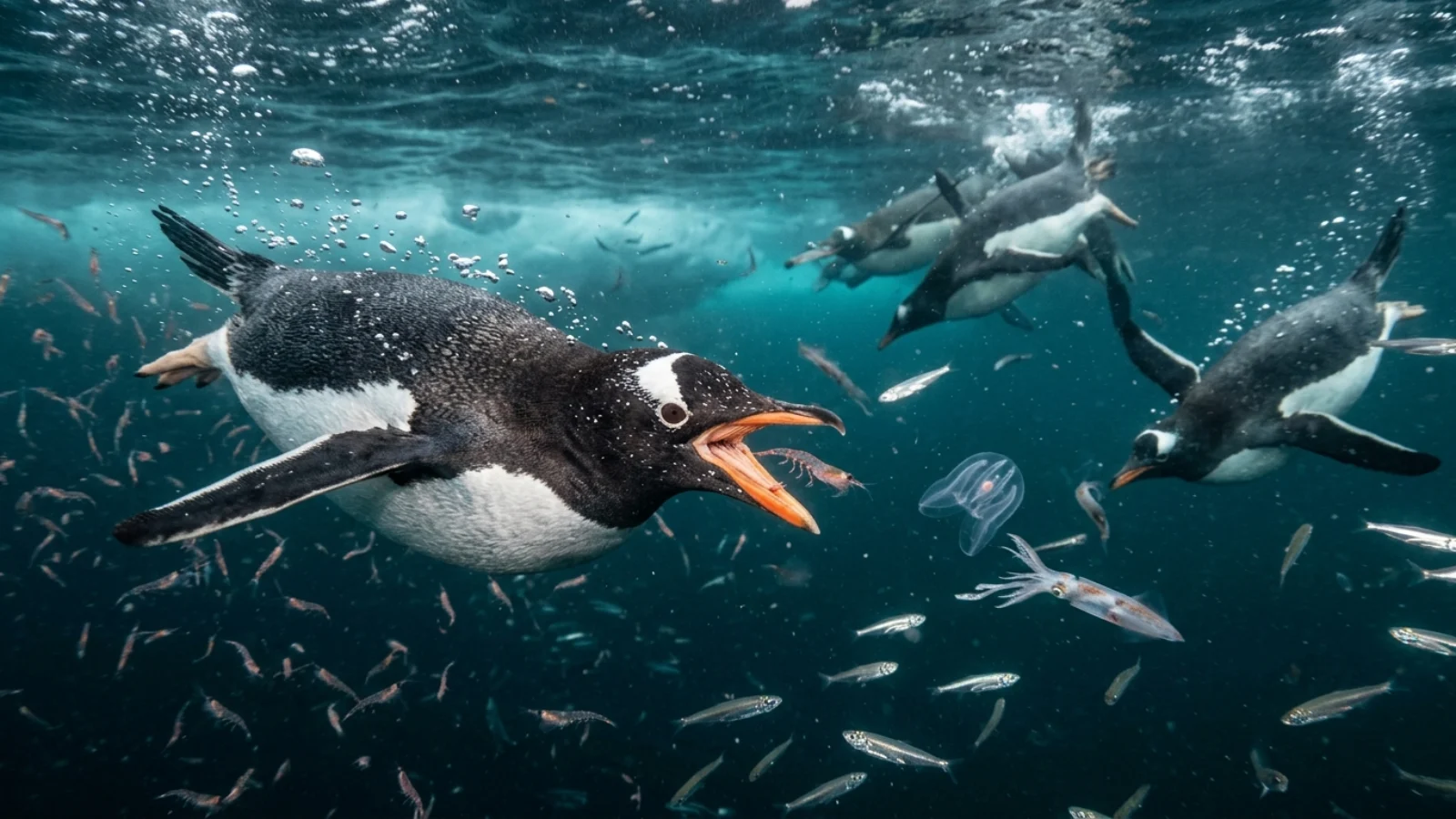
How penguins catch their food
Penguins hunt by sight. Their eyes are adapted for underwater vision and are their main way of finding prey and avoiding predators. The Humboldt penguin, for example, is a visual hunter whose foraging rhythm depends on light intensity, and it seizes most of its fish from below in short, shallow dives.
Penguins have no teeth. A penguin has a spiny tongue and powerful jaws to grip slippery prey, and in the emperor penguin the tongue carries rear-facing barbs that stop prey from escaping once caught. The prey is swallowed whole, usually underwater.
How deep penguins hunt varies enormously. Small penguins usually feed near the surface in dives of one or two minutes. African penguins average dives of about 25 m lasting 69 seconds, although they have been recorded at 130 m. King penguins repeatedly dive below 100 m during the day, have been recorded at 343 m, and feed at less than 30 m at night. The emperor, the deepest-diving bird, can reach about 535 m and stay down for around 20 minutes. Some species, such as the yellow-eyed penguin, hunt mainly on the seafloor: up to 90% of its dives are benthic, so its dive depth is set by the depth of the water where it lives.
The krill-eaters
Antarctic krill are the foundation of the Southern Ocean food web, and several penguins depend on them. The macaroni penguin is the most striking example. Krill, especially Antarctic krill, account for over 90% of its food during the breeding season, and the species is thought to be the largest single consumer of marine resources among all seabirds, taking an estimated 9.2 million tonnes of krill a year. Small fish and cephalopods become more important while it is raising chicks.
The chinstrap penguin eats krill along with small fish, shrimp and squid, and may swim up to 80 km offshore each day to find food during the breeding season. The Adelie penguin feeds mainly on Antarctic krill, ice krill, Antarctic silverfish, lanternfish, amphipods and glacial squid, with the mix varying by location. The rockhopper penguins eat krill and other small crustaceans such as shrimp and crabs, as well as squid and lanternfish, and generally take more krill than fish.
In New Zealand waters, the Snares penguin’s main prey is a different krill, Nyctiphanes australis, supplemented by small fish and squid. One study found that about 60% of the mass of its stomach contents was krill, 30% fish and about 10% cephalopods; another reported about 55% krill, 24% fish and 21% cephalopods. Both studies suggested that fish and squid matter more than the stomach percentages imply, judging by the number of fish ear bones and squid beaks found.
The gentoo penguin sits in the middle. It lives mainly on crustaceans such as krill and shrimp, with fish making up about 15% of its diet and cephalopods about 10%, but it is opportunistic and the mix changes with place. Around the Falklands it takes roughly equal amounts of fish, squat lobsters and squid.
The fish-eaters
The emperor penguin’s diet consists primarily of fish, but also includes crustaceans such as krill and cephalopods such as squid. The king penguin is a fish specialist for most of the year. Fish make up roughly 80% of its diet, except in the winter months of July and August, when they fall to around 30%. The main fish are lanternfish, especially Electrona carlsbergi, Krefftichthys anderssoni and Protomyctophum tenisoni, and kings also take squid of several kinds, including the sevenstar flying squid.
The four banded penguins live mostly on small schooling fish. The African penguin is a pursuit diver that feeds on pelagic fish such as sardines, Cape horse mackerel, red-eye round herring and anchovies, plus squid and small crustaceans such as krill and shrimp. It usually swims within 20 km of the shore. The Humboldt penguin also feeds mainly on schooling fish, but its menu varies along the coast: northern colonies eat mostly Atlantic saury and garfish, while southern ones eat anchovy, Araucanian herring, silversides, pilchards and squid. The Magellanic penguin preys on small pelagic fish, hagfish, cuttlefish, squid, krill and other crustaceans. The Galapagos penguin eats small schooling fish, mainly mullet, sardines, pilchards and anchovies, and sometimes crustaceans.
In New Zealand, about 90% of the yellow-eyed penguin’s diet is fish, mostly species that live near the seafloor, such as silversides, blue cod, red cod and opalfish, along with sprat, arrow squid and some krill. The little penguin hunts small fish of the herring family, cephalopods and crustaceans, with arrow squid, slender sprat, Graham’s gudgeon, red cod and ahuru among its important prey.
The squid-eaters
Squid and other cephalopods are part of most penguin diets, but for a few species they are the main course. The Fiordland penguin is the best example. One analysis reported its prey as 85% cephalopods, mainly arrow squid, 13% crustaceans, mainly krill, and only 2% fish, mostly red cod and hoki, although researchers caution that the importance of cephalopods may be exaggerated. Its prey also seems to differ between Codfish Island and northern Fiordland.
King penguins, macaronis during chick-rearing and many other species also take significant amounts of squid.
Do penguins eat jellyfish?
For a long time, any jellyfish found in penguin stomachs were assumed to have been swallowed by accident. Studies using cameras and other methods have changed that view. Jellyfish, including species in the genera Chrysaora and Cyanea, have been found to be actively sought out by Adelie penguins, and similar preferences have been reported in little, yellow-eyed and Magellanic penguins.
The yellow-eyed penguin shows why the details matter. It was initially thought that the birds were eating the jellyfish themselves, but camera loggers attached to the penguins revealed that they were actually going after juvenile fish and fish larvae sheltering among the jellyfish. Both interpretations appear in the scientific literature, and the answer may differ between species.
How much do penguins eat?
Food needs vary with size, season and breeding stage. An African penguin may eat up to about 540 g of prey a day, and more than 1 kg when it is raising older chicks. Across whole populations, the totals are enormous: the estimated 9.2 million tonnes of krill eaten each year by macaroni penguins alone is many times larger than the entire Antarctic krill fishery’s record 2025 catch of about 625,000 tonnes.
Penguins also have to plan for long periods without food. Macaroni penguins spend around two weeks building up fat before their annual moult, because they cannot go to sea to feed while their feathers are being replaced, and the moult itself takes three to four weeks ashore. King penguins returning from the sea carry a heavy load of fat and food for their chicks, then fast for up to a month. Emperor penguins may walk more than 160 km from their colonies to the open sea after fasting for about four months.
Feeding the chicks
Penguin parents carry food back to their chicks in their stomachs. In most species, the parents take turns: one guards the chick while the other forages. Yellow-eyed penguins return at least once a day to feed their chicks during the first six weeks, after which both parents go to sea. Royal penguin parents feed their chicks two to three times a day. Gentoo chicks go to sea at 80 to 100 days old, Adelie chicks at 50 to 60 days, and chicks of many species gather in creches while both parents hunt.
Breeding penguins also have to fit their hunting around the nest. Snares penguins show how carefully this can be organised. After the eggs are laid, the males leave on two-week foraging trips that coincide with the spring plankton bloom, a reliable sign of food. When they return, the females make shorter trips of less than a week and are back in time for the chicks to hatch, then become the sole providers during the guard stage, making trips of one to three days. Males on the long trips dive to as much as 120 m, while birds feeding chicks usually make shallow pursuit dives of 20 to 40 m. Royal penguins on Macquarie Island appear to divide up the sea between neighbouring colonies during the breeding season, each hunting in its own area, which nearly eliminates competition between them.
What parents bring back is not always what they eat themselves. Northern rockhopper penguins feed their chicks prey from a lower level of the food chain than they eat, eating zooplankton during the breeding season and switching to fish afterwards. African penguins, meanwhile, will not run themselves into a nutritional deficit to feed their chicks when food is scarce, which can lead to more chicks being lost in poor years.
Drinking seawater
Penguins do not need fresh water. They can drink seawater because a gland above each eye, the supraorbital or salt gland, filters excess salt from the blood. The salt is released as a concentrated fluid through the nasal passages and drips from the bill. The Magellanic penguin, for example, swallows seawater along with its prey and uses this gland to get rid of the salt. Salt is a particular challenge for gentoo chicks, whose salty diet can push their sodium levels dangerously high.
Why some penguins swallow stones
Macaroni penguins, like several other penguins, sometimes deliberately swallow small stones, 10 to 30 mm across. Two explanations have been suggested: the stones may act as ballast for deep diving, or they may help grind food, especially the hard exoskeletons of krill and other crustaceans, which make up much of the diet.
Diets that changed with history
Penguin diets are not fixed. A study of fossil Adelie eggshells, accumulated in colonies over the last 38,000 years, found a sudden switch from a fish-based diet to krill that began about 200 years ago. The most likely explanation is the slaughter of Antarctic fur seals from the late 18th century and of baleen whales in the early 20th century. With fewer of these krill predators, a surplus of krill became available, and the penguins took advantage of an easier food source.
Diets are also shifting today. Around South Africa, the decline of sardines near the African penguin’s colonies has pushed its diet towards anchovies. Anchovies seem generally sufficient, but they contain less fat and protein than sardines, and the amount of sardine available still helps determine how well the penguins breed. In the Galapagos, El Nino events weaken the cold currents that bring food, and the 1982-83 El Nino cut the Galapagos penguin population by 77%. In the Antarctic, loss of sea ice reduces the krill supply, a key reason scientists have predicted that emperor penguin colonies will decline as the climate warms.
Penguins and the krill fishery
Penguins share their main food with an industrial fishery. The Antarctic krill fishery is concentrated around the Antarctic Peninsula and the South Orkney Islands, where krill densities are highest and where many penguins feed. In 1991 the Commission for the Conservation of Antarctic Marine Living Resources (CCAMLR) set a precautionary trigger level of 620,000 tonnes a year to protect the foraging areas of predators.
That limit has now been reached. In 2025 the catch totalled 624,917 tonnes, with Norway and China taking the largest shares, and the fishery closed early, on 1 August, for the first time. In 2026 it closed early again, on 12 August. A measure that spread fishing effort across four management areas to reduce competition with wildlife, Conservation Measure 51-07, expired in 2024. Simeon Hill of the British Antarctic Survey has warned that catches are now unusually concentrated in penguin foraging grounds during the summer nesting season. A 2025 study using acoustic data from fishing vessels found that rules protecting breeding penguins on the Peninsula had simply shifted encounters between penguins and fishing vessels to the South Orkney Islands, where the affected colonies are not monitored.
For the full list of penguin species and their ranges, see types of penguins.
!comph What different penguins eat
| Penguin | Main foods |
|---|---|
| Emperor | Mostly fish; also krill and squid |
| King | About 80% fish (lanternfish), dropping to about 30% in July and August; squid, krill |
| Adelie | Antarctic and ice krill, silverfish, lanternfish, amphipods, squid |
| Chinstrap | Krill, small fish, shrimp, squid |
| Gentoo | Krill and shrimp; fish about 15%, squid about 10% |
| Macaroni | Over 90% krill when breeding; fish and squid when raising chicks |
| Rockhoppers | Krill, crabs, shrimp, squid, lanternfish |
| Fiordland | Mostly arrow squid in some studies; krill and a little fish |
| Snares | Krill (Nyctiphanes), fish, squid |
| Yellow-eyed | About 90% fish, mostly bottom-living species |
| Little | Small fish, squid, crustaceans |
| African | Sardines, anchovies, horse mackerel, squid, krill |
| Humboldt | Schooling fish such as saury, anchovy and herring; squid |
| Magellanic | Small fish, hagfish, cuttlefish, squid, krill |
| Galapagos | Mullet, sardines, pilchards, anchovies |
What do penguins eat?
Krill, fish and squid, plus other crustaceans and sometimes jellyfish. The balance depends on the species and where it lives.
Do penguins eat fish?
Yes. Emperor, king and the banded penguins of Africa, South America and the Galapagos eat mostly fish; nearly all penguins eat some.
Which penguins eat the most krill?
The macaroni penguin, estimated to eat about 9.2 million tonnes of krill a year; Adelie, chinstrap and rockhopper penguins also rely heavily on krill.
How do penguins eat without teeth?
They have spiny tongues and powerful jaws that grip slippery prey, which they swallow whole.
Do penguins drink salt water?
Yes. A salt gland above each eye removes excess salt from the blood and releases it through the nostrils.
How much does a penguin eat a day?
It varies; an African penguin may eat about 540 g a day, and over 1 kg when feeding large chicks.
Do penguins eat jellyfish?
Some do. Adelie, little, yellow-eyed and Magellanic penguins have been found targeting jellyfish, although yellow-eyed penguins may be after the small fish sheltering among them.
Does krill fishing affect penguins?
It may. The Antarctic krill fishery reached its 620,000-tonne limit and closed early in 2025 and 2026, with catches concentrated in penguin feeding areas.
- Wikipedia contributors, “Penguin” and species articles for the emperor, king, Adelie, chinstrap, gentoo, macaroni, rockhopper, Fiordland, Snares, yellow-eyed, little, African, Humboldt, Magellanic and Galapagos penguins (2023 snapshot via Kiwix mirror, accessed November 2026).
- Mongabay, “Antarctic krill fishery closes months early amid increasing fishing pressure” (24 August 2026).
- Bahlburg, D., et al. (2025). Mapping encounters between Antarctic krill fishing vessels and air-breathing krill predators. PNAS. doi:10.1073/pnas.2417203122.
- Willener, A. S., et al. (2016). Fat king penguins are less steady on their feet. PLOS ONE. doi:10.1371/journal.pone.0147784.
Blane Perun has been exploring Earth’s oceans and marine life for over 25 years. Founder of TheSea.Org in 1999, underwater photographer, coral aquaculture pioneer, and explorer of 80+ countries.
About Blane Perun →