Gentoo Penguin — The Fastest Swimming Penguin
The gentoo penguin (Pygoscelis papua) is the third-largest living penguin, 70 to 90 cm long, and the fastest underwater swimmer of all penguins, reaching speeds of up to 36 km/h. It is easy to recognise by its bright orange-red bill and the wide white stripe that runs like a bonnet across the top of its head. Gentoos breed on ice-free ground on sub-Antarctic islands, especially the Falklands, South Georgia and Kerguelen, and along the Antarctic Peninsula, where they build nests of stones and lay two eggs. They eat mostly krill and other crustaceans, plus fish and squid. The IUCN lists the gentoo as Least Concern, and on the Antarctic Peninsula its numbers are rising as it spreads south into areas that used to be too icy, but genetic studies suggest that what is called one species may actually be four.
Nobody is sure why it is called the gentoo. “Gentoo” was an Anglo-Indian term for Hindus, probably from the Portuguese gentio, “gentile”, and one theory is that the white head patch reminded sailors of a turban. Another is that it is a corruption of “Johnny penguin”, an old name for the bird. Its scientific name papua is simply a mistake: no penguins live in New Guinea.
The penguin with the white bonnet
Of all the penguins on the Antarctic Peninsula and the sub-Antarctic islands, the gentoo is one of the easiest to pick out. It has a wide white stripe that extends like a bonnet across the top of its head from eye to eye, a bright orange-red bill, and pale whitish-pink webbed feet. It also has the most prominent tail of any penguin, a fairly long, stiff tail that sticks out behind it and sweeps from side to side as it waddles. That tail is the reason for the genus name Pygoscelis, usually translated as “rump-legged” or “rump-tailed”, which the gentoo shares with its two closest relatives, the Adelie and chinstrap penguins. Gentoo chicks have grey backs and white fronts.
The gentoo is a vocal bird. It calls in a variety of ways, but the sound heard most often is a loud trumpeting that it gives with its head thrown back.
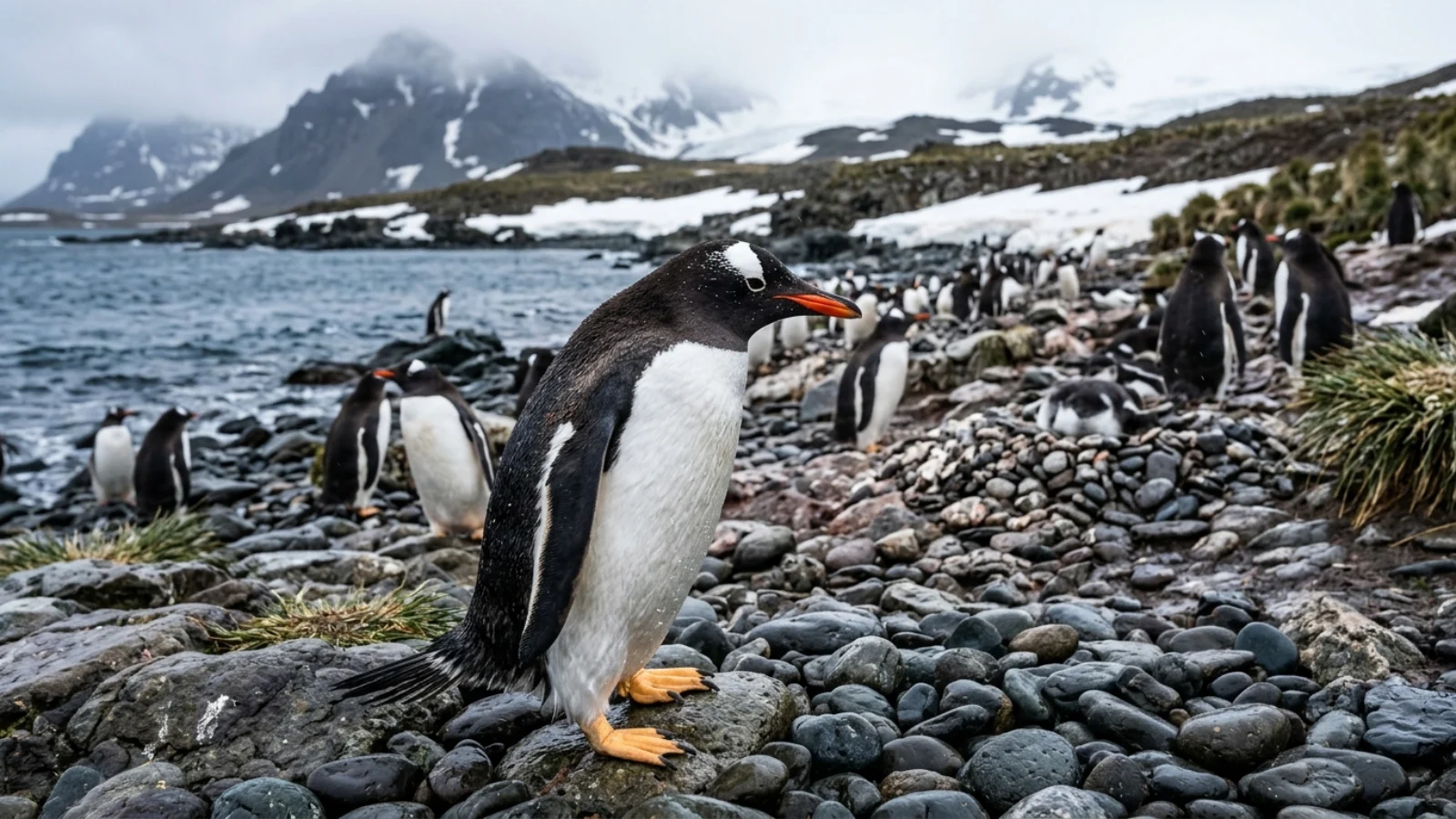
How the gentoo got its name
The origin of “gentoo” is genuinely unclear. Gentoo was an Anglo-Indian word used to distinguish Hindus from Muslims, and the English term probably came from the Portuguese gentio, meaning “pagan” or “gentile”. Some have speculated that the white patch on the bird’s head looked to sailors like a turban. Another suggestion is that it is a corruption of “Johnny penguin”, an old name for the bird, since Juanito, the Spanish for Johnny, sounds a little like gentoo. A bird of prey known as the Johnny rook is probably named after the Johnny penguin.
The scientific name is a plain error. When Johann Reinhold Forster, the naturalist who sailed around the world with Captain James Cook, described the species in 1781, he believed it lived in Papua, New Guinea. The nearest gentoos are actually more than 6,000 km to the south on Macquarie Island, and no penguins live in New Guinea at all. Some historians trace the mistake to a possibly fraudulent claim by the French naturalist Pierre Sonnerat, who in 1776 also gave a Papuan location for the king penguin without ever having visited the island.
Size and the fastest penguin
Gentoo penguins reach a length of 70 to 90 cm, making them the third-largest penguins after the emperor and king. Their weight swings widely through the year. Males peak at around 8.5 kg just before the moult and fall to about 4.9 kg just before mating; females peak at about 8.2 kg before the moult and drop to as little as 4.5 kg while guarding chicks. Birds from the northern part of the range average about 700 grams heavier and 10 cm longer than birds in the south, where southern gentoos measure about 75 to 80 cm.
The gentoo’s claim to fame is speed. It is the fastest underwater swimmer of all penguins, reaching up to 36 km/h. That record is the reason the Linux distribution Gentoo Linux, which aims to be fast and high-performance, was named after the bird.
Where gentoo penguins live
Gentoos breed on many sub-Antarctic islands. The main colonies are on the Falkland Islands, South Georgia, the South Sandwich Islands and the Kerguelen Islands, with smaller colonies on Macquarie Island, Heard Island, the Crozet Islands, the South Shetland Islands and the Antarctic Peninsula itself. They also breed on Martillo Island in the Beagle Channel and on Isla de los Estados off Argentina.
Unlike the Adelie, the gentoo prefers to stay close to home. It favours shallow coastal waters and breeds on ice-free ground, sometimes right on the shoreline and sometimes well inland; on South Georgia some colonies are about 2 km from the sea. Inland colonies often sit among tufts of grass, and because the birds trample the grass over time, these colonies shift slightly every year. In Antarctica the birds commute between their colonies and the sea along well-worn paths, often called penguin highways. For how gentoos fit into the overall pattern of penguin distribution, see where penguins live.
Stone nests and pebble courtship
Gentoos breed monogamously, and infidelity is reported to be punished by banishment from the colony. Nests are usually roughly circular piles of stones and can be quite large, about 20 cm high and 25 cm across. In a busy colony, suitable stones are scarce, and they are guarded jealously. Ownership of a stone can spark noisy arguments and physical fights between neighbours, and stones are prized by the females: a male can win a female’s favour by presenting her with a well-chosen pebble.
The female lays two eggs, each weighing about 130 grams, and the parents share incubation, changing over every day. The eggs hatch after 34 to 36 days. Developing gentoo embryos use a great deal of energy, and their oxygen consumption rises exponentially as they grow, reaching about 1,800 millilitres of oxygen a day by the time the chick hatches.
Chicks stay in the nest for about 30 days and then join other chicks in crèches. They moult into sub-adult plumage and go to sea at around 80 to 100 days old, a longer period of dependence than the Adelie’s 50 to 60 days.
What gentoo penguins eat
Gentoos live mainly on crustaceans such as krill and shrimp, with fish making up about 15% of the diet and cephalopods about 10%. They are opportunistic, though, and the mix changes with place. Around the Falklands they take roughly equal amounts of fish, including rock cods and southern blue whiting, squat lobsters, and squid such as the Patagonian longfin squid. Other recorded prey includes grey rockcod, the mackerel icefish and octopuses. The broader story of what different penguins eat is covered in what penguins eat.
Eating prey as salty as seawater creates a problem, especially for chicks, which can end up with dangerously high sodium levels. Like many seabirds, gentoos have a highly developed salt gland above each eye that pulls excess sodium from the blood and releases it as a concentrated salty solution that drips from the tip of the bill. Gentoos also store less fat than Adelie penguins. Researchers think this is because they get a better net energy return from their foraging trips than Adelies do, so they need less reserve.
Predators
At sea, gentoo penguins are hunted by leopard seals, sea lions and killer whales. On land there are no predators of full-grown, healthy adults, but skuas and giant petrels regularly kill many chicks and steal eggs, and petrels kill injured and sick adults. Kelp gulls and snowy sheathbills also take chicks and eggs. On King George Island, skuas have even been seen attacking and injuring adult gentoos, apparently in territorial disputes. Adults will confront petrels that threaten their chicks, but they cannot always prevent losses. For more on the seal predators of penguins, see which seals eat penguins.
Relatives and the four subspecies
The gentoo belongs to the brush-tailed penguins, the genus Pygoscelis, with the Adelie and the chinstrap. Mitochondrial and nuclear DNA suggest the genus split from other penguins about 38 million years ago, roughly 2 million years after the ancestors of the emperor and king penguins went their own way. Within the genus, the Adelie branched off first, about 19 million years ago, and the chinstrap and gentoo diverged from each other around 14 million years ago. That makes the chinstrap the gentoo’s closest living relative, even though the two look quite different: the chinstrap has a white face and a thin black line under the chin, while the gentoo has a dark face, a white bonnet and a bright bill.
The International Ornithological Congress currently recognises four subspecies of gentoo, each tied to a different part of the Southern Ocean. The eastern gentoo, P. p. taeniata, breeds on the Crozet, Prince Edward, Kerguelen, Heard and Macquarie islands, although the Kerguelen birds are only tentatively included and may be distinct. The northern gentoo, P. p. papua, lives in the Falklands, on Martillo Island in the Beagle Channel and on Isla de los Estados. The southern gentoo, P. p. ellsworthi, breeds on the Antarctic Peninsula and the South Orkney, South Shetland and South Sandwich Islands. The South Georgia gentoo, P. p. poncetii, was described only in 2020 and is confined to South Georgia. Northern birds are larger than southern ones, which fits the general rule that the northern populations average about 700 grams heavier and 10 cm longer.
One species or four?
The gentoo is at the centre of one of the liveliest debates in penguin taxonomy. Until about 2021, two subspecies were recognised: a larger sub-Antarctic form and a smaller Antarctic form, P. p. ellsworthi. Then a 2020 study by Tyler and colleagues argued that the gentoo is really a species complex of four similar-looking but separate species: the northern gentoo of the Falklands and southern South America, the southern gentoo of the Antarctic Peninsula and nearby islands, the eastern gentoo of the sub-Antarctic Indian and Pacific Ocean islands, and a newly described South Georgia gentoo, P. poncetii. The International Ornithological Congress adopted the four groupings in 2021, but only as subspecies of a single gentoo species, which is how the IOC list still treats them.
In April 2026 a second team, led by Julianna A. Vianna of Andrés Bello National University in Chile and Jane Younger of the University of Tasmania, with 20 other researchers, published a new genetic study in Communications Biology that also divides the gentoo into four species, but draws the lines differently. In their scheme the northern gentoo lives in the Falklands and on Martillo Island, the eastern gentoo on the Crozet, Marion and Macquarie islands, a newly described Kerguelen gentoo (P. kerguelensis) on the Kerguelen Islands, and the southern gentoo, the most numerous, along the Antarctic coast, the Antarctic Peninsula and South Georgia. The two studies therefore disagree about whether the South Georgia and Kerguelen birds are separate. As of 2026, no major taxonomic committee has adopted a split, and the authors say their proposal still needs to be assessed. If a four-way split were accepted, the number of penguin species would rise from 18 to 21. For the other disputed cases, see types of penguins.
Winners on a warming peninsula
The gentoo is one of the few penguins that appears to be benefiting from climate change, at least for now. Its population in the maritime Antarctic is increasing rapidly, and as the Antarctic Peninsula warms, gentoos are colonising places farther south that used to be inaccessible because of ice. That is the opposite of what is happening to the more ice-dependent Adelie and chinstrap penguins in the same region. The gentoo’s preference for coastal, ice-free waters and its flexible diet seem to suit the changing conditions.
The global picture is more mixed. The IUCN lists the gentoo as Least Concern, but its 2019 assessment noted that rapid declines at some important sites may be dragging the overall trend down. At Bird Island, South Georgia, for example, the gentoo population fell by about two-thirds over 25 years. Pollution, hunting, fishing and human recreational activity are also listed among continuing pressures. Population estimates vary: an older figure puts the total breeding population at more than 600,000 birds, while the current species list gives about 774,000.
Bird flu reaches the gentoos
A newer threat is highly pathogenic avian influenza. In January 2024 the H5N1 strain was confirmed in gentoo penguins in the Falkland Islands for the first time. Thirty-five penguins were found dead on 19 January, and by 30 January more than 200 gentoo chicks had died or were dying. How badly the virus will affect penguins in the long run is still being studied, but because gentoos nest in dense colonies, outbreaks can spread quickly.
Seeing gentoo penguins
Gentoos are among the most accessible penguins for visitors. Colonies in the Falkland Islands, such as those on Saunders Island and Carcass Island, are often photographed by visitors, and on South Georgia and the Antarctic Peninsula gentoos are seen at many expedition landing sites, including Petermann Island and Wiencke Island in the Palmer Archipelago. Visitors are asked to keep their distance, avoid blocking penguin highways and follow biosecurity rules, which have become more important since the arrival of bird flu.
Why is it called a gentoo penguin?
The origin is unclear. “Gentoo” was an old Anglo-Indian word for Hindus, and the white head patch may have suggested a turban; it may also come from “Johnny penguin”.
How fast can a gentoo penguin swim?
Up to about 36 km/h, the fastest of any penguin.
How big is a gentoo penguin?
70 to 90 cm long and about 4.5 to 8.5 kg, making it the third-largest penguin.
Where do gentoo penguins live?
On sub-Antarctic islands including the Falklands, South Georgia, Kerguelen, Crozet and Macquarie, and along the Antarctic Peninsula.
What do gentoo penguins eat?
Mostly krill and other crustaceans, with fish making up about 15% of the diet and squid about 10%.
Are gentoo penguins endangered?
No. They are listed as Least Concern and are increasing on the Antarctic Peninsula, though some colonies, such as Bird Island, South Georgia, have declined.
Is the gentoo penguin four species?
Studies in 2020 and 2026 proposed splitting it into four species, but taxonomic authorities still treat it as one species with several subspecies.
- Wikipedia contributors, “Gentoo penguin” (2023 snapshot via Kiwix mirror, accessed November 2026).
- MercoPress / Smithsonian Magazine, “Gentoo penguins are actually four different species” (21 May 2026), on Vianna, Younger et al. (2026), Communications Biology.
- Anadolu Agency, “Falkland Islands penguins detected with avian flu for first time” (1 February 2024).
- Wikipedia contributors, “List of penguins” (current version, accessed November 2026).
Blane Perun has been exploring Earth’s oceans and marine life for over 25 years. Founder of TheSea.Org in 1999, underwater photographer, coral aquaculture pioneer, and explorer of 80+ countries.
About Blane Perun →