Chinstrap Penguin — The Penguin With a Helmet Strap
The chinstrap penguin (Pygoscelis antarcticus) is a medium-sized Antarctic penguin, 68 to 76 cm long and 3.2 to 5.3 kg, named for the narrow black band under its white face that looks like the strap of a helmet. It breeds mainly on the Antarctic Peninsula and the islands of the Scotia Arc, including the South Shetlands, South Orkneys and South Sandwich Islands, building stone nests and laying two eggs. It feeds mostly on krill, along with small fish, shrimp and squid. A 2020 global survey counted about 3.4 million breeding pairs, and the IUCN lists it as Least Concern, but many colonies have declined sharply since the 1980s, some by half, as the climate warms and krill becomes scarcer.
Besides chinstrap, the bird has been called the ringed penguin, the bearded penguin and the stonecracker penguin, the last because of its loud, harsh call.
The penguin with the helmet strap
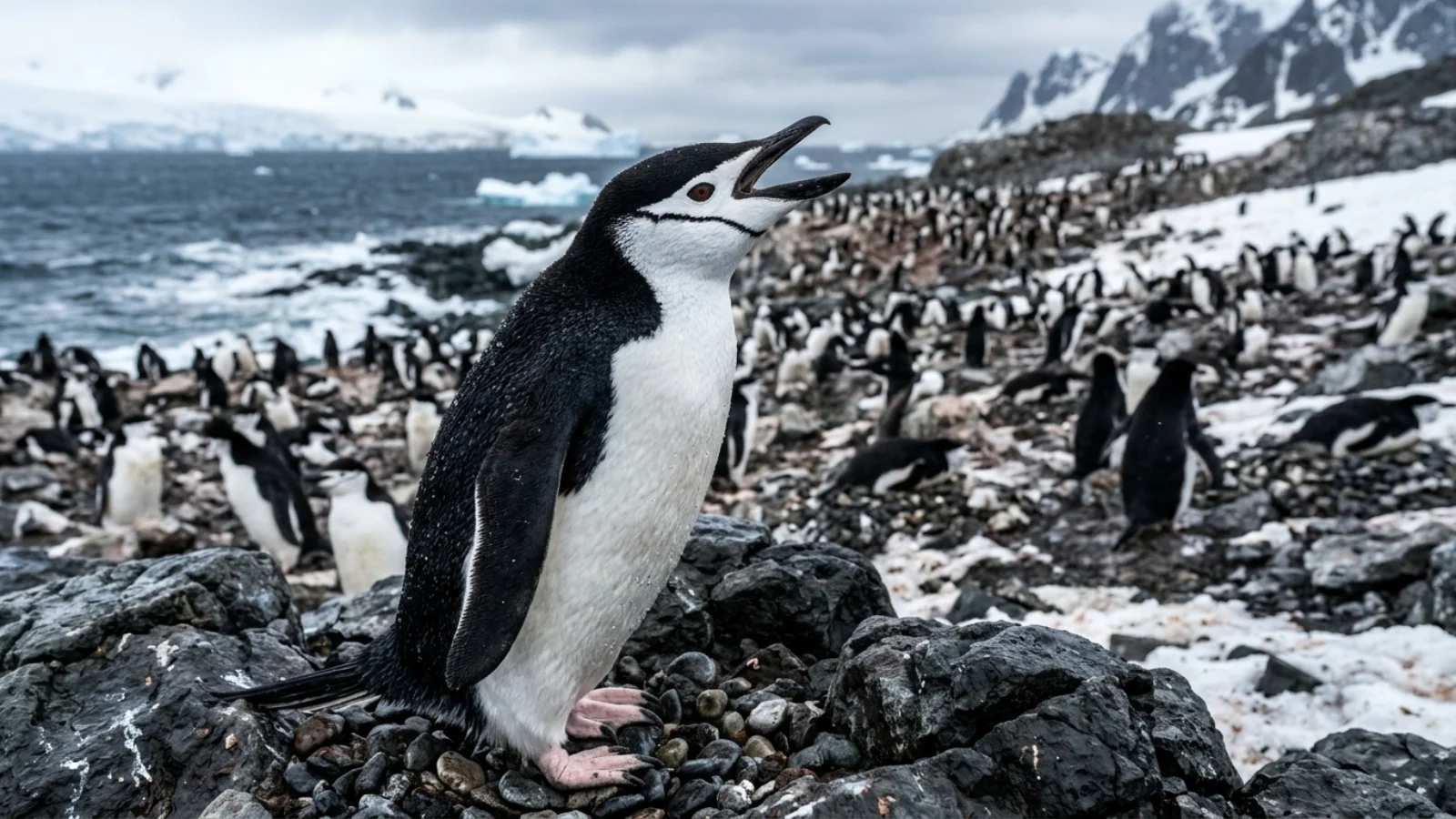
The chinstrap penguin is one of the easiest penguins to identify. Its face is white, extending behind the eyes, and a narrow black line runs from ear to ear under the chin, making it look as though it is wearing a black helmet held on by a strap. The rest of the head and the back are black, and the throat, chin and belly are white. The eyes are reddish brown, the short bill is black, and the strong legs and webbed feet are pink. Its short, stumpy legs give it a distinctive waddle.
Adults are 68 to 76 cm long and weigh 3.2 to 5.3 kg, depending on the time of year, and males are heavier and taller than females. The flippers are black with a white edge on the upper side and white underneath. Like all penguins, the chinstrap is countershaded: its black back blends with the dark sea when seen from above, and its white front blends with the bright surface when seen from below, which helps it avoid predators.
The only bird it is easily confused with is a young Adelie penguin, which has a white throat in its first year. But in the Adelie the black of the head extends below the eyes, and there is no black line under the throat. The chinstrap also has a longer bill, which lacks the feathering that covers most of the Adelie’s bill.
Names and relatives
The chinstrap was first described in 1781 by Johann Reinhold Forster, the naturalist who sailed around the world with Captain James Cook, who named it Aptenodytes antarctica, placing it in the same genus as the king and emperor penguins. In 1990 it was moved into the genus Pygoscelis, the brush-tailed penguins, alongside the Adelie and gentoo penguins. The new name was first written P. antarctica, but because that broke Latin grammar rules, the corrected form P. antarcticus is now the accepted name.
DNA evidence suggests the Pygoscelis lineage split from other penguins about 38 million years ago, about 2 million years after the ancestors of the emperor and king penguins went their own way. The Adelie branched off first, about 19 million years ago. Sources disagree on when the chinstrap and gentoo separated: one analysis puts their divergence at around 14 million years ago, while another describes both as having evolved some 5 million years ago. Either way, the gentoo is the chinstrap’s closest living relative, even though the two look quite different.
Where chinstrap penguins live
Chinstrap penguins have a circumpolar distribution. They breed in Antarctica, especially along the Antarctic Peninsula, and on the islands of the Scotia Arc: the South Shetland Islands, the South Orkney Islands, South Georgia and the South Sandwich Islands. They also breed on Bouvet Island and in the French Southern Territories, and the species is recorded as breeding in Argentina and Chile. Vagrants have turned up in New Zealand, on Saint Helena and Tristan da Cunha, and in South Africa.
A 2020 global assessment found chinstraps in 375 existing colonies. Several large colonies are in the South Sandwich Islands, where conditions appear to remain favourable for the species. Chinstrap colonies are among the biggest of any penguin: like king and macaroni colonies, they can number several hundred thousand pairs.
For how the chinstrap’s range compares with that of other penguins, see where penguins live.
Staying warm in freezing water
Chinstraps feed in some of the coldest water on Earth. Their tightly packed feathers form a waterproof coat, and thick fat deposits and an intricate network of blood vessels in the flippers and legs help them conserve heat. All penguins have a counter-current heat exchanger in their flippers, called the humeral plexus, in which branches of the main artery let warm blood heading out to the flipper heat the cold blood returning from it, so less heat is lost to the sea.
What chinstrap penguins eat
The chinstrap’s diet is built on Antarctic krill, supplemented by small fish, shrimp and squid. Like other penguins, it catches prey with its bill and swallows it whole underwater, and it has a spiny tongue and powerful jaws to grip slippery prey. Chinstraps may swim up to 80 km offshore each day to find food during the breeding season.
That dependence on krill ties the chinstrap closely to the health of the Southern Ocean. In several parts of the chinstrap’s range climate change appears to be reducing krill abundance, which likely makes breeding less successful. For more on krill, see krill, and for how the chinstrap’s diet compares with other penguins, see what penguins eat.
Three brush-tailed penguins on a changing peninsula
The Antarctic Peninsula is the one place where all three brush-tailed penguins breed side by side, and their fortunes there have moved in different directions. The gentoo population in the maritime Antarctic is rapidly increasing, and as the region’s climate changes, gentoos are colonising places farther south that used to be inaccessible. The Adelie, the most ice-dependent of the three, has gone the other way: with less sea ice, Adelie populations on the Antarctic Peninsula have dropped by about 65% over 25 years, although increases in East Antarctica have more than offset that loss for the species as a whole.
The chinstrap’s own trend in the region, as the colony counts below show, has been mostly downward. One difference from the gentoo is diet. Gentoos are opportunistic feeders whose diet changes from place to place, with fish making up about 15% and squid about 10% on average, while the chinstrap relies heavily on krill. That makes the chinstrap more exposed when krill becomes scarce.
The three species also differ in how they use the ocean. Gentoos favour shallow coastal water close to their colonies, while chinstraps may travel up to 80 km offshore each day during the breeding season, which brings them into the same feeding grounds as the krill fishing fleet.
Stone nests and two eggs
On land, chinstraps build roughly circular nests from stones. The female lays two eggs, and both parents incubate them, taking shifts of around six days while the other feeds at sea. The eggs hatch after about 37 days. The chicks have fluffy grey backs and white fronts. They stay in the nest for 20 to 30 days and then gather with other chicks in groups called creches. At about 50 to 60 days old they moult into adult feathers and go to sea.
Breeding in a crowded colony is noisy and competitive, with hostile neighbours close by and predatory birds patrolling for an unguarded egg or chick. That constant threat helps explain one of the most remarkable discoveries about the species.
Ten thousand naps a day
In 2023 a team led by Paul-Antoine Libourel of the Lyon Neuroscience Research Center in France published a study in Science showing that nesting chinstrap penguins sleep in an extraordinary way. The researchers fitted 14 chinstraps in a colony of about 2,700 breeding pairs on King George Island, in the South Shetlands, with electrodes that recorded their brain activity and data loggers on their backs.
The birds slept for about 11 hours a day in total, but almost all of it came in tiny bursts. They took more than 10,000 microsleeps a day, about 600 an hour, each lasting on average about 4 seconds. The researchers concluded that nesting penguins have to stay watchful to guard their nests from predatory skuas and hostile neighbours, so they doze in short bursts instead of sleeping deeply. Commentators in the same journal called it one of the most extreme examples of how sleep can be accumulated in small increments. They also noted that proving this way of sleeping comes at no cost to the penguins will need further work. A 2026 modelling study that used the same data reproduced the very short sleep episodes, calculating an average of about 2.8 seconds against the 3.9 seconds observed.
Predators
The chinstrap’s main predator at sea is the leopard seal, which has been estimated to reduce the chinstrap population by about 5 to 20% each year. Antarctic fur seals also occasionally kill chinstraps. On land, brown skuas, south polar skuas and southern giant petrels are the main predators, taking mostly eggs and young chicks. Adult penguins have no land predators in Antarctica, which is one reason why penguins have little fear of humans. For more on the seals that hunt penguins, see which seals eat penguins.
How many chinstrap penguins are there?
Population estimates for the chinstrap depend on what is counted. In 2018 the IUCN estimated a population of around 8 million birds. In 2020, a team led by Noah Strycker published the first comprehensive global assessment in Scientific Reports, combining satellite images, drone surveys and ground counts. It put the population at 3.42 million breeding pairs (with a 95% confidence range of 2.98 to 4.00 million) in 375 colonies.
The same assessment found that 23 previously known colonies were absent or extirpated. It also identified five new colonies and 21 more that had probably been missed by earlier surveys. For colonies that could be compared with counts from the 1980s, 45% had probably or certainly declined and 18% had probably or certainly increased. For 35% of colonies, historical data were too limited to tell.
Shrinking colonies
The declines are concentrated in some of the best-known parts of the chinstrap’s range. A 2019 expedition to breeding grounds on Elephant Island, in the South Shetlands, found that the population there had fallen by about 50% in just under 50 years. Other potential threats include volcanic events and fishing for krill by people.
The krill fishery is a growing concern because chinstraps and the fishing fleet target the same food in the same areas. A 2025 study in the Proceedings of the National Academy of Sciences used more than 30,000 hours of acoustic data from three krill fishing vessels to map encounters between the fishery and diving krill predators. It found that measures introduced to protect breeding penguins on the Antarctic Peninsula had simply shifted penguin-vessel encounters to the South Orkney Islands, where the affected colonies are not currently monitored.
Despite the declines, the IUCN lists the chinstrap as Least Concern, as it has in every assessment since 2004, because of its very large range and population. The IUCN notes that the population is believed to be decreasing overall but is not severely fragmented, and that at many sites it is stable or increasing.
Penguins that fertilise the ocean
Chinstraps matter to the ecosystem as well as feeding on it. A 2023 study in Nature Communications used drone images, a census powered by deep learning and chemical analysis of guano to estimate how much iron chinstraps return to the Southern Ocean, where iron limits the growth of phytoplankton. With an average of 3 mg of iron per gram of guano, the authors estimated that the chinstrap population recycles about 521 tonnes of iron a year. They calculated that this is about half what the birds recycled four decades ago, because the population has declined by more than 50% since then.
Chinstrap guano also carries pollution. A 2026 study of guano from the South Shetland Islands detected microplastics in 91% of samples from chinstrap and gentoo penguins, with chinstrap guano containing the most. Polypropylene and polyethylene were the most common plastics.
Roy and Silo
Chinstraps became unexpectedly famous in 2004, when two male chinstrap penguins at the Central Park Zoo in New York City, named Roy and Silo, formed a pair bond and took turns trying to hatch a rock. A keeper eventually gave them a fertile egg, and the pair hatched and raised the chick. Their story inspired the children’s book And Tango Makes Three.
Seeing chinstrap penguins
Chinstraps are among the penguins seen by visitors to the Antarctic Peninsula and the South Shetland Islands. Visitors are expected to keep their distance from nesting birds and not to block the paths penguins use between their nests and the sea, rules that matter more in a species that already loses so much sleep guarding its nest.
Why is it called a chinstrap penguin?
Because of the thin black line that runs under its white face from ear to ear, like the strap of a helmet.
Where do chinstrap penguins live?
Mainly on the Antarctic Peninsula and the South Shetland, South Orkney, South Georgia and South Sandwich islands, and also on Bouvet Island.
How big is a chinstrap penguin?
About 68 to 76 cm long and 3.2 to 5.3 kg, with males larger than females.
What do chinstrap penguins eat?
Mostly Antarctic krill, plus small fish, shrimp and squid.
How many chinstrap penguins are there?
A 2020 global survey counted about 3.42 million breeding pairs in 375 colonies; the IUCN estimated about 8 million birds in 2018.
Are chinstrap penguins endangered?
No. They are listed as Least Concern, but many colonies have declined since the 1980s, some by about half.
Do chinstrap penguins really sleep in 4-second naps?
Yes. A 2023 study found nesting chinstraps take more than 10,000 microsleeps a day, about 4 seconds each, adding up to about 11 hours of sleep.
What eats chinstrap penguins?
Leopard seals at sea, and occasionally Antarctic fur seals; skuas and giant petrels take eggs and chicks on land.
- Wikipedia contributors, “Chinstrap penguin”, “Adelie penguin”, “Gentoo penguin” and “Penguin” (2023 snapshot via Kiwix mirror, accessed November 2026).
- Strycker, N., et al. (2020). A global population assessment of the Chinstrap penguin. Scientific Reports. doi:10.1038/s41598-020-76479-3.
- Live Science, “Weird chinstrap penguins sleep over 10,000 times a day for just 4 seconds at a time” (1 December 2023), on Libourel et al., Science.
- Phillips, K. L., et al. (2026). A dynamic model of microsleep and vigilance tradeoffs in nesting chinstrap penguins. Nature and Science of Sleep. doi:10.2147/nss.s612907.
- Belyaev, O., et al. (2023). The contribution of penguin guano to the Southern Ocean iron pool. Nature Communications. doi:10.1038/s41467-023-37132-5.
- Bahlburg, D., et al. (2025). Mapping encounters between Antarctic krill fishing vessels and air-breathing krill predators. PNAS. doi:10.1073/pnas.2417203122.
- Sparaventi, E., et al. (2026). From carbon to plastics: partitioning of biogeochemical and anthropogenic particles in penguin guano. Environmental Science & Technology. doi:10.1021/acs.est.5c17586.
Blane Perun has been exploring Earth’s oceans and marine life for over 25 years. Founder of TheSea.Org in 1999, underwater photographer, coral aquaculture pioneer, and explorer of 80+ countries.
About Blane Perun →