Rockhopper Penguin — The Crested Penguin That Hops
Rockhopper penguins are the smallest of the yellow-crested penguins, about 45 to 58 cm long and 2 to 3.4 kg, named for the way they hop over boulders and across cracks instead of sliding or climbing. They have red eyes, an orange bill and straight yellow eyebrows that end in long golden plumes. Most lists now recognise two species: the southern rockhopper (Eudyptes chrysocome) of the Falklands, southern South America and sub-Antarctic islands of the Indian and Pacific Oceans, and the northern rockhopper (Eudyptes moseleyi), more than 99% of which breed on Tristan da Cunha and Gough Island. The southern rockhopper is listed as Vulnerable after losing about a third of its population in 30 years; the northern rockhopper is Endangered after a decline of about 90% since the 1950s.
Most penguins get past obstacles by sliding on their bellies or by clambering awkwardly with the help of their flippers. Rockhoppers jump, feet together, over boulders and across cracks. Other crested penguins hop too, but the rockhoppers lived on islands visited by explorers and whalers, so it was in this species that sailors first noticed the habit.
The smallest crested penguin
The rockhopper penguins belong to the crested penguins, the genus Eudyptes, the largest group of penguins, which also includes the macaroni, royal, Fiordland, Snares and erect-crested penguins. Rockhoppers are the smallest of these yellow-crested, black-and-white penguins, reaching a length of 45 to 58 cm and typically weighing 2 to 3.4 kg, although there are records of exceptionally large birds of 4.5 kg. They are also the most widespread crested penguins, ranging from the Antarctic front to the South Atlantic and Indian Oceans.
The genus name Eudyptes was introduced by the French ornithologist Louis Jean Pierre Vieillot in 1816 and combines the Ancient Greek eu, “fine”, with dyptes, “diver”. The southern rockhopper’s species name, chrysocome, comes from the Greek khrusokomos, “golden-haired”, after its yellow plumes.
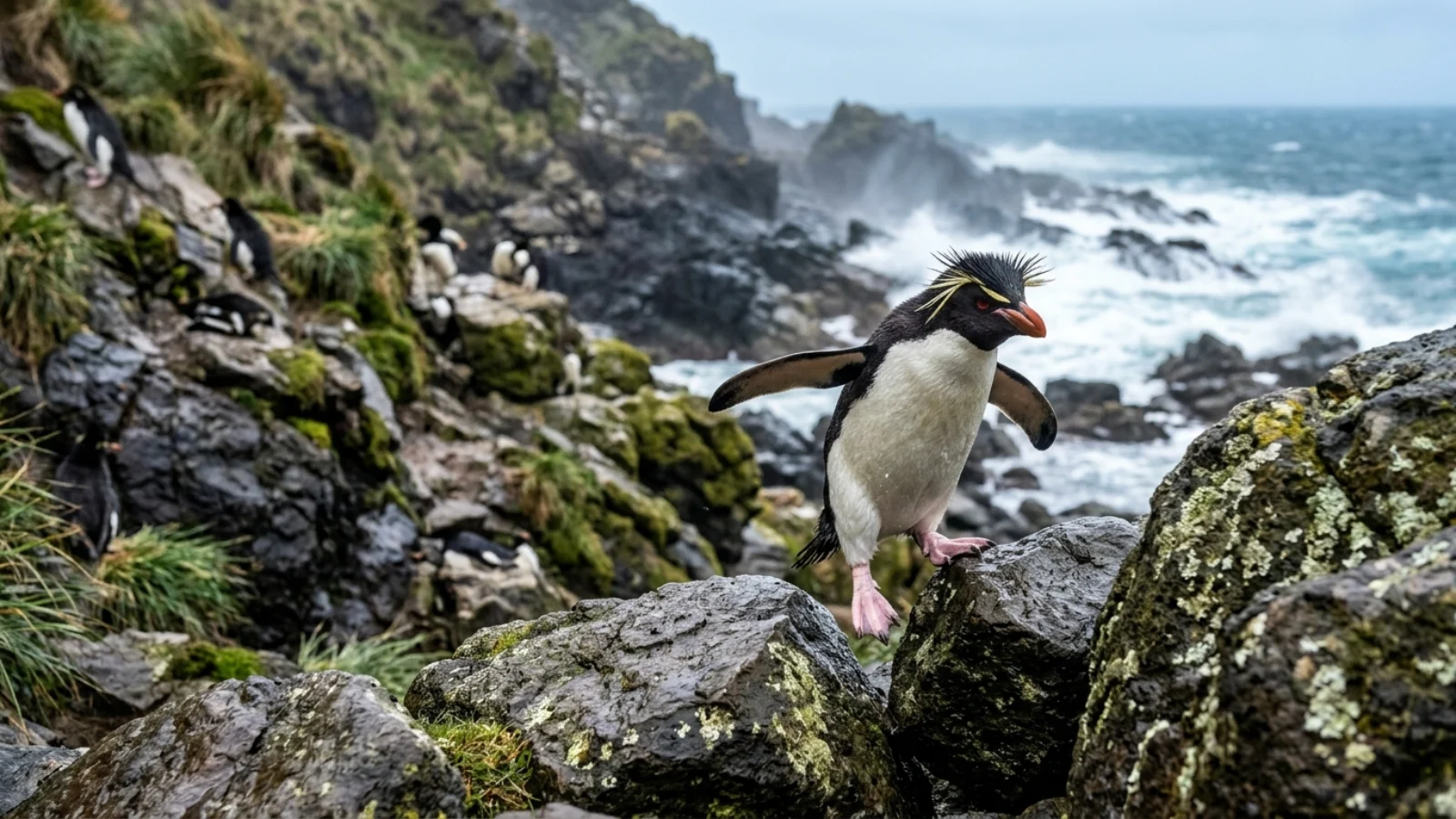
Red eyes and golden plumes
Rockhoppers have slate-grey to black upperparts, a white belly, pink webbed feet and an orange bill. Their most striking features are on the head: a bright red eye and a straight, bright yellow eyebrow stripe that ends in long yellowish plumes projecting sideways behind the eye, along with spiky black feathers on the crown. Chicks lack the crest and plumes, which develop with age, and their bills start out black and turn orange as they get older.
Males and females look alike. They cannot be reliably told apart by eye, so researchers sometimes sex rockhoppers by DNA from a single feather.
Telling a rockhopper from its relatives comes down to the head. The macaroni and royal penguins have a crest that rises from the middle of the forehead, while the rockhopper has a separate thin yellow stripe above each eye that flares into a spray of plumes. Among the rockhoppers themselves, the northern bird is the largest, and the three forms differ in the length of their crest tassels.
How rockhoppers got their name
The rockhopper’s name describes how it moves. Its breeding colonies are on rugged, rocky coasts where belly-sliding is not practical, so it hops, jumping with both feet together over boulders and across gaps. Penguins in general jump with both feet together when they want to move quickly or cross steep or rocky terrain, but rockhoppers have made it their trademark.
The habit is not unique. At least the other crested penguins of the genus Eudyptes hop around rocks too. The difference is history: most of the rockhopper’s relatives breed on remote islands in the New Zealand region, whereas rockhoppers live in places that explorers and whalers visited from the early modern era. The islands around southern South America were popular stopovers for whalers and other seafarers from at least the early 18th century, so it was here that the behaviour was first noticed and named.
One species, two or three?
The rockhopper is a textbook example of how difficult penguin taxonomy can be. Traditionally, all rockhoppers were treated as a single species, Eudyptes chrysocome. In 1992 it was divided into three subspecies, separated by where they breed: the western or southern rockhopper (E. c. chrysocome) around the southern tip of South America, the eastern rockhopper (E. c. filholi) on sub-Antarctic islands of the Indian and western Pacific Oceans, and the northern rockhopper (E. c. moseleyi) in the temperate South Atlantic and Indian Oceans. They differ in the length of the crest tassels, the size and colour of the fleshy margin at the gape, the pattern on the underside of the flipper and the size of the eyebrow stripe, and the northern bird is larger.
Research published in 2006 found morphological, vocal and genetic differences between the northern birds and the rest, and since then most lists have treated the rockhoppers as two species, the northern rockhopper (E. moseleyi) and the southern rockhopper (E. chrysocome), with the eastern rockhopper as a subspecies of the southern. Not all experts agree. Some consider all three forms distinct species, while others still treat them as one. The mitochondrial DNA shows the eastern and southern forms are not as different from each other as the northern is from both.
An unusual line of evidence comes from lice. Penguins are parasitised by 15 species of chewing lice in two genera, and each rockhopper form has its own. The louse Austrogoniodes keleri occurs only on southern rockhoppers, A. concii only on northern rockhoppers among the rockhopper forms, and A. hamiltoni only on eastern rockhoppers. Because chewing lice can only pass between birds through close contact, their separate distributions suggest the three forms rarely mix. The two species also use different songs and head ornaments when courting.
How the rockhoppers split
The split between the rockhoppers seems to have been driven by ocean temperature rather than distance. During the early Pleistocene, the Southern Ocean was cold, and rockhopper populations in the Atlantic and Indian Oceans lived in the same water mass and remained undifferentiated. During the mid-Pleistocene climate transition, the oceanic fronts shifted south, and islands such as Tristan da Cunha, Gough, Amsterdam and St Paul became surrounded by warmer subtropical water. The northern rockhoppers living there became isolated from the southern birds by the Subtropical Front.
Later, repeated advances and retreats of the Patagonian ice caps during the late Pleistocene may have created a barrier between the South Pacific and South Atlantic populations, separating the eastern rockhoppers from the southern ones. Despite the separation, some birds still wander: a northern rockhopper found on the Kerguelen Islands had DNA suggesting it had come from Gough Island, 6,000 km away. For how the rockhoppers fit into the full list of penguins, see types of penguins.
Where rockhopper penguins live
The southern rockhopper group has a global population of roughly 1 million pairs. About two-thirds belong to the southern (western) form, which breeds on the Falkland Islands and on islands off Patagonia, most significantly Isla de los Estados, the Ildefonso Islands, the Diego Ramirez Islands and Isla Noir, with colonies around Cape Horn. The Falklands hold one of the largest populations. The eastern rockhopper breeds on the Prince Edward Islands, Crozet, Kerguelen, Heard, Macquarie, Campbell, Auckland and Antipodes Islands. Eastern rockhoppers are mostly found breeding on Campbell Island, in New Zealand, but their numbers there have declined immensely.
The northern rockhopper is much more localised. More than 99% breed on Tristan da Cunha and Gough Island in the South Atlantic, with smaller colonies on Amsterdam Island and St Paul Island in the French Southern and Antarctic Lands. Very occasionally, a northern rockhopper turns up in Australia: one was seen at Robe, South Australia, in 2006, and in July 2023 a very underweight bird was found on Goolwa beach.
Rockhoppers usually live on rocky shorelines, with colonies anywhere from sea level to cliff tops and sometimes inland. They often nest among tall tussock grasses. Outside the breeding season, they roam the waters offshore from their colonies. For how rockhopper ranges compare with those of other penguins, see where penguins live.
Diving for krill, squid and fish
Rockhoppers eat krill and other small crustaceans, such as shrimp, crabs, lobsters or crayfish, along with squid and lanternfish. They generally take more krill than fish, and their diet shifts with the seasons and during migration. On foraging trips they can stay at sea for several days, diving to depths of up to about 100 m.
They use two kinds of dives. Pelagic dives are short, relatively shallow and frequent. Benthic dives go much deeper, near the seafloor, last longer and include more time at the bottom, and they are more strongly linked to full stomachs. The longest dive a rockhopper can make without switching to anaerobic metabolism is about 110 seconds, but dives can last 180 to 190 seconds. One study recorded rockhoppers travelling up to 157 km from their colonies, swimming at about 6.9 to 8.1 km/h.
Rockhoppers usually leave and return to their colonies in groups. Breeding females typically forage during the day on trips of 11 to 12 hours, leaving around dawn and returning at dusk, with occasional shallower night dives. While they are brooding chicks, they keep a fixed schedule, returning at roughly the same time each day. If a female is low on energy because she has been fasting while feeding a chick, she may make several short trips instead of one long one.
In the northern rockhopper, adults have been found to feed their chicks prey from a lower level of the food chain than they eat themselves, eating zooplankton during the breeding season and switching to fish afterwards. For how rockhopper diets compare with those of other penguins, see what penguins eat.
Two eggs, one chick
Rockhoppers breed in colonies, often returning to the same nest year after year. The breeding season of the southern birds starts in September, and northern rockhoppers begin breeding about two months earlier than southern ones.
Like other crested penguins, rockhoppers lay two eggs a few days apart, and the second egg is usually larger than the first. Usually only one egg is incubated successfully, and the pair normally raises just one chick. Incubation lasts about 35 days, and the chicks are then brooded for about 26 days.
Rockhoppers can live a long time. A rockhopper named Rocky at Bergen Aquarium in Norway lived to 29 years and 4 months, dying in October 2003. That stands as the age record for rockhopper penguins and possibly for any penguin known.
Predators
Adult rockhoppers have no land-based predators. At sea they are eaten by leopard seals, fur seals, killer whales and blue sharks. On land their eggs and chicks are taken by giant petrels, skuas, sheathbills and gulls. On Tristan da Cunha and Gough, subantarctic fur seals have been listed both as predators and as competitors of northern rockhoppers. For the seals that hunt penguins, see which seals eat penguins.
Rockhoppers occasionally interbreed with other crested penguins. Three rockhopper-macaroni hybrids were recorded on Heard and Marion Islands by an Australian National Antarctic Research Expedition in 1987-88.
A sharp decline in the south
Although the rockhopper was long among the world’s most numerous penguins, the southern rockhopper is estimated to have declined by about 30% over the last three decades of the 20th century, and it is listed as Vulnerable by the IUCN. The causes are not fully understood. Commercial overfishing, oil exploitation and pollution have all been suggested, and research has linked population declines to changes in sea surface temperature, a direct sign of the effect of climate change on the birds’ food supply. Because the species is so sensitive to changes in the food web, there may be little opportunity for quick recovery.
The northern rockhopper’s 90% crash
The northern rockhopper’s situation is worse. A study published in 2009 found that its world population had declined by 90% since the 1950s, and it is listed as Endangered. The fall at Gough Island has been described as equivalent to losing 100 birds every day since the 1950s, and declines at the Atlantic sites have been measured at 2.7% a year.
Current estimates put the population at between 100,000 and 499,999 breeding pairs on Gough Island, 18,000 to 27,000 pairs on Inaccessible Island and 3,200 to 4,500 pairs on Tristan da Cunha. In the Indian Ocean, there were 25,500 pairs on Amsterdam Island and 9,000 on St Paul Island in 1993, but there has been no information on trends there since the 1990s.
The suggested causes include climate change and changing marine ecosystems, which reduce nutrients and productivity and affect the birds’ body condition and breeding success; overfishing of squid and octopus; disturbance and pollution from tourism and fishing; egg harvesting; and predation and competition from subantarctic fur seals. Birds have also been found with infections of goose barnacles.
Oil on Nightingale Island
On 16 March 2011, the Maltese-registered freighter MS Oliva ran aground on Nightingale Island in the Tristan da Cunha group, spilling heavy crude into the sea. The crew was rescued, but the ship broke up and the oil slick surrounded the island, threatening its rockhopper penguins. Thousands of penguins were oiled. Because Nightingale has no fresh water, the oiled birds had to be transported to Tristan da Cunha for cleaning. Oil spills have affected many penguin species since shipping switched from sail and coal to liquid fuels in the early 20th century.
The mice of Gough Island
On Gough Island, house mice introduced by people have become a serious threat to seabirds. They eat northern rockhopper eggs and attack the young. In 2021, the RSPB, on behalf of Tristan da Cunha and with partners, attempted to eradicate the mice from Gough. The operation reduced the mouse population substantially but did not succeed: surviving mice were found in December 2021, and the RSPB expected the population to recover quickly. By the 2022-23 season, camera traps had recorded a mouse attacking a seabird chick on the island again.
Rockhoppers in zoos and on screen
Rockhoppers are probably the most familiar crested penguins to the public. Their colonies around South America attract many tourists, and almost all crested penguins depicted in films, books and other media are ultimately based on the southern rockhopper. In Happy Feet and Happy Feet Two, the character Lovelace, voiced by Robin Williams, is a rockhopper. In Europe, Drusillas Park in East Sussex holds the studbook for rockhopper penguins on behalf of the European Association of Zoos and Aquaria, coordinating breeding programmes between zoos.
Why are they called rockhopper penguins?
Because they hop, jumping with both feet together over boulders and across cracks, rather than sliding on their bellies or clambering.
How big are rockhopper penguins?
About 45 to 58 cm long and usually 2 to 3.4 kg, making them the smallest yellow-crested penguins.
Where do rockhopper penguins live?
Southern rockhoppers breed on the Falklands, islands off southern Chile and Argentina and sub-Antarctic islands of the Indian and Pacific Oceans; northern rockhoppers mainly on Tristan da Cunha and Gough Island.
What is the difference between northern and southern rockhopper penguins?
The northern rockhopper is larger and lives in warmer subtropical waters; it differs genetically and in its calls and is usually treated as a separate species.
What do rockhopper penguins eat?
Mainly krill and other small crustaceans, plus squid and lanternfish.
Are rockhopper penguins endangered?
The northern rockhopper is Endangered after a 90% decline since the 1950s; the southern rockhopper is Vulnerable.
How long do rockhopper penguins live?
The record is 29 years and 4 months, for a rockhopper named Rocky at Bergen Aquarium in Norway.
How many eggs do rockhopper penguins lay?
Two, a few days apart, with the second usually larger, but normally only one chick is raised.
- Wikipedia contributors, “Rockhopper penguin”, “Southern rockhopper penguin” and “Northern rockhopper penguin” (2023 snapshot via Kiwix mirror, accessed November 2026).
- Wikipedia contributors, “Penguin” (2023 snapshot via Kiwix mirror) and “List of penguins” (current version, accessed November 2026).
- RSPB / Gough Island Restoration Programme, “MacGillivray’s Prions: good 2022-23 breeding success but evidence of mouse predation recorded” (24 April 2023).
Blane Perun has been exploring Earth’s oceans and marine life for over 25 years. Founder of TheSea.Org in 1999, underwater photographer, coral aquaculture pioneer, and explorer of 80+ countries.
About Blane Perun →