King Penguin — The Emperor’s Smaller, Brighter Cousin
The king penguin (Aptenodytes patagonicus) is the second-largest living penguin, standing about 70 to 100 cm tall and weighing 9.3 to 18 kg, and it breeds in huge colonies on ice-free sub-Antarctic islands such as South Georgia, Crozet, Kerguelen, Marion and Macquarie. It is the emperor penguin’s only living relative in the genus Aptenodytes, but it is about 25% shorter and a third lighter, with a solid bright-orange ear patch, a longer, straighter bill and a sleeker build. Unlike the emperor, which breeds on Antarctic sea ice in winter, the king takes 14 to 16 months to raise a single chick, so pairs usually manage to breed only twice every three years. It feeds mainly on lanternfish, diving routinely to 100 to 300 metres. The IUCN lists it as Least Concern, but warming seas threaten to push its feeding grounds out of reach.
The two great penguins are easy to confuse in photographs, but they rarely meet in the wild. Emperors breed on sea ice around Antarctica; kings breed on beaches and plains of sub-Antarctic islands farther north. If you see one standing on grass or a pebble beach, it is almost certainly a king.
The second-largest penguin
The king penguin is the second-largest species of penguin, after its close relative the emperor penguin. It stands about 70 to 100 cm tall and weighs from 9.3 to 18 kg. Males and females look the same but can be told apart by their calls, and males are slightly larger: on Marion Island, adult males averaged 12.4 kg and females 11.1 kg, and another study there found adults feeding chicks averaged 13.1 kg.
The species entered science through an illustration. In 1778 the English illustrator John Frederick Miller published a hand-coloured engraving of it in his Icones animalium et plantarum, coining the name Aptenodytes patagonica and giving its home simply as the Antarctic Ocean. In 1911 Gregory Mathews narrowed the type locality to South Georgia. Sources disagree on subspecies. Some recognise two, A. p. patagonicus in the South Atlantic and A. p. halli in the southern Indian Ocean and at Macquarie Island, while others treat the species as monotypic, with no subspecies at all.
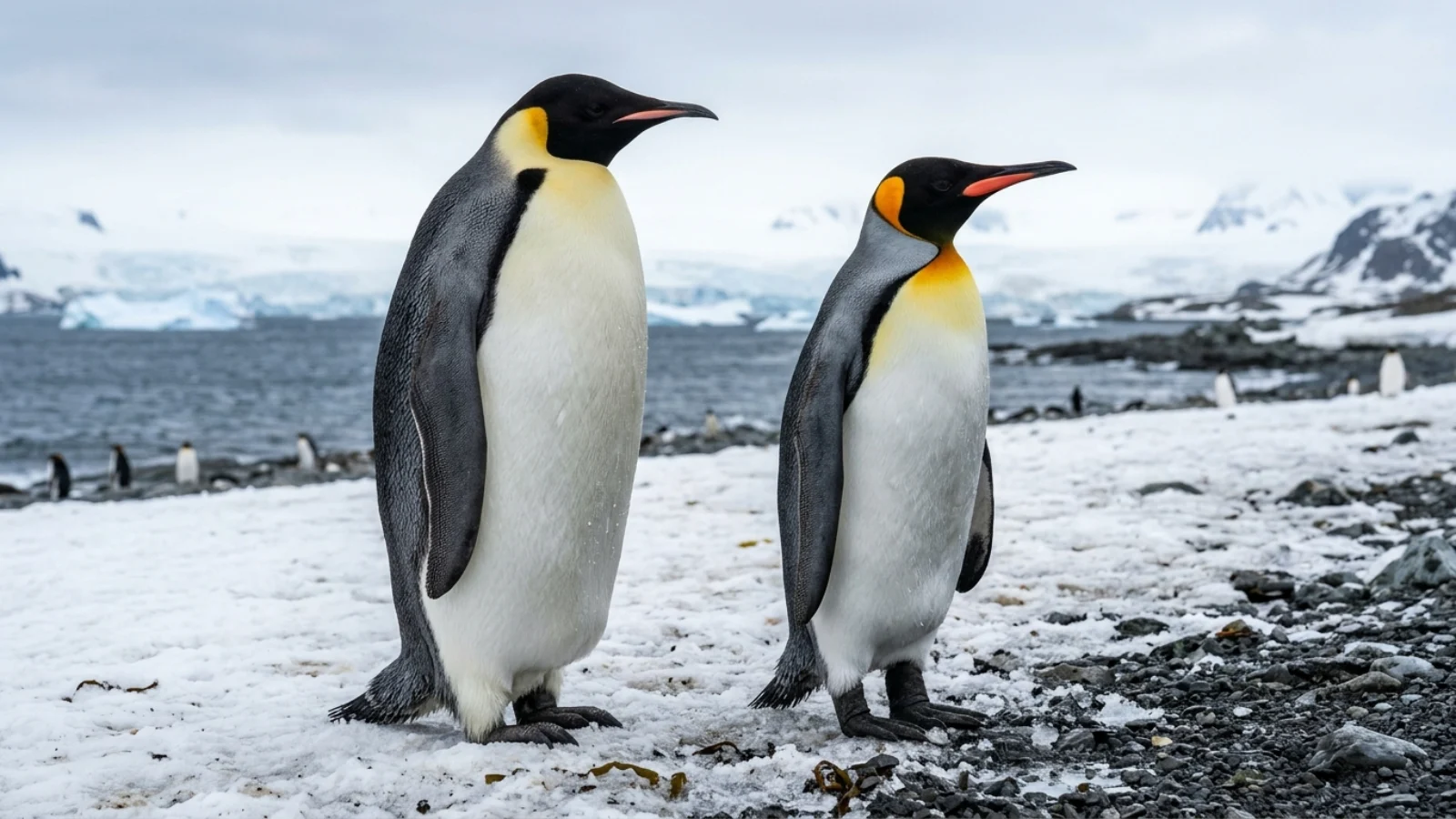
King penguin vs emperor penguin
The king and the emperor are the only two living members of the genus Aptenodytes, the great penguins, and at first glance they look remarkably alike. Both have a dark head with a broad, bright patch on each side of it, a yellow-orange wash on the upper chest, a white belly and a coloured stripe along the lower bill. Both incubate a single egg on their feet under a fold of belly skin, and both raise chicks in large crèches. But the differences are clear once you know them.
| Feature | King penguin | Emperor penguin |
|---|---|---|
| Height | 70–100 cm | Standing about 81–97 cm; often quoted as 110–120 cm long |
| Weight | 9.3–18 kg | 22–45 kg |
| Ear patch | Solid, bright orange | Yellow fading to white |
| Upper chest | More orange | More yellow |
| Bill stripe | Orange | Pink to lilac |
| Build | Sleeker, with a longer, straighter bill and larger flippers | Bulkier, with a shorter bill |
| Back | Grizzled, sooty grey | Black |
| Chick | Thick, woolly dark brown down | Silver-grey down with a black-and-white face mask |
| Breeds | Ice-free sub-Antarctic islands | Antarctic sea ice |
| Breeding season | Begins in spring; cycle takes 14–16 months | Antarctic winter; cycle within one year |
| IUCN status | Least Concern | Endangered (April 2026) |
Size is the most obvious difference. The king penguin is roughly 25% shorter and weighs around a third less than the emperor. Colour is the next giveaway. The king’s ear patch is a solid, vivid orange, while the emperor’s is yellow and fades into white towards the neck, and the king’s chest is more orange and less yellow. The colourful stripe along the lower mandible tends to be orange in the king and pink in the emperor. The king also has a longer, straighter bill, larger flippers and a noticeably sleeker body, and its back is a grizzled, sooty grey rather than black.
The chicks could hardly be more different. A king penguin chick is covered in thick, dark brown down that makes it look like a large, shaggy brown bird with a long bill. An emperor chick is mostly grey, with a striking black-and-white face. The biggest difference of all is where and when they breed. The emperor breeds on sea ice attached to the Antarctic coast during the polar winter; the king breeds on ice-free beaches and plains of sub-Antarctic islands and spreads its breeding cycle over more than a year. The two species therefore rarely meet, except for the occasional vagrant at sea.
Where king penguins live
King penguins breed on sub-Antarctic islands between about 45 and 55 degrees south, at the northern edge of the Antarctic region, as well as in the Argentine part of Tierra del Fuego and in the Falkland Islands. The largest breeding populations have been reported on the Crozet Islands, with around 455,000 pairs, followed by the Kerguelen Islands with 240,000 to 280,000 pairs, the Prince Edward Islands with about 228,000 pairs, South Georgia with more than 100,000 pairs and Macquarie Island with around 70,000 pairs.
Some colonies are enormous. The colony at Salisbury Plain on South Georgia holds more than 100,000 breeding pairs, and the colony at St Andrews Bay more than 100,000 birds. Because the breeding cycle lasts more than a year, these colonies are occupied all year round by adults and chicks at different stages. King penguins do not build nests, but they are strongly territorial and keep a pecking distance from their neighbours, and studies show that birds’ positions in a colony are very stable and evenly spaced.
Away from the colonies, the non-breeding range is poorly known, because vagrants have turned up on the Antarctic Peninsula and in South Africa, Australia and New Zealand. In August 1936 a nature protection society even released king penguins in northern Norway, at Gjesvær in Finnmark and Røst in the Lofoten Islands. Birds were seen there several times in the 1940s, but none were officially recorded after 1949. For more on how the different species divide up the Southern Hemisphere, see where penguins live.
Deep divers
King penguins are among the deepest-diving birds. The American zoologist Gerry Kooyman, who pioneered the use of automatic dive recorders on emperor penguins in 1971, recorded a king penguin dive of 235 metres in 1982. The deepest king penguin dive now on record is 343 metres, in the Falkland Islands region, and the longest recorded time underwater is 552 seconds, a little over nine minutes, at the Crozet Islands.
Their normal pattern is more modest. In daylight, king penguins typically dive to 100 to 300 metres and stay down for around five minutes; at night they dive less than 30 metres, following prey that rises towards the surface in the dark. Around 88% of their dives in one study were flat-bottomed, U- or W-shaped dives in which the bird descends to a particular depth and hunts there for about half the dive before returning to the surface. The remaining dives were V-shaped spikes, the pattern most other penguins use.
Average swimming speed is about 6.5 to 10 km/h. On shallow dives under 60 metres, kings average about 2 km/h going down and coming up, and on deep dives of more than 150 metres about 5 km/h. Like many penguins they porpoise, leaping out of the water to breathe without losing speed. On land they alternate between walking with a wobbling gait and tobogganing on their bellies, pushing with their feet and flippers.
What king penguins eat
King penguins eat small fish, squid and krill, but fish dominate: they make up roughly 80% of the diet for most of the year, falling to about 30% in the winter months of July and August, when squid become more important. The main fish are lanternfish, small, deep-living fish named for their light organs, especially Electrona carlsbergi, Krefftichthys anderssoni and Protomyctophum tenisoni. Kings also take the slender escolar and other fish, and squid including hooked squids, the sevenstar flying squid and young Gonatus antarcticus.
Much of this food is found along the Antarctic Polar Front, also called the Antarctic Convergence, where cold Antarctic water meets warmer sub-Antarctic water. This frontal zone supplies around 80% of the king penguin’s food, and birds from some colonies currently travel 300 to 500 km over more than a week to reach it. Observations at the Crozet Islands found most kings within about 30 km of the colony, and Kooyman estimated foraging trips of about 28 km from average swimming speeds, so trip lengths vary a great deal with colony and season. The broader topic of penguin diets is covered in what penguins eat.
A breeding cycle longer than a year
The king penguin’s breeding is unlike that of any other penguin except perhaps the emperor in its demands, and unlike any other penguin in its length. It takes around 14 to 16 months from laying the egg to the chick going to sea. Because of that, a pair cannot fit a breeding attempt into every year. Pairs try to breed annually but usually succeed only one year in two, or two years in three in a three-year pattern recorded on South Georgia.
Birds can breed at three years old, but very few do, only about 5% at the Crozet Islands; the average age at first breeding is around five to six. Kings are serially monogamous: each bird has one mate per season and stays faithful during it, but fewer than 30% of pairs stay together from one year to the next, probably because the long and staggered breeding cycle makes it hard for partners to be ready at the same time.
The cycle starts between September and November, when birds return to their colonies to moult. They then go back to sea for about three weeks before coming ashore to breed in November or December. Birds that failed the previous season usually arrive earlier. The female lays one pear-shaped white egg weighing about 300 grams and measuring about 10 by 7 cm. It is soft at first and later hardens and turns pale green.
Both parents incubate the egg for about 55 days, in shifts of 6 to 18 days, balancing it on their feet under a brood pouch of belly skin, exactly as emperors do. Hatching can take two to three days. The chick is born with only a thin covering of down and depends completely on its parents for food and warmth. For the next 30 to 40 days, the guard phase, the chick sits on a parent’s feet in the brood pouch while the parents swap duties every three to seven days, one guarding and the other feeding at sea. Parents feed the chick by regurgitating partly digested fish.
Woolly chicks through the winter
Once the chick is big enough to keep itself warm and fend off most predators, it joins a crèche of other chicks watched over by a few adults while most parents go to sea. King penguin chicks are notably curious and will wander far from the crèche. By April the chicks are almost fully grown, covered in their thick brown down. Then they face the sub-Antarctic winter, when parents visit rarely and the chicks lose weight, fasting for long periods. They regain it in spring, from September, and finally fledge in late spring or early summer, more than a year after the egg was laid.
This strategy is the opposite of most smaller penguins, which raise their chicks through a single summer when food is plentiful. The king’s timing means the chick grows through the leanest season, but it is ready to go to sea on its own in summer, when food is abundant and young birds have the best chance of surviving.
Predators
Giant petrels are the king penguin’s main predators on land. They take many chicks of all sizes and some eggs, occasionally kill adults, probably mostly sick or injured ones, and scavenge birds that die of other causes. Skuas take eggs and smaller chicks, especially where they nest close to penguin colonies, and snowy sheathbills and kelp gulls scavenge dead chicks and unattended eggs. At sea, leopard seals take adults and fledglings, and orcas also hunt king penguins. On Marion Island, male Antarctic fur seals, especially young ones, have been seen chasing, killing and eating king penguins on the beach. For more on penguin-eating seals, see which seals eat penguins.
Burned for fuel: the whaling era
The king penguin nearly vanished from parts of its range a century ago. By the early 1920s, whalers had almost wiped out the populations on South Georgia and the Falkland Islands. These islands had no trees, so the whalers burned millions of oily, blubber-rich penguins as fuel for the fires used to boil down whale blubber. They also rendered penguins for oil for lamps, heating and cooking, and ate the birds and their eggs. Today’s large colonies on South Georgia are the product of a long recovery.
Population and conservation
Population estimates differ between sources. One widely cited figure puts the total at about 2.23 million pairs and increasing; the current species list based on IUCN data gives about 1.08 to 1.23 million breeding pairs. Part of the difference may reflect real changes. One of the largest known colonies, on Île aux Cochons in the Crozet Islands, is thought to have collapsed from about half a million breeding pairs in the 1980s to about 60,000 pairs in 2017, possibly because changes linked to climate pushed the birds’ food farther from the island.
The IUCN lists the king penguin as Least Concern: the overall population is large, and adult survival has stayed high since the 1970s. Colonies are well protected. All those on the Crozet and Kerguelen Islands lie within the French Southern and Antarctic Lands national nature reserve, South Georgia’s penguins are in a special protected area under the island’s environmental management plan, and in the Falklands all wildlife is protected by law. Access and tourism at breeding sites are restricted to limit disturbance and disease.
Climate change and fishing
The king penguin’s long-term outlook depends on the Antarctic Polar Front. As the ocean warms, this front is expected to shift south, away from breeding islands such as the Crozets and the Falklands. If carbon emissions continue to rise at their current rate, kings may need to travel an extra 200 km or so to reach their feeding areas, and parents feeding a chick cannot easily afford longer trips. One modelling study projected that about 70% of king penguins could abruptly lose their breeding grounds or have to move in less than 80 years, and that nearly half the population may lose suitable breeding sites by 2100.
Commercial fishing is another concern. More than 200,000 tonnes of lanternfish had been taken around South Georgia by the early 1990s, and any revival of that fishery near key foraging areas would compete directly with the penguins. Conservation groups have urged the Commission for the Conservation of Antarctic Marine Living Resources, which manages fishing in the Southern Ocean, to create large fully protected marine reserves and to manage the krill fishery cautiously.
King penguins and people
King penguins are among the most familiar penguins in zoos and aquariums, and the species is widely kept in Europe, North America, Asia and Australia. The most famous individual is Sir Nils Olav, a king penguin at Edinburgh Zoo who holds the rank of major general and is the mascot and colonel-in-chief of the Royal Norwegian Guard. King penguins also appeared in the film Batman Returns. In the wild, the great colonies of South Georgia, such as Salisbury Plain, St Andrews Bay and Gold Harbour, are among the most spectacular wildlife sights on Earth and are visited by expedition cruises each summer. For every other species, see types of penguins.
What is the difference between a king penguin and an emperor penguin?
The king is about 25% shorter and a third lighter, with a solid orange ear patch, a longer bill and brown chicks; it breeds on sub-Antarctic islands rather than Antarctic sea ice.
How big is a king penguin?
About 70 to 100 cm tall, weighing 9.3 to 18 kg.
Where do king penguins live?
On sub-Antarctic islands between about 45 and 55 degrees south, including South Georgia, Crozet, Kerguelen, Prince Edward, Macquarie and the Falklands.
What do king penguins eat?
Mainly lanternfish, which make up about 80% of the diet for most of the year, plus squid.
How deep can king penguins dive?
Usually 100 to 300 metres; the record is 343 metres.
Why are king penguin chicks brown?
Their thick brown down keeps them warm through the sub-Antarctic winter, when they fast for long periods before fledging the next summer.
Are king penguins endangered?
No, they are listed as Least Concern, but climate change may push their feeding grounds farther from their breeding islands.
- Wikipedia contributors, “King penguin” (2023 snapshot via Kiwix mirror, accessed November 2026).
- Wikipedia contributors, “List of penguins” (current version, accessed November 2026).
- IUCN, “Emperor penguin and Antarctic fur seal now Endangered due to climate change” (press release, 9 April 2026).
Blane Perun has been exploring Earth’s oceans and marine life for over 25 years. Founder of TheSea.Org in 1999, underwater photographer, coral aquaculture pioneer, and explorer of 80+ countries.
About Blane Perun →