Adelie Penguin — The Classic Penguin of the Antarctic Coast
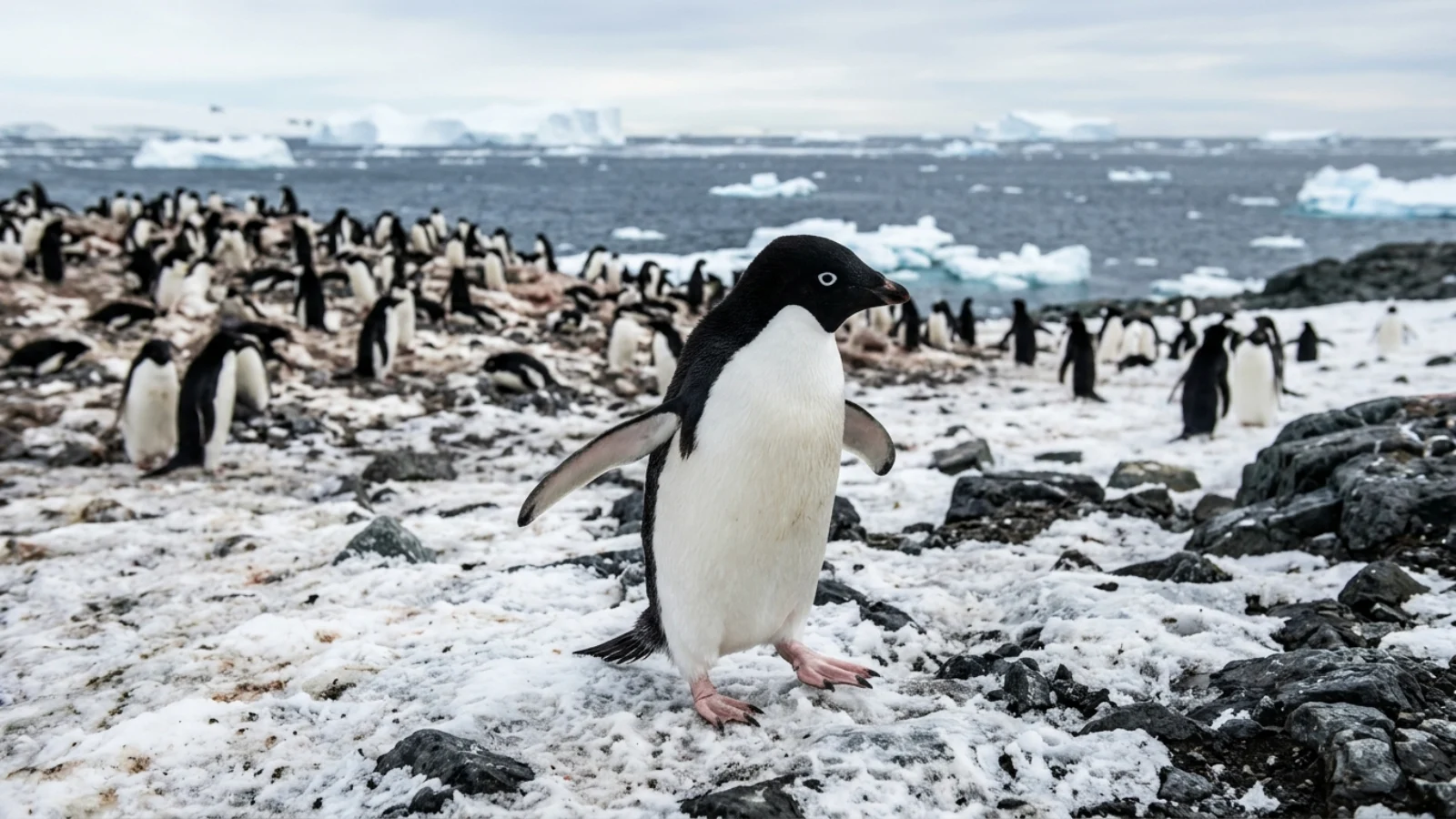
The Adelie penguin (Pygoscelis adeliae) is a medium-sized penguin found only in Antarctica and its nearby islands, breeding on bare, rocky ground all the way around the continent’s coast. Adults are about 70 to 73 cm long and weigh 3.8 to 8.2 kg, with a black head, white belly and a conspicuous white ring around each eye. With the emperor penguin, it lives farther south than any other penguin. It eats mainly krill and small fish, builds its nest out of stones, and in winter follows the edge of the sea ice to stay in daylight, with Ross Sea birds travelling about 13,000 km a year. The IUCN lists it as Least Concern, with more than 10 million mature birds in 2020, but its numbers have fallen sharply on the Antarctic Peninsula and at some East Antarctic colonies.
The Adelie penguin takes its name from Adélie Land, a stretch of the Antarctic coast that the French explorer Jules Dumont d’Urville named after his wife, Adèle. Two surgeon-naturalists on his expedition, Jacques Bernard Hombron and Honoré Jacquinot, described the bird for science in 1841.
A truly Antarctic penguin
The Adelie penguin is the bird most people picture when they think of a penguin in Antarctica: compact, black and white, with a round head and a habit of marching in long lines across the ice. It is common along the entire coast of the Antarctic continent, which is the only region where it is found, and it is the most widespread penguin species in Antarctica. Along with the emperor penguin it is the most southerly distributed of all penguins, and it is one of only four penguin species that nest on the continent itself.
The species was first collected by crew members on Jules Dumont d’Urville’s French expedition to Antarctica in the late 1830s and early 1840s. Hombron and Jacquinot, the two ship’s surgeons who doubled as naturalists, described it in 1841 under the name Catarrhactes adeliæ, using specimens from the coast d’Urville had named Terre Adélie. Over the following decades the bird was moved between several genera, including Eudyptes and the now-defunct Dasyrhamphus, and was even accidentally described a second time as Pygoscelis brevirostris, before settling in Pygoscelis.
The brush-tailed penguins
The Adelie is one of three species in the genus Pygoscelis, alongside the chinstrap and gentoo penguins. The genus name combines the Ancient Greek words for “rump” and “leg”, and members of the genus are often called brush-tailed penguins after their long, stiff tail feathers. The birds regularly lean on their tails for support, and the stiff feathers sweep the ground as they walk.
DNA evidence suggests the Pygoscelis lineage split from other penguins some 38 million years ago, about 2 million years after the ancestors of the emperor and king penguins. The Adelie itself is the oldest branch of the three: it diverged about 19 million years ago from the ancestor of the chinstrap and gentoo, which separated from each other some 5 million years later. The species has no recognised subspecies, but it does contain two distinct genetic lineages, one found mainly in the Ross Sea and the other widespread around the rest of Antarctica.
Size and identification
The Adelie is a mid-sized penguin, measuring 70 to 73 cm in length and weighing between 3.8 and 8.2 kg. The sexes look the same, although females have shorter wings and bills and weigh significantly less.
The adult’s plumage is simple and striking. The head, throat and upperparts are black and the underparts snowy white. Its most distinctive feature is a conspicuous white ring around the black iris, which gives the bird a permanently startled look. The bill is mostly covered in black feathers, leaving only the tip exposed. The upper side of each flipper is black with a white trailing edge; the underside is white with a narrow black leading edge and a small black tip. The legs and feet, largely unfeathered, are pinkish.
Chicks hatch fully covered in down, usually silvery-grey and darker on the head, though some are much darker overall. Within about 10 days they moult into a second coat of dark, smoky-grey down. After a third moult, 7 to 9 weeks after hatching, the young look much like adults, but they are smaller, have a bluish tinge to the upperparts and have white rather than black chins and throats. They lack the full white eye-ring until they are at least a year old.
Adults are hard to confuse with any other penguin, but white-throated immatures can resemble the chinstrap. The difference is that in the young Adelie the black of the face extends below the eye, and there is no thin black line under the throat. The chinstrap also has a longer bill, without the feathering that covers most of the Adelie’s.
Where Adelie penguins live
Adelie breeding colonies are scattered around the coasts of Antarctica and on a number of nearby islands, including the South Orkneys, South Shetlands, South Sandwich Islands, Balleny Islands, Scott Island and South Georgia. The species is much less common north of 60 degrees south, although vagrants have reached Australia, New Zealand and southern South America. For the bigger picture of how penguins are spread around the Southern Hemisphere, see where penguins live.
Despite living among ice, the Adelie will not nest on it. During the breeding season it needs bare, rocky ground, and it prefers spots where the wind or the angle of the sun keeps snow from drifting over the nests. Early in the season, colonies may be as much as 100 km from open water, because the sea is still frozen; that distance shrinks as the summer goes on and the pack ice breaks up. Once breeding is over, adults usually move onto ice floes or ice shelves to moult, though some stay on land.
In winter, Adelie penguins stay in the pack-ice zone, but most move north to where there is at least some daylight for part of the day, roughly north of 73 degrees south. Some stay close to their colonies, while others travel hundreds or thousands of kilometres. As long as there are cracks and openings in the ice, they can survive hundreds of kilometres from open water, and birds are known to forage in winter in areas with up to 80% ice cover.
Following the sun
The Adelie’s winter travels are among the longest of any penguin. Birds from the Ross Sea region migrate an average of about 13,000 km a year as they move from their breeding colonies to their winter foraging grounds and back. South of the Antarctic Circle the sun does not rise in midwinter, but the sea ice spreads hundreds of kilometres out from the coast and into lower latitudes. By staying near the outer edge of the ice, the penguins remain where there is daylight. As the ice retreats in spring, they ride its edge back south until they are on the coast again for the summer. The longest recorded journeys have reached about 17,600 km.
At some research colonies, scientists have tracked these movements and the birds’ condition with automated weighbridges: each penguin is identified and weighed every time it walks across the bridge on the way to or from the sea, giving a running record of how well birds are feeding without anyone having to handle them.
Diet
During the chick-rearing season, Adelie penguins feed mainly on Antarctic krill and ice krill, along with Antarctic silverfish, lanternfish, amphipods, other krill species, glacial squid and other cephalopods. The exact mix depends on location. They usually swim at around 8 km/h and can leap about 3 metres out of the water to land on rocks or ice.
A remarkable piece of evidence shows how their diet has changed over time. Fragments of eggshell accumulate in Adelie colonies, and the chemical signature of eggshells covering the last 38,000 years reveals a sudden switch from a fish-based diet to a krill-based one that began around 200 years ago. The most likely explanation is the hunting of Antarctic fur seals from the late 18th century and of baleen whales in the early 20th century. With fewer of these krill-eaters competing for food, a surplus of krill became available, and the penguins took advantage of an easier food source.
Jellyfish also turn out to be on the menu. Studies found Adelie penguins actively seeking out jellyfish in the genera Chrysaora and Cyanea, overturning the earlier assumption that jellyfish were only swallowed by accident. Similar preferences have been found in little, yellow-eyed and Magellanic penguins. For more on the foods different penguins rely on, see what penguins eat.
Salt, water and life on a frozen desert
Adelie penguins live in what is effectively a desert: almost all the water around them is frozen or salty, and their food is salty too. They cope in several ways. They tend to eat krill whose internal salt concentrations are at the lower end of the possible range. Adults feeding chicks also adjust the chemistry of the food while it is still in their stomachs, removing some of the sodium and potassium before regurgitating it, which protects chicks from too much salt.
Like other seabirds, Adelies have nasal salt glands that excrete a highly concentrated sodium chloride solution, easing the load on their kidneys, and they can concentrate the fluids they excrete through the cloaca far more than most birds. Those wastes have an ecological role. Thousands of birds in a colony deposit concentrated salts and nitrogen on the ground, moving nutrients from the sea to the land and making the soil habitable for bacteria in an otherwise barren landscape.
Stone nests and breeding
Adelie penguins breed from October to February. Adults return to their colonies in late October or November, after spending the winter away from the continent, and build rough nests from piles of stones. Good stones are in short supply in a busy colony, and they are a valuable commodity.
The female lays two eggs, which both parents incubate for 32 to 34 days, taking turns in shifts that typically last about 12 days. While one parent feeds at sea, the other stays on the nest and does not eat at all; it does not even leave to defecate, but instead squirts its droppings away from the nest. They are still trading shifts in December, the warmest month of the Antarctic year, when coastal temperatures hover only a little below freezing.
Chicks stay in the nest for about 22 days before joining crèches, groups of chicks that huddle together for warmth and protection while both parents go to sea to find enough food. The chicks moult into juvenile plumage and go to sea when they are 50 to 60 days old, and in March adults and young return to the sea.
Penguins in explorers’ journals
Adelie penguins were the penguins that the explorers of the early 20th century saw most, and they left vivid descriptions. Apsley Cherry-Garrard, a survivor of Robert Falcon Scott’s British Antarctic Expedition of 1910, wrote in The Worst Journey in the World that the birds were “extraordinarily like children, these little people of the Antarctic world, either like children or like old men, full of their own importance”. He admired them for fighting “against bigger odds than any other bird”.
George Murray Levick, a Royal Navy surgeon on the same expedition, watched them at Cape Adare, the site of the largest Adelie colony in the world. He described crowds of penguins at the ice edge pushing one bird into the water first and then following once it proved safe. Levick also recorded unusual sexual behaviour among young, inexperienced birds; his notes were judged too indecent to publish at the time and were only rediscovered and published in 2012, when scientists described them as accurate observations deserving publication.
Scott himself found the birds’ curiosity a nuisance, recording how penguins would approach the expedition’s sled dogs to investigate, with fatal results. That boldness is part of the species’ character. Adelies are known for confronting much larger animals, and in footage filmed for the 2018 BBC documentary Spy in the Snow, an Adelie charged a southern giant petrel that was menacing a group of emperor penguin chicks and placed itself between the predator and the chicks until it retreated.
Predators
At sea, leopard seals regularly prey on adult Adelie penguins, and orcas and giant petrels occasionally kill adults. On land, south polar skuas in particular, along with giant petrels, kill many chicks and eat eggs, and kelp gulls and snowy sheathbills also take eggs and chicks. Colonies gather in large numbers partly for safety, and when colonies shrink, the remaining birds lose some of that protection. For more on the seal predators, see which seals eat penguins.
How many Adelie penguins are there?
The Adelie is one of the best-counted penguins, partly because its colonies can be spotted from space. In 2014 researchers carried out a comprehensive global census using high-resolution satellite images, looking for the reddish-brown guano stains that colonies leave on snow-free ground, and backing these up with recent field counts. They found an estimated 3.79 million breeding pairs in 251 colonies, including more than 40 that had never been surveyed before, a 53% increase on a census carried out 20 years earlier. In 2018 a previously unknown “supercolony” of around 1.5 million birds was discovered in the Danger Islands, where BirdLife International has recorded 751,527 pairs in at least five colonies. On the basis of a very large population, estimated at more than 10 million mature birds in 2020, and an unfragmented range, the IUCN lists the Adelie penguin as Least Concern.
A tale of two regions
The global total hides very different local stories, which is why the Adelie is often described as a bellwether of climate change. On the Antarctic Peninsula, one of the fastest-warming parts of the planet, Adelie colonies have declined since the early 1980s, with one estimate putting the fall at 65% over 25 years as sea ice has shrunk. The Adelie lives on sea ice but needs ice-free land to breed, and it depends on ice-associated krill, so changes in either hurt it.
In East Antarctica, on the other hand, most colonies have grown, more than offsetting the Peninsula losses. But even there the picture is not uniform. A study by Louise Emmerson and Colin Southwell, published in Global Change Biology in 2022, found that Adelie numbers around Mawson Station had fallen by 43% in a decade, a loss of about 154,000 breeding birds, while colonies elsewhere in East Antarctica were stable or growing. The trigger there was the opposite of the Peninsula problem: about five years of unusually extensive summer sea ice in the mid-2000s blocked the birds’ access to their feeding grounds, and almost no chicks survived. Frequent poor breeding seasons and lower survival of young birds then compounded the decline. The lesson is that Adelie penguins need the right amount of sea ice, not simply more or less of it.
Seeing Adelie penguins
Most visitors see Adelie penguins on expedition cruises to the Antarctic Peninsula, the South Shetland Islands and, less often, the Ross Sea. Hope Bay at the northern tip of the Peninsula is among the places where they are regularly photographed. Visitor rules require keeping a respectful distance and giving way to penguins on their paths between colony and sea. To compare the Adelie with its two closest relatives, see the chinstrap penguin and gentoo penguin, and for every species see types of penguins.
How big is an Adelie penguin?
About 70 to 73 cm long, weighing 3.8 to 8.2 kg; females are lighter than males.
Where do Adelie penguins live?
Only in Antarctica and nearby islands, breeding on bare rock all around the continent’s coast and wintering in the pack ice.
What do Adelie penguins eat?
Mainly Antarctic krill and ice krill, plus small fish such as Antarctic silverfish and lanternfish, squid, amphipods and jellyfish.
How did the Adelie penguin get its name?
From Adélie Land, which the French explorer Jules Dumont d’Urville named after his wife, Adèle.
Are Adelie penguins endangered?
No. The IUCN lists them as Least Concern, with over 10 million mature birds, though some regional populations have fallen sharply.
How do you tell an Adelie from a chinstrap penguin?
Adults have an all-black head with a white eye-ring; chinstraps have a white face with a thin black line under the chin.
How far do Adelie penguins migrate?
Ross Sea birds travel about 13,000 km a year on average, and up to about 17,600 km.
- Wikipedia contributors, “Adélie penguin” (2023 snapshot via Kiwix mirror, accessed November 2026).
- Emmerson, L. and Southwell, C. (2022). Adélie penguin decline at Mawson, East Antarctica. Global Change Biology, as reported by Polar Journal (19 October 2022).
- Emslie, S. D. and Patterson, W. P. (2007). Abrupt recent shift in δ13C and δ15N values in Adélie penguin eggshell in Antarctica. PNAS 104(28): 11666–69.
- Russell, D. G. D., Sladen, W. J. L. and Ainley, D. G. (2012). Dr. George Murray Levick (1876–1956): unpublished notes on the sexual habits of the Adélie penguin. Polar Record 48(4).
- Wikipedia contributors, “List of penguins” (current version, accessed November 2026).
Blane Perun has been exploring Earth’s oceans and marine life for over 25 years. Founder of TheSea.Org in 1999, underwater photographer, coral aquaculture pioneer, and explorer of 80+ countries.
About Blane Perun →