African Penguin — Boulders Beach and a Species in Crisis
The African penguin (Spheniscus demersus) is a small banded penguin found only on the coasts and islands of South Africa and Namibia, and in October 2024 it became the first penguin species to be listed as Critically Endangered by the IUCN. Adults stand about 60 to 70 cm tall and weigh 2.2 to 3.5 kg, with a black facial mask, pink skin above the eyes and a single black band across the chest. They feed on sardines and anchovies close to shore and nest in burrows. Once numbering in the millions, the population fell to fewer than 10,000 breeding pairs, mostly because of food shortages, with egg collecting, guano removal and oil spills adding to the damage. In March 2025 a South African court ordered 10-year closures of sardine and anchovy fishing around six of its main colonies.
The African penguin is also known as the Cape penguin, the South African penguin, the black-footed penguin and the jackass penguin, the last for its loud, donkey-like braying call, although some related South American penguins make a similar sound.
The only penguin that breeds in Africa
The African penguin is the only penguin species that breeds in Africa, and its presence gave its name to the Penguin Islands. It lives on the south-western coast of the continent, nesting in colonies on about two dozen islands between Namibia and Algoa Bay, near Port Elizabeth (Gqeberha) in South Africa’s Eastern Cape, plus a handful of mainland sites. It is one of four banded penguins in the genus Spheniscus, alongside the Humboldt, Magellanic and Galapagos penguins, all of which share the same basic shape, colouring and behaviour.
The species was one of the first penguins known to European science. In 1747 the English naturalist George Edwards illustrated and described it as “The Black-Footed Penguins” in his A Natural History of Uncommon Birds, working from two preserved specimens brought to London, probably from near the Cape of Good Hope. When Carl Linnaeus updated his Systema Naturae in 1758, he placed the bird in the same genus as the wandering albatross, naming it Diomedea demersa. It was later moved to Spheniscus, the genus created by the French zoologist Mathurin Jacques Brisson in 1760. Spheniscus comes from the Greek for “wedge”, after the bird’s thin, wedge-shaped flippers, and demersus is Latin for “plunging”.
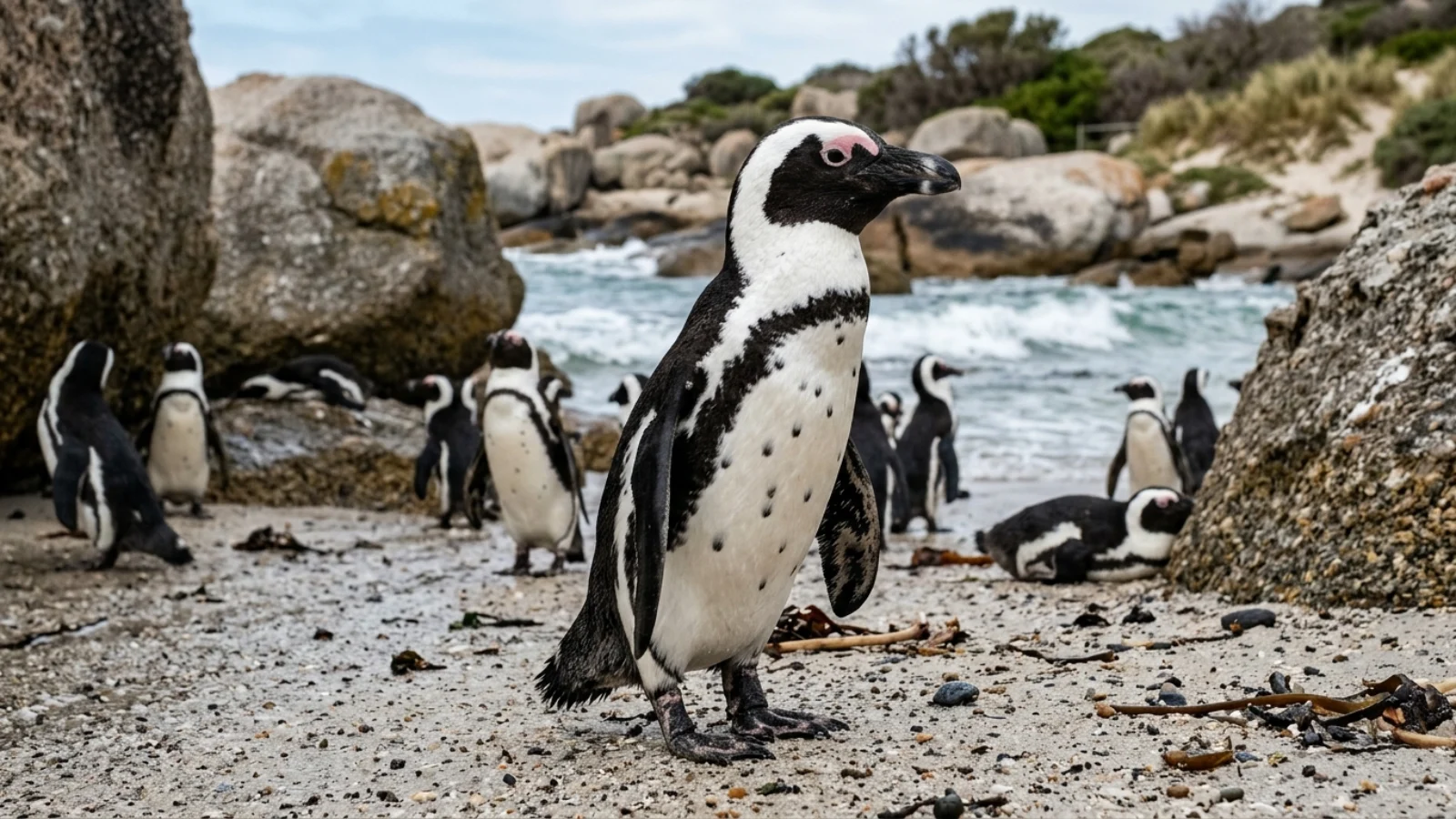
How to recognise an African penguin
African penguins grow to about 60 to 70 cm tall and weigh between 2.2 and 3.5 kg. Males are slightly larger than females and have longer bills. The black back and white belly are a form of countershading: from below, the white underside is hard for predators to see against the bright surface, and from above, the black back blends with the dark water.
The face is distinctive. It has a black facial mask, and above each eye is a patch of bare pink skin. These patches help the bird keep cool: as the temperature rises, more blood flows to them, and they turn a deeper pink as heat is shed. Across the chest runs a thick black band shaped like an upside-down horseshoe, and the white belly is scattered with black spots. The pattern of spots is unique to each bird, much like a human fingerprint.
The African penguin can be confused with the Magellanic penguin of South America, which has a similar pattern. The easiest difference is the number of bars: the Magellanic has two black bands across the throat and chest, while the African has one. Juveniles look quite different from adults, with dark upperparts ranging from greyish-blue to brown and pale underparts that lack both the spots and the chest band.
Boulders Beach and the mainland colonies
Most African penguins breed on offshore islands, where they are safe from land predators. In the 1980s, however, penguins established two new colonies on the mainland near Cape Town: one at Boulders Beach near Simon’s Town and the other at Stony Point in Betty’s Bay. Mainland colonies probably became possible only in recent times, as numbers of large predators fell, although leopards have attacked the Betty’s Bay colony. The only other mainland colony is in Namibia, and when it formed is not known.
Boulders Beach has become one of the best-known places in the world to see penguins. The colony sits among granite boulders and sheltered coves on the edge of a suburban town, and the penguins can be approached to within about a metre, which makes it a major tourist attraction. For many people it is the easiest chance anywhere to see a wild penguin without an expedition cruise. To see how the African penguin’s range compares with other species, see where penguins live.
What African penguins eat
African penguins forage in the open sea, usually within about 20 km of the shore. Their main prey are small, oily schooling fish: sardines (including the blue pilchard), anchovies, Cape horse mackerel and red-eye round herring, along with squid and small crustaceans such as krill and shrimp. A penguin may eat up to about 540 grams of food a day, and more than 1 kg when it is raising large chicks.
Dives are relatively short and shallow. On average they reach about 25 metres and last 69 seconds, although a maximum depth of 130 metres and a longest dive of 275 seconds have been recorded.
The balance of the diet has been shifting. As sardine stocks near the colonies declined, the penguins switched partly to anchovies. Anchovies can keep them going, but they are lower in fat and protein, and the amount of sardine available remains one of the strongest predictors of how well the penguins breed and whether their numbers rise or fall. When food is scarce, parents do not sacrifice their own condition to feed their chicks, which means broods are more often lost in bad years. The wider picture of penguin diets is covered in what penguins eat.
Burrows of guano
The African penguin is monogamous, breeds in colonies, and pairs return to the same site year after year. Its breeding season is long, peaking from March to May in South Africa and from November to December in Namibia. The clutch is two eggs, each three to four times the size of a chicken’s egg, and both parents share incubation for about 40 days.
Traditionally, the eggs were laid in burrows dug into thick layers of guano, the accumulated droppings of seabirds. Guano burrows are ideal: they keep eggs and chicks at a steady temperature and out of the sun. But guano was removed from the islands for use as fertiliser, leaving the penguins nowhere to dig. Today many birds have to nest in sand burrows, under rocks or bushes, or in the open, where eggs and chicks overheat and are more exposed to predators. Adults will abandon eggs that become overheated, and abandoned eggs do not survive. Conservation groups now provide artificial nest boxes in many colonies to replace the lost burrows.
At least one parent guards the chicks for about a month, after which the chicks join a crèche and both adults spend most of the day at sea. Parents tend to feed their chicks at dawn and dusk. Chicks fledge at 60 to 130 days old, depending on how much food is available, and then go to sea alone for one to nearly two years before returning to their home colony to moult into adult plumage. Adults moult once a year, fasting for about three weeks and losing about half their body weight, because without waterproof feathers they cannot go to sea to feed.
Research at Bird Island in Algoa Bay found that in 2015, a good year for food, more male than female chicks were produced, and male chicks grew faster and fledged heavier. Combined with higher death rates among adult females, this may be skewing the adult population towards males, which could mean conservation should focus particularly on helping females.
Predators
In the wild, African penguins typically live about 10 to 25 years, and up to 30 in captivity. At sea, their main predators are sharks and Cape fur seals. On land, kelp gulls, Cape genets, mongooses, caracals and domestic cats and dogs take eggs, chicks and sometimes adults, and losses are higher where birds are forced to nest in the open. At some colonies, such as Dyer Island, Cape fur seals are thought to put heavy pressure on the penguins, and trials have found that removing individual “problem” seals can help, though it takes a lot of management effort. For more on how seals prey on penguins, see which seals eat penguins.
From millions to a few thousand pairs
The scale of the African penguin’s decline is hard to overstate. There were roughly 4 million African penguins at the beginning of the 19th century. About 1.5 million were estimated in 1910, and only around 10% of those remained by the end of the 20th century. Over the long term, populations have declined by about 95% since pre-industrial times.
The fall continued into the 21st century. The total population was around 150,000 to 180,000 birds in 2000, about 55,000 in 2010, and by 2019 the breeding population across South Africa and Namibia had fallen to a historic low of about 20,850 pairs. Individual colonies collapsed: Dyer Island dropped from about 46,000 birds in the early 1970s to about 3,000 in 2008. According to figures cited in 2025 by BirdLife South Africa and SANCCOB, breeding pairs fell from 15,187 in 2018 to an estimated 8,750 at the end of 2023, a drop of about 42% in five years, and scientists have warned that the species could be extinct in the wild by 2035.
Different sources give different headline numbers depending on whether they count birds or breeding pairs and which year they use, but every series points the same way. On 28 October 2024 the IUCN moved the African penguin from Endangered to Critically Endangered, making it the first of the world’s penguin species to reach that category, after its breeding population fell below 10,000 pairs. In the United States it had already been listed as endangered under the Endangered Species Act in 2010.
Why the African penguin is disappearing
Food shortages: the main driver
The single biggest cause of the recent decline is lack of food. Commercial purse-seine fisheries target sardines and anchovies, the same fish the penguins depend on and environmental changes in the ocean have affected those stocks too. The penguins have been forced to travel farther and switch to less nutritious prey.
A study by the University of Exeter and South Africa’s Department of Forestry, Fisheries and the Environment, reported in December 2025 with Richard Sherley among its authors, estimated that about 62,000 breeding African penguins starved to death at two major colonies near Cape Town, including Dassen and Robben islands, between 2004 and 2011, when sardine stocks fell below 25% of their peak abundance. Some colonies lost about 95% of their birds in eight years, and the global population fell by nearly 80% over 30 years. Earlier experiments had already shown that closing fishing around colonies such as Robben Island for even three years markedly improved breeding success.
Historical egg collecting and guano removal
For much of the 20th century, African penguin eggs were collected and sold as a delicacy. They were taken from Dassen Island and sold in nearby towns in the 1950s; 12,000 eggs were collected in 1953 alone, and some French chefs placed annual orders in the late 1950s. In the mid-1960s eggs were still being sold by the dozen, and collecting continued until the 1970s. Collectors smashed eggs found a few days before each harvest so that only freshly laid eggs went to market. Along with guano scraping, which destroyed the birds’ nesting burrows, the egg trade drove the early collapse around the Cape coast.
Oil
The waters off southern Africa carry some of the world’s busiest shipping routes, and African penguins have been oiled since at least the 1930s. In 1948 the sinking of the tanker Esso Wheeling killed thousands of birds from the Dyer Island colony. In 1975, when the blocked Suez Canal diverted tanker traffic around the Cape, around 650 oil tankers a month passed Dassen Island, and newspapers reported that tens of thousands of penguins had been killed by oil from wrecks and bilge pumping. After the Apollo Sea sank in 1994, 10,000 oiled penguins were collected and cleaned, but fewer than half survived. More recently, ship-to-ship refuelling at the Port of Ngqura in Algoa Bay, near St Croix Island, has caused small oil spills since 2016 that have harmed hundreds of penguins.
The MV Treasure rescue
The most dramatic oil disaster came on 23 June 2000, when the iron-ore carrier MV Treasure sank between Robben Island and Dassen Island, releasing between 400 and 1,000 tonnes of fuel oil at the height of what was shaping up to be the best breeding season on record. About 19,000 adult penguins were oiled. They were taken to an abandoned railway repair warehouse in Cape Town to be cleaned and cared for.
At the same time, rescuers captured another 19,500 un-oiled penguins from Dassen Island and nearby and released them about 800 km east of Cape Town. It took the birds one to three weeks to swim home, which gave teams time to clean the water and shorelines before they returned. Some were named and radio-tracked on the way. Tens of thousands of volunteers took part in an operation run by SANCCOB and the International Fund for Animal Welfare that lasted more than three months, and more than 91% of the penguins were successfully rehabilitated and released. It has been described as the largest animal rescue event in history. A 2003 modelling study by the University of Cape Town’s FitzPatrick Institute found that, thanks to such rehabilitation, the population was about 19% larger than it would otherwise have been. One unexpected cost was disease: bringing birds inland exposed them to mosquitoes carrying avian malaria, which has been blamed for a notable share of deaths among rehabilitated birds.
Saving the African penguin
Many organisations work on the species, including SANCCOB, the Dyer Island Conservation Trust and BirdLife South Africa. Their work includes monitoring colonies, hand-rearing and releasing abandoned chicks, providing artificial nests, and campaigning for marine reserves where fishing is not allowed. SANCCOB, founded in 1968, is the only organisation mandated by the South African government to respond to seabird emergencies along the coast. In 2015 the Dyer Island Conservation Trust opened the African Penguin and Seabird Sanctuary in Gansbaai.
The biggest recent step came in court. BirdLife South Africa and SANCCOB, represented by the Biodiversity Law Centre, took the South African government minister responsible for fisheries to court over the size of fishing closures around penguin colonies. On 18 March 2025, just before the hearing was due to begin, a settlement with the commercial fishing industry and the government was made an order of the Pretoria High Court. It created year-round no-take zones for commercial sardine and anchovy purse-seine fishing around six key colonies, Dassen Island, Robben Island, Stony Point, Dyer Island, St Croix Island and Bird Island, for 10 years, with a scientific review after six. Whether the closures come in time is the question that will decide the species’ future. For a comparison with the world’s other penguins and their status, see types of penguins.
Where do African penguins live?
Only on the coasts and islands of South Africa and Namibia, from Namibia to Algoa Bay, including mainland colonies at Boulders Beach and Stony Point.
Are African penguins endangered?
Yes. The IUCN listed the species as Critically Endangered on 28 October 2024, the first penguin to reach that category.
How many African penguins are left?
About 8,750 breeding pairs were estimated at the end of 2023, down from 15,187 in 2018 and from millions of birds in the 19th century.
Why are African penguins called jackass penguins?
Because of their loud, braying call, which sounds like a donkey.
What do African penguins eat?
Mainly sardines and anchovies, plus horse mackerel, round herring, squid and small crustaceans.
Why are African penguins declining?
Mainly food shortages as sardine and anchovy stocks fell and shifted, plus past egg collecting, guano removal, oil spills and predators.
Can you see African penguins at Boulders Beach?
Yes. The colony near Simon’s Town, founded in the 1980s, is a popular tourist attraction where the birds can be seen at close range.
How long do African penguins live?
About 10 to 25 years in the wild and up to 30 in captivity.
- Wikipedia contributors, “African penguin” (2023 snapshot via Kiwix mirror, accessed November 2026).
- SANCCOB, statement on the uplisting of the African penguin to Critically Endangered (28 October 2024).
- BirdLife South Africa and SANCCOB, “Order of Court” media release (18 March 2025).
- ARY News / AFP, “African penguins starved en masse off South Africa, study says” (26 December 2025), reporting University of Exeter and DFFE research.
Blane Perun has been exploring Earth’s oceans and marine life for over 25 years. Founder of TheSea.Org in 1999, underwater photographer, coral aquaculture pioneer, and explorer of 80+ countries.
About Blane Perun →