Types of Penguins — All 18 Species, Genus by Genus
Most bird lists, including the IOC World Bird List, recognise 18 living species of penguin in six genera: the great penguins (emperor and king), the brush-tailed penguins (Adelie, chinstrap and gentoo), the crested penguins (seven species including the macaroni and rockhoppers), the banded penguins (African, Humboldt, Magellanic and Galapagos), the little penguin, and the yellow-eyed penguin. Depending on how disputed forms are treated, published totals range from 17 to 20 species. They range in size from the little penguin, about 30 to 33 cm tall and around 1.5 kg, to the emperor penguin, which can weigh 45 kg. All live in the Southern Hemisphere except the Galapagos penguin, which reaches just north of the Equator. More than half are listed as threatened by the IUCN, including the African penguin, now Critically Endangered, and the emperor penguin, moved to Endangered in April 2026.
Penguins look so alike in their black-and-white tuxedos that it is easy to assume they are all one kind of bird. In fact the family Spheniscidae splits cleanly into six groups, each with its own look, habits and part of the Southern Hemisphere. Learn the six genera and the 18 species fall into place.
Penguin species are separated by small differences in plumage, voice and DNA, and several pairs of populations sit right on the line between species and subspecies. Whether the royal penguin is a species or a pale-faced macaroni, whether there are one or two rockhoppers, and whether the little penguins of Australia and New Zealand are one species or two all change the total.
How many types of penguins are there?
The short answer is 18, and that is the number used by the IOC World Bird List, which most modern references follow. The longer answer is that penguin specialists do not fully agree. Depending on which authority is followed, the number of living penguin species varies between 17 and 20. The differences come down to a handful of borderline cases, explained further down this page, where scientists disagree about whether two populations are distinct species or just regional forms of one.
Whatever the total, all living penguins belong to a single family, the Spheniscidae, and to the subfamily Spheniscinae, the modern penguins. The family name was coined by Charles Lucien Bonaparte from the genus Spheniscus, which comes from the Greek word for “wedge”, a reference to the shape of the African penguin’s swimming flippers. Within the family, living penguins fall into six genera. Genetic work, including a project that sequenced high-coverage genomes covering every living penguin species, has largely settled how those genera are related, even where the species boundaries inside them remain argued over.
All 18 penguin species (IOC list)
| Species | Genus | Size | Where it breeds | IUCN status |
|---|---|---|---|---|
| Emperor | Aptenodytes | 22–45 kg | Antarctic sea ice | Endangered (2026) |
| King | Aptenodytes | 70–100 cm, 9.3–18 kg | Sub-Antarctic islands | Least Concern |
| Adelie | Pygoscelis | 70–73 cm, 3.8–8.2 kg | Entire Antarctic coast | Least Concern |
| Chinstrap | Pygoscelis | 68–76 cm, 3.2–5.3 kg | Antarctic Peninsula, Scotia Arc islands | Least Concern |
| Gentoo | Pygoscelis | 70–90 cm, 4.5–8.5 kg | Sub-Antarctic islands, Antarctic Peninsula | Least Concern |
| Macaroni | Eudyptes | about 70 cm, 3.2–6.4 kg | South Georgia to Kerguelen, Antarctic Peninsula | Vulnerable |
| Royal | Eudyptes | 65–76 cm, 3–8 kg | Macquarie Island | Least Concern or Near Threatened (sources differ) |
| Southern rockhopper | Eudyptes | 45–58 cm, 2–3.4 kg | Falklands, southern Chile and Argentina, sub-Antarctic Indian and Pacific islands | Vulnerable |
| Northern rockhopper | Eudyptes | similar to southern | Tristan da Cunha, Gough, Amsterdam and St Paul | Endangered |
| Fiordland | Eudyptes | about 60 cm, average 3.7 kg | South-west South Island and Stewart Island, New Zealand | Near Threatened |
| Snares | Eudyptes | 50–70 cm, 2.5–4 kg | Snares Islands, New Zealand | Vulnerable |
| Erect-crested | Eudyptes | 50–70 cm; males average 6.4 kg | Bounty and Antipodes Islands | Endangered |
| Yellow-eyed | Megadyptes | 62–79 cm, 3–8.5 kg | South-east South Island and sub-Antarctic islands of New Zealand | Endangered |
| Little | Eudyptula | 30–33 cm, about 1.5 kg | New Zealand and southern Australia | Least Concern |
| African | Spheniscus | 60–70 cm, 2.2–3.5 kg | South Africa and Namibia | Critically Endangered (2024) |
| Humboldt | Spheniscus | 56–70 cm, 2.9–6 kg | Coasts of Peru and Chile | Vulnerable |
| Magellanic | Spheniscus | 61–76 cm, 2.7–6.5 kg | Patagonia and the Falklands | Least Concern |
| Galapagos | Spheniscus | 48–50 cm, 2–4 kg | Galapagos Islands | Endangered |
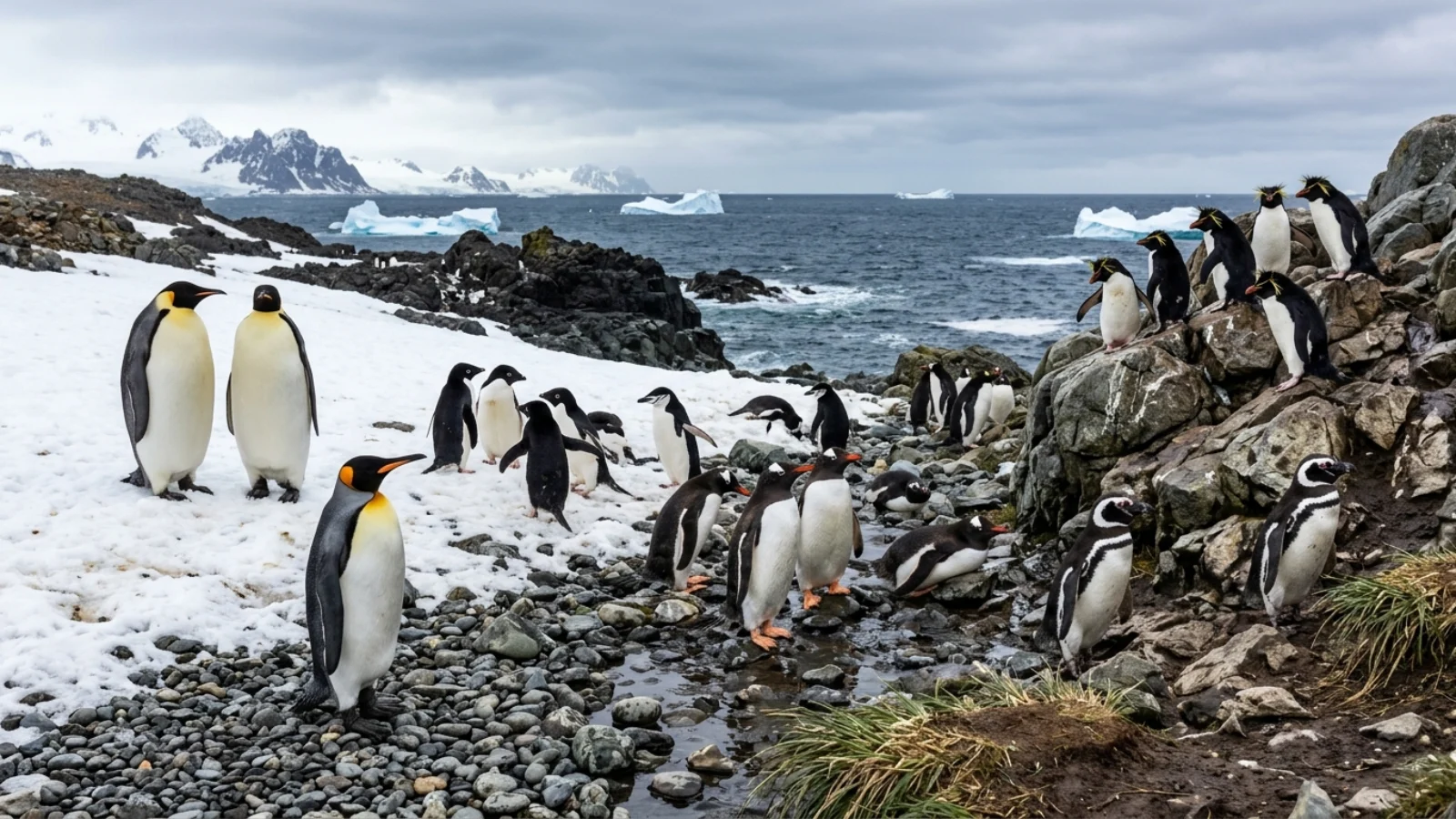
The great penguins: emperor and king
The genus Aptenodytes, meaning “wingless diver”, holds the two largest living penguins, and genetic studies place it as the earliest branch among living penguins. Both species have bright yellow-orange patches on the neck, breast and bill, both incubate a single egg on top of their feet rather than in a nest, and both hatch chicks that are almost naked.
The emperor penguin is the giant of the family, weighing about 22 to 45 kg depending on sex and season. It is also the only penguin that breeds through the Antarctic winter, raising its chick on sea ice attached to the coast. That dependence on sea ice is why the IUCN moved it from Near Threatened to Endangered on 9 April 2026, citing satellite evidence of a loss of around 10% of the population between 2009 and 2018 and projections that numbers could halve by the 2080s.
The king penguin is the second largest species, standing about 70 to 100 cm tall and weighing 9.3 to 18 kg. It looks like a slimmer, more brightly coloured emperor, but it breeds on ice-free sub-Antarctic islands such as South Georgia, Crozet, Kerguelen, Marion and Macquarie, not on Antarctic sea ice. Two subspecies are recognised, one in the South Atlantic and one in the southern Indian Ocean and at Macquarie Island. With well over a million breeding pairs, it is listed as Least Concern.
The brush-tailed penguins: Adelie, chinstrap and gentoo
The genus Pygoscelis is known as the brush-tailed penguins. All three species have fairly simple black-and-white head patterns and live from the Antarctic coast to the sub-Antarctic islands. In external appearance they are thought to resemble the common ancestor of modern penguins more closely than the specialised great penguins do.
The Adelie penguin is the classic Antarctic penguin: black above, white below, with a plain black head and a distinctive white ring around each eye. It breeds along the entire coast of Antarctica, which is the only place it is found, and, with the emperor, it reaches farther south than any other penguin. It is named after Adélie Land, which the French explorer Jules Dumont d’Urville named after his wife, Adèle. The current list gives a population of around 10 million birds.
The chinstrap penguin is named for the thin black line that runs under its white face from ear to ear, like the strap of a helmet. Other names include ringed, bearded and stonecracker penguin, the last for its loud, harsh call. It breeds mainly on the Antarctic Peninsula and the islands of the Scotia Arc, and it is still one of the most abundant penguins, though some long-studied colonies have shrunk.
The gentoo penguin is the third-largest living penguin, 70 to 90 cm long, and is the easiest of the three to recognise: it has a bright orange-red bill, orange feet, and a white patch above each eye that joins across the crown. It is the fastest underwater swimmer of all penguins, reaching speeds of up to 36 km/h. Gentoos are often treated as a species complex, with four subspecies on the current list, and some researchers argue that the populations deserve recognition as separate species.
The crested penguins: seven species with golden plumes
The genus Eudyptes, the crested penguins, is the largest penguin genus, with seven species on the IOC list. All have yellow or orange ornamental head feathers and bills that are at least partly red, and their highest diversity is in the New Zealand region, and genetic evidence suggests the living species are the product of a relatively recent radiation stretching from about 8 million years ago to the end of the Pliocene. Several crested penguins share an odd breeding habit: they lay two eggs of very different sizes and usually raise only the chick from the larger, second egg.
The macaroni penguin has a crest that starts from a single patch in the middle of the forehead. It is one of the most numerous penguins, with older estimates of around 18 million birds and a current list figure of about 6.3 million breeding pairs, yet it is listed as Vulnerable because of steep declines at some colonies. The royal penguin of Macquarie Island looks almost identical except for its white face, and some authorities treat it as a subspecies of the macaroni.
The rockhopper penguins are the smallest crested penguins, named for the way they bound from rock to rock rather than waddling. Since research published in 2006 showed differences in shape, voice and genetics, most lists split them into the southern rockhopper of the Falklands, southern South America and the sub-Antarctic Indian and Pacific Oceans, and the northern rockhopper, which breeds mainly on Tristan da Cunha, Gough Island and the islands of Amsterdam and St Paul. The northern rockhopper is listed as Endangered after a reported decline of about 90% since the 1950s; the southern is Vulnerable.
The remaining three crested penguins are New Zealand specialities. The Fiordland penguin, or tawaki, nests among tree roots and rocks in dense temperate coastal forest on the south-western South Island and Stewart Island and is listed as Near Threatened. The Snares penguin breeds only on the small Snares Islands south of New Zealand and is listed as Vulnerable. The erect-crested penguin, which breeds only on the Bounty and Antipodes Islands, is the largest of the crested penguins, with males averaging about 6.4 kg, and the least known: it spends the winter at sea and little is known about its biology. It is listed as Endangered.
The yellow-eyed penguin
The yellow-eyed penguin, known in New Zealand by its Maori name hoiho, is the only living member of the genus Megadyptes. It stands about 62 to 79 cm tall, has a pale yellow eye and a band of yellow feathers running from the eye around the back of the head, and nests in forest and scrub along the south-eastern coast of the South Island, on Stewart Island and on the Auckland and Campbell Islands. It was once thought to be a close relative of the little penguin, but molecular research shows it is closer to the crested penguins. Two related forms, including the Waitaha penguin, are known only from bones and are extinct. It is one of the rarest penguins, with a current estimate of about 2,600 to 3,000 birds, and is listed as Endangered.
The little penguin
The little penguin, Eudyptula minor, is the smallest penguin in the world, standing about 30 to 33 cm tall and weighing on average around 1.5 kg. It is also known as the fairy penguin, the little blue penguin or the blue penguin, after its slate-blue plumage, and in New Zealand as korora. It breeds in burrows and rock crevices along the coasts of New Zealand and southern Australia and comes ashore after dark; Phillip Island Nature Park in Victoria, home to a well-known colony, also runs a rehabilitation facility where oil spills are the most common reason little penguins are admitted.
The little penguin is at the centre of two of the disputes over penguin numbers. Some authorities split the birds of Australia and the Otago coast of New Zealand into a separate species, the Australian little penguin Eudyptula novaehollandiae. Others also treat the white-flippered penguin of New Zealand’s South Island as its own species, while many regard it as a subspecies; the real situation appears to be more complicated than either view. The IOC list used for the 18-species total counts a single little penguin.
The banded penguins
The genus Spheniscus, the banded penguins, contains four species with a strong family resemblance: black faces crossed by white stripes, and one or two black bands across the chest. Unlike the other genera they lack any yellow or orange colouring, and they are unique among living penguins in often nesting in burrows. They also live farther north than any other penguins, in temperate and even tropical waters cooled by ocean currents.
The African penguin, also called the Cape, black-footed or jackass penguin, the last for its loud, donkey-like call, breeds on the coasts and islands of South Africa and Namibia and is famous for the colony at Boulders Beach near Cape Town. In October 2024 it became the first penguin to be listed as Critically Endangered, after breeding pairs fell below 10,000.
The Humboldt penguin lives along the coasts of Peru and Chile and is named, like the cold current it depends on, after the explorer Alexander von Humboldt. It is the heaviest of the banded penguins and is listed as Vulnerable. The Magellanic penguin, named after Ferdinand Magellan, who saw the birds in 1520, breeds in Patagonia and the Falklands and is the most numerous banded penguin, with an estimated 2.2 to 3.2 million birds. The Galapagos penguin, one of the smallest penguins at about 48 to 50 cm, is the only penguin found north of the Equator and the rarest of all, with only about 1,200 birds on the current list. It is listed as Endangered.
The disputed species
Four cases explain most of the disagreement over the number of penguin species. The first is the royal penguin, which may be a full species or merely a colour form of the macaroni; molecular estimates suggest the two split only about 1.5 million years ago, and individuals of the two interbreed. Even its conservation status is reported inconsistently: some sources describe it as Near Threatened, while the current species list gives Least Concern.
The second is the rockhoppers. Most lists now recognise northern and southern species, and the southern rockhopper itself is divided into a western form and an eastern, Indo-Pacific form, Eudyptes chrysocome filholi, which some treat as distinct. The third is the little penguin complex, where the Australian little penguin and the white-flippered penguin are each sometimes given species rank. The fourth is the gentoo, where genetic differences among the populations have led to proposals to split it into several species.
Count all the splits and the total climbs to 20 or more; lump the royal penguin back into the macaroni and treat the rockhoppers as one species and it drops to 17. The 18 used on this page and across the penguin section is the IOC figure, and wherever the distinction matters the individual species pages note it.
How to tell the types of penguins apart
The quickest way to identify a penguin is to look at its head. A bright orange or yellow neck patch on a very large bird means one of the great penguins: a heavy, pale-yellow-chested bird on Antarctic sea ice is an emperor, and a slimmer bird with vivid orange ear patches on a sub-Antarctic beach is a king. A plain black head with a white eye-ring is an Adelie; a white face with a thin black line under the chin is a chinstrap; and an orange bill with a white band across the top of the head is a gentoo.
Golden plumes mean a crested penguin. A crest that rises from the middle of the forehead is a macaroni or royal; a thin yellow stripe above each eye that flares into a spray of plumes is a rockhopper; and in New Zealand waters the Fiordland, Snares and erect-crested penguins are separated by the shape of the crest, the amount of bare skin at the bill and where they breed. A pale yellow eye and a yellow band around the head means the yellow-eyed penguin, and a tiny blue-grey penguin with no markings at all is a little penguin. White stripes on a black face and black bands across the chest mean one of the four banded penguins, which are best told apart by where you are: southern Africa, Peru and Chile, Patagonia or the Galapagos.
Where the different penguins live
Larger penguins generally live in colder regions and smaller penguins in temperate or tropical waters. Only the emperor and Adelie breed on the Antarctic continent proper, with the chinstrap and gentoo along the Antarctic Peninsula. The king, macaroni, rockhoppers and gentoos dominate the sub-Antarctic islands. New Zealand and its outlying islands hold more species than anywhere else, including all the yellow-eyed, Fiordland, Snares and erect-crested penguins. For a full guide, see where penguins live.
Threatened species
Penguins are among the most threatened groups of seabirds. On the current Red List, one species, the African penguin, is Critically Endangered; five are Endangered (emperor, northern rockhopper, erect-crested, yellow-eyed and Galapagos); four are Vulnerable (macaroni, southern rockhopper, Snares and Humboldt); and the Fiordland penguin is Near Threatened, with the royal penguin reported as either Near Threatened or Least Concern. Only the king, Adelie, chinstrap, gentoo, little and Magellanic penguins are clearly in the Least Concern category. The main threats vary by species: loss of sea ice for the emperor, food shortages caused by overfishing and shifting fish stocks for the African and Humboldt penguins, warm El Nino events for the Galapagos penguin, and introduced predators, disease and disturbance for the New Zealand species.
- Most lists recognise 18 penguin species in six genera; published totals range from 17 to 20.
- The emperor is the largest penguin and the little penguin the smallest.
- The crested penguins (Eudyptes) are the largest genus, with seven species.
- The African penguin is Critically Endangered and the emperor penguin became Endangered in April 2026.
How many types of penguins are there?
18 on the IOC World Bird List, which most references follow; depending on the authority, between 17 and 20.
What is the biggest type of penguin?
The emperor penguin, which weighs about 22 to 45 kg. The king penguin is second.
What is the smallest type of penguin?
The little penguin, about 30 to 33 cm tall and around 1.5 kg.
What are the six genera of penguins?
Aptenodytes (great penguins), Pygoscelis (brush-tailed), Eudyptes (crested), Spheniscus (banded), Eudyptula (little penguins) and Megadyptes (yellow-eyed penguin).
Which penguin is the rarest?
The Galapagos penguin, with about 1,200 birds on the current list; the yellow-eyed penguin is also very rare.
Which penguins are endangered?
The African penguin is Critically Endangered; the emperor, northern rockhopper, erect-crested, yellow-eyed and Galapagos penguins are Endangered.
Do any penguins live in the Northern Hemisphere?
Only the Galapagos penguin, some of which live just north of the Equator.
- Wikipedia contributors, “Penguin” and individual species articles (2023 snapshot via Kiwix mirror, accessed November 2026).
- Wikipedia contributors, “List of penguins” (current version, accessed November 2026), following the IOC World Bird List.
- IUCN, “Emperor penguin and Antarctic fur seal now Endangered due to climate change” (press release, 9 April 2026).
- SANCCOB, African penguin uplisted to Critically Endangered (28 October 2024).
Blane Perun has been exploring Earth’s oceans and marine life for over 25 years. Founder of TheSea.Org in 1999, underwater photographer, coral aquaculture pioneer, and explorer of 80+ countries.
About Blane Perun →