Do Penguins Have Knees? — The Hidden Legs Under the Feathers
Yes. Penguins have knees, just like other birds and like people. Their legs contain a thigh bone (femur), a knee joint, a shin made of the tibiotarsus and fibula, and a foot, but the upper part of the leg, including the knee, is hidden inside the body outline under feathers. All you normally see is the lower leg and the large webbed feet, which is why penguins look as if they have almost no legs at all. The legs are short and set far back on the body, which makes penguins streamlined in the water but means they walk with an upright, waddling gait on land. That waddle, far from being wasteful, helps them recover energy with each step.
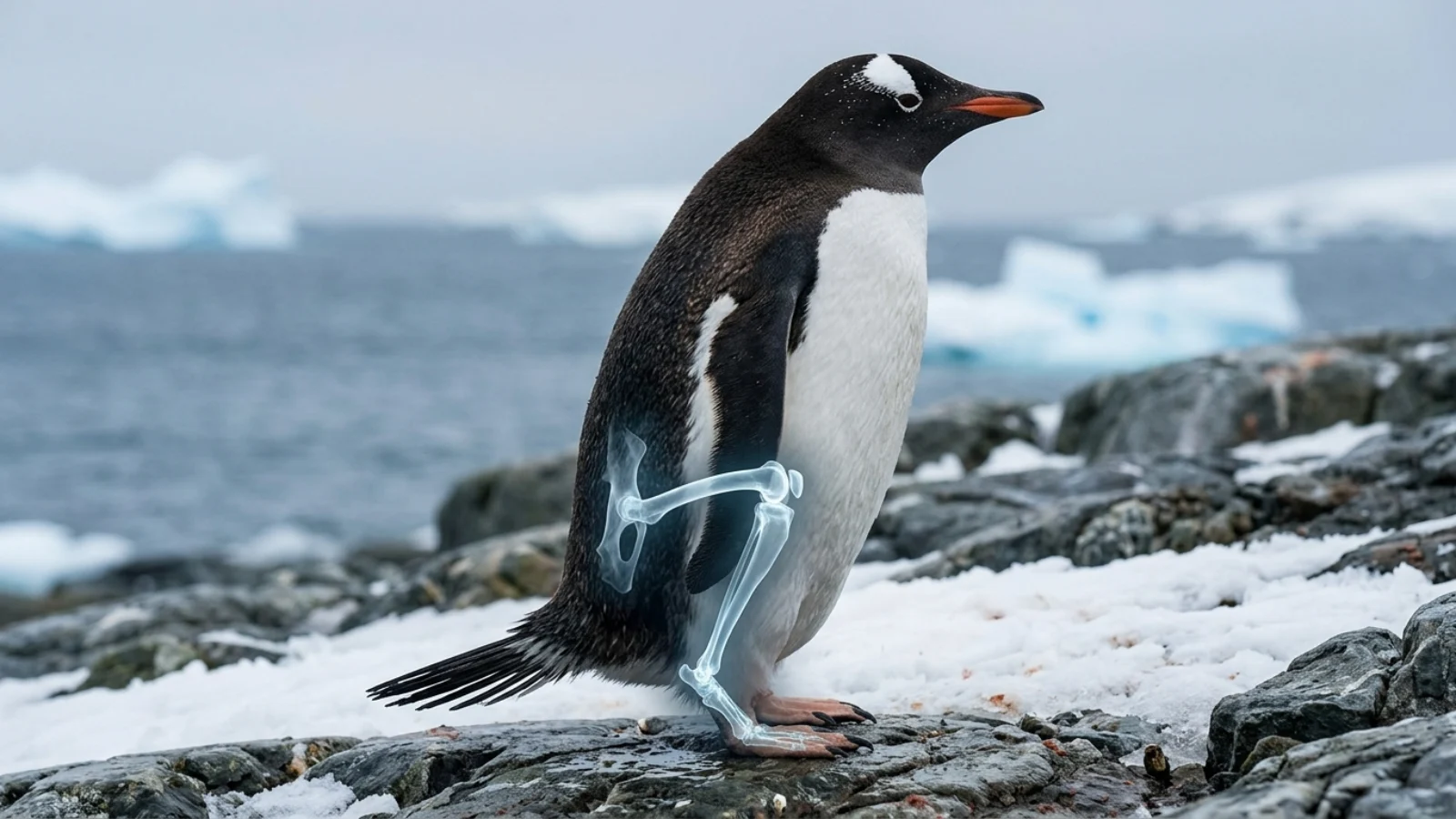
An X-ray of a penguin leg shows the same basic parts as a human leg: a femur, a knee, a tibia (in birds, the tibiotarsus) and a fibula, followed by the foot. The upper leg is covered by feathers, so the legs are longer than they look.
The short answer
Yes, penguins have knees. A penguin’s leg is built on the same plan as every other bird’s leg, and on the same broad plan as ours. It has an upper leg bone, the femur, which meets the lower leg at the knee joint. Below the knee are the shin bones, then the foot and toes.
The reason the question comes up at all is that you cannot see a penguin’s knees. The upper leg is hidden by the bird’s feathers, so the only part of the leg that shows is the very bottom of it and the feet. That creates an optical illusion: penguins look as though their feet are attached directly to their bodies, when in fact the legs are longer than they appear. If you could see the penguin’s skeleton, the femur and the knee would be clearly visible inside the outline of the body.
So the knee is there, it bends, and it does real work every time a penguin walks, hops or slides. It is just tucked away under the plumage.
How a bird’s leg is built
To understand where a penguin’s knee is, it helps to know how bird legs work in general. In a bird, the pelvic bones meet at the hip socket, the acetabulum, where they join the femur, the first bone of the hind limb. The femur makes up the upper leg. At the knee joint, the femur connects to the tibiotarsus, the main shin bone, and the fibula, which runs along the side of the lower leg.
Below the tibiotarsus comes the tarsometatarsus, which forms the upper part of the foot, and then the digits, which make up the toes. In many birds the tarsometatarsus is long and the joint between it and the tibiotarsus, the tibio-tarsal joint, is the obvious bend halfway down the leg. Because that joint bends the opposite way from a human knee, it is often mistaken for a “backwards knee”. But it lies below the true knee, which is the joint between the femur and the tibiotarsus, higher up the leg and usually hidden against the body.
In penguins, the visible part of the leg is shorter still. Their legs are short overall, and much of what would be visible in a wading bird is hidden. The parts you see when a penguin stands are mainly the lower end of the leg and the large, webbed feet.
Where a penguin’s knee is
A penguin’s femur is short and runs from the hip inside the body, so the knee sits within the body’s outline, under a covering of feathers. A study of the knee region in Humboldt penguins describes the femur as comparatively short, with a broad joint surface where it meets the tibia and a narrower one for the fibula. Like other birds, penguins have the full set of hind-limb bones, just arranged so that most of the leg is out of sight.
Because the leg bones are hidden, people often assume penguins have only stubby little stumps. In reality, a penguin’s leg has the same four main parts as a human leg: femur, knee, tibia and fibula. The difference is in the proportions and how much of the limb is wrapped up inside the body.
Some penguins show a little more leg than others. The legs and feet of the Adelie penguin, for example, are mostly unfeathered and pinkish, so the lower leg is easy to see as it walks.
Why the legs sit so far back
The most important feature of a penguin’s legs is where they are attached. They are set far back on the body, a feature captured in the name of the brush-tailed penguins, the genus Pygoscelis, which combines the Ancient Greek puge, “rump”, and skelos, “leg”: in effect, “legs at the rump”.
That arrangement is a trade-off between life in water and life on land. Penguins are superbly adapted to swimming, and short legs placed at the back of a streamlined body help make them efficient swimmers and divers. Short legs may also reduce heat loss while penguins are incubating eggs. But legs at the back of the body make walking harder. Penguins stand upright on land, and they use their tails and wings to help keep their balance in that upright stance. The brush-tailed penguins regularly lean on their stiff tail feathers, which sweep the ground as they walk.
How penguins walk
A penguin walks flat on the soles of its feet, rather than up on its toes as many other birds do. With short legs and big feet, it cannot take long strides, so it moves with short, quick steps and rocks from side to side, the waddle that makes penguins so recognisable.
For a long time, penguin walking was thought to be very inefficient. A 1977 study by researchers from Duke University in Antarctica found that penguins burn about twice as many calories walking as other animals of similar body mass, such as a dog. The obvious suspect was the waddle.
In 2000, Timothy Griffin, then a graduate student at the University of California, Berkeley, and Rodger Kram, who had moved to the University of Colorado, Boulder, tested that idea with five emperor penguins at SeaWorld San Diego’s Penguin Encounter. They walked the birds over a force platform that measured the side-to-side and fore-and-aft forces of each step, as well as the vertical forces supporting the body. Their results, published in Nature under the title “Penguin waddling is not wasteful”, showed that walking is expensive for penguins not because they waddle but because they have such short legs.
Why the waddle saves energy
Short legs force the leg muscles to generate force very quickly, and fast muscle action is costly. When the researchers compared penguins with animals of similar leg length, rather than similar body mass, penguins burned about the same amount of energy per unit of body mass. In other words, penguins are not bad walkers; they are short-legged walkers.
The waddle turned out to help. Walking works like an inverted pendulum: with each step, the body vaults over the supporting leg, converting energy of motion into height and back again. Some of that energy is recovered and reused rather than supplied fresh by the muscles. In some penguins the recovery rate reaches up to 80%, compared with an average of about 65% in humans. The side-to-side rocking is part of how penguins achieve this. Without it, their muscles would have to do more of the work of lifting the body with each step, and walking would cost even more.
That efficiency matters. Emperors may walk 50 to 120 km over the sea ice between the open sea and their colonies, and they do some of that walking after long fasts, when every bit of energy counts.
Fat penguins walk differently
A penguin’s walk also changes with its body condition. King penguins returning to their colonies after feeding at sea often have to walk a long way while carrying a heavy load of fat, mostly at the front of the body, along with food in the stomach for their chicks. They then fast for up to a month, losing a great deal of weight.
A 2016 study in PLOS ONE walked king penguins on a treadmill at 1.4 km/h, once when they were fat (about 13.2 kg) and again when they were slimmer (about 11 kg), using acceleration data loggers. It found no clear difference in stride frequency or overall body acceleration, but the leaning angle and the amount of side-to-side lean varied much less when the birds were slimmer, and there was some evidence that their waddle became smaller. The researchers suggested that frontal fat shifts the centre of mass forwards, making the upright posture less stable. In short, fat king penguins are less steady on their feet.
Hopping and tobogganing
Penguins have other ways to get around that rely on their knees and ankles. They jump with both feet together when they want to move more quickly or cross steep or rocky terrain. The rockhopper penguins are named for this habit, bounding over boulders and across cracks rather than sliding or clambering, and other crested penguins hop too.
On snow and ice, penguins often drop onto their bellies and slide, pushing with their feet and steering with them, a movement called tobogganing. Emperor penguins alternate between walking with a wobbling gait and tobogganing, propelled by their feet and flipper-like wings. Tobogganing conserves energy while still moving quickly, and the legs provide the push.
What the legs do in the water
In the water, penguins swim mainly with their wings, which have evolved into stiff flippers. Their swimming looks very similar to the flight of other birds through the air. That was not always the case. The oldest known penguin, Waimanu manneringi, which lived in New Zealand about 62 million years ago, was a loon-like bird that swam at the surface using mainly its feet, although its wings were already adapting to underwater movement. Over time, penguins shifted the work of swimming from their legs to their wings, and the legs became short and set far back, which suits a streamlined swimming body. For the story of how penguin wings became flippers, see can penguins fly?
Feet as incubators
Penguin feet do more than carry the bird. The two largest penguins, the emperor and king, do not build nests. Instead they incubate their single egg on their feet. The male emperor balances the egg on the tops of his feet and engulfs it with a fold of loose skin and feathers, the brood pouch, for around 65 to 75 consecutive days until it hatches. After hatching, the young chick spends time balanced on its parent’s feet, kept warm by the brood patch. The king penguin does the same, balancing its egg on its feet in a brood pouch.
The Berkeley researchers suggested that short legs may also help reduce heat loss while penguins are incubating.
Feet as radiators and heat savers
Penguin feet are also important for controlling body temperature. In cold species, penguins can control blood flow to their extremities, reducing the amount of blood that gets cold while still keeping the feet from freezing. The chinstrap penguin, for example, has an intricate network of blood vessels in its flippers and legs that helps it conserve heat. In hot places the feet do the opposite job. The Galapagos penguin‘s feet lose and gain heat quickly because they have a high blood flow and no insulation, so on hot days the bird hunches forward to shade its feet with its own body.
Do penguins have elbows?
The same logic applies to penguin wings. A penguin’s flipper contains the same general bones as the wing of a flying bird: the humerus, a sesamoid bone, the radius and ulna, the wrist bones, the carpometacarpus and the phalanges. The bones are shorter, stouter, thicker and denser, so that the wing works as a fin rather than an airfoil, and the joints are stiffened. So penguins do have elbows and wrists, just as they have knees and ankles, but like the knees they are not obvious from the outside.
Why penguins are built this way
Every part of a penguin’s body reflects a compromise between land and sea. Penguins spend about half of their lives on land and half in the water, but most of their food, and most of their danger, is in the sea. Legs placed far back on a streamlined body, wings turned into flippers, and dense, waterproof plumage that hides the limbs all make penguins excellent swimmers. The cost is a slow, upright, waddling walk on land, partly offset by the energy-saving pendulum of the waddle, by hopping on rocks and by sliding on snow. Their knees are part of that design, hidden but working, every time a penguin takes a step. For an overview of penguin bodies and lives, see the penguins hub.
Do penguins have knees?
Yes. Penguins have a femur, a knee joint, a tibiotarsus and fibula, and a foot, like other birds. The upper leg and knee are hidden under feathers.
Where are a penguin’s knees?
Inside the outline of the body, under the feathers, above the short visible part of the leg.
Why do penguins have short legs?
Short legs set far back on the body make penguins more streamlined in the water, and may reduce heat loss while incubating, but make walking on land more costly.
Why do penguins waddle?
Because of their short legs and big feet. The side-to-side waddle works like a pendulum and helps penguins recover up to 80% of the energy of each stride.
Can penguins bend their knees?
Yes. They bend their knees when they walk, hop over rocks, push themselves along while tobogganing and crouch over an egg.
Is walking hard work for penguins?
It costs penguins about twice as much energy as other animals of the same mass, mainly because their legs are short, not because they waddle.
Do penguins have elbows?
Yes. Their flippers contain a humerus, radius and ulna and wrist and hand bones, but the joints are stiffened so the wing works as a fin.
- Wikipedia contributors, “Bird anatomy”, “Penguin”, “Adelie penguin”, “Emperor penguin”, “King penguin”, “Chinstrap penguin”, “Galapagos penguin” and “Flipper (anatomy)” (2023 snapshot via Kiwix mirror, accessed November 2026).
- UC Berkeley News release on penguin waddling (20 December 2000), on Griffin, T. M. & Kram, R. (2000). Penguin waddling is not wasteful. Nature. doi:10.1038/35050167.
- Willener, A. S., Handrich, Y., Halsey, L. G. & Strike, S. (2016). Fat king penguins are less steady on their feet. PLOS ONE. doi:10.1371/journal.pone.0147784.
- Wonderopolis, “Do penguins have knees?” (accessed November 2026).
- “Biomorphology of Humboldt penguins knee elements”, journal abstract, National University of Life and Environmental Sciences of Ukraine (journals.nubip.edu.ua, accessed November 2026).
Blane Perun has been exploring Earth’s oceans and marine life for over 25 years. Founder of TheSea.Org in 1999, underwater photographer, coral aquaculture pioneer, and explorer of 80+ countries.
About Blane Perun →