Do Seals Eat Penguins? — Yes: Which Seals Do, and How They Hunt
Yes, seals eat penguins. The leopard seal is the main penguin hunter, taking Adélie, gentoo and chinstrap penguins around Antarctica every summer. It is not the only one: Antarctic, sub-Antarctic, Cape and New Zealand fur seals, New Zealand sea lions and, occasionally, southern elephant seals have all been recorded killing penguins. Most seals, including Weddell and crabeater seals, never do.
The leopard seal (Hydrurga leptonyx). It is a solitary ambush hunter that can reach about 3.5–3.8 m and 500 kg or more, with females larger than males. It patrols ice edges and colony landing beaches, catching penguins in the water as they come and go. Elsewhere, fur seals are the bigger threat: in south-eastern Australia, penguin remains turn up in up to 40% of long-nosed fur seal droppings at some sites.
Penguins and seals share the same cold, food-rich waters of the Southern Hemisphere, and penguins have to cross the seals’ hunting ground every time they leave or return to a colony. That makes them obvious prey for a large, fast marine mammal. Even so, the relationship is much more uneven than the question suggests. One species, the leopard seal, hunts penguins every summer at colonies around Antarctica. A handful of fur seals and sea lions have learned to do it in particular places, often just a few individual animals. Most seals ignore penguins entirely. This page sets out which seals kill penguins, how often, how they do it, and whether it matters for penguin populations, using the field studies that actually measured it.
Which seals eat penguins?
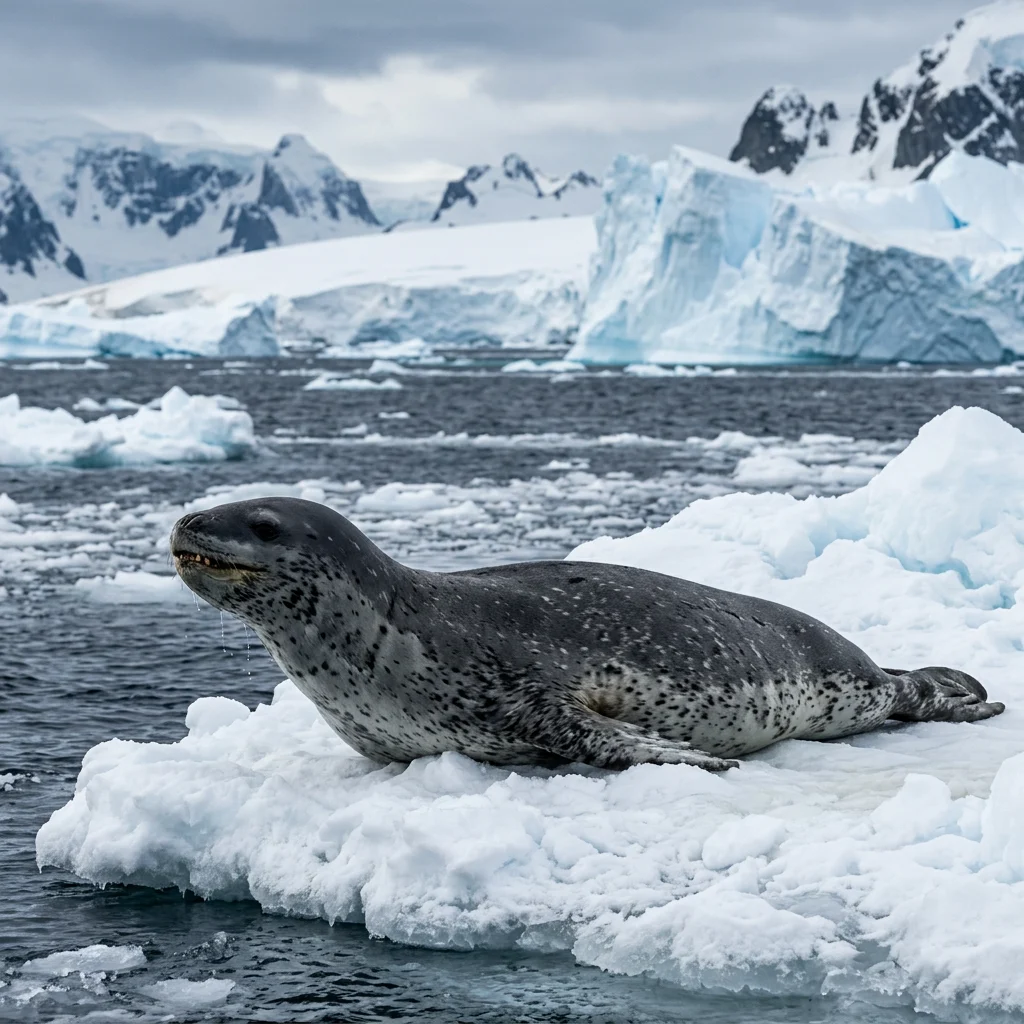
Six or more species have been documented doing it. Only the leopard seal makes penguins a regular, large part of its diet across a whole region.
| Seal | Eats penguins? | Penguins taken | Where |
|---|---|---|---|
| Leopard seal | Yes, regularly | Adélie, gentoo, chinstrap, emperor, king | Antarctica and sub-Antarctic islands |
| Antarctic fur seal | Yes, locally | Adélie, chinstrap, macaroni, king | Antarctic Peninsula, South Georgia, Marion Island |
| Sub-Antarctic fur seal | Yes, locally | Rockhopper, macaroni, king | Southern Indian Ocean islands |
| Cape fur seal | Yes | African penguin | South Africa, Namibia |
| New Zealand (long-nosed) fur seal | Yes | Little penguin | South-eastern Australia, New Zealand |
| New Zealand sea lion | Some females | Yellow-eyed penguin | Otago Peninsula, New Zealand |
| Southern elephant seal | Rarely | Magellanic penguin | Patagonia (killings on land recorded) |
| Weddell seal | No | — | Eats fish and squid |
| Crabeater seal | No | — | Eats krill |
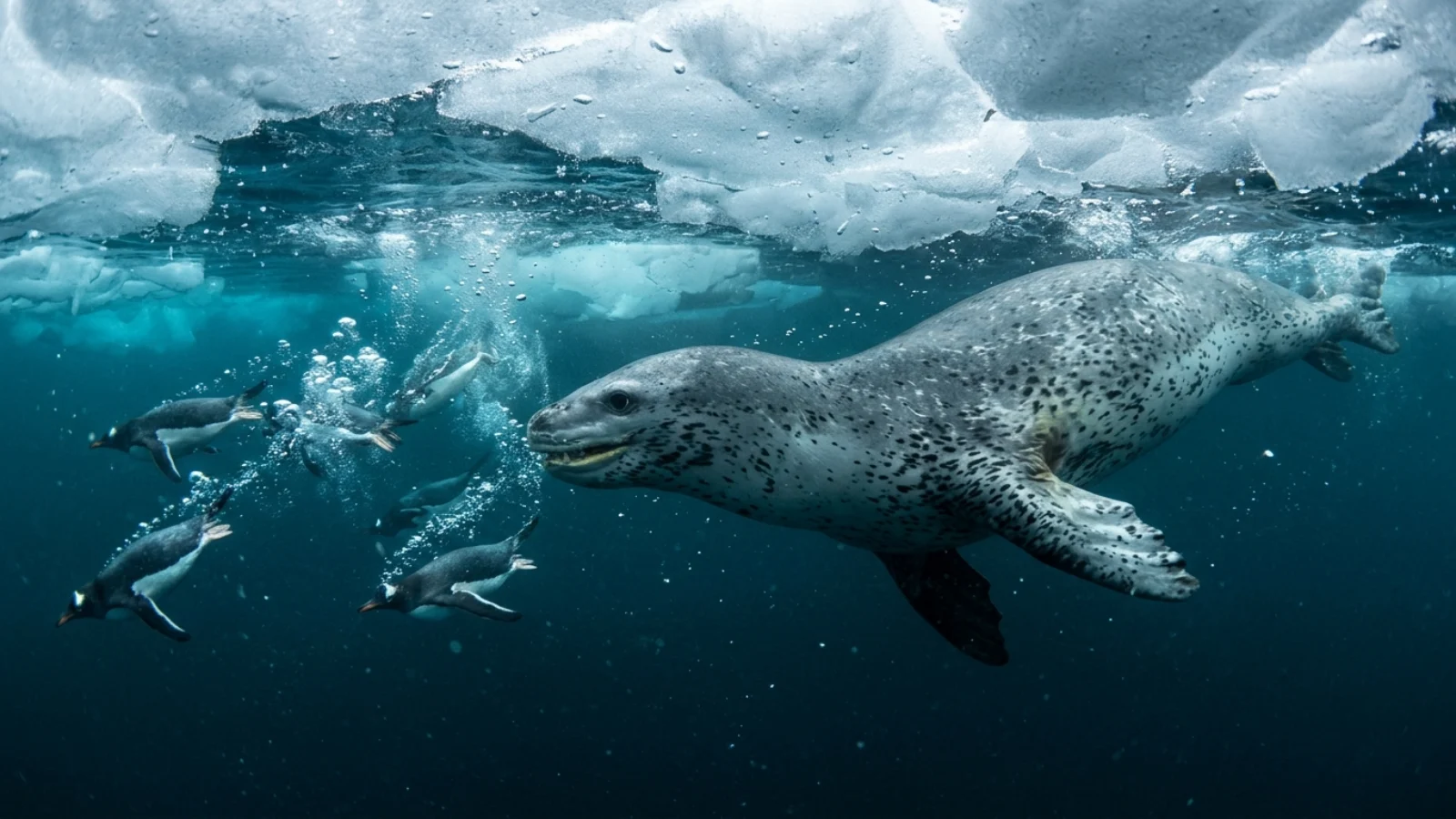
How do leopard seals hunt penguins?
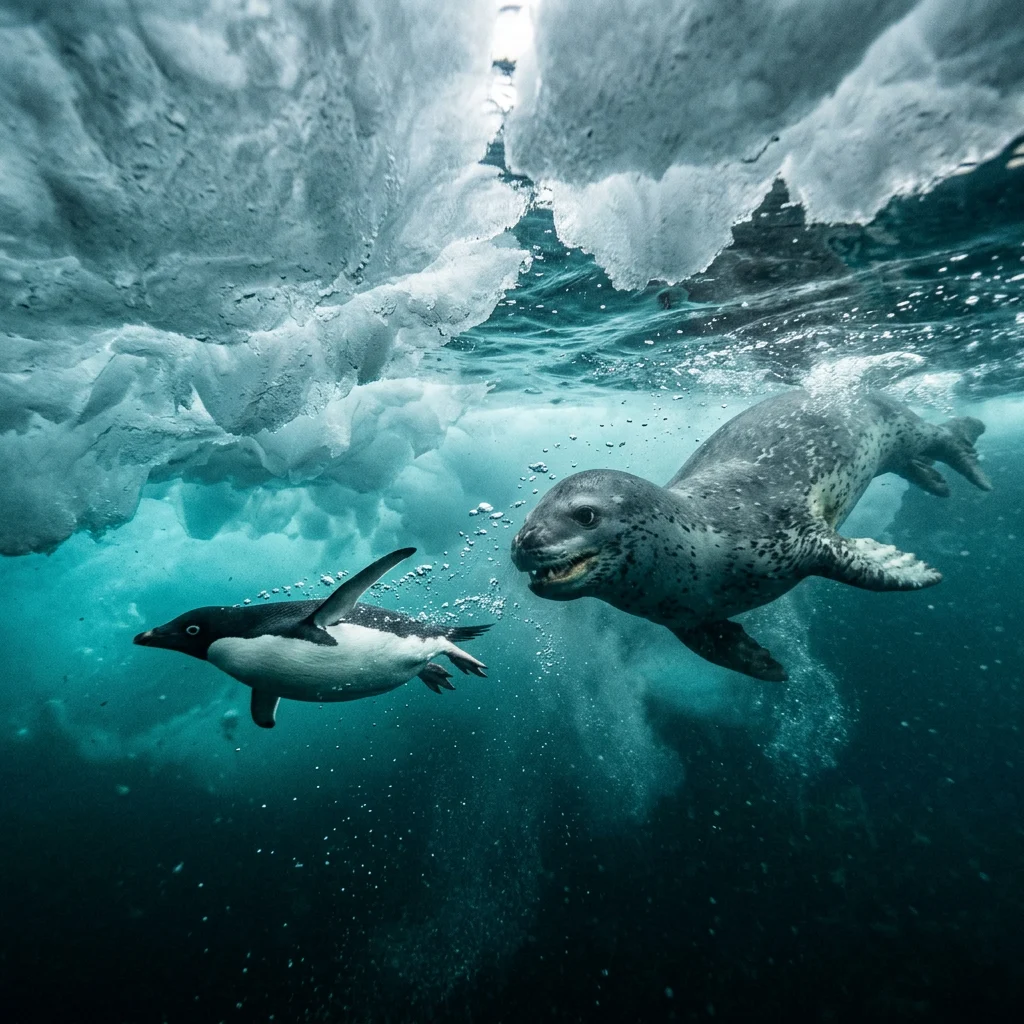
Almost always in the water. They wait under the ice edge or just off a landing beach and ambush penguins as they jump in or come back from feeding.
On ice or land a penguin can usually waddle or toboggan out of reach. In the water the balance flips: the leopard seal’s long fore-flippers and huge, almost reptilian head make it faster and more agile than any penguin over a short chase. The seal often strikes from below, grabs the bird, and then whips it back and forth at the surface to tear it into pieces small enough to swallow. Fledgling chicks taking to the water for the first time in late summer are especially vulnerable, which is when leopard seals gather off the busiest colonies.
Leopard seals are not penguin specialists, though. Their cheek teeth interlock into a sieve that strains krill, and krill, fish and squid make up much of their diet, especially away from colonies and outside the breeding season. They also take young crabeater and fur seals. The share of penguins in the diet varies hugely from one site and season to the next. More on the species in why leopard seals are dangerous.
The way a leopard seal deals with a penguin once it has caught one is distinctive. It grabs the bird by the head or feet and swings it in a wide arc, slamming it against the surface again and again. Penguins are too large to swallow whole, and the thrashing strips the skin and feathers away from the body so that the seal can bite off pieces of meat. Inside-out penguin skins floating near an ice edge are a reliable sign that a leopard seal has been feeding. Brown skuas, giant petrels and gulls often gather to pick up the scraps.
In the Ross Sea the seals waited next to the ice foot of the beach or just beyond the breaking waves, often with only their nostrils above water. The most dangerous zone for penguins was about 10–20 m from the shore or ice edge, where birds heading out to sea or coming home had to pass. Seals used a wait-and-rush ambush, and they spaced themselves out along the beach as if holding territories. Not every seal at a colony hunts penguins. At Cape Crozier in 2000, seals that were feeding on fish under the fast ice never attacked penguins at all.
How many penguins do leopard seals kill?
Usually a small share of a colony: most studies put it at roughly 1–5% of the breeding adults in a season.
The classic estimate comes from Richard Penney and George Lowry, who watched leopard seals at the huge Adélie colony at Cape Crozier on Ross Island in the 1960s. Their figures, published in Ecology in 1967, suggested that the seals took between 1.4% and 5% of the penguins there over a full breeding season. Later work came out at the low end of that range. Between 1996 and 2003, David Ainley and colleagues counted seals and kills at three Ross Island colonies of very different size: Cape Crozier, with about 99,000–133,000 pairs, Cape Bird, with 25,000–33,000 pairs, and Cape Royds, with only 2,000–3,900 pairs. At Crozier the seals took an estimated 1.6% of breeders a year on average, ranging from 0.7% to 2.6%. At Cape Bird kills reached 2.2% in one season and were close to zero in the others. At tiny Cape Royds a leopard seal turned up on only four days in four years, and average losses were about 0.6%.
In Prydz Bay, East Antarctica, Tracey Rogers and Michael Bryden watched leopard seals hunting Adélies along the fast-ice edge from November 1993 to January 1994. They estimated that six seals feeding there over a 120-day summer would eat about 2.7% of the adult penguins. They also recorded five different hunting techniques and found that individual seals favoured particular ones. An older idea held that a few large males did most of the penguin hunting. Rogers and Bryden found that many seals of both sexes took part.
The Ross Island study also showed how seals decide where to hunt. Leopard seals were present persistently only when more than about 250 penguins an hour were passing through the water off the beach. Kill rates per seal rose with penguin traffic but levelled off at about 1,200 swimming penguins an hour, because a seal can only catch and process so many birds. The result is a curious advantage for colonies at either extreme. Very small colonies do not attract seals at all, and very large ones swamp the few seals that do turn up, so each individual penguin’s risk is diluted.
What share of a leopard seal’s diet is penguin?
It depends on the place, the season and the individual seal. The most detailed recent study combined droppings, chemical analysis of tissue and animal-borne video cameras from leopard seals at Cape Shirreff on Livingston Island, off the Antarctic Peninsula, over the 2013, 2014 and 2017 seasons. Douglas Krause and colleagues reported in 2020 that in spring the diet of both sexes was split fairly evenly between Antarctic krill (about 32–38%), notothen fish (about 32–37%) and penguins (about 24–27%). In summer the females switched strongly toward large prey. Penguins rose to between 30% and 46% of their diet, and Antarctic fur seal pups to between 21% and 38%. The size of that switch was linked to body size, with larger seals eating more fur seal pups.
So penguins are a major item, but not the only one, even at a site with large penguin colonies. Away from colonies, and in the months when penguins are at sea or the seals follow the pack ice north, leopard seals live largely on krill, fish and squid. Their cheek teeth have deep lobes that interlock to form a sieve, which lets them strain krill from the water much as a crabeater seal does, as well as the large canines used to grip penguins and seal pups.
Do fur seals eat penguins?
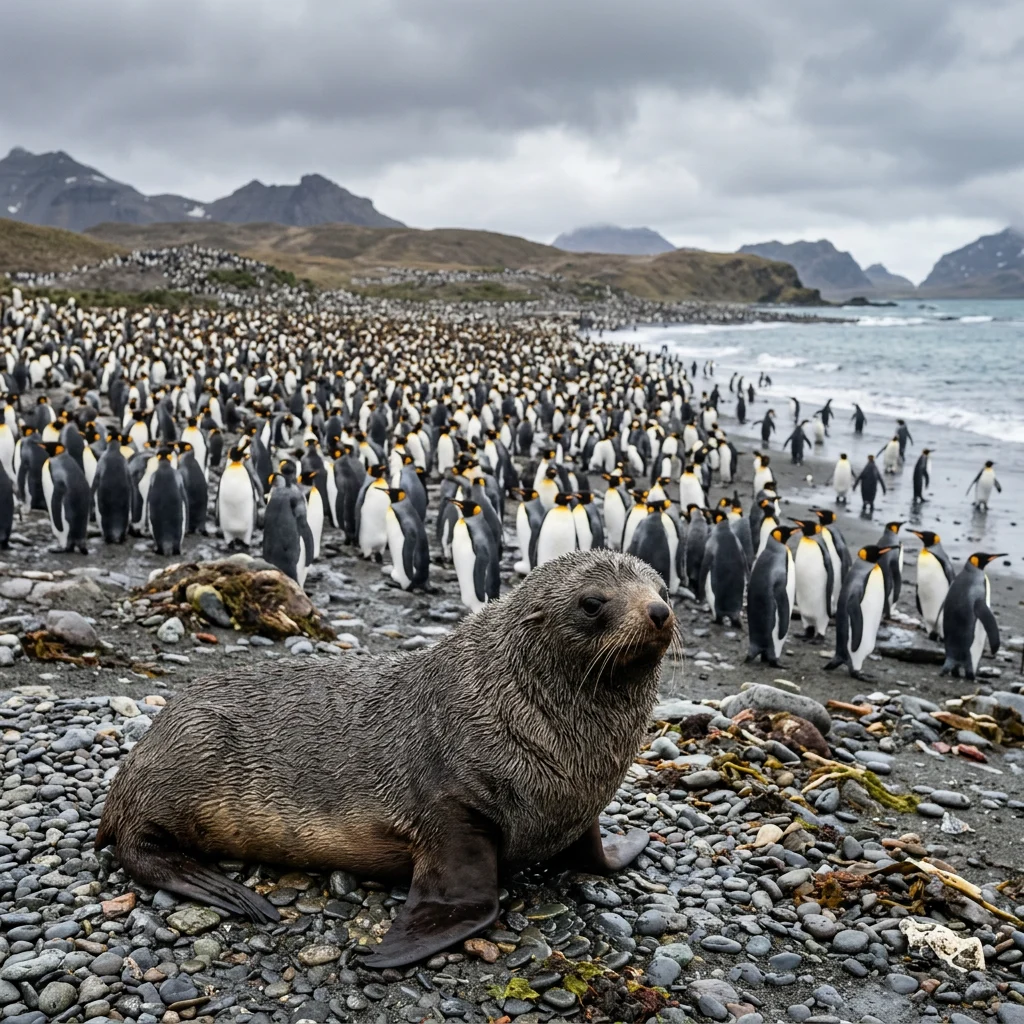
Yes, and in some places they matter more to penguin numbers than leopard seals do.
Fur seals usually eat fish, squid and krill, but individuals learn to hunt penguins near colonies. In 2007 researchers watching Antarctic fur seals at Brown Bluff on the Antarctic Peninsula and Baily Head on Deception Island saw them catch and kill Adélie and chinstrap penguins, shaking them at the surface in the same way leopard seals do. Cape fur seals off South Africa prey on the endangered African penguin. In south-eastern Australia, recovering long-nosed (New Zealand) fur seals eat little penguins, which has caused real friction between seal and penguin conservation. See the fur seal profile.
The Antarctic Peninsula records are worth looking at in detail, because they show how fur seals hunt. Ingrid Visser and colleagues, writing in Aquatic Mammals in 2008, described five cases from February 2007. At Brown Bluff, on the north-eastern tip of the peninsula, Antarctic fur seals caught two Adélie penguins, one of them a recently fledged chick on an ice floe. At Baily Head on Deception Island, in the South Shetlands, a seal chased a group of chinstrap penguins across the beach, caught one, lost it to a giant petrel, and then caught and killed another. The seals grabbed the penguins by the tail and shook them violently, often at the water’s edge, much as leopard seals do. The two seals whose age and sex could be identified were subadult males. Leopard seals were hunting penguins nearby within an hour of each observation, and the authors suggested that the fur seals may have learned the technique by watching them.
Further north, the same species goes after much bigger birds. On Marion Island in the southern Indian Ocean, Greg Hofmeyr and Marthan Bester described adult male Antarctic fur seals chasing, killing and eating adult king penguins, the second-largest penguin species. Most of the chases took place on land. It was the first report of fur seals taking seabirds that large, and of them catching penguins ashore rather than in the water.
Off southern Africa the issue is a conservation problem. African penguins are endemic to the region and lost about 90% of their population during the 20th century. The colony on Dyer Island, near Gansbaai, fell from about 23,000 pairs in the late 1970s to about 2,000 pairs from 1997 onward. Cape fur seals live on neighbouring Geyser Rock. A study by Johnson and colleagues, published in 2006 in the South African Journal of Wildlife Research, collected 134 penguin carcasses on Dyer Island in 2000 and found that 101 showed seal injuries. All 92 successful attacks on live penguins that the team witnessed were by seals. The seals killed an estimated 2–2.5% of the breeding birds that year, mostly at dawn and dusk as penguins travelled to and from their feeding grounds. Systematic watches from June to December 2004 put the toll much higher, at about 300 adults or roughly 7.5% of the island’s penguins. Adult African penguins normally suffer only about 10–20% total mortality a year, so losses of that size are considered unsustainable.
Researchers in South Africa have found that the seabird killers there are almost all subadult males aged roughly 2 to 8 years. Because the behaviour is learned and limited to a small number of animals, removing those particular seals has been proposed as a way to protect the birds, and work at Malgas Island, where seals also kill Cape gannet chicks, supports the idea.
In south-eastern Australia the story involves the long-nosed fur seal, also called the New Zealand fur seal. It was heavily hunted in the 19th century and is now recovering. Monitoring in South Australia found little penguin remains in about 37–47% of fur seal droppings on the Fleurieu Peninsula, compared with about 10% on the Yorke Peninsula and only 2–5% on Kangaroo Island. Over the same period the little penguin colony on Granite Island, off Victor Harbor, dwindled to just a few dozen birds, with 26 counted in 2012. State monitoring reports are careful to say that the causes of the decline are not fully understood. Seal predation is one suspect, alongside prey availability, predators on land and disease. In 2022 Sarah-Lena Reinhold and colleagues used chemical “feather-prints” to trace penguin feathers in seal droppings back to their home colony, and found that 46–70% came from nearby colonies. That kind of tool lets managers work out which colonies are most at risk.
Do sea lions and elephant seals eat penguins?
Some do. New Zealand sea lions are the best-documented case; elephant seals only rarely.
On the Otago Peninsula, a 2007 study in Biological Conservation recorded 20 attacks by New Zealand sea lions on endangered yellow-eyed penguins. Prey remains showed that males did not eat penguins, but females ate an estimated 20–30 a year, and a single animal may have been responsible for most of them. In 2005 only nine females lived there, alongside 50–70 males. At the two worst-hit sites, penguin nest numbers and adult survival fell. The southern elephant seal, despite its size, is a deep-diving fish and squid hunter; killings of Magellanic penguins on land have been recorded but are unusual. It is the elephant seal people most often picture when they ask “do elephant seals eat penguins?”, and the honest answer is: almost never.
On the Otago Peninsula, local reporting named the likely penguin-killing sea lion as Katya, the first pup born on the Otago Peninsula to the sea lion that founded the mainland colony in the late 1980s, as the probable culprit. Researchers estimated that she was eating up to three yellow-eyed penguins a month. It created an awkward choice for conservation managers. The yellow-eyed penguin is one of the rarest penguins in the world, but the New Zealand sea lion is also threatened, and Katya was then the best-breeding female in a small colony that the Department of Conservation was trying to build up. The department chose to monitor rather than remove her.
South American sea lions, the largest sea lions in their region, also take penguins. At Gonzalo Island in the Diego Ramírez archipelago, south-west of Cape Horn, Jaime Cursach and colleagues recorded 75 sea lion attacks on southern rockhopper penguins during the 2010–2011 summer. About 45% of them (34 attacks) killed the penguin. The sea lions used three tactics: chasing penguins as they swam, chasing them on land, and ambushing them from below the surface. Southern giant petrels gathered around the kills, as skuas and petrels do around leopard seals further south.
Why do only some seals eat penguins?
Most seals are built and behave in ways that make penguins poor prey. Weddell seals feed under the fast ice on fish, squid and other invertebrates. Crabeater seals, despite their name, live almost entirely on krill, and Ross seals hunt squid and fish in the deep pack ice. Southern elephant seals dive hundreds of metres for squid and fish and spend most of the year far from penguin colonies. For these animals a fast, wary, feathered bird near the surface is simply not worth the effort.
Among the seals that do take penguins, the habit is patchy and often learned. In almost every study outside Antarctica, a few individuals account for most of the kills: one female sea lion in Otago, subadult male fur seals at Dyer Island, a few older males at Marion Island. The Antarctic Peninsula observers noted that the fur seals they watched handled penguins with practised skill, which suggests they had done it before. Learned predation of this kind can spread when young animals watch others, and it can disappear when the specialists die. That is why managers in South Africa have focused on individual problem seals rather than seal populations as a whole.
How do penguins avoid seals?
Penguins cannot outswim a leopard seal over a short distance, but they can avoid giving it the chance. Adult penguins are fast and agile underwater, and most of the danger is concentrated in a narrow band of water close to the colony. Penguins at the ice edge are often seen hesitating, crowding together and then entering the water in a rush, so that a waiting seal can only catch one bird among many. The same dilution effect works at the scale of whole colonies, as the Ross Island counts showed.
Timing matters too. Adélie and emperor penguins tend to avoid entering or leaving the water at night. A 2012 review by David Ainley and Grant Ballard argued that this is driven by fear of predation rather than an inability to feed in the dark, since Adélies can catch prey in very low light. The most vulnerable birds are the fledglings. When chicks enter the sea for the first time in late summer they are inexperienced, slower and easily caught, and that is when leopard seals gather off the busiest colonies and when fur seal scats with penguin feathers become common on the Antarctic Peninsula.
Do seals threaten penguin populations?
For most Antarctic penguins, no. Losing 1–3% of breeding adults a season to leopard seals is part of the natural mortality that Adélie, gentoo and chinstrap colonies have always lived with, and long-term changes in Ross Sea colonies are usually linked to sea-ice conditions and food rather than to seals. Leopard seals themselves are listed as Least Concern by the IUCN.
The picture is different where a penguin population is already small or falling for other reasons. For the endangered African penguin, the extra deaths from seals at a few colonies come on top of food shortages caused by shifts in sardine and anchovy stocks. For the yellow-eyed penguin, Lalas and colleagues modelled the Otago Peninsula population and concluded that penguins at a single site could not remain viable if sea lion predation were their only source of deaths. For the little penguins of Granite Island, seal predation may be one of several pressures on a colony that has almost vanished. In each case the issue is a recovering marine mammal meeting a declining seabird, and conservationists have to protect both.
Common misconceptions about seals and penguins
The most common mistake is to picture seals and penguins together everywhere. Penguins live almost entirely in the Southern Hemisphere, from Antarctica north to South Africa, Australia, New Zealand and South America, with the Galápagos penguin reaching the equator. Arctic seals such as harp, ringed and bearded seals never meet a penguin, and neither do polar bears. Another misconception is that elephant seals, as the largest seals, must be the biggest penguin killers. They are deep-water fish and squid hunters, and penguin kills by elephant seals are rare oddities.
Orcas are often assumed to be major penguin predators as well. Some killer whale populations do take penguins, but at Ross Island, where Grant Ballard and David Ainley watched thousands of Adélies over nine field seasons, they recorded only two interactions. In one, a pod spent about an hour chasing penguins near the ice edge, and one dead penguin was seen afterwards. The authors concluded that killer whales generally do not bother with small, agile Adélies, and suggested that the chase may have been practice for young whales rather than a meal.
Related on TheSea
Do seals eat penguins?
Yes. Leopard seals are the main penguin predators, and fur seals, New Zealand sea lions and occasionally elephant seals also kill penguins. Most seal species do not.
Which seal eats the most penguins?
The leopard seal, which hunts Adélie, gentoo and chinstrap penguins at Antarctic colonies every summer.
Do elephant seals eat penguins?
Very rarely. Southern elephant seals eat mainly fish and squid; a few killings of Magellanic penguins on land have been recorded.
Do fur seals eat penguins?
Yes. Antarctic, sub-Antarctic, Cape and New Zealand fur seals have all been documented killing penguins near colonies.
Do Weddell seals eat penguins?
No. Weddell seals eat fish, squid and other invertebrates under the sea ice.
Do sea lions eat penguins?
Some do. New Zealand sea lions kill yellow-eyed penguins on the Otago Peninsula, South American sea lions also kill rockhopper and other penguins where colonies overlap.
How do leopard seals catch penguins?
They ambush them in the water near ice edges and landing beaches, then shake them at the surface to tear them apart.
Do leopard seals eat emperor penguins?
Occasionally. Emperors are large, but leopard seals do take them, especially near the ice edge.
- Visser, I. N. et al. (2008). Antarctic fur seals (Arctocephalus gazella) observed predating Adélie and chinstrap penguins, Antarctic Peninsula. Aquatic Mammals 34(2): 193–199.
- Lalas, C. et al. (2007). Predation by New Zealand sea lions as a threat to the viability of yellow-eyed penguins at Otago Peninsula. Biological Conservation 135: 235–246.
- Reinhold, S.-L. et al. (2022). Tracing seal predation back to the source colony of their penguin prey: a trace element and stable isotope analysis. Frontiers in Marine Science 9: 813106.
- Johnson, R. L. et al. (2006). Seal predation on seabirds at Dyer Island, South Africa. South African Journal of Wildlife Research 36(1); and Makhado, A. B., Crawford, R. J. M. & Underhill, L. G. (2007). Predation of African penguins by Cape fur seals at Dyer Island.
- Penney, R. L. & Lowry, G. (1967). Leopard seal predation on Adélie penguins. Ecology 48.
- Ainley, D. G., Ballard, G., Karl, B. J. & Dugger, K. M. (2005). Leopard seal predation rates at penguin colonies of different size. Antarctic Science 17(3): 335–340.
- Rogers, T. & Bryden, M. M. (1995). Predation of Adélie penguins by leopard seals in Prydz Bay, Antarctica. Canadian Journal of Zoology 73.
- Krause, D. J., Goebel, M. E. & Kurle, C. M. (2020). Leopard seal diets in a rapidly warming polar region vary by year, season, sex, and body size. BMC Ecology 20.
- Hofmeyr, G. J. G. & Bester, M. N. Predation on king penguins by Antarctic fur seals. South African Journal of Antarctic Research.
- Cursach, J. A., Suazo, C. G. & Rau, J. R. (2014). Predation of the South American sea lion on the southern rockhopper penguin at Gonzalo Island, Diego Ramírez archipelago. Revista de Biología Marina y Oceanografía 49(2): 373–377.
- Ballard, G. & Ainley, D. G. (2005). Killer whale harassment of Adélie penguins at Ross Island. Antarctic Science 17(3): 385–386.
- Department for Environment and Water, South Australia (2015). Penguin monitoring and conservation activities, Gulf St Vincent.
Blane Perun has been exploring Earth’s oceans and marine life for over 25 years. Founder of TheSea.Org in 1999, underwater photographer, coral aquaculture pioneer, and explorer of 80+ countries.
About Blane Perun → More on Seals →