Where Do Penguins Live? — From Antarctic Ice to the Equator
Penguins live almost entirely in the Southern Hemisphere, along the coasts and islands of the Southern Ocean and the cool currents that flow north from it. Only a few of the 18 or so species live in Antarctica itself, chiefly the emperor and Adelie penguins. Most live farther north: on sub-Antarctic islands such as South Georgia, the Falklands, Crozet and Kerguelen, and along the coasts of South America, southern Africa, southern Australia and New Zealand. One species, the Galapagos penguin, lives on the Equator, and some cross just into the Northern Hemisphere. There are no wild penguins in the Arctic. All penguins spend much of their lives at sea, coming ashore to breed and moult.
Only a few penguin species actually live as far south as Antarctica. Several live in the temperate zone, nesting on beaches, cliffs, forest floors and burrows on islands from New Zealand to southern Africa, and one lives on the Equator.
The short answer
Penguins live in the Southern Hemisphere. Every species breeds south of the Equator except the Galapagos penguin, some of which live just north of it on the tip of Isabela Island. There are no wild penguins in the Arctic, despite their reputation as polar birds.
Within the Southern Hemisphere, penguins are much more widespread than most people imagine. Only a few species live as far south as Antarctica. The rest are spread across the sub-Antarctic islands of the Southern Ocean and the temperate coasts of South America, southern Africa, southern Australia and New Zealand, wherever cool, nutrient-rich water brings them food. The Galapagos penguin manages to live on the Equator only because the cold Humboldt and Cromwell currents keep the waters around the western Galapagos cool and productive.
Penguins also live in two worlds. They spend about half of their lives on land and the other half at sea. On land they breed, raise chicks and moult. At sea they feed, and outside the breeding season many species range far from their colonies, sometimes thousands of kilometres. So “where penguins live” means both the coasts where they nest and the ocean where they spend the rest of the year.
The overview of penguins as seabirds explains how they fit among ocean birds; this page goes region by region.
Antarctica: the ice specialists
Only four penguin species nest on the Antarctic continent itself, and just two of them, the emperor and the Adelie, are found all around its coast. They are the most southerly penguins in the world.
The emperor penguin is endemic to Antarctica and breeds in the coldest environment of any bird, on fast sea ice, during the polar winter. Air temperatures can reach −40 °C, and the sea is about −1.8 °C. Emperors walk 50 to 120 km over the ice to reach their breeding colonies, where the male incubates a single egg on his feet through the winter darkness. Because they breed on sea ice rather than land, they depend on it forming at the right time and lasting long enough for the chicks to fledge.
The Adelie penguin is found along the entire Antarctic coast, which is the only place where it breeds, and it is the most widespread penguin. Unlike the emperor, it will not nest on ice. It needs bare, rocky, ice-free ground, where it builds a nest of stones. Adelies also breed on several sub-Antarctic islands, including the South Orkneys, South Shetlands, South Sandwich Islands and Balleny Islands, but they are much less common north of 60°S. In winter they move north to stay in the pack ice zone where there is at least some daylight. Adelies from the Ross Sea travel an average of about 13,000 km a year following the sun between their colonies and their winter foraging grounds.
The other two species that reach the continent are the chinstrap and gentoo, both found along the Antarctic Peninsula, the long arm of Antarctica that reaches north towards South America. The Peninsula is the most crowded part of the continent for penguins, and its warming climate is reshuffling which species thrive there.
The Antarctic Peninsula and the Scotia Arc
The chinstrap penguin has a circumpolar distribution but is centred on the Antarctic Peninsula and the island arc that curves from it towards South America. It breeds in Antarctica, Argentina, Chile, Bouvet Island, the French Southern Territories, and South Georgia and the South Sandwich Islands. Chinstrap colonies can number several hundred thousand pairs.
The gentoo penguin breeds on the Antarctic Peninsula and the South Shetland and South Orkney islands, as well as on many sub-Antarctic islands farther north. It prefers shallow coastal waters close to its colonies, and as the Peninsula has warmed it has been spreading south into areas that used to be too icy. That contrasts with the more ice-dependent Adelie and chinstrap penguins, which have declined in parts of the same region.
The sub-Antarctic islands
The heart of the penguin world is not Antarctica but the scattered sub-Antarctic islands of the Southern Ocean. South Georgia, the South Sandwich Islands, Bouvet, the Prince Edward Islands, Crozet, Kerguelen, Heard and McDonald, and Macquarie Island lie in a ring around the Antarctic, close enough to the cold, food-rich waters of the Southern Ocean but free of the sea ice that covers the continent’s coast. King penguins often breed on the same large islands as at least half of all living penguins.
The king penguin breeds on sub-Antarctic islands between about 45 and 55°S, as well as in Tierra del Fuego and the Falklands. Its largest colonies are on the Crozet Islands, the Prince Edward Islands, Kerguelen and South Georgia. Even here, numbers can change dramatically: satellite images and photos released in 2018 showed that the king penguin colony on France’s remote Ile aux Cochons in the Crozet Islands had collapsed from about 2 million birds to barely 200,000.
The macaroni penguin, once considered the most abundant penguin, ranges from the sub-Antarctic to the Antarctic Peninsula, with at least 216 breeding colonies at 50 sites recorded. It breeds on South Georgia, the South Sandwich and South Orkney Islands, Bouvet, the Prince Edward and Marion Islands, Crozet, Kerguelen and Heard, as well as in southern Chile and the Falklands. Its close relative the royal penguin breeds only on Macquarie Island and nearby islets.
The southern rockhopper penguin breeds on the Falklands and on islands off Patagonia, such as Isla de los Estados and the Diego Ramirez Islands, while its eastern form breeds on the Prince Edward, Crozet, Kerguelen, Heard, Macquarie, Campbell, Auckland and Antipodes islands. The northern rockhopper is found much farther north, in the South Atlantic and Indian Oceans: more than 99% breed on Tristan da Cunha and Gough Island, with others on Amsterdam and St Paul islands.
South America
South America has penguins on both its cold-water coasts. Along the Atlantic side, the Magellanic penguin breeds in coastal Patagonia in Argentina and Chile and on the Falkland Islands. It is the most numerous of the banded penguins, and after breeding it migrates north for the winter, feeding offshore as far as Brazil and Uruguay. It has occasionally been seen as far north as Espirito Santo in Brazil.
On the Pacific side, the Humboldt penguin lives along the coast of Peru and northern Chile, from southern Chile along the arid coast of the Atacama Desert to subtropical Isla Foca in northern Peru. Its range is restricted to coasts and offshore islands bathed by the cold Humboldt Current, which provides a continuous supply of nutrients and supports huge populations of seabirds. Humboldt penguins traditionally nested in burrows dug into thick guano deposits. On the central Chilean coast, the ranges of the Humboldt and Magellanic penguins overlap, and the two have been found nesting in mixed colonies.
Farther south, gentoos breed on Martillo Island in the Beagle Channel and on Isla de los Estados, king penguins breed in the Argentine part of Tierra del Fuego, and rockhoppers and macaronis breed on islands off southern Chile and Argentina. The Falkland Islands alone host gentoo, king, Magellanic, rockhopper and macaroni penguins.
Africa
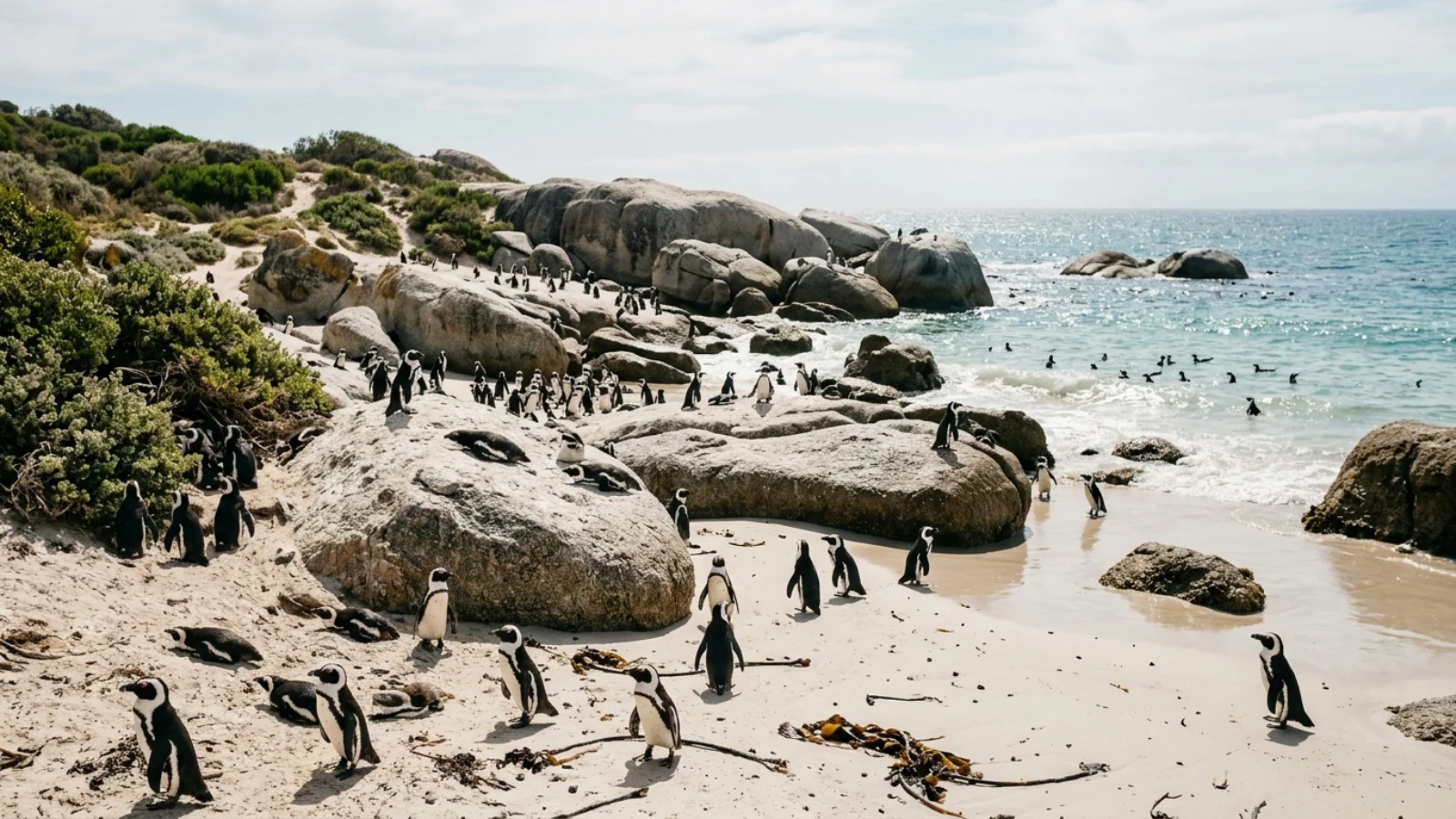
Only one penguin breeds in Africa. The African penguin lives on the south-western coast of the continent, in colonies on 24 islands between Namibia and Algoa Bay near Port Elizabeth, South Africa, as well as at a few mainland sites. It is the only penguin species that breeds in Africa and gave its name to Namibia’s Penguin Islands. Its diet is built on sardines and anchovies; as sardine stocks declined near its colonies it shifted partly to anchovies, which carry less fat and protein. Vagrant juveniles occasionally turn up beyond the normal range. The species is now Critically Endangered.
New Zealand and Australia
The New Zealand region is the centre of diversity for the crested penguins and home to some of the most unusual penguin habitats. The Fiordland penguin breeds along the south-western coasts of the South Island and on Stewart Island, nesting among tree roots and rocks in dense temperate coastal forest. The Snares penguin breeds only on the Snares Islands, south of the South Island, where many colonies nest under the cover of Olearia forest. The erect-crested penguin breeds only on the Bounty and Antipodes Islands and spends the winter at sea.
The yellow-eyed penguin is the largest penguin to breed on the New Zealand mainland. It lives in two populations, one along the south-east coast of the South Island and Stewart Island, and one on the sub-Antarctic Auckland and Campbell Islands. Unlike most penguins, it does not nest in dense colonies: birds come ashore in small groups and then walk to individual nest sites up to a kilometre inland, out of sight of each other.
The smallest penguins of all, the little penguins, live in New Zealand and southern Australia. Little penguins of Australia and New Zealand were long treated as one species, but a 2016 study described the Australian birds as a separate species, Eudyptula novaehollandiae, which also lives in the Otago region of New Zealand. Little penguins have even moved into towns: some new colonies have been established in urban areas, and one lives in Wellington Harbour on Matiu/Somes Island. Little penguins have also been reported from Chile and South Africa, although it is unclear whether these were vagrants.
The Galapagos: penguins on the Equator
The Galapagos penguin is the most northerly penguin and the only one whose range includes part of the Northern Hemisphere. About 90% of the population lives on Fernandina Island and the west coast of Isabela Island, where the cold currents well up, and the northern tip of Isabela crosses the Equator. It nests in caves and lava crevices to keep its eggs and chicks out of the tropical sun, and it copes with heat by panting and shading its feet.
Why penguins live where they do
The pattern of penguin distribution comes down to food and history. Penguins evolved in the Southern Hemisphere: the earliest known penguins lived around the time of the Cretaceous-Paleogene extinction in the region of southern New Zealand and Antarctica, which were then much closer together. Modern penguins originated in the oceans between the Australia-New Zealand region and Antarctica, and different groups then spread. The banded and little penguins radiated eastwards with the Antarctic Circumpolar Current from about 28 million years ago, while the crested penguins have their highest diversity in the New Zealand region.
Wherever they went, penguins followed cold, productive water. The ranges of the Humboldt, African and Galapagos penguins trace cold upwelling currents almost exactly. Ocean currents and upwelling may matter more than latitude: although some researchers argue that penguins follow Bergmann’s rule, with larger species in colder places, others point out that fossil penguins contradict it and that currents and upwelling probably had a greater effect on where penguin species live.
Temperature alone does not set the limits. Small penguins can live in very cold water because all penguins have a counter-current heat exchanger in their flippers, the humeral plexus, which keeps heat in the body. At the other extreme, the Galapagos penguin lives where air temperatures reach 28 °C by behaving in ways that shed heat. What every penguin needs is a reliable supply of fish, krill or squid within swimming distance of a safe place to breed.
Where penguins nest
Penguin breeding habitats are surprisingly varied. Emperors breed on fast sea ice. Adelies, chinstraps and gentoos nest on bare rock or gravel, building nests of stones. King penguins do not build nests at all but incubate their single egg on their feet. Macaroni colonies are among the largest and most densely packed of any penguin, and rockhoppers breed anywhere from sea level to cliff sides and sometimes inland. The banded penguins and little penguins are the only living penguins that nest in burrows, digging into soil, sand or guano, or using caves and crevices. Fiordland and Snares penguins nest in forest, and yellow-eyed penguins walk to scattered nest sites up to a kilometre inland.
Most penguins breed in large colonies. The exceptions are the yellow-eyed and Fiordland penguins. Colonies range from as few as 100 pairs for gentoo penguins to several hundred thousand for king, macaroni and chinstrap penguins.
Where penguins go at sea
Outside the breeding season, many penguins disappear from land for months. Adelies follow the edge of the pack ice through the polar winter. Erect-crested penguins spend extended periods at sea before their moult and through the winter, and individuals have turned up as far away as the Falkland Islands, Argentina, Antarctica and Australia. Magellanic penguins migrate north to the coasts of Brazil and Uruguay, and vagrants have been found as far away as El Salvador, Australia and New Zealand. A northern rockhopper found on the Kerguelen Islands appears, from its DNA, to have come from Gough Island, 6,000 km away.
Wandering birds sometimes end up far off course. In June 2011, an emperor penguin came ashore on New Zealand’s Peka Peka Beach, about 3,200 km off course on its journey to Antarctica. Nicknamed Happy Feet, it was suffering from heat exhaustion and had eaten sand and driftwood. After surgery and recovery it was released back into the sea south of New Zealand.
Why there are no penguins in the Arctic
The Arctic and Antarctic have similar climates, but there are no wild penguins in the Arctic. Penguins evolved in the Southern Hemisphere, and apart from the Galapagos penguin’s small step over the Equator, no wild population lives in the north. In the far north, a similar niche was filled by the auks, including puffins and the extinct great auk, which look strikingly like penguins because of convergent evolution. In fact the word “penguin” originally belonged to the great auk; sailors later gave it to the southern birds because they looked alike.
Puffins and other living auks can still fly, and one explanation is that a flightless bird would not survive alongside land predators such as polar bears and foxes. There are no such predators in the Antarctic, which is one reason penguins could give up flight.
There was once an attempt to put penguins in the Arctic. In 1936, nine king penguins were brought to Norway and released in pairs at Rost in Lofoten and at Gjesvaer in Finnmark, on islands with easy access to the sea and no predators. Macaroni and African penguins were later released at Rost as well. Penguins were sighted along the coasts of Nordland and western Finnmark, and it is unclear whether any of them bred. One was killed in a farmyard in 1937 by a woman who thought it was a freak of nature, and the last was seen in 1949.
Seeing penguins in the wild
Because penguins live in so many places, there are many ways to see them. Boulders Beach and other mainland colonies in South Africa, the little penguins of southern Australia and New Zealand, Magellanic colonies in Patagonia and the Falklands, and the Galapagos Islands are all far more accessible than Antarctica. Wherever penguins are seen, the same rules apply: keep a respectful distance, never block their paths to the sea, and follow local guidance, especially for endangered species such as the African and Galapagos penguins. For the full list of species and where each breeds, see types of penguins.
Where do penguins live?
Almost entirely in the Southern Hemisphere: Antarctica, the sub-Antarctic islands, and the coasts of South America, southern Africa, southern Australia and New Zealand, plus the Galapagos Islands on the Equator.
Do penguins live in the Arctic?
No. There are no wild penguins in the Arctic. A few were released in northern Norway in 1936, but the last was seen in 1949.
Do penguins live in Antarctica?
Yes, but only a few species. Four nest on the continent, and only the emperor and Adelie penguins are found all around its coast.
Which penguin lives farthest north?
The Galapagos penguin. Some live on the northern tip of Isabela Island, just north of the Equator.
Do penguins live in Africa?
Yes. The African penguin breeds on islands and a few mainland sites from Namibia to Algoa Bay in South Africa.
Do penguins live in Australia?
Yes. Little penguins breed along the coasts of southern Australia, and Fiordland penguins are occasionally found there.
Do penguins live in hot places?
Some do. The Galapagos penguin lives on the Equator, and the Humboldt penguin nests along the Atacama Desert coast, but both depend on cold ocean currents for food.
How much time do penguins spend at sea?
About half of their lives. They come ashore to breed and moult and spend the rest of the time feeding at sea.
- Wikipedia contributors, “Penguin”, and species articles for all 18 penguins including “Adelie penguin”, “Chinstrap penguin”, “King penguin”, “Humboldt penguin”, “Magellanic penguin”, “African penguin”, “Fiordland penguin”, “Snares penguin”, “Yellow-eyed penguin” and “Little penguin” (2023 snapshot via Kiwix mirror, accessed November 2026).
- Norwegian Polar Institute, “Did you know that penguins used to live in Lofoten?” (5 December 2011).
- University of Washington News, on Galapagos penguin nesting habitat (19 October 2010).
Blane Perun has been exploring Earth’s oceans and marine life for over 25 years. Founder of TheSea.Org in 1999, underwater photographer, coral aquaculture pioneer, and explorer of 80+ countries.
About Blane Perun →