Can Penguins Fly? — Why Penguins Traded the Air for the Sea
No, penguins cannot fly. All living penguins are flightless birds whose wings have evolved into stiff, flattened flippers that are useless in the air but work superbly underwater, where penguins swim with a motion very like flying. Penguins lost the ability to fly more than 60 million years ago; the oldest known penguin, Waimanu, which lived about 62 million years ago in New Zealand, was already flightless. Research on diving seabirds suggests why: a wing shaped for efficient diving makes flying so expensive that, for larger wing-propelled divers, flight stops being an option. With no land predators in the Antarctic to escape from, penguins could afford to give up the air.
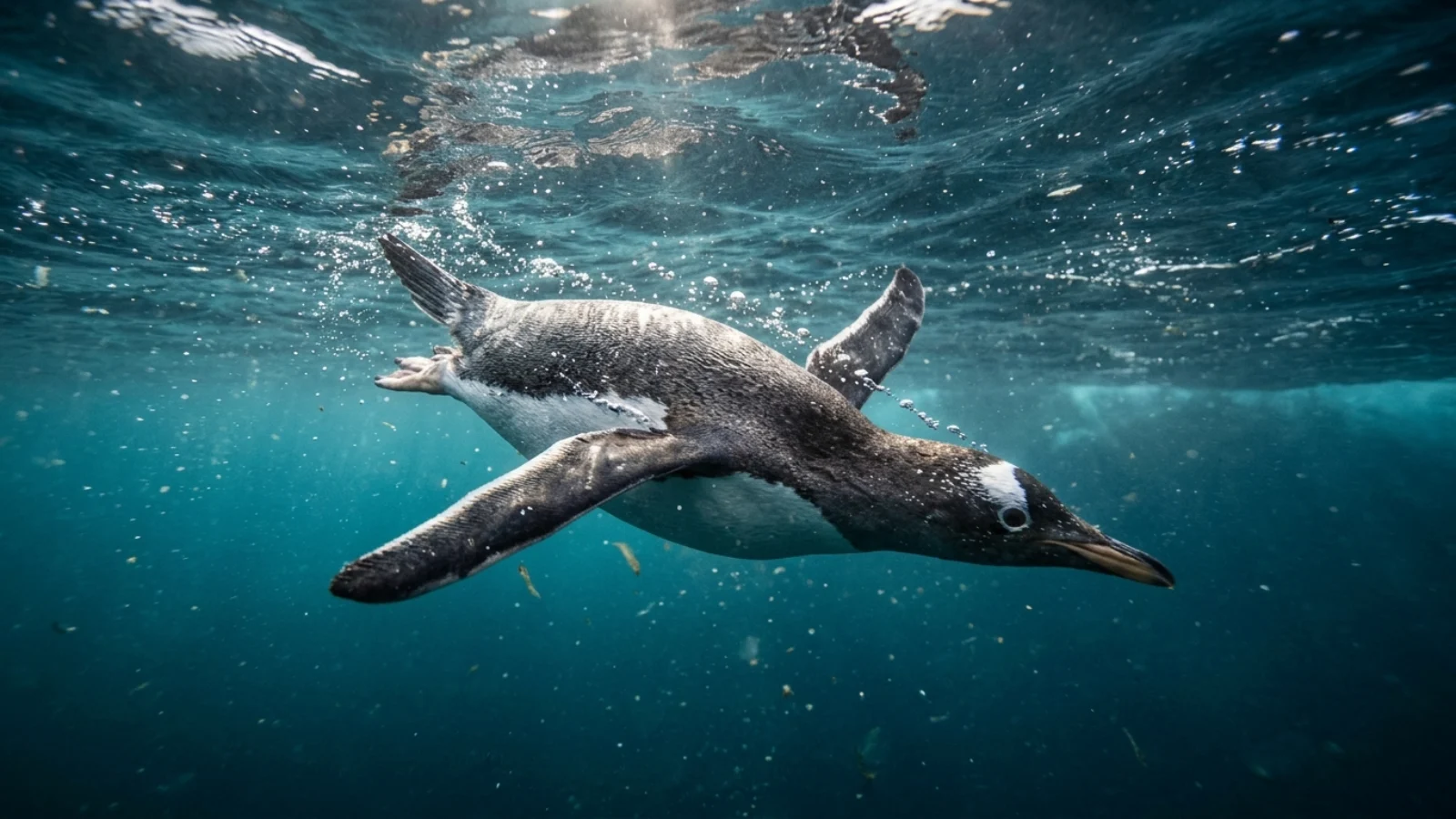
A swimming penguin beats its flippers in a way that looks very much like a bird flying through the air. Penguins did not stop “flying” so much as move it into the water, where the gentoo can reach about 36 km/h.
The short answer
Penguins cannot fly. All of the 18 or so living penguin species are flightless birds, and none of them can take off or glide. Their wings have evolved into flippers that are useless for flight in the air.
But penguins have not really given up flying so much as changed where they do it. In the water they are astonishingly agile, and their swimming looks very similar to the flight of other birds through the air. Penguins propel themselves with their flippers and can reach speeds and depths that no flying bird could match. The gentoo penguin, the fastest, reaches up to 36 km/h underwater, and the emperor penguin is the deepest-diving bird in the world.
What a penguin’s wing is made of
A penguin’s flipper is a true wing. It contains the same general bones as the wing of a flying bird: the humerus in the upper arm, a small sesamoid bone, the radius and ulna in the forearm, the wrist bones, the carpometacarpus and the phalanges. What has changed is their shape. The bones are shorter and stouter so that the wing serves as a fin, and over the course of evolution penguin flippers became thicker, denser and smaller as they were modified for moving through water.
In the emperor penguin, as in all penguins, the wings are stiffened and flattened into flippers suited to a marine life.
Penguins have not lost their flight muscles. Unlike flightless running birds such as kiwis, which have small pectoral muscles and a low basal metabolic rate, penguins have well-developed pectoral muscles that power their swimming when hunting and diving, and they have an intermediate basal metabolic rate as a result.
Flying underwater
The penguin body is built around underwater flight. It is streamlined to reduce drag, and a layer of air trapped within the smooth plumage provides buoyancy and insulation in cold water. Penguins are countershaded, with dark backs and white fronts, which hides them from predators and prey both above and below.
The results are impressive. Gentoo penguins can dive to depths of 170 to 200 m and are the fastest underwater birds in the world. Emperor penguins can stay underwater for around 20 minutes and have been recorded diving to 535 m; some sources give approximately 550 m. To manage that, the emperor has an unusually structured haemoglobin that works at low oxygen levels, solid bones that reduce the risk of pressure injury, and the ability to slow its metabolism and shut down non-essential organ functions during dives. Smaller penguins generally feed near the surface in dives of one or two minutes.
Solid bones are part of the story. Many birds have air-filled, or pneumatised, bones, and even some flightless running birds, such as ostriches and emus, have air-filled thigh bones. Penguins, like loons and puffins, have no pneumatised bones at all, and the emperor penguin’s solid bones are one of its adaptations for deep diving.
What penguins do with their wings
A penguin’s wings are busy even out of the water. On land, penguins use their tails and wings to keep their balance in their upright stance. Emperor penguins push themselves across the ice with their flipper-like wings as well as their feet when tobogganing. During courtship, Galapagos penguins pat each other with their flippers, and on hot days they stretch their flippers out while hunching forward to shade their feet.
The flippers also control body heat. All living penguins, even those in warm climates, have a counter-current heat exchanger in the flipper called the humeral plexus. At least three branches of the main artery run alongside the returning veins, so cold blood coming back from the flipper is warmed by blood heading out to it, limiting heat loss. That system helps explain how relatively small penguins survive in very cold water.
When penguins lost flight
Penguins have been flightless for a very long time. A 2022 genomic study in Nature Communications concluded that penguins lost the ability to fly more than 60 million years ago and then evolved a hyper-specialised marine body plan.
The fossil record agrees. The oldest known fossil penguin, Waimanu manneringi, lived in the early Paleocene of New Zealand, about 62 million years ago. It was a loon-like bird, less well adapted to the water than modern penguins, but it was already flightless, with short wings adapted for deep diving. Waimanu swam on the surface mainly with its feet, but its wings were already adapting to underwater movement, unlike most other diving birds.
Waimanu is one of the most important bird fossils for understanding bird evolution, because of its age and because penguins sit near the base of the modern bird family tree. Its first fossils were found in 1980 in the Waipara Greensand near the Waipara River in Canterbury, New Zealand, and the holotype, a partial skeleton including the leg bones and pelvis, is held in the Canterbury Museum in Christchurch. The name comes from the Maori wai, “water”, and manu, “bird”. Waimanu was about the size of an emperor penguin, around 1 m long, and may have resembled a flightless loon in shape and moved rather like the great auk. Its wing bones do not yet show the extreme specialisations of modern penguins, which shows that the penguin flipper was refined gradually over tens of millions of years after flight was lost.
That means penguins became flightless within a few million years of the extinction of the dinosaurs at the end of the Cretaceous. The penguin lineage itself is thought to have split from its closest relatives around 70 to 68 million years ago, and a 2014 analysis of whole genomes concluded that penguins are the sister group of the tubenoses, the albatrosses, petrels and shearwaters of the order Procellariiformes, from which they diverged about 60 million years ago. Their ancestors were probably auk-like birds that could fly through the air as well as underwater.
Why diving beat flying
Why would a bird give up flight? Flight is the most costly form of locomotion in nature, and the energy it requires rises with body size. For a seabird, there is an added complication: a wing cannot be perfect both in air and in water.
A 2013 study in the Proceedings of the National Academy of Sciences, led by Kyle Elliott, tested this idea on two living birds that both fly and dive: thick-billed murres, which are auks that swim with their wings, and pelagic cormorants, which swim with their feet. Both had the highest flight costs ever recorded for vertebrates. The murres’ diving costs were low, but still higher than those of penguins, which do not fly at all. The murres’ flight costs were also higher than biomechanical models had predicted.
The authors concluded that form follows function in diving birds. Optimising wing shape for wing-propelled diving leads to such high flight costs that, in larger wing-propelled diving seabirds, flying stops being an option. Murres sit close to that boundary: they can still fly, but only at enormous cost. Penguins crossed it. Flightlessness has evolved independently in at least five lineages of seabirds.
No predators to fly from
The other half of the explanation is what penguins did not need to escape. Penguins have no land predators in Antarctica or on the nearby offshore islands, which is also why they show so little fear of humans. Birds that live where there are no ground predators can afford to lose flight, and many birds on oceanic islands have done so.
The contrast with the Arctic is striking. The distantly related puffins, which live in the North Pacific and North Atlantic, evolved a similar body to penguins, with a white chest, black back and short, stubby wings that make them excellent swimmers in icy water. But puffins can still fly. One explanation is that a flightless bird would not survive alongside land predators such as polar bears and foxes; there are no such predators in the Antarctic. The resemblance between puffins and penguins is an example of convergent evolution, in which similar environments lead to similar body forms in unrelated animals.
The great auk: the original penguin
The northern hemisphere did once have a large flightless wing-propelled diver: the great auk. Its scientific name, Pinguinus impennis, means roughly “plump or fat without flight feathers”. It was the bird for which the word “penguin” was first used, centuries ago. When European explorers later met the birds we now call penguins in the Southern Hemisphere, they noticed the resemblance and gave them the same name, although the two are not closely related. Genetic work in 2004 confirmed that the great auk belongs to the auk family, the Alcidae, in the order Charadriiformes. The great auk became extinct in the mid-19th century.
Bigger bodies, no flight
Losing flight also freed penguins to grow. The energy needed for flight rises in proportion to body size, which is why flightlessness so often goes hand in hand with large bodies, and in birds gigantism and flightlessness are closely linked on islands that lack mammal or reptile predators. Even the smallest living penguin, the little penguin, weighs more than a kilogram, and the emperor typically weighs 22 to 45 kg.
For a diving animal, size has real advantages. Larger bodies can catch bigger prey and conserve heat in cold seas. The researchers who described the giant fossil Kumimanu suggested that crossing a size threshold of roughly 45 kg may even have helped early penguins spread from New Zealand to other parts of the Southern Hemisphere.
Giant penguins and the evolution of the flipper
Fossils show that early penguins grew enormous. In February 2023, a team led by Daniel Ksepka of the Bruce Museum, with Alan Tennyson of Te Papa and Daniel Field of the University of Cambridge, described Kumimanu fordycei, the largest fossil penguin ever found, from beach boulders in North Otago, New Zealand. Estimated at about 154 kg, it was more than three times the weight of the largest living penguins; emperor penguins typically weigh 22 to 45 kg. A second new species, Petradyptes stonehousei, weighed about 50 kg. The fossils are 59.5 to 55.5 million years old.
Those giants still had some primitive features, including more slender flipper bones and muscle attachment points resembling those of flying birds, and the team compared them with flying, diving birds such as auks. The finding suggests that penguins evolved very large body sizes before their flippers became fully specialised for swimming. Large bodies may have helped them catch bigger prey, hold on to heat in cold seas and perhaps dive deeper than living penguins.
Later giants were tall as well as heavy. During the Late Eocene and Early Oligocene, about 40 to 30 million years ago, Nordenskjoeld’s giant penguin grew to nearly 1.8 m tall, while the New Zealand giant penguin probably weighed 80 kg or more. Icadyptes salasi, a giant 1.5 m tall, lived as far north as northern Peru about 36 million years ago. The giants had disappeared by about 25 million years ago.
The modern flipper took shape later. A 2024 study described Pakudyptes hakataramea, the earliest known tiny penguin, from the Late Oligocene of New Zealand and about the size of the living little penguin. It had a well-developed upper end of the humerus but an archaic elbow joint. The authors concluded that penguin wings evolved rapidly from the Late Oligocene to the Early Miocene, gaining the features that make modern penguins such excellent swimmers.
Other flightless seabirds
Penguins are the most famous flightless seabirds, but not the only ones. The Galapagos Islands, home to the Galapagos penguin, also have the flightless cormorant, and the two are counted together in the national park’s regular seabird censuses. Flightless birds as a whole include more than 60 living species, among them the ratites such as ostriches, emus and kiwis, and many island rails. Species that already have short wings, or that moult all of their wing feathers at once, are more likely to evolve flight loss.
Can penguins get airborne at all?
Penguins can still leave the ground briefly. On land they jump with both feet together to move quickly or cross rocky terrain, and the rockhopper penguins are named for bounding over boulders and across cracks. On snow and ice they slide on their bellies, a movement called tobogganing. None of this is flight, but it shows that penguins are far from helpless out of the water. For more on how penguin legs work, see do penguins have knees?
Can penguins fly?
No. All living penguins are flightless. Their wings have evolved into flippers, which they use to “fly” underwater.
Could penguins ever fly?
Their distant ancestors probably could, but penguins have been flightless for more than 60 million years; the oldest known penguin, Waimanu, was already flightless.
Why can’t penguins fly?
A wing shaped for efficient diving makes flying extremely costly. With no land predators in the Antarctic, penguins could give up flight and specialise in swimming.
Do penguins have wings?
Yes. Their flippers are wings containing the same bones as a flying bird’s wing, but shorter, stouter, denser and stiffer.
How fast can penguins swim?
The gentoo, the fastest, can reach about 36 km/h underwater.
Why can puffins fly but penguins cannot?
Puffins live where there are land predators such as foxes and polar bears, so flight is still worth its cost; Antarctic penguins have no land predators.
What was the biggest penguin ever?
Kumimanu fordycei, which lived in New Zealand 59.5 to 55.5 million years ago, is estimated to have weighed about 154 kg.
- Wikipedia contributors, “Penguin”, “Flightless bird”, “Flipper (anatomy)”, “Emperor penguin” and “Bird anatomy” (2023 snapshot via Kiwix mirror, accessed November 2026).
- Elliott, K. H., et al. (2013). High flight costs, but low dive costs, in auks support the biomechanical hypothesis for flightlessness in penguins. PNAS. doi:10.1073/pnas.1304838110.
- Cole, T. L., et al. (2022). Genomic insights into the secondary aquatic transition of penguins. Nature Communications. doi:10.1038/s41467-022-31508-9.
- University of Cambridge, “Fossil bones of largest penguin ever unearthed” story (9 February 2023), on Ksepka et al. (2023), Journal of Paleontology, doi:10.1017/jpa.2022.88.
- Ando, T., et al. (2024). A new tiny fossil penguin from the Late Oligocene of New Zealand and the morphofunctional transition of the penguin wing. Journal of the Royal Society of New Zealand. doi:10.1080/03036758.2024.2362283.
Blane Perun has been exploring Earth’s oceans and marine life for over 25 years. Founder of TheSea.Org in 1999, underwater photographer, coral aquaculture pioneer, and explorer of 80+ countries.
About Blane Perun →