Seabirds — Birds That Make the Open Ocean Their Home
What is a seabird?
A seabird is a bird that lives most of its life at sea and feeds on marine prey such as fish, squid, krill and plankton. Most come ashore only to breed, often in dense colonies on remote islands and cliffs.
Seabirds are not a single family but a way of life shared by several unrelated groups of birds that have each adapted to the ocean. An albatross and a puffin are no more closely related than an albatross and a pigeon, yet both spend most of their lives at sea, catch marine food and return to land only to nest. A 2019 global assessment led by Maria Dias for BirdLife International covered 359 species that fit this definition, ranging from storm petrels that weigh less than a sparrow to emperor penguins taller than a metre and albatrosses with the longest wings of any living bird.
Despite their different ancestry, seabirds share a recognisable set of traits. They have dense, waterproof plumage and, in most cases, webbed feet. They have salt glands above the eyes that let them drink seawater and eat salty prey. And they share a distinctive life history: they live long, mature late, lay few eggs and invest heavily in each chick. Ninety-five percent of seabirds nest in colonies, and both parents care for the young in almost every species.
What are the main types of seabirds?
The tubenoses (albatrosses and petrels), penguins, the gannets, boobies, cormorants and frigatebirds, the tropicbirds, and the gulls, terns, skuas and auks.
| Group | Families on TheSea.Org | Signature trait |
|---|---|---|
| Tubenoses (Procellariiformes) | Albatrosses, giant petrels, fulmars, gadfly petrels, prions, shearwaters, storm petrels, diving petrels | Tube nostrils, keen smell, oceanic wanderers |
| Penguins (Sphenisciformes) | Penguins | Flightless, wings as flippers |
| Gannets, boobies, cormorants (Suliformes) | Gannets & boobies, cormorants & shags, frigatebirds | Plunge-divers, pursuit-divers, aerial pirates |
| Tropicbirds (Phaethontiformes) | Tropicbirds | Long tail streamers |
| Gulls, terns, auks (Charadriiformes) | Gulls, terns, noddies, skimmers, skuas & jaegers, alcids, auks | Coastal to oceanic; auks are the northern “penguins” |
| Grebes (Podicipediformes) | Grebes | Freshwater breeders that winter at sea |
Tubenoses (order Procellariiformes) are the most oceanic of all birds. Their name comes from the tubular nostrils on top of the bill, linked to an unusually keen sense of smell; many species can track the odours given off by plankton blooms and feeding prey across vast stretches of open ocean. The group includes the albatrosses, giant petrels, fulmars, shearwaters, gadfly petrels, prions, storm petrels and diving petrels. Most spend years at sea before breeding, and many store energy-rich stomach oil, which they feed to chicks and can spit at intruders.
Penguins (Sphenisciformes) gave up flight for swimming. Their wings are stiff flippers, their bones are dense, and their bodies are streamlined for pursuit underwater. All are found in the Southern Hemisphere, from Antarctica to the Galápagos Islands on the equator.
Gannets, boobies, cormorants and frigatebirds (Suliformes) include the spectacular plunge-divers, the gannets and boobies, which fold their wings and hit the water at speed; the cormorants and shags, which chase fish underwater with their feet; and the frigatebirds, which cannot land on the water safely and feed by snatching prey from the surface or stealing it from other birds. Tropicbirds (Phaethontiformes), with their long tail streamers, are a small, ancient group of tropical plunge-divers.
Gulls, terns, skuas, skimmers and auks belong to the large order Charadriiformes, which also includes sandpipers and plovers. Gulls are adaptable generalists of coasts and harbours; terns are graceful plunge-divers; skuas and jaegers are predators and pirates; and the auks, including puffins, murres and guillemots, are the Northern Hemisphere’s counterparts of penguins, diving with their wings but still able to fly. Grebes and some ducks, loons and phalaropes are sometimes counted as seabirds too, because they spend the non-breeding season at sea.
How do seabirds survive at sea?
Life on the open ocean poses three big problems: finding food in a patchy environment, staying warm and dry, and getting by without fresh water. Seabirds have solved each in characteristic ways.
Fresh water is handled by the salt glands, a pair of glands above the eyes that extract excess salt from the blood and excrete it as a concentrated solution that drips from the nostrils or the tip of the bill. That lets seabirds drink seawater and eat salty prey such as krill and squid without becoming dehydrated. Waterproofing comes from tightly interlocking feathers, maintained by constant preening with oil from a gland at the base of the tail. Cormorants are a partial exception: their outer feathers become wet, which reduces buoyancy and helps them dive, and they are often seen standing with wings spread to dry.
Many seabirds are masters of energy-efficient flight. Albatrosses use a technique called dynamic soaring, repeatedly climbing into the wind and gliding down across the gradient of wind speed above the waves, so they can travel enormous distances with very little flapping. The wandering albatross, whose wingspan typically ranges from about 2.5 to 3.7 m, can cover thousands of kilometres on a single foraging trip. Great frigatebirds, tracked by Henri Weimerskirch and colleagues in a study published in 2016, were shown to stay aloft for months during transoceanic flights, riding thermals under cumulus clouds and sometimes climbing inside clouds to around 4,000 m.
How do seabirds feed?
In almost every way a bird can catch food at sea: plunge-diving, pursuit-diving, surface-seizing, skimming, scavenging and stealing.
Gannets and boobies plunge from height like darts, often from tens of metres up, and use the momentum to reach fish below the surface. Penguins, cormorants and auks chase prey underwater using wings or feet. Emperor penguins regularly dive to more than 400 m, and dives of more than 500 m have been recorded; thick-billed murres, which can still fly, reach depths of around 150 m. Albatrosses and petrels mostly seize squid, fish and krill at or near the surface, often at night when prey rises. Prions filter tiny crustaceans through comb-like plates in their bills. Skimmers fly low with the elongated lower bill slicing the water and snap it shut when it touches a fish. Frigatebirds and skuas harass other seabirds until they drop or disgorge their catch.
Many seabirds depend on other predators. Tuna, dolphins and whales drive schools of small fish to the surface, where they become available to birds that cannot dive deep. Fishing boats also provide food in the form of discards and bait, a mixed blessing that brings birds into contact with hooks and nets. Because seabirds rely on dense patches of prey such as sand eels, anchovies, capelin and krill, their breeding success is a sensitive indicator of what is happening in the ocean below.
How do seabirds breed?
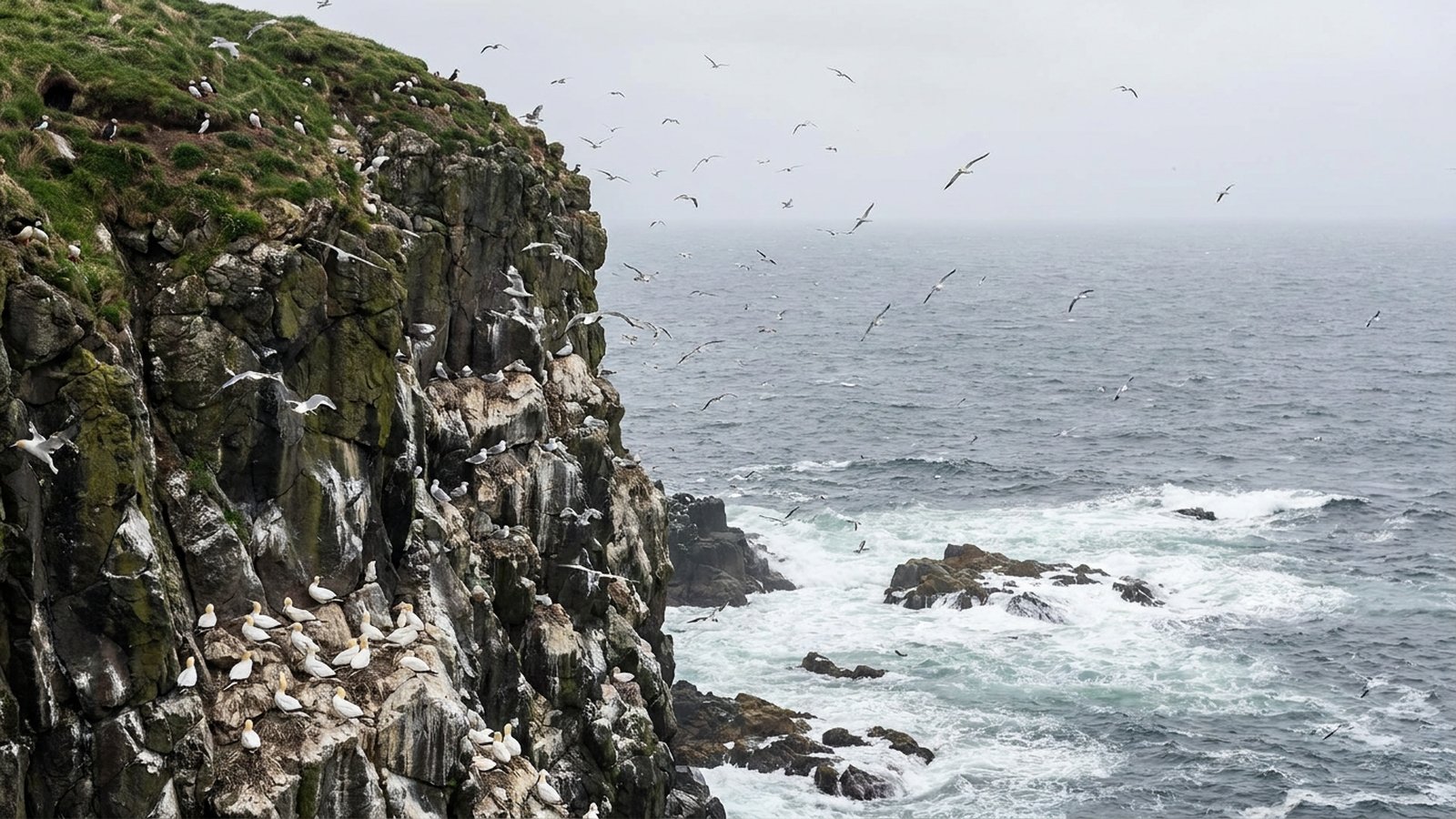
Seabirds come ashore to breed, usually on islands, cliffs and headlands that land predators find hard to reach. Colonies range from a few dozen pairs to more than a million birds, and colonies of that size have been recorded both in the tropics, for example on Kiritimati in the Pacific, and in polar regions. Most species are strongly faithful to their birthplace: one study of Laysan albatrosses found that birds established their own nest sites, on average, only about 22 m from where they had hatched.
Clutches are small. Albatrosses, most petrels and many auks lay a single egg, and the larger albatrosses may breed only every other year because raising one chick takes so long. Pairs are typically at least seasonally monogamous, and many albatrosses and petrels keep the same partner for years. In return for this slow pace, seabirds live long. The most famous example is Wisdom, a Laysan albatross banded at Midway Atoll in 1956 when already an adult; she has continued to return to the colony and lay eggs for decades since, and she is the oldest known wild bird in the world.
How far do seabirds travel?
Seabirds make some of the longest journeys of any animals. In a study published in 2006, Scott Shaffer and colleagues fitted sooty shearwaters from New Zealand with miniature tags and found that they flew a figure-of-eight route around the entire Pacific Ocean, averaging about 64,000 km on the round trip and stopping over off Japan, Alaska or California before returning south. In 2010, Carsten Egevang and colleagues tracked Arctic terns from Greenland and Iceland to the Southern Ocean and back and found that some individuals travelled more than 80,000 km a year, the longest known animal migration. Both species follow the most productive waters of both hemispheres, living in a kind of endless summer.
Why are seabirds in trouble?
Seabirds are among the most threatened groups of birds. The 2019 global assessment found the top threats were invasive alien species (affecting 165 species), fisheries bycatch (100 species) and climate change and severe weather (96 species).
Monitoring data paint a worrying picture. Michelle Paleczny and colleagues compiled population records for the world’s monitored seabirds, about a fifth of the global seabird population, and estimated in 2015 that the monitored populations had declined by about 70% between 1950 and 2010. The largest declines were in families of wide-ranging ocean wanderers, such as albatrosses and petrels.
Invasive predators are the leading threat. Rats, cats and mice introduced to nesting islands eat eggs, chicks and sometimes adults, and seabirds that evolved on predator-free islands have no defences against them. In fisheries, longlines, gillnets and trawls drown albatrosses, petrels, shearwaters, penguins and auks. Overfishing removes prey, and warming seas shift fish beyond the reach of breeding colonies, causing breeding failures. Plastic is another concern: many seabirds, particularly albatrosses and petrels, swallow floating plastic, and parents may feed it to their chicks. Because seabirds live long and breed slowly, adult deaths are especially hard for populations to make up.
What is being done to help seabirds?
Seabird conservation has some of the clearest success stories in the conservation world. Removing invasive predators from islands has allowed many colonies to recover; on South Georgia in the South Atlantic, a multi-year baiting campaign led to the island being declared free of rats and mice in 2018, and the island, and seabirds such as the South Georgia pipit and burrowing petrels have since begun to recolonise.rsquo;s endemic South Georgia pipit, a ground-nesting songbird that shares the seabirds, and seabirds such as the South Georgia pipit and burrowing petrels have since begun to recolonise.rsquo; nesting grounds, has since begun to recover. Similar eradications have succeeded on hundreds of smaller islands.
At sea, simple changes to fishing gear can cut bycatch dramatically. Streamer lines that scare birds away from baited hooks, weighting lines so they sink quickly, and setting lines at night all reduce the number of albatrosses and petrels caught. The Agreement on the Conservation of Albatrosses and Petrels, an international treaty that came into force in 2004, promotes these measures among fishing nations. Protecting key foraging areas, managing forage-fish catches and tackling plastic pollution are the other pillars of seabird conservation.
Where can you see seabirds?
Seabird colonies are among the great wildlife spectacles. In the North Atlantic, cliffs in Scotland, Norway, Iceland and Newfoundland host puffins, gannets, murres and kittiwakes in summer. In the Southern Hemisphere, sub-Antarctic islands and the Antarctic Peninsula hold albatrosses, penguins and petrels, and New Zealand has more breeding seabird species than almost anywhere else. Pelagic boat trips offshore are the best way to see shearwaters, storm petrels and albatrosses at sea. Visitors should keep their distance from nests, stay on paths and follow local rules, as disturbance can cause parents to leave eggs and chicks exposed to predators.
What is a seabird?
A bird that spends most of its life at sea and feeds on marine prey, coming ashore mainly to breed.
How many seabird species are there?
About 350; a 2019 global assessment covered 359 species.
What are examples of seabirds?
Albatrosses, petrels, shearwaters, penguins, gannets, boobies, cormorants, frigatebirds, tropicbirds, gulls, terns, skuas and puffins.
How do seabirds drink salt water?
Salt glands above their eyes remove excess salt, which drips out through the nostrils.
What is the biggest seabird?
By wingspan, the wandering albatross, typically about 2.5–3.7 m. By weight, the emperor penguin.
What is the oldest known seabird?
Wisdom, a Laysan albatross banded at Midway Atoll in 1956, is the oldest known wild bird.
Why are seabirds declining?
Invasive predators on nesting islands, fisheries bycatch, overfishing of prey, climate change and plastic. Monitored populations fell about 70% from 1950 to 2010.
Are penguins seabirds?
Yes, penguins are flightless seabirds.
- Dias, M.P. et al. (2019). Threats to seabirds: a global assessment. Biological Conservation 237. doi:10.1016/j.biocon.2019.06.033
- Paleczny, M. et al. (2015). Population trend of the world’s monitored seabirds, 1950–2010. PLoS ONE 10(6): e0129342.
- Shaffer, S.A. et al. (2006). Migratory shearwaters integrate oceanic resources across the Pacific Ocean in an endless summer. PNAS 103.
- Egevang, C. et al. (2010). Tracking of Arctic terns Sterna paradisaea reveals longest animal migration. PNAS 107.
- Weimerskirch, H. et al. (2016). Frigate birds track atmospheric conditions over months-long transoceanic flights. Science 353.
- BirdLife International. Seabird conservation programme; Agreement on the Conservation of Albatrosses and Petrels (ACAP).
- Wikipedia: Seabird; Wandering albatross; Emperor penguin; Thick-billed murre; Wisdom (albatross).
Every Species, Where They Live and How They Survive.
All 18 Species, Genus by Genus.
Breeding Through the Antarctic Winter.
King vs emperor: size, range and breeding.
The Classic Penguin of the Antarctic Coast.
The Fastest Swimming Penguin.
The Penguin With a Helmet Strap.
The Most Numerous Crested Penguin.
The Crested Penguin That Hops.
Boulders Beach and a Species in Crisis.
The Only Penguin North of the Equator.
Every Region, From Antarctica to the Equator.
Krill, Fish, Squid and Surprises.
Why Penguins Traded the Air for the Sea.
The Hidden Legs Under the Feathers.
Blane Perun has been exploring Earth’s oceans and marine life for over 25 years. Founder of TheSea.Org in 1999, underwater photographer, coral aquaculture pioneer, and explorer of 80+ countries.
About Blane Perun →