Sea Monsters, Myths and Legends — The Stories and the Science Behind Them
Every seafaring culture has told stories about monsters, cursed ships and impossible places at sea. This section treats them as what they are: legends, folklore and modern mysteries with a traceable history. Each guide separates three things clearly: what the earliest sources actually say, how the story grew, and what the evidence shows. None of the creatures in these stories has ever been shown to exist, but several are rooted in real animals, real wrecks and real hazards, from oarfish and giant squid to tidal whirlpools and Atlantic hurricanes.
Legend and evidence are kept apart on every page. When we describe what a myth claims, we say whose claim it is and where it was first written down. When we give a date, a depth or a casualty figure, it comes from the historical record, and where records disagree, both figures are given.
Why the sea makes monsters
For most of history the ocean was the largest unknown that ordinary people ever faced. Sailors spent months out of sight of land, on water whose depth they could not measure, among animals they glimpsed for a few seconds before they sank out of view. A whale’s back, a tangle of kelp, a dead basking shark or a sudden squall could all be remembered, retold and enlarged until they became a monster. The folklore of the sea is the record of that uncertainty, and it is remarkably consistent across cultures. Greek epic, Norse saga, Hebrew scripture, Caribbean oral tradition and the logbooks of the Royal Navy all describe giant serpents, women of the sea, ships that never reach port and places where vessels vanish.
These stories deserve to be taken seriously as history and as literature, and they are worth checking carefully as claims about the natural world. That is the approach of every guide in this section. We go back to the earliest written source we can find, follow how the story changed as it was retold, and then set out what modern evidence says. Where a legend has a plausible real basis, we explain it. Where a modern “mystery” was largely manufactured by later writers, we show how.
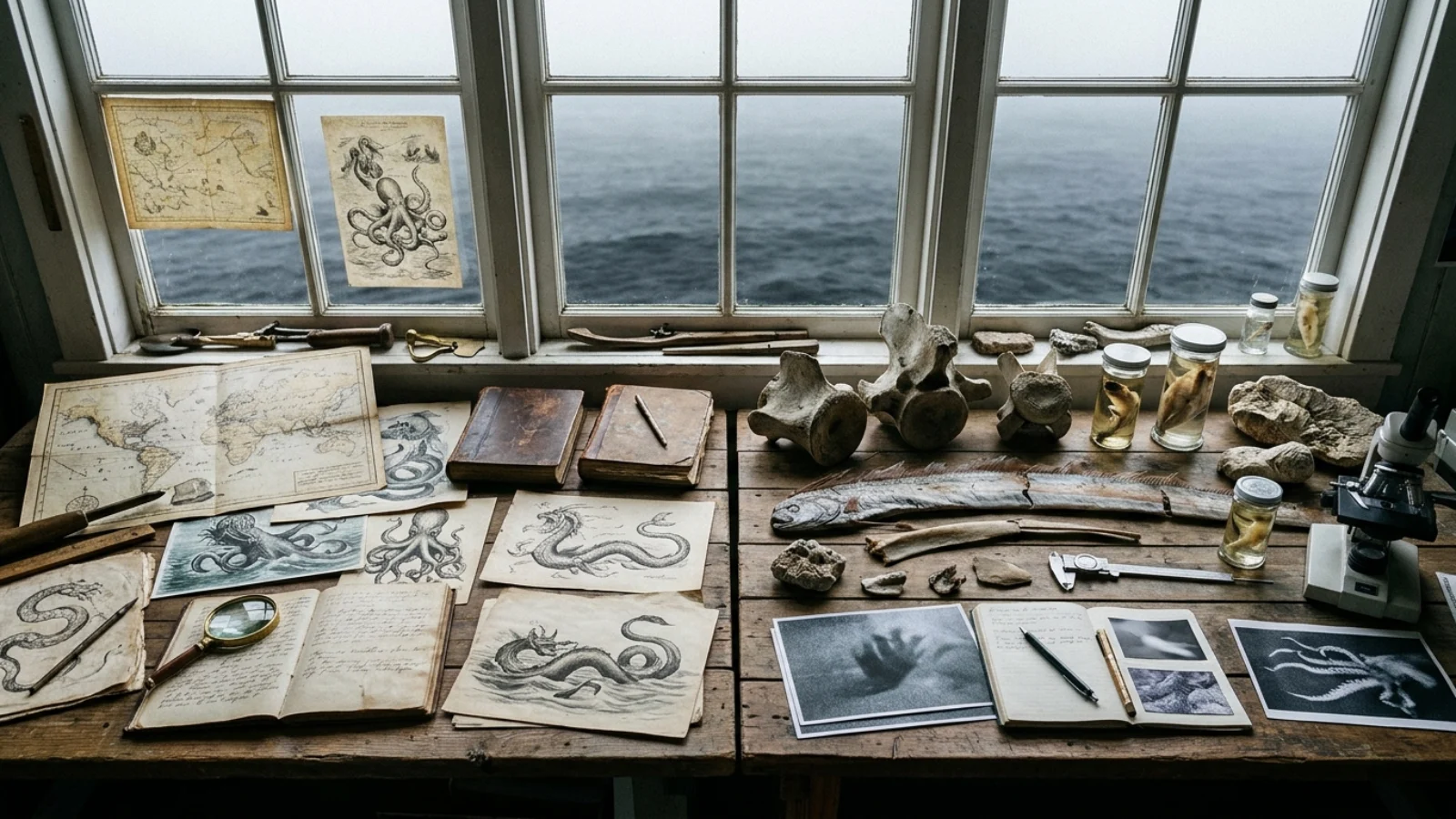
Monsters with a real animal behind them
Several of the most famous sea monsters can be matched, at least in part, to animals that zoologists now know well. The kraken of Scandinavian tradition is widely linked to the giant squid, a real animal estimated to reach 12 to 13 metres including its two long feeding tentacles, which was first photographed alive in its natural habitat by a Japanese team only in 2004; see our giant squid profile. Long, ribbon-like serpents seen at the surface fit the giant oarfish, the longest bony fish in the sea, which is rarely seen alive because it lives in deep water. A 5-metre oarfish that washed up in Bermuda in 1860 was originally described as a sea serpent.
Other “monsters” turned out to be the remains of familiar animals. Decomposing basking sharks lose their jaws and fins in a way that leaves a small “head”, a long “neck” and a bulky body, which is why a carcass trawled up by the Japanese vessel Zuiyo Maru off New Zealand in 1977 was hailed as a plesiosaur. The shapeless white masses called globsters, once taken for giant octopuses, have repeatedly turned out to be sheets of whale blubber; DNA testing identified a carcass washed up in Newfoundland in 2001 as a sperm whale. Our guide to sea monsters and the real animals behind them works through the main legends one by one, and sea serpents follows the long history of serpent sightings from Olaus Magnus in 1555 to the officers of HMS Daedalus in 1848.
Women of the sea
Mermaids and sirens are among the oldest figures in sea folklore, and the two are not the same. In Greek tradition the sirens were part woman and part bird, whose song lured sailors to their deaths; the fish-tailed mermaid belongs mainly to later European folklore. The notion that sailors mistook manatees and dugongs for mermaids is old and popular, and Christopher Columbus did record seeing three “mermaids” off Hispaniola in 1493 that were almost certainly manatees; see Columbus and the manatee. In 2012, after a television mockumentary presented mermaids as real, the US National Oceanic and Atmospheric Administration stated plainly that no evidence of aquatic humanoids has ever been found. Are mermaids real? traces the legend from the Syrian goddess Atargatis to the Feejee mermaid that P. T. Barnum exhibited in 1842, and looks at the real sea cows behind the story.
Cursed ships and vanishing places
Ghost-ship legends combine two very different things. One is pure folklore: the Flying Dutchman, a phantom ship doomed never to make port, whose oldest surviving version dates from the late 18th century and which was turned into an opera by Richard Wagner in 1843. The other is a set of real vessels found adrift without their crews. The brigantine Mary Celeste, found deserted between the Azores and Portugal in December 1872, is the most famous, but she is one of many documented derelicts, from the schooner Carroll A. Deering, found aground and empty at Diamond Shoals, North Carolina, on 31 January 1921, to modern fishing boats found drifting across the Pacific. Ghost ships sorts the documented cases from the legends.
The Bermuda Triangle is the clearest example of a modern legend with a known starting point. The phrase first appeared in an article by Vincent Gaddis in the magazine Argosy in February 1964, building on earlier newspaper and magazine stories about the loss of Flight 19, five US Navy torpedo bombers, in December 1945. When the librarian Larry Kusche went back to the original records for his 1975 book, he found that many incidents had been exaggerated, had happened in bad weather that later writers left out, or had taken place far from the Triangle. NOAA notes that the US Board on Geographic Names does not recognize the Bermuda Triangle as an official name, and the Navy and Coast Guard attribute losses in the area to weather, the Gulf Stream and human error.
Monsters of the deep and the loch
Some legends attach to particular places. Scylla and Charybdis, the six-headed monster and the swallowing whirlpool that Odysseus had to pass between in Homer’s Odyssey, were placed by later Greek writers in the Strait of Messina between Sicily and mainland Italy, where strong tidal currents still form eddies. The Lusca of Bahamian folklore is said to haunt the blue holes of Andros Island, where real tidal currents can pull water into the holes and push it out again; see also our guide to blue holes.
The Loch Ness Monster is a freshwater legend, but its story turns on marine animals: the plesiosaurs it is often drawn as, and the eels that live in the loch. In 2019 a team led by Neil Gemmell of the University of Otago analysed environmental DNA from about 250 water samples and found no trace of reptiles, sharks, catfish or sturgeon, but a very large amount of eel DNA at almost every sampling point.
What the legends still teach
It would be easy to treat all of this as a catalogue of errors, but the legends record something real. They show how hard the ocean was to know before sonar, satellites and deep-sea submersibles, and how much of it is still unexplored. They preserve the names of real ships and real people lost at sea, and in several cases, such as the giant squid, folklore described an animal long before scientists accepted that it existed. Reading the original sources closely, and checking them against the evidence, is the best way to respect both the stories and the sea.
What oceanography and the records actually say.
Sightings, hoaxes and the eel hypothesis.
Real derelicts found adrift without a crew.
The phantom ship that never makes port.
Sirens, sea cows and a famous fake.
The real animals behind the legends.
Homer’s monsters and the Strait of Messina.
From Olaus Magnus to HMS Daedalus.
The Bahamas’ blue-hole monster.
The brigantine found deserted in 1872.
The sea serpent that actually exists.
The animal behind the kraken.
Plato’s legend versus the evidence.
The 1493 “mermaid” sighting.
A real nautical term.
Myth versus what happens.
Umibōzu, Isonade and the Ningen.
Poseidon, Oceanus, Tethys and more.
The Lake Champlain monster and the science.
The monster Perseus killed.
How a bird-woman became a fish-tail.
Names from every culture.
The sea monsters of the Bible.
The Carta Marina and the medieval ocean.
Nereus, Proteus and Phorcys.
Nereids, Oceanids and Naiads.
Are any sea monsters real?
No legendary sea monster has been shown to exist, but several legends were probably inspired by real animals such as the giant squid, the giant oarfish, whales and decomposing basking sharks.
Where did the Bermuda Triangle idea come from?
The name was coined by Vincent Gaddis in Argosy magazine in February 1964, building on earlier stories about the loss of Flight 19 in 1945.
Has science ever looked for the Loch Ness Monster?
Yes. Sonar sweeps, photography and a 2019 environmental DNA survey of about 250 water samples found no evidence of a large reptile; the DNA survey found abundant eel DNA.
Are mermaids real?
No. NOAA stated in 2012 that no evidence of aquatic humanoids has ever been found. Manatees and dugongs are often suggested as one source of the legend.
What is a ghost ship?
In folklore, a phantom vessel such as the Flying Dutchman; in maritime history, a real ship found adrift with no one aboard, such as the Mary Celeste in 1872.
Where are Scylla and Charybdis?
In Homer’s Odyssey they guard a narrow strait; later Greek writers placed them in the Strait of Messina between Sicily and Calabria.
- NOAA National Ocean Service, “What is the Bermuda Triangle?” (Ocean Facts; text posted 4 January 2010, accessed November 2026).
- KSL / Associated Press, “Mermaids are not real, US government reveals” (9 July 2012), quoting NOAA Ocean Facts (26 June 2012).
- Sci.News, “Scientists Find Significant Amount of Eel DNA in Loch Ness” (10 September 2019), reporting the University of Otago eDNA survey led by Neil Gemmell.
- Kusche, L. D. (1975). The Bermuda Triangle Mystery: Solved. Harper & Row.
- Homer, Odyssey, Book 12; Olaus Magnus, Historia de Gentibus Septentrionalibus (1555).
- Wikipedia contributors, “Sea monster”, “Sea serpent”, “Bermuda Triangle”, “Flight 19”, “Ghost ship”, “Carroll A. Deering”, “Scylla and Charybdis”, “Lusca” (2023 snapshot via Kiwix mirror, accessed November 2026).
Blane Perun has been exploring Earth’s oceans and marine life for over 25 years. Founder of TheSea.Org in 1999, underwater photographer, coral aquaculture pioneer, and explorer of 80+ countries.
About Blane Perun →