The Loch Ness Monster — Sightings, Hoaxes and the Eel Hypothesis
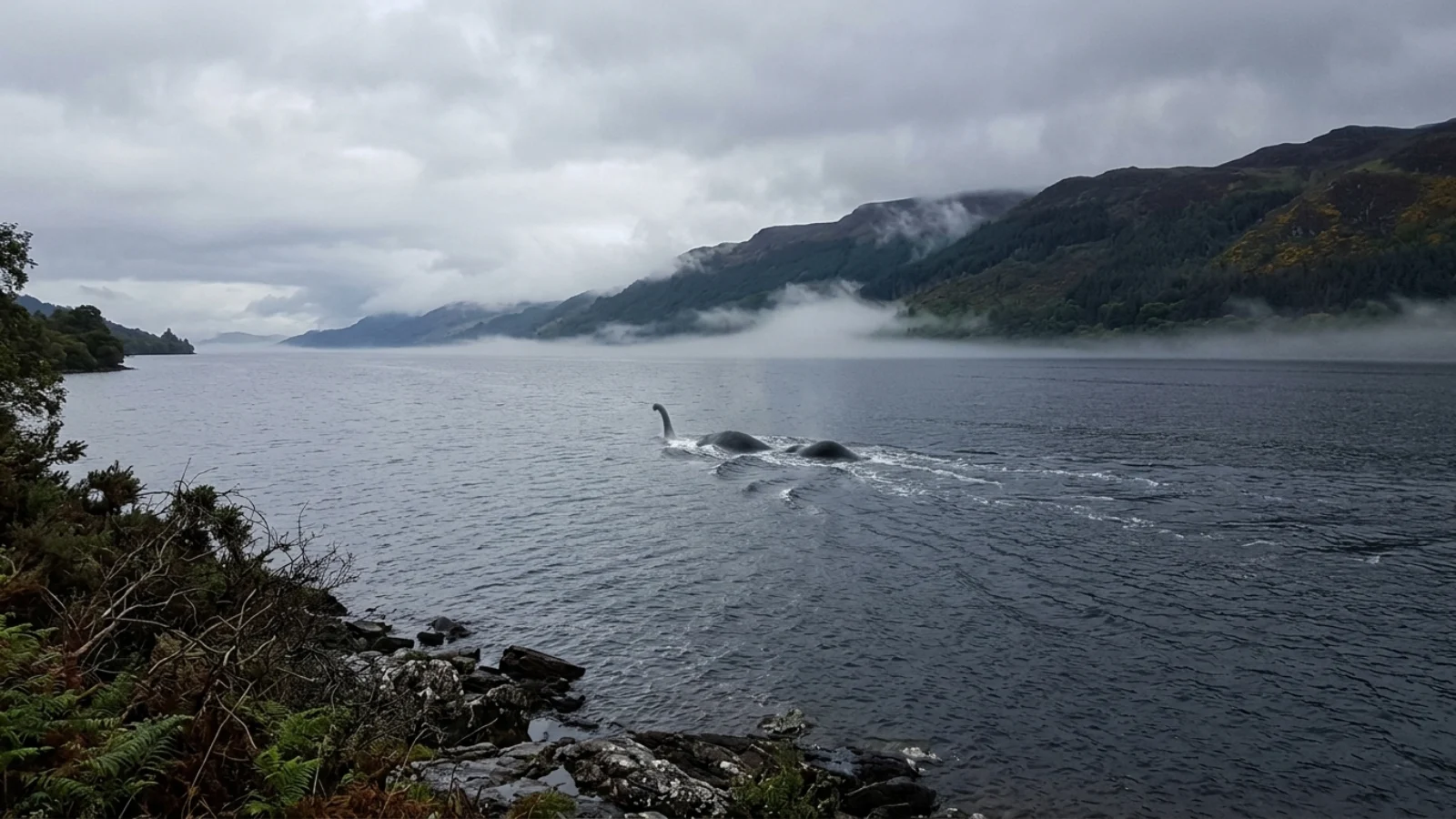
There is no good evidence that a large unknown animal lives in Loch Ness. The modern legend began with newspaper reports in 1933, and its most famous photograph, the 1934 “surgeon’s photograph”, was a hoax made with a toy submarine. Decades of watches, sonar sweeps and underwater photography have produced nothing conclusive. In 2019 a team led by Neil Gemmell of the University of Otago analysed environmental DNA from about 250 water samples and found no reptile DNA at all, but a very large amount of eel DNA, which makes European eels the most plausible real animals behind at least some sightings.
This page separates the legend, which goes back to a seventh-century saint’s life and a long Highland tradition of water beasts, from the evidence collected since 1933. Claims are attributed to the people who made them, and none of the sightings described here is presented as proof of a monster.
The loch itself
Loch Ness is a long, narrow freshwater loch running about 37 kilometres from Fort Augustus in the south-west to the River Ness and Inverness in the north-east. It lies along the Great Glen, a valley cut along a major geological fault that splits the Scottish Highlands diagonally. Although its surface area of about 56 square kilometres makes it only the second-largest Scottish loch after Loch Lomond, it is extraordinarily deep. Its maximum depth is usually given as about 227 metres, with some sources giving 230 metres, and its volume of about 7.5 cubic kilometres makes it the largest body of fresh water in Great Britain.
Two features of the loch matter for the legend. The water is very dark, because peat from the surrounding soils stains it brown and cuts underwater visibility to almost nothing, so anything below the surface is effectively invisible. And the loch is young. It is only about 10,000 years old, having formed when the ice sheets of the last glaciation melted, and before that it was frozen for something like 20,000 years. Any animal living in it today must have arrived after the ice, by way of the River Ness from the sea.
St Columba and the water beast
Believers often trace the monster back to the sixth century. The source is the Life of St Columba, written by Adomnán, abbot of Iona, in the seventh century, about a hundred years after the events it describes. In one episode, Columba, travelling in the land of the Picts, meets local people burying a man by the River Ness. They tell him that the man was swimming when a “water beast” attacked him and dragged him under. Columba sends one of his followers, Luigne moccu Min, to swim across the river. When the beast surges towards him, Columba makes the sign of the cross and commands it: “Go no further. Do not touch the man. Go back at once.” The creature stops as if pulled back with ropes and flees.
The story is set in the river, not the loch, and it is a miracle story in a saint’s life, a genre full of saints subduing beasts. Skeptics point out that water-beast episodes were common in medieval hagiography and that Adomnán was probably attaching a familiar motif to a local landmark. The author Ronald Binns, himself a former member of the Loch Ness Phenomena Investigation Bureau, regards the Columba story as the most serious of the alleged early sightings but argues that the others before 1933 are dubious and do not prove a monster tradition before that date. The Scottish Highlands did have a wider folklore of kelpies and water-horses, shape-shifting spirits said to live in lochs and rivers, but historians who have examined Adomnán closely, such as Christopher Cairney, argue that the modern Loch Ness Monster is a twentieth-century, media-driven creation rather than a direct descendant of that tradition.
1933: the year the monster arrived
The modern legend has a clear starting date. On 2 May 1933, the Inverness Courier published an article by Alex Campbell, the water bailiff for Loch Ness and a part-time journalist, describing how Aldie Mackay and her husband had seen an enormous creature with the body of a whale rolling in the water on 15 April while driving along the loch. Campbell’s article remarked that Loch Ness had “for generations been credited with being the home of a fearsome-looking monster”. Then, on 4 August 1933, the Courier reported that George Spicer and his wife had seen “a most extraordinary form of animal” cross the road in front of their car on 22 July. They described a body about 1.2 metres high and 8 metres long with a long, narrow, wavy neck, lurching across the road towards the water.
The Spicer report caused a sensation. Letters poured in describing a “monster fish”, a “sea serpent” or a “dragon”, and the name “Loch Ness Monster” stuck. It is often said that sightings increased because a new road had just opened up an isolated loch to traffic and tourists. Binns calls this “the myth of the lonely loch”: the area was far from isolated, thanks to the Caledonian Canal, but the existing lochside road was substantially upgraded in the early 1930s, putting more people in a position to look at the water. The first photograph claimed to show the monster was taken by Hugh Gray near Foyers on 12 November 1933. It is blurred, and Gray had been walking his Labrador that day; many who have studied it think it shows the dog swimming with a stick.
The surgeon’s photograph
The image that fixed the monster’s appearance in the public mind was published in the Daily Mail on 21 April 1934. It showed a small head on a slender, curving neck rising from the water, and it was credited to Robert Kenneth Wilson, a London gynaecologist who did not want his name attached to it, so it became known as the “surgeon’s photograph”. For about sixty years it was treated as the best evidence for the monster, even though uncropped prints showed that the ripples around the “neck” were small, and the object therefore much smaller than it appeared.
In 1994 the photograph was publicly exposed as a hoax, and the full story was set out in the 1999 book Nessie: The Surgeon’s Photograph Exposed. The “monster” was a model head and neck mounted on a toy submarine, built by Christian Spurling, a relative of Marmaduke Wetherell. Wetherell had gone to the loch to look for the monster and found “footprints”, which scientists showed came from a hippopotamus, apparently made with a hippopotamus-foot umbrella stand. Ridiculed by the Daily Mail, he took his revenge with the help of Spurling and others: the model was photographed near the Altsaigh Tea House, and the plates were passed to Wilson, a friend of one of the conspirators, to give them a respectable source. When a water bailiff approached, Wetherell is said to have sunk the model with his foot. The hoax had in fact been described in a Sunday Telegraph article on 7 December 1975, but that article was overlooked for almost two decades.
Sixty years of searching
The surgeon’s photograph was followed by a long series of organised searches, most of them sincere and some of them technically sophisticated. In 1934 Sir Edward Mountain financed a search in which twenty men watched the loch with binoculars and cameras for five weeks from 13 July; 21 photographs were taken, none of them conclusive. In 1960 the aeronautical engineer Tim Dinsdale filmed a hump crossing the loch and leaving a wake. An analysis by the RAF’s photographic intelligence unit, JARIC, called the object “probably animate”, while skeptics argued that a boat could not be ruled out.
From 1962 the Loch Ness Phenomena Investigation Bureau, founded by the naturalist Peter Scott and others, ran summer camera watches around the loch, and in 1968 the engineer D. Gordon Tucker of the University of Birmingham tested a prototype sonar there. In 1972 Robert Rines of the Academy of Applied Science combined sonar with an underwater strobe camera and obtained two photographs that, after heavy enhancement, appeared to show a diamond-shaped flipper. On the strength of those images Peter Scott proposed a scientific name, Nessiteras rhombopteryx, in 1975, hoping to give the animal legal protection. The Scottish politician Nicholas Fairbairn pointed out that the name was an anagram of “Monster hoax by Sir Peter S”. Skeptics have suggested that the flipper photos show the loch bottom, bubbles or a fish fin, and the originals look far less striking than the retouched versions that were published.
The biggest single survey was Operation Deepscan in 1987, in which 24 boats fitted with echo sounders moved in a line across the width of the loch, sweeping it with sound. It recorded a few strong returns that the operators could not immediately explain, including one at about 180 metres near Urquhart Bay, but analysis suggested debris on the bottom or other ordinary causes, and nothing like a population of large animals was found.
Why a plesiosaur does not fit
The most popular image of Nessie, a small head on a long neck above a bulky body with flippers, is essentially a plesiosaur, a group of marine reptiles that died out with the dinosaurs about 66 million years ago. The comparison was made in 1933 and has never gone away, but it runs into several basic problems.
The first is time. Loch Ness has existed for only about 10,000 years and was frozen solid for thousands of years before that, so no animal could have lived in it continuously since the Cretaceous. The second is breathing. Plesiosaurs breathed air, so a population large enough to survive for thousands of years would have to surface several times a day, every day, and would be seen constantly rather than occasionally. The third is anatomy. In a 2006 New Scientist article, the palaeontologist Leslie Noè of the Sedgwick Museum in Cambridge said that the structure of the plesiosaur neck makes it certain that the animal could not raise its head swan-like out of the water, as the classic Nessie image shows. The fourth is food. A breeding population of large predators needs a large supply of fish, and a cold, dark, nutrient-poor loch is not a rich enough larder. Our profiles of real marine reptiles such as plesiosaurs and Liopleurodon explain what these animals were actually like.
The 2019 DNA survey
The most decisive test came from a technique that did not exist when the legend began. Every living thing sheds traces of DNA into the water around it, in skin cells, mucus, scales and waste. By filtering water and sequencing the DNA it contains, scientists can build up a list of the organisms living in a lake without ever seeing them. In June 2018 an international team led by Professor Neil Gemmell of the University of Otago in New Zealand, with collaborators from the universities of Copenhagen, Hull, Bangor and the Highlands and Islands, collected about 250 water samples from points all around Loch Ness and compared the DNA in them with genome databases. The results were announced in September 2019.
They found no DNA from any reptile, which Gemmell said makes the plesiosaur idea very hard to sustain. They found no DNA from sharks, including the Greenland shark proposed by the television presenter Jeremy Wade in 2013, none from catfish, and no evidence of sturgeon, two other candidates that had been suggested over the years. They did find DNA from humans, dogs, sheep, cattle, deer, badgers, foxes and many birds, washed in from the land. And they found a very large amount of eel DNA, present at almost every sampling location.
The eel hypothesis
Eels were suggested as an explanation as early as 1933, and the idea faded only as the plesiosaur became the favourite image. The European eel, Anguilla anguilla, is a snake-like fish that lives in fresh water for most of its life and returns to the sea to breed. Adults are normally about 60 to 80 centimetres long and rarely exceed a metre, though exceptional individuals reach about 1.5 metres. Their remarkable life cycle explains how they reach the loch: the larvae drift across the Atlantic towards Europe, transform into transparent “glass eels” near the coast, and swim up rivers such as the Ness to grow in lakes and streams.
Gemmell was careful about what the DNA can and cannot show. It cannot reveal the size of the eels, so the survey does not prove that giant eels exist, but the sheer quantity of eel DNA means that unusually large eels cannot be ruled out, and he described giant eels as a plausible explanation that deserves further investigation. Not everyone is persuaded: Tim Dinsdale dismissed the eel idea because eels swim by undulating side to side, not in the up-and-down humps many witnesses describe. A large eel near the surface would also not explain a long neck raised high out of the water. The most reasonable reading is that eels may account for some sightings of dark, sinuous shapes, while many others have different causes.
The European eel has a very different problem of its own. It is now listed as Critically Endangered, and the number of young eels reaching Europe is thought to have fallen by around 90 per cent, possibly more, since the 1970s because of overfishing, parasites, dams and other barriers to migration. For more on eels in general, see our guide to eels.
Waves, wakes, logs and birds
Many reports of the monster describe not an animal but a disturbance: a wake on a calm day, a hump that appears and disappears, a patch of boiling water. Loch Ness is long, straight and deep, and it behaves in ways that can surprise observers. Wind can pile water up at one end of the loch, which then sloshes back and forth in a standing wave called a seiche; Loch Ness has a seiche period of about 31.5 minutes. Boat wakes can persist and travel long after the boat has passed, and on a still day they can appear to come from nowhere. The racing driver John Cobb was killed on the loch in 1952 when his jet-powered boat Crusader hit an unexplained wake during an attempt on the water speed record.
Other proposed explanations are more mundane still. In 1982 the zoologist Maurice Burton suggested in New Scientist that Scots pine logs, rich in resin, could sink, build up gas from decay and then burst back to the surface. Swimming deer, otters, seals that occasionally enter the loch from the sea, diving birds and waterfowl seen at a distance have all been identified as the source of individual photographs, and some observers have also suggested that gas escaping along the Great Glen Fault could disturb the surface. Ronald Binns, after decades of studying the reports, concluded that there is probably no single explanation for the monster, and that a combination of misidentified animals and objects, wave effects, hoaxes and the human tendency to see what one is looking for accounts for the record.
Nessie today
Whatever its basis, the Loch Ness Monster is a remarkable piece of modern folklore and a major part of the Highland tourist economy, with exhibitions at Drumnadrochit and boat trips from several points along the loch. Organised watches continue, and visitors still report sightings every year. The difference now is that the loch has been surveyed more thoroughly than almost any lake on Earth, and the evidence points to ordinary animals and ordinary physics. For the marine legends that Nessie resembles, see our guides to sea serpents and sea monsters. North America has its own Nessie in Champ, the Lake Champlain monster, whose sightings point to sturgeon and gar.
Is the Loch Ness Monster real?
There is no reliable evidence that it is. Sonar surveys, underwater photography and a 2019 environmental DNA survey have found nothing to support a large unknown animal in the loch.
When was the Loch Ness Monster first seen?
The modern legend began with an Inverness Courier article on 2 May 1933. A seventh-century saint’s life describes St Columba driving off a “water beast” in the River Ness, but historians doubt it is connected.
Was the famous Loch Ness Monster photo fake?
Yes. The 1934 “surgeon’s photograph” was a model head and neck on a toy submarine, built by Christian Spurling and publicly exposed in 1994.
Could Nessie be a plesiosaur?
Very unlikely. The loch is only about 10,000 years old, plesiosaurs breathed air and would be seen constantly, their necks could not be raised swan-like, and no reptile DNA was found in 2019.
What did the Loch Ness DNA survey find?
About 250 water samples contained no reptile, shark, catfish or sturgeon DNA but a very large amount of eel DNA, found at almost every sampling site.
How big are the eels in Loch Ness?
European eels are usually 60 to 80 cm long and rarely more than a metre. The DNA survey could not measure size, so it neither proves nor rules out unusually large eels.
How deep is Loch Ness?
About 227 to 230 metres at its deepest point, depending on the survey, and it holds about 7.5 cubic kilometres of water.
- Adomnán of Iona, Vita Columbae (Life of St Columba), late 7th century, Book II.
- Sci.News, “Scientists Find Significant Amount of Eel DNA in Loch Ness” (10 September 2019), reporting the University of Otago-led eDNA survey (N. Gemmell et al.).
- Binns, R. (1983). The Loch Ness Mystery Solved; Binns, R. (2017). The Loch Ness Mystery Reloaded.
- Nessie: The Surgeon’s Photograph Exposed (1999), reproducing the Sunday Telegraph article of 7 December 1975.
- Noè, L., quoted in “Why the Loch Ness Monster is no plesiosaur”, New Scientist (October 2006).
- Wikipedia contributors, “Loch Ness Monster”, “Loch Ness”, “European eel” (2023 snapshot via Kiwix mirror, accessed November 2026).
Blane Perun has been exploring Earth’s oceans and marine life for over 25 years. Founder of TheSea.Org in 1999, underwater photographer, coral aquaculture pioneer, and explorer of 80+ countries.
About Blane Perun →