Sea Monsters — The Real Animals Behind 12 Legends
Sea monsters are creatures of folklore, but many of them have a real animal somewhere in their history. The kraken of Norwegian lore is widely linked to the giant squid; island-sized monsters such as the hafgufa probably began as whales; sea serpents fit the giant oarfish; a sixteenth-century “sea monk” was most likely an angelshark; and shapeless “globsters” washed up on beaches have repeatedly proved to be whale blubber or rotting basking sharks. None of the monsters exists as described, and some, such as Leviathan, were never meant as natural history at all.
For each monster, this page gives the earliest source we could trace, then the real animal or phenomenon that scientists or historians have linked to it. Where an identification is only a suggestion, it is labelled as one.
Why the sea is full of monsters
Accounts of sea monsters are found in virtually every culture that has lived beside the sea. An ancient Latin poem, Avienius’s Ora Maritima, says that the Carthaginian explorer Himilco met “monsters of the deep” swimming among his slow-moving ships. Renaissance mapmakers filled the empty spaces of their charts with whales, serpents and tentacled beasts, most famously on Olaus Magnus’s Carta Marina of 1539, a map of Scandinavia and its seas. Sailors brought home stories of monsters lifting their heads above the masthead or dragging down ships.
Most of these stories were not invented from nothing. Sailors saw real animals, usually briefly and often in poor conditions, and found carcasses on beaches that were hard to recognise once decay had done its work. Folklore then did what it always does: it enlarged, combined and moralised. The twelve monsters below show how that process worked, and in several cases how science eventually caught up with the legend.
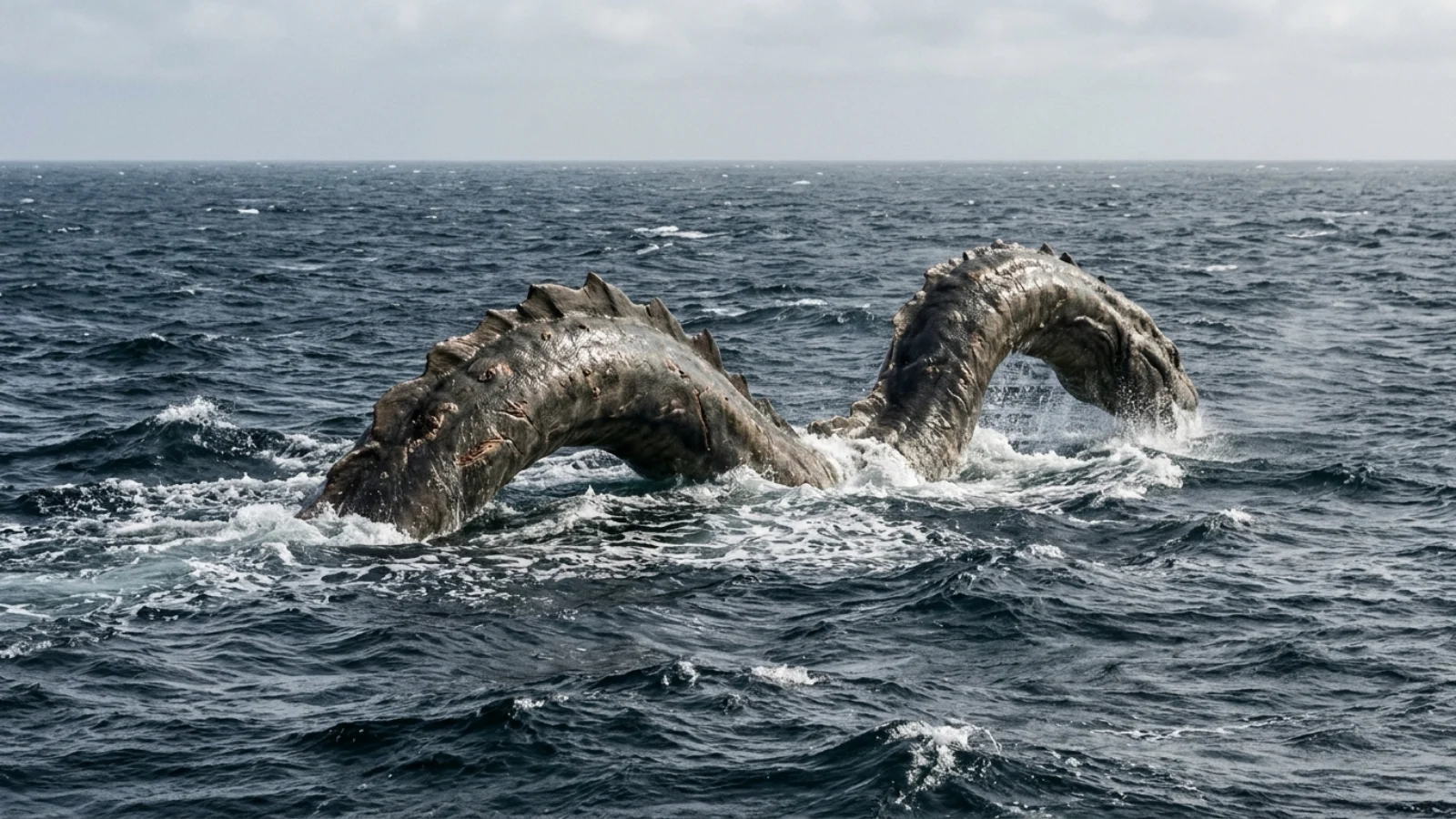
1. The kraken and the giant squid
The kraken is the archetypal sea monster: a creature so vast that when it surfaced it seemed to cover the sea, with many arms able to seize ships and men. Norwegian sailors’ stories about it were first written down at length by Erik Pontoppidan, the bishop of Bergen, in his Natural History of Norway, published in 1752 and 1753. Pontoppidan reported that the kraken was sometimes mistaken for a cluster of small islands, that fishermen risked fishing over it because the catch was so rich, and that if its arms laid hold of the largest warship they would pull it to the bottom. He was the first to describe the kraken as a giant polyp, the old word for an octopus, though he also tentatively compared it to a giant crab. Earlier, in 1734, the missionary Hans Egede had described the kraken in Greenland and equated it with the hafgufa of medieval Icelandic lore.
The animal most often linked to the kraken is the giant squid, Architeuthis dux, a real deep-sea cephalopod whose existence was accepted by science only in the nineteenth century, after the Danish zoologist Japetus Steenstrup described it in the 1850s and after the French warship Alecton secured part of one in 1861. Females are estimated to reach about 12 to 13 metres including their two long feeding tentacles, though reports of 20 metres or more have never been documented and probably came from stretched tentacles. Pontoppidan himself recorded a possible young kraken stranded at Alstahaug in 1680, which the twentieth-century malacologist Paul Bartsch thought was a giant squid. The first images of a living giant squid in its natural habitat were taken by a Japanese team in 2004. For the reality of attacks on ships, see giant squid attacks.
2. The hafgufa and the island whale
The medieval Norwegian King’s Mirror, written around 1250, describes the hafgufa as the largest of the sea monsters, living in the Greenland Sea. A related idea, an animal so large that sailors mistake it for an island, appears in medieval lore as the aspidochelone, a giant turtle or whale that looked like an island and lured sailors to their doom. Scholars who have studied the King’s Mirror read its account of the hafgufa as a garbled eyewitness description of a whale, and an English translator in 1917 rendered the word as “kraken”, which is how the two legends became tangled. The real basis is easy to imagine: a resting great whale at the surface can look like a low, dark island, and a feeding whale drives fish to the surface around it.
3. Leviathan and Cetus
Leviathan, the great sea monster of the Hebrew Bible, is named six times in the Tanakh, in the books of Job, Psalms and Isaiah. Job 41 describes it in detail, with impenetrable scales and fire from its mouth. Leviathan is not a misidentified animal so much as a theological figure. The name and the image continue the Ugaritic sea monster Lotan, a servant of the sea god Yam defeated by the storm god Baal in the Baal Cycle, and they belong to a widespread Near Eastern pattern in which a god defeats a monster of the chaotic waters, as Marduk defeats Tiamat in Babylonian myth. The Revised Standard Version of the Bible suggests in a footnote that Leviathan in Job may be a name for the crocodile, and in English the word has long been used for any huge sea creature, especially whales, as in Herman Melville’s Moby-Dick. A fossil sperm whale with enormous teeth was named Livyatan in its honour.
Greek myth’s equivalent is Cetus, the monster sent by Poseidon to devour the princess Andromeda, who was chained to a rock as a sacrifice until Perseus killed it.
4. Sea serpents and the giant oarfish
Long, serpent-like monsters are the most frequently reported sea creatures of all, from the Norwegian serpent “200 to 400 feet long” that Olaus Magnus described lurking in caves near Bergen in 1555 to the animal seen by the officers of HMS Daedalus in the South Atlantic in 1848. The best real candidate for many sightings is the giant oarfish, Regalecus glesne, the longest bony fish in the sea, a silvery ribbon of a fish with a red crest that is rarely seen alive. An oarfish about 5 metres long that washed up in Bermuda in 1860 was originally described as a sea serpent. The full story of serpent sightings, and the other candidates from basking sharks to rows of porpoises, is told in our guide to sea serpents.
5. Scylla
In Homer’s Odyssey, Scylla is a six-headed monster living in a cave above a narrow strait, who seizes and devours six of Odysseus’s men as his ship passes. She is a literary monster, not a natural-history report, and later writers rationalised her as a dangerous rock on the Italian side of the Strait of Messina. Some authors have nonetheless wondered whether stories of giant squid, whose long arms might reach up from the water, contributed to the image of a many-headed beast. That is speculation, but it shows how persistently the giant squid turns up behind sea monsters. Scylla and her partner Charybdis have their own page: Scylla and Charybdis.
6. The sea monk
In the mid-sixteenth century, a creature was caught in the Øresund, the strait between the Danish island of Zealand and Sweden, probably in 1546. It was described as a “fish” that outwardly resembled a monk in his habit, and it was either caught in a herring net or found stranded, depending on the source. King Christian III of Denmark sent an illustration to the Holy Roman Emperor Charles V, and the “sea monk” appeared in the great illustrated natural histories of the age, by Pierre Belon in 1553, Guillaume Rondelet in 1554 and Conrad Gesner in 1558. A Danish chronicle of 1575 gives its length as 4 ells, about 4.6 metres. Rondelet himself suspected that the pictures had been embellished “to make the thing seem more marvelous”.
In the nineteenth century, Steenstrup compared the sea monk with a squid, but a 2005 study concluded that it was most likely an angelshark, a flattened bottom-dwelling shark with broad, wing-like pectoral fins.
7. The sea bishop
The sea bishop, or bishop-fish, is the sea monk’s even more fanciful cousin. According to a sixteenth-century story, one was taken to the king of Poland, who wanted to keep it, but it gestured to a group of bishops to let it go; when they did, it made the sign of the cross and vanished into the sea. Another was said to have been caught near Germany in 1531, refused to eat, and died after three days. Gesner included it in his Historiae animalium. No convincing animal identification exists. The cryptozoologist Bernard Heuvelmans suggested that the reports grew from a mutilated specimen of a large deep-sea squid, but that is a suggestion rather than a finding, and the story’s moral shape, a creature recognising bishops and blessing them, marks it as a pious legend.
8. Pliny’s giant polyp
The Roman naturalist Pliny the Elder, writing in the first century AD, described a gigantic cephalopod in his Natural History, with a head “as big as a cask”, arms about 9 metres long and a body weighing about 320 kilograms. Later writers, notably the French naturalist Pierre Denys-Montfort in 1801, used Pliny’s account to support the existence of a “colossal octopus” that attacked ships, illustrated in a famous engraving of tentacles rising over a sailing vessel. The giant Pacific octopus, the largest octopus species, is a real and impressive animal, but nothing like the ship-sinking giant of Denys-Montfort’s picture; modern accounts of the giant squid list Pliny’s description among the early reports of giant squid rather than octopus.
9. Hans Egede’s monster of 1734
On 6 July 1734, off the west coast of Greenland, the Dano-Norwegian missionary Hans Egede and his companions saw “a very large and frightful sea monster” that raised its head above the main-top of the ship, spouted water like a whale and had broad flappers, a wrinkled body and a snake-like lower part. When it dived, its tail rose a whole ship’s length from its head. In 1883 the naturalist Henry Lee proposed that this was a giant squid seen with its head and one long tentacle above the water, and the writer Richard Ellis later agreed that a giant squid was a plausible explanation. Either way, the description is detailed enough to show that Egede’s party saw something real, and then interpreted it through the expectations of their time.
10. Globsters: the St. Augustine monster
Every so often a huge, shapeless mass of white or grey tissue washes up on a beach, and newspapers announce a monster. These carcasses are now called globsters. One of the earliest recorded was found on the beach near St. Augustine, Florida, on 30 November 1896. The visible part measured about 6 metres long and 2.5 metres wide, and Dr DeWitt Webb, who examined it, believed it was a giant octopus with the stumps of arms. The zoologist A. E. Verrill published drawings of it showing the apparent arm stumps, and the supposed species was even given the name Octopus giganteus, although that is not a valid scientific name. Later studies of preserved tissue told a different story. A 1995 biochemical analysis concluded that the carcass was a large mass of the collagen matrix of whale blubber, most likely from a sperm whale, and a 2004 study comparing it with other globsters from Bermuda, Tasmania and Nantucket against samples of whale blubber reached the same kind of conclusion. When a whale decomposes at sea, its blubber can detach as a single featureless sheet, sometimes with exposed collagen fibres that look like hair. The St. Augustine carcass also feeds into the legend of the Lusca, the giant octopus of Bahamian folklore.
11. The Zuiyo Maru “plesiosaur”
In 1977 the Japanese trawler Zuiyo Maru, fishing off New Zealand, netted a decomposing carcass with a small head, a long neck and a bulky body, and it caused a sensation as a possible surviving plesiosaur. It was even pictured on a Brazilian postage stamp. Later analysis suggested that it was the rotting carcass of a basking shark. Basking sharks decompose in a characteristic way: they lose most of the lower head and the dorsal and tail fins first, leaving a small “head” on a long “neck” attached to a bulky body that looks remarkably like a long-necked reptile. The same process explains many “sea serpent” carcasses. DNA testing has similarly identified a supposed monster washed ashore in Newfoundland in August 2001 as a sperm whale, and a carcass first described as a “mammoth jellyfish as long as a bus” at Los Muermos in Chile in July 2003 also proved to be a sperm whale. For real marine reptiles, see our profile of plesiosaurs.
12. The Bloop
The newest monster on the list is a sound. In 1997, hydrophones operated by NOAA in the Pacific recorded an extremely loud, ultra-low-frequency noise that rose in pitch over about a minute and was detected by sensors more than 5,000 kilometres apart. It was roughly located near 50°S 100°W, a remote point in the South Pacific west of the tip of South America, and nicknamed the Bloop. Because the signal varied rapidly in frequency in a way that resembled sounds made by marine animals, it was widely speculated to come from a creature far louder, and so far larger, than any known whale. NOAA’s Christopher Fox said in 2002 that its profile resembled a living creature, while noting the problem of its enormous loudness.
NOAA’s explanation is less exciting. By 2012 its scientists described the sound as consistent with a large icequake, the noise produced when an iceberg cracks and breaks apart or ice calves from a glacier. While tracking the disintegrating iceberg A53a near South Georgia Island in early 2008, researchers recorded many icequakes with spectrograms very similar to the Bloop and loud enough to be heard over thousands of kilometres. The Bloop is a good example of a modern legend: a real, unexplained signal, filled in by imagination until the evidence caught up.
What the monsters tell us
The pattern across these twelve legends is consistent. A real animal or event is glimpsed, found dead or heard, and is then interpreted through existing stories, enlarged by retelling and fixed in print or pictures. Many legends have a kernel of fact: the giant squid really is enormous, oarfish really are serpent-like, whales really can look like islands. Others, like Leviathan and the sea bishop, belong to religion and moral storytelling rather than natural history. The ocean still holds plenty of surprises, from the colossal squid to creatures of the deep sea that have only recently been filmed, but every one of them has been discovered by evidence, not by legend. For more names, see our A–Z list of mythical sea creatures, the Japanese sea monsters such as the Umibōzu and the Ningen, and Leviathan and Rahab, the sea monsters of the Bible.
Are sea monsters real?
No legendary sea monster exists as described, but many were inspired by real animals such as giant squid, oarfish, whales, angelsharks and decomposing basking sharks.
What animal was the kraken?
The kraken is most often linked to the giant squid, which can reach about 12 to 13 metres including its tentacles, though the legend’s island-sized monster is greatly exaggerated.
What is a globster?
An unidentified mass of tissue washed up on a beach. Analyses of famous globsters, such as the 1896 St. Augustine carcass, have shown them to be whale blubber.
What was the Zuiyo Maru carcass?
A rotting carcass trawled up off New Zealand in 1977 and hailed as a plesiosaur. The evidence points to a basking shark, which decomposes into a plesiosaur-like shape.
What was the Bloop?
A loud underwater sound recorded by NOAA in 1997. NOAA now attributes it to a large icequake from breaking Antarctic ice rather than an animal.
What was the sea monk?
A creature caught off Denmark around 1546 and described as looking like a monk. A 2005 study concluded it was most likely an angelshark.
Is Leviathan a real animal?
Leviathan is a monster of the Hebrew Bible rooted in older Canaanite myth. Some translations suggest the crocodile, and the word is often used for whales.
- Pontoppidan, E. (1752–53). Det første Forsøg paa Norges naturlige Historie (The Natural History of Norway).
- Egede, H., journal entry for 6 July 1734, as translated in Lee, H. (1883).
- Pierce, S. K. et al. (1995). Amino acid analysis of the St. Augustine carcass tissue (collagen of whale blubber).
- NOAA Pacific Marine Environmental Laboratory, Acoustics Program, on the 1997 “Bloop” and icequakes recorded near South Georgia (2008).
- Gesner, C. (1558). Historiae animalium, vol. IV; Rondelet, G. (1554); Pliny the Elder, Natural History, Book IX.
- Wikipedia contributors, “Sea monster”, “Kraken”, “Hafgufa”, “Leviathan”, “Monk fish”, “Sea bishop”, “St. Augustine Monster”, “Globster”, “Bloop”, “Giant squid” (2023 snapshot via Kiwix mirror, accessed November 2026).
Blane Perun has been exploring Earth’s oceans and marine life for over 25 years. Founder of TheSea.Org in 1999, underwater photographer, coral aquaculture pioneer, and explorer of 80+ countries.
About Blane Perun →