Are Mermaids Real? — Sirens, Sea Cows and the History of the Myth
No. Mermaids are not real. There is no physical evidence that any creature half human and half fish has ever existed, and the US National Oceanic and Atmospheric Administration stated in 2012 that no evidence of aquatic humanoids has ever been found. Mermaids are a very old and very widespread figure of folklore, with roots in the fish-tailed gods of the ancient Near East and the sirens of Greek myth. Some historical “mermaid” sightings were almost certainly manatees or dugongs, and many preserved “mermaids” shown to the public were fakes made from monkeys and fish.
This page treats mermaids as a subject of folklore and history. It explains what ancient and medieval sources say and what explorers reported, and sets that beside the zoology of the real animals often linked to the legend. Nothing here suggests that mermaids exist.
The short answer
Mermaids are not real. No skeleton, carcass, photograph or specimen of a creature with a human upper body and a fish’s tail has ever been verified, and nothing in the fossil record or in the biology of living animals suggests that such a combination could exist. Humans are mammals and fish are fish; their lineages separated hundreds of millions of years ago, and there is no evolutionary route by which a human-like primate could acquire a fish’s tail.
The question became news in 2012, after the American television channel Animal Planet broadcast a programme called Mermaids: The Body Found, a fictional documentary presented in the style of a real one, which claimed that government scientists had found evidence of mermaids. So many people asked whether it was true that NOAA, the federal agency responsible for the oceans, posted a short statement in its Ocean Facts series. “No evidence of aquatic humanoids has ever been found,” it said, before asking the more interesting question: why, then, do mermaids occupy the imagination of nearly all seafaring peoples?
Fish-tailed gods of the ancient world
The idea of a being that is part human and part fish is very old. Figures with human upper bodies and fish tails appear on cylinder seals from Mesopotamia from the Old Babylonian period onward. Most are male, known as kulullû or fish-men, but female figures, perhaps called kuliltu or “fish-woman”, also appear, and in Neo-Assyrian art such figures served as protective spirits in both monumental sculpture and small figurines. Mesopotamian cuneiform texts also describe Oannes, one of the seven sages known as apkallu, as a fish-man.
In Syria and the Levant, a goddess known to Greek and Roman writers as Atargatis or Derceto was worshipped in a mermaid-like form. The Greek historian Diodorus Siculus, writing in the first century BC, tells how Derceto, ashamed after bearing a child to a mortal, abandoned the baby and threw herself into a lake at Ashkelon, where she was transformed into a fish with a human head. The child, Semiramis, was fed by doves and grew up to be a queen. In the second century AD, the writer Lucian described seeing a Phoenician statue of Derceto with a woman’s upper body and a fish’s tail. NOAA’s own account of the legend begins with this goddess, dating the story to around 1000 BC.
Sirens: from birds to fish
In Greek mythology, the sirens were not mermaids at all. In early Greek art and literature they were creatures with women’s heads and birds’ bodies who lived on an island and sang so beautifully that sailors steered towards them and were destroyed. In Homer’s Odyssey, the enchantress Circe warns Odysseus about them, and on her advice he has his crew stop their ears with beeswax and tie him to the mast so that he can hear the song without being able to steer towards it. When he hears it, he orders his men to release him, and they bind him tighter. Circe describes the sirens lolling in their meadow surrounded by heaps of rotting corpses.
Over the following centuries the sirens slowly changed shape. By the classical period, Greek artists occasionally showed them as part fish. The earliest text to describe a siren with a fish’s tail is the Liber Monstrorum, a book of monsters compiled between the seventh and mid-eighth centuries, which calls them “sea girls” with the bodies of women and the scaly tails of fish. Medieval bestiaries, the illustrated books of animals and their moral meanings, completed the transformation. An Old German version of the Physiologus from the eleventh century states plainly that “sirens are mermaids”, and many bestiaries show sirens with fish tails even when their text still describes birds. The comb and mirror that mermaids so often hold come from these books, where they stood for vanity. The confusion survives in language: French sirène and Spanish and Italian sirena all mean “mermaid”.
Mermaids in European folklore
By the Middle Ages, mermaids had become part of the folklore of every European coast. The English word “mermaid”, from Old English mere, “sea”, and “maid”, first appears in Chaucer’s Nun’s Priest’s Tale, written around 1390. The Norman chapel of Durham Castle, built around 1078, has what is probably the earliest surviving depiction of a mermaid in England, carved on a capital above one of the original pillars. A fifteenth-century carved bench end in the church of St Senara at Zennor in Cornwall gave rise to the legend of a mermaid who fell in love with a local chorister, Matthew Trewhella, and lured him away to the sea.
In most British and Scandinavian traditions, mermaids were bad news. They were omens of storms and shipwrecks. In some versions of the Scottish ballad Sir Patrick Spens, a mermaid tells the doomed sailors that they will never see land again. In Norway, sailors did not wish to see the havfrue because she heralded bad weather; in Sweden, the appearance of the sjörå foretold a storm or a poor catch. Some traditions were kinder. The ben-varrey of the Isle of Man were said to reward people who helped them, and one story tells of a fisherman who carried a stranded mermaid back to the sea and was shown where treasure lay.
Water women around the world
Mermaid-like beings appear far beyond Europe. In Japan the ningyo, literally “human-fish”, was said to have flesh that granted extraordinary long life, and in a famous legend a woman who ate it lived for centuries as the Yao bikuni. In West, Central and southern Africa and across the African diaspora in the Americas, water spirits known as Mami Wata are venerated, often depicted as beautiful women who can be dangerous to men. In Brazil the legend of the Iara is thought to have grown from older indigenous stories of a water-dweller called the Ipupiara. Korean village traditions also tell of mermaids, including a mayor who saved four captured mermaids from a fisherman. The variety of these figures is part of the answer to NOAA’s question: wherever people live by the sea, they have imagined people living in it.
Columbus, Hudson and the explorers
When European explorers reached the tropics, they encountered animals that fitted the old stories surprisingly well. In 1493, sailing off the coast of Hispaniola, Christopher Columbus recorded seeing three “mermaids” which, he noted, were not as beautiful as they were usually painted and had something masculine about their faces. Historians are confident that they were manatees; our page on Columbus and the manatee examines his log entry in detail.
On 15 June 1608, during Henry Hudson’s second voyage, members of his crew reported seeing a mermaid in the Arctic Ocean, in either the Norwegian or the Barents Sea. In the seventeenth century the Danish physician Thomas Bartholin described and illustrated a “sea-man” caught in Brazil and dissected at Leiden; modern researchers have identified the “hand” in his illustration as the front flipper of a manatee. Spanish writers in the Philippines described a “woman-fish” that local people called duyon, almost certainly the dugong, and they prized its bones as a remedy for bleeding.
The Amboina mermaid
One of the most detailed early “mermaid” records comes from the Dutch East Indies. Samuel Fallours, who served the Dutch East India Company first as a soldier and then as a lay church assistant on Ambon between 1706 and 1712, came into possession of a creature said to have been caught off the island of Buru, in what is now Maluku province, and made a full-colour painting of it. The picture was reproduced in Louis Renard’s illustrated book of the fishes and crabs of the Moluccas, first published in 1719, captioned as a monster or siren, and the case was described in more detail by the minister and writer François Valentijn in 1726.
According to these accounts, the “mermaid” was 59 Dutch inches long, about 1.5 metres, survived for four days and seven hours in a tank of water, refused the food it was offered, and made no intelligible sound, only small squeaking noises before it died. The contemporary naturalist Georg Rumphius suspected that such creatures were really dugongs. Valentijn could not accept that, but the modern scholar who has studied the Fallours paintings most closely, Theodore Pietsch, agrees with the dugong identification, while at least one ichthyologist has suggested that a small oarfish or another eel-like fish might fit the description better. Either way, the Amboina mermaid shows how an unfamiliar animal, a vivid painting and a well-known legend could combine into a convincing-looking record.
The manatee theory
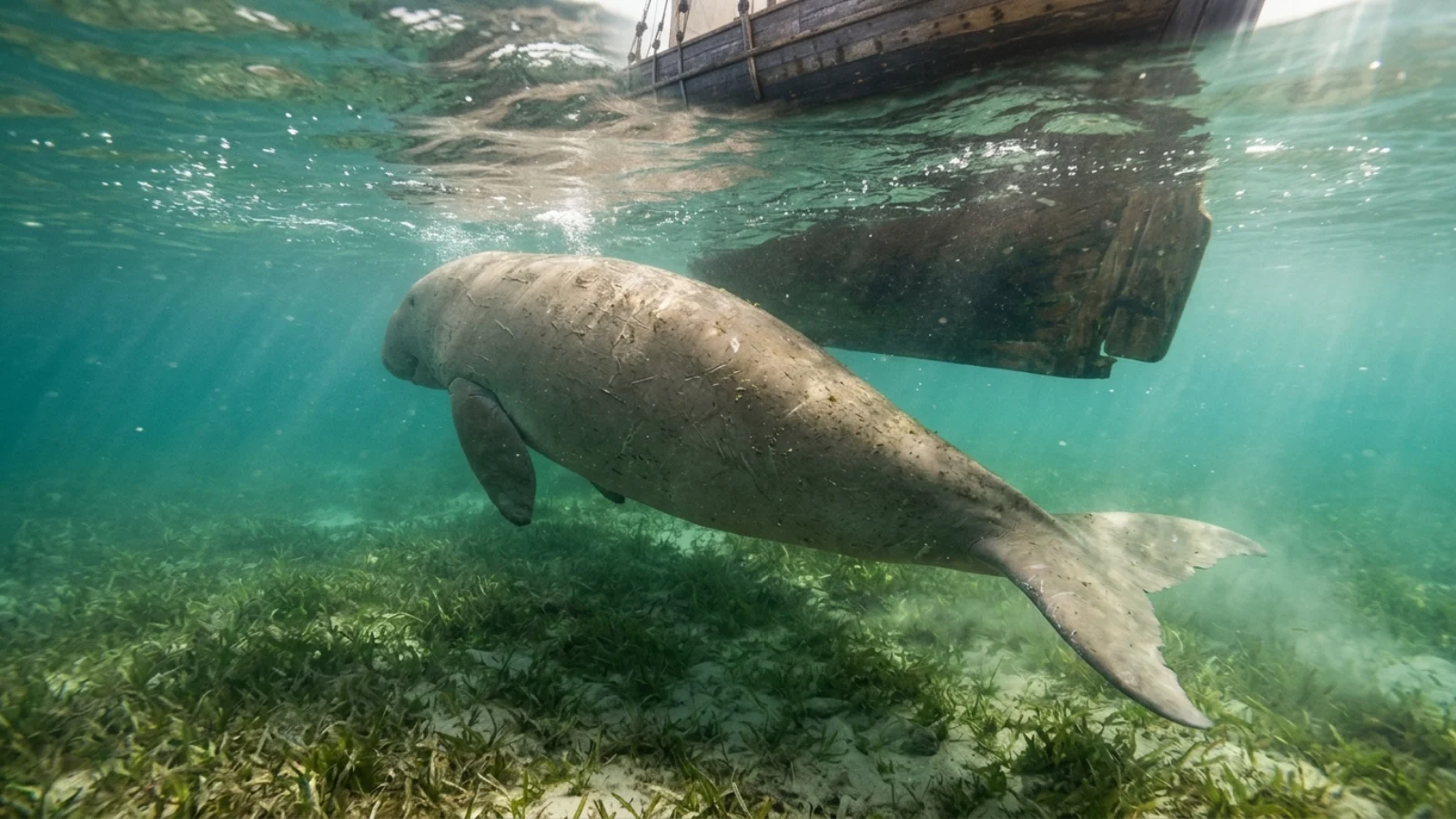
The idea that sailors mistook sea cows for mermaids is the most popular naturalistic explanation of the legend, and the sirenians themselves carry the echo in their scientific name, Sirenia. The order today contains four species: the dugong of the Indo-Pacific, and the West Indian, West African and Amazonian manatees. Steller’s sea cow, a giant relative that lived in the North Pacific and reached about 9 metres in length, was extinct by about 1768, only twenty-seven years after Europeans discovered it; see our guide to Steller’s sea cow. Living sirenians are fully aquatic herbivores that graze on seagrass and other plants in warm, shallow coastal waters and rivers, and large manatees can weigh up to about 1,500 kilograms.
At first sight the comparison seems absurd: a manatee is a large, grey, whiskered animal that looks nothing like a beautiful woman. But several features may have helped. Sirenians often rest upright in the water with the head and shoulders above the surface. They have flexible front flippers, and mothers keep their calves close for a long period of care, which can look strikingly human from a distance. Seen briefly, at a distance, in poor light, by sailors who had spent months at sea and grown up on mermaid stories, a manatee or dugong could plausibly become something else in the retelling. Columbus’s own comment shows both sides of this: he called them mermaids, but he also noticed that they did not look like the pictures. Our guides to the manatee and dugong versus manatee describe these animals properly.
Other suggestions have been made, such as seals, which can look surprisingly human when they raise their heads from the water, or skilled women divers who spent much of their lives in the sea. None of these theories needs to explain the whole legend, because the legend was already ancient before any European sailor saw a manatee. Real animals probably did not create the mermaid; they gave sailors something to fit to a story they already knew.
Fake mermaids: the Feejee mermaid and others
For several centuries a steady trade in fake mermaids kept the idea alive. From the mid-sixteenth century, Dutch traders imported “mermaids” made in China and the Malay archipelago from the upper bodies of monkeys and the back halves of fish. In Japan, especially in Kyushu, such figures were produced as souvenirs for foreigners. The most famous of all is the Feejee mermaid. It was bought from Japanese sailors in 1822 by an American sea captain, Samuel Barrett Edes, and exhibited in London that year; in 1842 it was taken to New York and shown by the showman P. T. Barnum, who leased it for $12.50 a week. A naturalist Barnum consulted would not vouch for it, but Barnum promoted it anyway, printing 10,000 pamphlets about mermaids. In his autobiography he described it as “an ugly dried-up, black-looking diminutive specimen, about 3 feet long”, with its mouth open and its arms thrown up “giving it the appearance of having died in great agony”. It was the torso and head of a young monkey sewn to the tail of a fish.
From Andersen to the screen
The modern image of the mermaid owes most to literature and film. Hans Christian Andersen’s fairy tale The Little Mermaid, first published in 1837 (some sources date it to 1836), tells of the sea king’s youngest daughter who gives up her voice for legs and a chance at a human soul. It has been translated into more than 100 languages and inspired the bronze statue unveiled in Copenhagen harbour in 1913. Disney’s animated film of 1989 removed the religious themes of the original, and it shaped the picture of a mermaid for generations of children.
That popularity is the context for the 2012 mockumentary and NOAA’s reply. The legend is real; the animal is not. For more on the real creatures behind sea legends, see our guides to sea monsters and sea serpents. And if you have ever found a “mermaid’s purse” on the beach, it was the egg case of a skate or shark; see mermaid’s purse. For how the Greek bird-women of the Odyssey turned into fish-tailed maidens, read sirens vs mermaids, and for the kindly sea goddesses who were never fish-tailed at all, see sea nymphs in Greek mythology.
Are mermaids real?
No. No evidence of any human-fish creature has ever been found, and NOAA stated in 2012 that no evidence of aquatic humanoids has ever been found.
Where did the idea of mermaids come from?
From ancient fish-tailed deities such as the Syrian goddess Atargatis, Mesopotamian fish-men, and the Greek sirens, who were later reimagined with fish tails in medieval Europe.
Were the sirens in Greek myth mermaids?
Not originally. Early Greek sirens were women with birds’ bodies. They were shown with fish tails only later, and medieval bestiaries merged them with mermaids.
Did sailors mistake manatees for mermaids?
Some did. Columbus recorded three “mermaids” off Hispaniola in 1493 that were almost certainly manatees, and dugongs were described as “woman-fish” in the Philippines.
What was the Feejee mermaid?
A fake made from the upper body of a monkey sewn to the tail of a fish, exhibited in London in 1822 and by P. T. Barnum in New York in 1842.
Why did Animal Planet say mermaids were real?
Its 2012 programme Mermaids: The Body Found was a fictional mockumentary presented like a real documentary. NOAA responded that no evidence of aquatic humanoids has ever been found.
Is the Sirenia order named after mermaids?
Its name refers to the sirens of myth. The order includes the dugong and three species of manatee, the animals most often linked to mermaid sightings.
- KSL / Associated Press, “Mermaids are not real, US government reveals” (9 July 2012), quoting NOAA Ocean Facts (26 June 2012).
- Homer, Odyssey, Book 12 (the sirens); Diodorus Siculus, Library of History, Book II (Derceto at Ashkelon); Lucian, On the Syrian Goddess.
- Liber Monstrorum de diversis generibus (7th–8th century); Old High German Physiologus (11th century).
- Barnum, P. T., autobiography, description of the Feejee mermaid (as quoted in the Feejee mermaid literature).
- Wikipedia contributors, “Mermaid”, “Siren (mythology)”, “Feejee mermaid”, “Sirenia”, “The Little Mermaid” (2023 snapshot via Kiwix mirror, accessed November 2026).
Blane Perun has been exploring Earth’s oceans and marine life for over 25 years. Founder of TheSea.Org in 1999, underwater photographer, coral aquaculture pioneer, and explorer of 80+ countries.
About Blane Perun →