The Lusca — The Bahamas’ Blue-Hole Monster, Legend and Reality
The Lusca is a monster of Bahamian folklore, not a real animal. It is said to live in the blue holes of Andros Island and is usually described as half shark and half octopus, sometimes as a giant octopus or cuttlefish, around 20 metres long, which drags swimmers, divers and even boats down into the depths. No specimen or reliable evidence of such a creature exists, and no known octopus comes close to that size. The legend is best understood as a way of explaining real dangers: blue holes are deep, dark, tidally influenced caves where water can swirl and bubble, where divers have died, and where real sharks and octopuses live.
This page reports the Lusca as a legend, attributing each account to its source and labelling unverified stories as such. The geology of blue holes and the sizes of real octopuses are given from scientific sources.
The legend
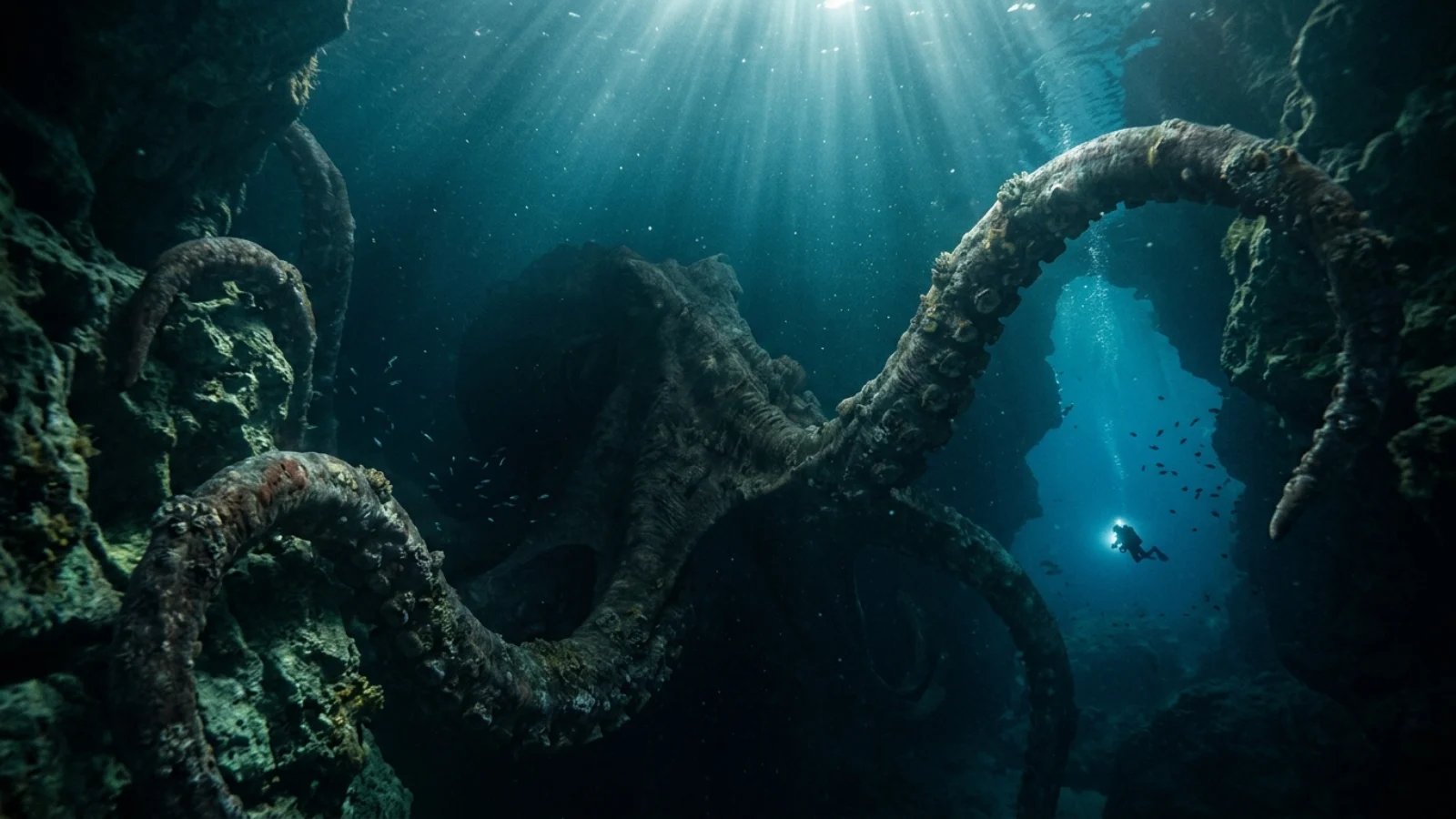
In the folklore of the Bahamas, the Lusca is a monster that lives in the blue holes, the deep, circular pits in the limestone that pock the island of Andros and its surrounding shallows. It is most often described as a creature that is half shark and half octopus, with a shark’s head and body and a mass of tentacles, though other versions make it a giant octopus, a giant squid or a giant cuttlefish. Its size is given as around 75 feet, about 20 to 23 metres. The Lusca is said to seize swimmers, fishermen and cave divers with its tentacles and drag them down into its underwater lair, and in some tellings it can pull down whole boats.
Local accounts link the monster to particular signs. According to traditions summarised by the travel publisher Fodor’s, water bubbling or boiling at the surface of a blue hole is taken as a sign that the Lusca is about to strike, and the monster has been blamed for missing swimmers, lost cave divers and wrecked boats. Some people who claimed to have survived attacks reportedly described sucker marks on their bodies. In other words, the Lusca gathers into one creature several things that really do happen at blue holes: sudden surface disturbances, unexplained disappearances and the presence of animals with suckers and teeth.
The origin of the name is uncertain. One suggestion is that it is a clipped form of “Mollusca”, the scientific name of the group that includes octopuses and squid, which would fit the monster’s tentacles, but this is a modern guess rather than an established etymology.
Stories and retellings
Like most folklore, the Lusca has been retold so often that its story is hard to pin down. Writers on the blue holes repeat a nineteenth-century tale in which an American captain told the French writer Bénédict-Henry Révoil that in 1836 a creature had dragged two sailors into the sea, and that one sailor had cut off one of its arms, which was later given to P. T. Barnum’s American Museum, where curators doubted that it was genuine. This story, reported by ExplorersWeb in 2025, cannot be checked against any surviving specimen. A report of a tentacled body washing ashore on Grand Bahama in 2011 is likewise unverified.
In more recent years the Lusca has become a fixture of television. In an episode of the series River Monsters titled “Terror in Paradise”, the biologist and angler Jeremy Wade investigated reports of the Lusca attacking swimmers and divers. After considering reef sharks, tiger sharks and the giant Pacific octopus, he concluded that a large octopus was the most likely real basis for the legend. The explorer and presenter Josh Gates has also interviewed a fisherman who claimed to have seen the creature. The name has spread in popular culture: the Lusca Fantastic Film Fest, an annual festival in Puerto Rico, is named after it, and a resort restaurant on South Andros bears its name.
Andros Island and its blue holes
The Lusca’s home is as remarkable as the legend. Andros is the largest island of the Bahamas, an archipelago of hundreds of small islets and cays joined by mangrove creeks and tidal swamps, with three main islands, North Andros, Mangrove Cay and South Andros. Its land area of about 5,957 square kilometres is greater than all the other Bahamian islands combined, and it stretches about 167 kilometres from north to south. Off its eastern shore lies one of the world’s largest barrier reefs, often described as the third largest, and beyond it the Tongue of the Ocean, a deep trench where the seabed drops to about 2,000 metres only 1.6 kilometres from shore.
Andros has more blue holes than anywhere else on Earth. Recent counts give about 175 inland blue holes and about 50 more in the shallow waters offshore, more than 200 in all. Blue Holes National Park, established in 2002 and managed by the Bahamas National Trust, protects about 40,000 acres, or 162 square kilometres, of the island, including several blue holes and thousands of acres of pine forest. The holes are named and visited: Cousteau’s Blue Hole, Stargate, Captain Bill’s, Uncle Charlie’s, Benjamin’s and Rat Cay among them.
How blue holes form
A blue hole is a large marine cavern or sinkhole, open to the surface, that has developed in limestone or old coral reef. Blue holes formed during the ice ages, when so much water was locked up in ice sheets that sea level stood about 100 to 120 metres lower than today. The carbonate banks of the Bahamas were then dry land, and rainwater, slightly acidic, dissolved the limestone to form caves, shafts and sinkholes. When the ice melted at the end of the last glaciation, the sea rose and flooded them. See our guide to blue holes for the geology and the world’s deepest examples, including Dean’s Blue Hole on Long Island in the Bahamas.
Inside, blue holes are layered. Most have fresher water at the top and saltier water below, separated by a sharp boundary called a halocline, where chemical reactions eat away at the rock and can carve long side passages; in Sawmill Sink in the Bahamas these run for more than 600 metres. Circulation is poor, and below a certain depth the water is usually anoxic and laced with hydrogen sulfide, which is toxic to most life. That airless water preserves whatever falls into it, which is why Bahamian blue holes have yielded fossils of crocodiles and tortoises and bacterial communities that interest astrobiologists. In 2009 a team led by Keith Tinker made more than 150 dives in seven Bahamian blue holes to study such bacteria.
Tides, currents and the “boiling” water
The feature of the Lusca legend with the clearest physical basis is the bubbling water said to warn of an attack. Blue holes typically contain tidally influenced water, and many are connected through cave passages to the sea or to other holes. Jacques Cousteau demonstrated that connection on Andros: Andros’s own historical timeline records him exploring the blue holes and the Tongue of the Ocean with his research ship Calypso in 1970, and the Caribbean Journal reports a 1971 experiment in which he released dye into an inland blue hole and later detected it offshore in the Tongue of the Ocean.
When a cave system links a blue hole to the open sea, the rise and fall of the tide must push water through it. As the tide changes, water can be drawn down into a hole or forced up out of it, producing swirls, currents and boils on the surface. Fodor’s suggests that such rapid tidal changes could explain the “bubbling” that local tradition associates with the Lusca. For a swimmer or a small boat at the mouth of a hole, a strong inflow could feel exactly like being pulled down by something below.
Real dangers in blue holes
The other part of the Lusca’s reputation, as a taker of lives, also rests on reality. Blue holes are among the most dangerous places in the world to dive. Nitrogen narcosis begins to affect divers below about 21 metres, clouding judgement just as light fades and the walls close in, and overhead rock, silt and strong currents can trap the unwary. Elsewhere, the Blue Hole near Dahab in the Red Sea is nicknamed the “Divers’ Cemetery” because at least 40 divers have died there. On Andros, early cave explorers such as Rob Palmer, who dived the island’s holes in the 1970s and 1980s, found Lucayan remains and a canoe at the bottom of Stargate Blue Hole, a reminder that people have been lost in these holes for centuries. The Lucayans, a branch of the Taíno who lived across the Bahamas and numbered perhaps 40,000 when the Spanish arrived, had been almost wiped out by about 1520.
Sharks are a real presence too. Bull sharks, reef sharks and hammerheads have been seen using blue holes, and they occasionally attack people. A large shark appearing out of the dark water of a blue hole is a frightening sight, and the “half-shark” part of the Lusca may well owe something to them.
Could a giant octopus be real?
The most popular “real” Lusca is a giant octopus. Octopuses certainly live around the Bahamas, including the Caribbean reef octopus, and they shelter in holes and crevices in the reef. But none comes anywhere near the size of the legend. The largest octopus species in the world, the giant Pacific octopus, lives in the cold North Pacific, not the Caribbean. Adults usually weigh around 15 kilograms with an arm span of up to about 4.3 metres; the largest individuals measured weighed about 50 kilograms with a span of about 6 metres. A 20-metre octopus would be many times larger than any octopus ever recorded. Jeremy Wade’s conclusion that a large octopus underlies the legend is a reasonable guess about what inspired the stories, not evidence of a monster.
The giant squid, which can reach about 12 to 13 metres including its long tentacles, is closer in length but is a deep-ocean animal that is not known from the shallow blue holes; see our giant squid profile.
The St. Augustine connection
Writers on cryptids often link the Lusca to a famous carcass found in Florida. On 30 November 1896, two boys found a huge mass of tissue on the beach near St. Augustine. The visible part was about 6 metres long and 2.5 metres wide, and Dr DeWitt Webb, who examined it, estimated its weight at nearly 5 tons and believed it was the body of a giant octopus with stumps of arms. The supposed animal was named Octopus giganteus, a name that is not valid under the rules of zoological nomenclature, and it became the centrepiece of claims that giant octopuses roam the western Atlantic.
Scientific analysis tells a different story. When preserved tissue was re-examined, a 1995 study concluded that the carcass was a large mass of the collagen matrix of whale blubber, most likely from a sperm whale, and a 2004 comparison of the St. Augustine tissue with other “globsters” and with whale blubber reached the same kind of conclusion. A dead whale’s blubber can come away as a single shapeless sheet, and its fibres can look like the remains of arms. Our guide to sea monsters covers this and other globsters.
The chickcharney and other Andros folklore
The Lusca is not the only creature of Andros folklore. The best known is the chickcharney, a mischievous feathered being said to live in the pine forests, with three-toed feet, a head that can turn all the way round, and a habit of bringing luck to those who treat it with respect and misfortune to those who do not. It is sometimes said that the legend was inspired by an extinct giant barn owl, Tyto pollens, which lived in the Bahamas during the last ice age. Some popular accounts claim its remains were found on Andros and that it survived into historical times, but the fossil record does not support either claim: no fossils of Tyto pollens are known from Andros, and the claims that it lived in the island’s pine forests and was a metre tall and flightless were made without evidence. Its body mass has been estimated at perhaps 9 kilograms. Andros folklore also includes tales of buried pirate treasure at Morgan’s Bluff, named after the privateer Henry Morgan, and a strong tradition of bush medicine. Yoruba-influenced belief, according to the writer Noelle Nicolls, associates the blue holes with a water spirit.
Visiting the blue holes
The blue holes of Andros can be visited safely, and the national park has trails and docks at some holes for swimming. The rules are simple. Swim only where local guides and park signs indicate, stay well away from the mouths of ocean blue holes when the tide is running, and never enter caves or overhead environments without proper cave-diving training and equipment. Divers should go with local operators who know the tidal timing of each hole. Treat the Lusca as a story that encodes good advice: the blue holes are beautiful, but they deserve respect. For other legends rooted in real places, see Scylla and Charybdis and the Bermuda Triangle. For a lake monster with a similar mix of real animals and real water, see Champ, and for dozens more legends see our A–Z of mythical sea creatures.
Is the Lusca real?
No. The Lusca is a creature of Bahamian folklore. There is no specimen or reliable evidence, and no known octopus or shark matches its description or size.
Where does the Lusca live?
According to legend, in the blue holes of Andros Island in the Bahamas, which has more than 200 blue holes inland and offshore.
What does the Lusca look like?
It is usually described as half shark and half octopus, or as a giant octopus, squid or cuttlefish, about 20 to 23 metres (75 feet) long.
What causes the bubbling water linked to the Lusca?
Tidal flows through cave passages connected to blue holes can draw water in and push it out, producing swirls and boils at the surface.
How big can a real octopus get?
The giant Pacific octopus, the largest species, usually weighs about 15 kg; the largest measured individuals reached about 50 kg and 6 metres across.
Was the St. Augustine monster a giant octopus?
No. Analyses of preserved tissue in 1995 and 2004 concluded that the 1896 Florida carcass was a mass of whale blubber, probably from a sperm whale.
Is it safe to swim in the blue holes of Andros?
Yes, where guides and park signs allow, but avoid the mouths of ocean blue holes when tides are running and never enter caves without cave-diving training.
- Wikipedia contributors, “Lusca”, “Blue hole”, “Andros Island”, “St. Augustine Monster”, “Giant Pacific octopus”, “Tyto pollens”, “Blue Holes National Park” (2023 snapshot via Kiwix mirror and en.wikipedia.org, accessed November 2026).
- De Abreu, K. (27 May 2025). “A Guide to the Blue Holes of the Bahamas’ Andros Island”. ExplorersWeb.
- Britton, G. (26 September 2025). “This Island in The Bahamas Has 200 Blue Holes, a National Park, and a Legendary Mystery”. Caribbean Journal.
- Fodor’s Travel, “12 Ways to Explore the Myths and Mysticism of Andros, Bahamas” (accessed November 2026).
- Pierce, S. K. et al. (1995), amino acid analysis of the St. Augustine carcass tissue; River Monsters, season 8, episode 4, “Terror in Paradise”.
Blane Perun has been exploring Earth’s oceans and marine life for over 25 years. Founder of TheSea.Org in 1999, underwater photographer, coral aquaculture pioneer, and explorer of 80+ countries.
About Blane Perun →