Sea Serpents — The Sightings, the Hoaxes and the Oarfish
No giant sea serpent has ever been caught, photographed clearly or found as a carcass that withstood examination. Serpent-like sea monsters appear in the myths of Mesopotamia, Israel, Greece and Scandinavia, and from the sixteenth to the twentieth centuries sailors, fishermen and naval officers reported hundreds of sightings. The best-documented reports describe something real, but the most plausible explanations are known animals: the giant oarfish, the longest bony fish, which reaches about 8 metres; whales seen at an angle; decomposing basking sharks; and occasionally giant squid. Several famous “sea serpent” skeletons and carcasses were hoaxes or misidentified remains.
This page reports sightings in the words and figures of the people who made them, then sets out what later analysts proposed. A sighting is a claim about what someone saw, not evidence that a serpent exists.
Serpents of myth
Long before anyone reported seeing a sea serpent from the deck of a ship, the sea serpent was a figure of myth. In the ancient Near East and in Indo-European tradition, one of the most widespread stories is the combat between a god and a serpent or dragon of the waters, the Drachenkampf. The Babylonian god Marduk defeats Tiamat; the Canaanite storm god Baal, or Hadad, defeats the sea and its serpent Lotan; the God of the Hebrew Bible subdues Leviathan; the Hittite storm god defeats the serpent Illuyanka. In Norse myth, Jörmungandr, the Midgard Serpent, is so long that it encircles the whole world and is the destined enemy of the god Thor. In Greek myth, sea serpents kill the priest Laocoön and his sons in Virgil’s Aeneid after he warns the Trojans against the wooden horse.
These serpents are religious and cosmic figures rather than animals anyone claimed to have met. But the image of a vast serpent in the sea was firmly in place long before the age of exploration, ready to be applied to anything long, dark and moving that sailors saw in the water. Our guide to sea monsters covers Leviathan and its relatives in more detail.
Ancient reports
The first accounts that read like natural history appear in Greek and Roman writers. Aristotle mentions large sea serpents in his History of Animals. The geographer Strabo, citing the philosopher Poseidonius, describes a “fallen dragon” seen on a plain by the coast of the northern Levant sometime between 130 and 51 BC: its body was about a plethrum, roughly 30 metres, long, so bulky that horsemen standing on either side could not see each other, with jaws large enough to admit a man on horseback and scales each longer than a shield. Whatever Poseidonius saw, the description fits a stranded whale far better than a reptile. The Roman writer Claudius Aelianus describes a giant “sea centipede” with many feet on each side, an image that was still being repeated by the French naturalist Guillaume Rondelet in the sixteenth century.
The Norwegian sea serpent
The sea serpent as most people imagine it, a huge, maned snake rising in coils beside a ship, comes from Scandinavia. The Swedish churchman Olaus Magnus drew sea serpents on his great map of the northern seas, the Carta Marina of 1539, and described one in his History of the Northern Peoples of 1555. Sailors along the coast of Norway, he wrote, all told of a serpent “of fearsome size, from 200 feet to 400 feet long, and 20 feet wide”, roughly 60 to 120 metres long and 6 metres across, living in cliffs and caves near Bergen. On summer nights it came out to eat calves, lambs and pigs, or went to sea to feed on sea nettles and crabs. It had hair hanging from its neck, sharp black scales and flaming red eyes, and it attacked ships, raising itself “like a column from the water” to seize people.
Norwegian tradition had many such stories. One legend says that Saint Olaf killed a sea serpent at Valldal in 1028 and threw its body onto the mountain Syltefjellet, where marks on the rock are still pointed out, and the town of Seljord in Norway carries a sea serpent on its coat of arms. Two centuries after Olaus, Erik Pontoppidan, bishop of Bergen, discussed sea serpents in his Natural History of Norway, which included an illustration of a maned sea serpent. He did not doubt that they existed, but he was more skeptical than Olaus about whether they attacked ships and ate people. Sailors at the time still told of serpents wrapping ships in their coils, and of crews throwing oars or shovels overboard in the hope that the serpent would take the object and leave the ship alone.
Hans Egede, 1734
One of the most often quoted early sightings comes from the Dano-Norwegian missionary Hans Egede, a pioneer of the colonisation of Greenland. In his journal for 6 July 1734 he wrote that “a very large and frightful sea monster” appeared, raising itself so high that its head reached above the main-top. It had a long, sharp snout, spouted water like a whale and had very broad flappers; its body seemed covered with scales, its skin was uneven and wrinkled, and its lower part was formed like a snake. When it plunged back, it raised its tail above the water a whole ship’s length from its head. Egede placed the sighting at about latitude 64°N and described the animal as as bulky as the ship and three or four times as long.
Egede’s companion, a missionary named Bing, sketched it, and Pontoppidan used the sketch to argue that this was a different kind of animal from the usual sea serpent. In 1883 the naturalist Henry Lee proposed a rational explanation: that the party had seen a giant squid, with its head and one of its long tentacles raised above the water. That interpretation is still the most widely cited, though no one can be certain.
The Gloucester sea serpent, 1817
The most widely witnessed sea serpent appeared off Gloucester and Cape Ann, Massachusetts. An earlier sighting off Cape Ann is attributed to John Josselyn in 1638, though some sources give 1639, but the great outbreak began in August 1817 and continued into 1818 and 1819. Fishermen and townspeople described a creature about 18 metres long, with a head like a turtle’s or a serpent’s and humps along its back. One famous report came from the crew of the schooner Caravan, who said they fired a cannon at it before it dived out of sight. Because hundreds, perhaps thousands, of people claimed to have seen it, and because the Linnaean Society of New England gathered sworn statements and published a report, the Gloucester serpent is one of the best-documented sea serpents on record.
It also illustrates how hard such reports are to interpret. Descriptions varied widely, from a long snake to a humped creature with a head like a horse. Some observers suggested a large eel or a hoax, and the investigator Joe Nickell, noting that several witnesses described a spear-like projection from the head, has suggested a narwhal. The Charleston playwright William Crafts mocked the whole affair in 1819 with a play called The Sea Serpent; or, Gloucester Hoax. The serpent remains a cheerful symbol of the town today.
HMS Daedalus, 1848
The single most famous sea serpent report came from the Royal Navy. On 6 August 1848, the corvette HMS Daedalus, on passage between the Cape of Good Hope and St Helena, sighted what her captain, McQuhae, and several of his officers described as an enormous serpent. McQuhae reported that about 1.2 metres of its head and shoulders were held above the water and that they believed about another 18 metres of the body was in the sea. It was dark brown with a yellowish-white throat and passed the ship at around 19 to 24 kilometres per hour, so close under the lee quarter, he said, that if it had been a man of his acquaintance he could have recognised his features with the naked eye. According to seven members of the crew, it stayed in view for about twenty minutes. McQuhae’s report was published in The Times and debated for months.
Not everyone aboard agreed on what they had seen: another officer wrote that the creature looked more like a lizard than a serpent. Later analysts have proposed several explanations. The evolutionary biologist Gary J. Galbreath argued that the crew saw a sei whale, a large, fast baleen whale on the reasoning that the long back of a fast-moving whale, seen at an angle, could be read as a serpent. A few months later, on 31 December 1848, an officer of HMS Plumper, west of Oporto in Portugal, reported a long black creature with a sharp head and something like a mane, its back about 6 metres above the water, and the Illustrated London News published a sketch on 14 April 1849. These naval reports gave the sea serpent a respectability it had never had before.
Hoaxes and misidentified bones
The sea serpent’s popularity in the nineteenth century made it a target for showmen. In 1845 the collector Albert Koch exhibited a fossil skeleton about 35 metres long in New York, which he called Hydrarchos and presented as the remains of an extinct sea serpent. The anatomist Jeffries Wyman examined it and declared that the skull was mammalian and that the skeleton had been assembled from the bones of several different animals. It was in fact made from at least five fossil specimens of Basilosaurus, an early whale whose long, slender body had already caused its first describers to mistake it for a reptile.
Carcasses have caused similar confusion. A creature thrown up by storms or recovered by fishermen and called a sea serpent often turns out to be a decomposing basking shark, whose jaws and fins fall away to leave a small “head” on a long “neck”. In British Columbia, home of the sea serpent known as Cadborosaurus or “Caddy”, a supposed carcass recovered from the stomach of a sperm whale at Naden Harbour in October 1937 was photographed and tentatively identified by the provincial museum director, Francis Kermode, as a fetal baleen whale.
Cadborosaurus and other modern serpents
Caddy, named after Cadboro Bay near Victoria, is the best-known modern sea serpent of the Pacific coast of North America. Witnesses describe a serpent with a horse-like head on a long neck, humps or vertical coils behind it, small front flippers and either hind flippers or a fan-shaped tail. The oceanographer Paul LeBlond of the University of British Columbia and the zoologist Edward Bousfield argued that it might be an unknown species and gave it a scientific name, Cadborosaurus willsi. Their critics point out that no specimen exists, and LeBlond and Bousfield themselves list the many long animals that have been proposed to explain sightings, including conger eels, humpback whales, elephant seals and oarfish.
The Dutch zoologist Anthonie Cornelis Oudemans, director of the zoological gardens at The Hague, took a more radical approach in his 1892 book The Great Sea Serpent, arguing that many reports could be explained by an unknown giant, long-necked seal. Later cryptozoologists such as Bernard Heuvelmans, in his 1968 book In the Wake of the Sea-Serpents, sorted sightings into several supposed types. Some writers have suggested surviving plesiosaurs or ichthyosaurs, or extinct whales such as Basilosaurus. None of these proposals is supported by a specimen, a clear photograph or a breeding population large enough to survive.
The real suspects
If sea serpents are not unknown animals, what did all these people see? The best single candidate is the giant oarfish, Regalecus glesne. It is the longest bony fish in the world, with a record length of about 8 metres, and unconfirmed specimens of up to 11 metres have been reported, though most measured fish are around 3 metres. Its body is a narrow, silvery ribbon spotted with dark marks, with a crimson dorsal fin running its whole length and a crest of long red rays above the head, and it swims with an undulating motion. It lives in the open ocean from near the surface down to about 1,000 metres and is rarely seen alive, but sick or dying oarfish come to the surface and wash ashore. An oarfish about 5 metres long found on a beach in Bermuda in 1860 was originally described as a sea serpent. A crested, red-maned, ribbon-like fish rising at the surface is a remarkably good match for many descriptions.
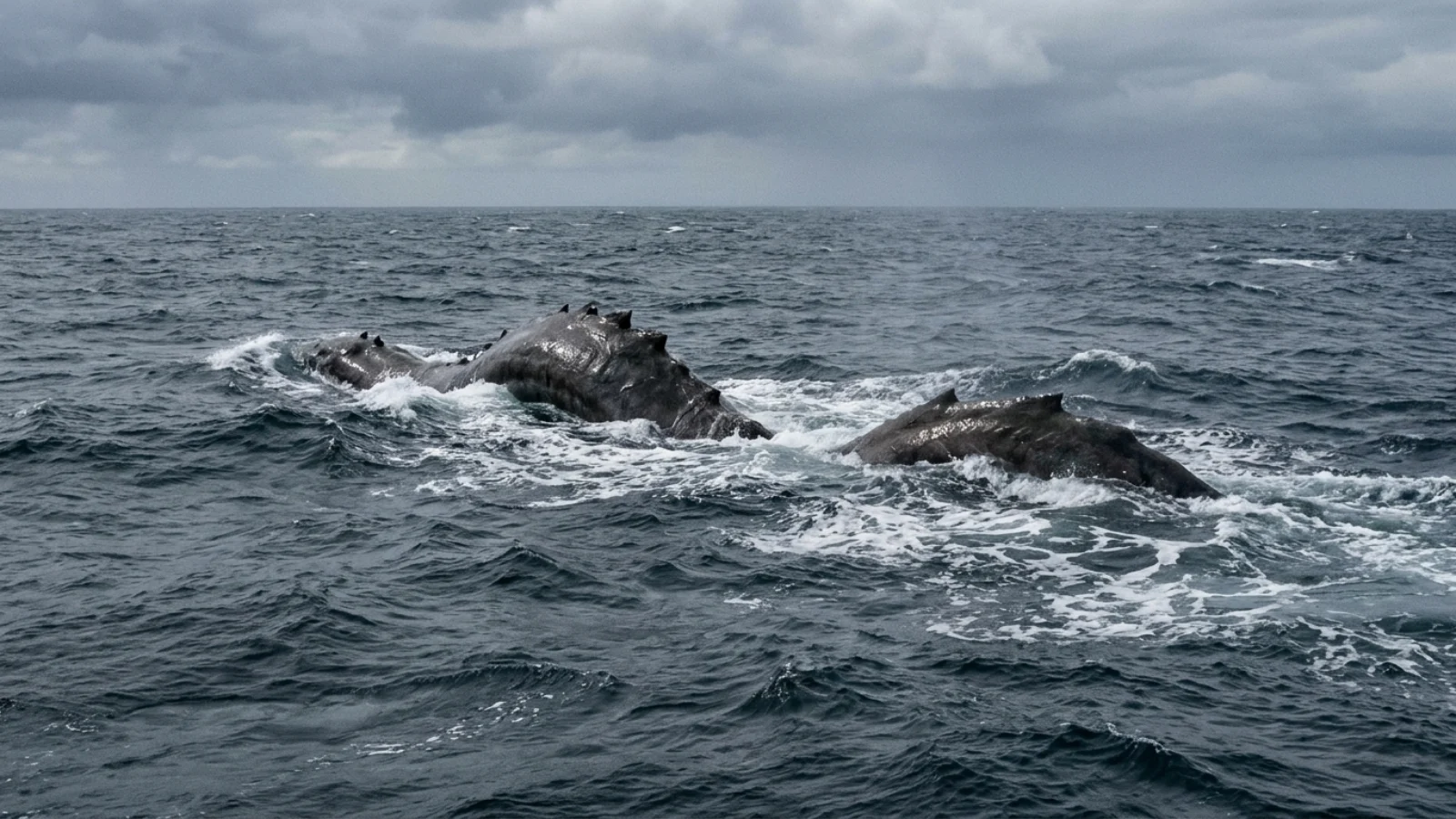
Whales are another strong candidate. A large whale swimming with its head up, or a line of humps formed by its back and fin breaking the surface in turn, can look like a serpent at a distance, and Galbreath’s sei whale is one of the best-argued identifications of a specific sighting. Rows of animals swimming in line, mats of kelp, logs and other floating debris, and abandoned nets have all been suggested for individual reports. Giant squid fit some of the older North Atlantic accounts, especially Egede’s. Our guide to the giant squid explains why such animals so rarely reach the surface alive.
Why the serpent faded
Sea serpent reports peaked in the nineteenth century, when more people than ever were at sea, newspapers spread every report, and natural history was full of genuine new discoveries. They have become rarer as ships became faster and higher above the water, as cameras spread, and as marine biologists identified and filmed the oarfish, the giant squid and other deep-sea animals. The sea serpent is a reminder that observers can be honest, sober and experienced, as McQuhae and his officers certainly were, and still see something they cannot identify. The right response to such a sighting is not to invent a new monster but to check it against the animals that are known to exist. For the freshwater cousin of the sea serpent, see the Loch Ness Monster.
Are sea serpents real?
No sea serpent has ever been confirmed by a specimen or clear photograph. Sightings are best explained by known animals such as giant oarfish, whales, basking sharks and giant squid.
What did HMS Daedalus see in 1848?
The crew reported a serpent with about 1.2 m of head above water and an estimated 18 m of body. The biologist Gary Galbreath has argued that it was a sei whale.
What animal is most often mistaken for a sea serpent?
The giant oarfish, the longest bony fish, which reaches a record of about 8 metres, with a crimson dorsal fin and crest, and swims with an undulating motion.
What was the Gloucester sea serpent?
A creature reported by hundreds of people off Gloucester, Massachusetts, from August 1817. Suggested explanations include a large eel, a narwhal or a hoax.
Was the Hydrarchos skeleton real?
No. Albert Koch’s 35-metre “sea serpent” of 1845 was assembled from the bones of at least five specimens of Basilosaurus, an extinct whale.
What is Cadborosaurus?
A sea serpent of Pacific Northwest folklore, named after Cadboro Bay in British Columbia. No specimen exists; proposed explanations include conger eels, whales, elephant seals and oarfish.
Where do sea serpent legends come from?
From ancient myths of gods fighting water serpents, such as Leviathan and Jormungandr, combined with real sightings of long animals at sea.
- Olaus Magnus (1555). Historia de Gentibus Septentrionalibus; Olaus Magnus (1539). Carta Marina.
- Egede, H., journal for 6 July 1734, as translated in Lee, H. (1883).
- McQuhae, report of HMS Daedalus, published in The Times (1848); Illustrated London News, 14 April 1849 (HMS Plumper).
- Oudemans, A. C. (1892). The Great Sea Serpent; Heuvelmans, B. (1968). In the Wake of the Sea-Serpents.
- Wikipedia contributors, “Sea serpent”, “Gloucester sea serpent”, “HMS Daedalus (1826)”, “Cadborosaurus”, “Giant oarfish”, “Basilosaurus”, “Erik Pontoppidan” (2023 snapshot via Kiwix mirror, accessed November 2026).
Blane Perun has been exploring Earth’s oceans and marine life for over 25 years. Founder of TheSea.Org in 1999, underwater photographer, coral aquaculture pioneer, and explorer of 80+ countries.
About Blane Perun →