The Flying Dutchman — The Ghost Ship Legend and the Science Behind It
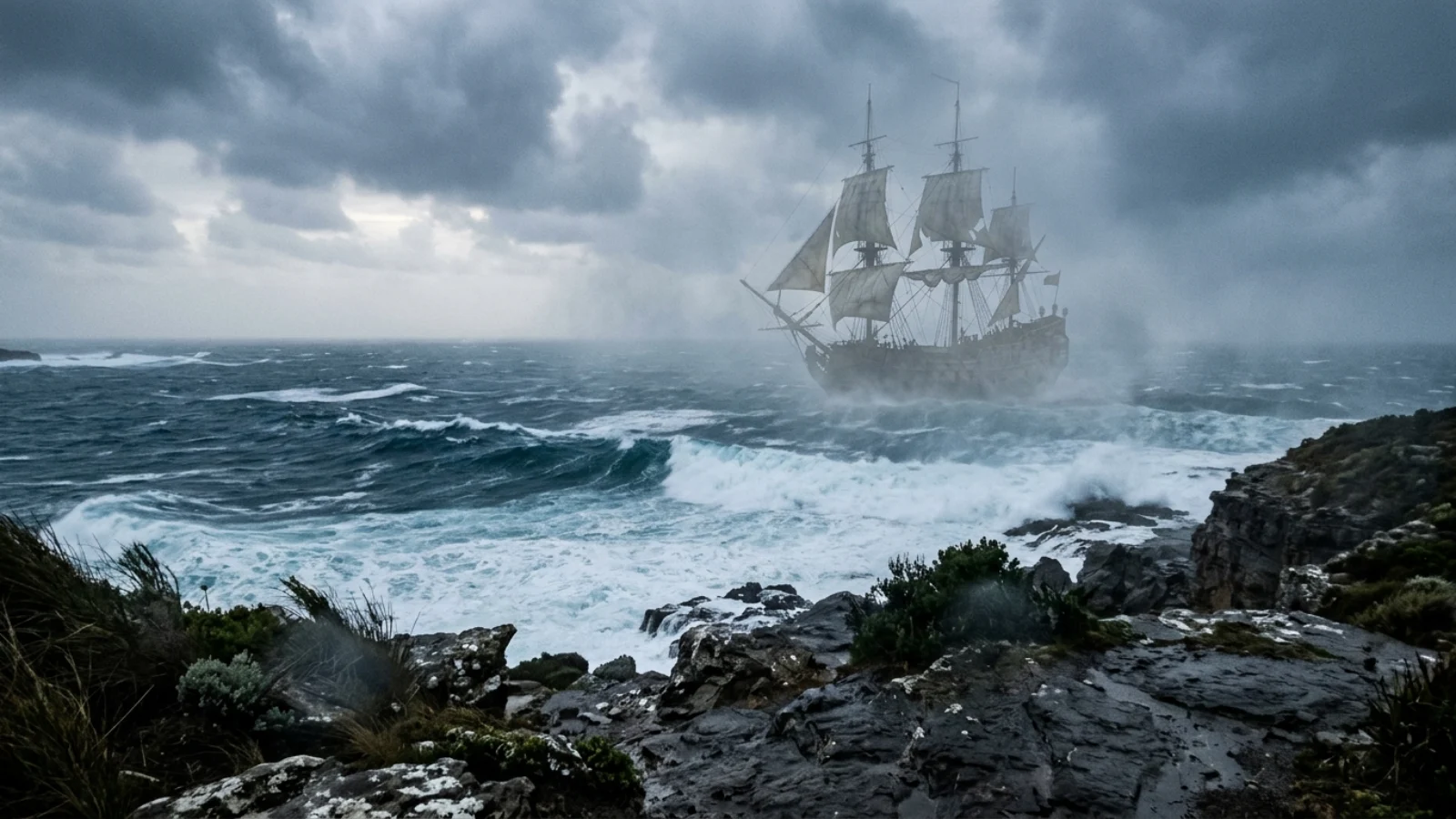
The Flying Dutchman is a legendary ghost ship doomed never to make port, usually said to haunt the stormy seas off the Cape of Good Hope. It is folklore, not a real vessel. The legend probably grew among sailors in the age of the Dutch East India Company, and the oldest surviving written versions date from 1790 and 1795. Writers in the early nineteenth century gave the ship a cursed captain, later named Van der Decken, and Richard Wagner’s opera of 1843 made the story world-famous. Reported sightings, including one recorded by the future King George V in 1881, are most plausibly explained by mirages such as the Fata Morgana, which can lift and distort the image of a distant ship.
This page traces the legend through its dated written sources, so that each new element can be pinned to the writer who added it. Sightings are reported as claims in the words of those who made them; none is evidence of a supernatural ship.
What the legend says
In its best-known form, the legend of the Flying Dutchman tells of a ship whose captain, caught in a storm while trying to round the Cape of Good Hope, swore that he would round it if it took him until the end of time. For that blasphemy he and his crew were condemned to sail the seas forever without ever reaching port. Sailors who meet the ship in bad weather see her under full sail when no ship could carry so much canvas, sometimes glowing with a strange light. Her crew may try to hand over letters addressed to people on shore who have been dead for many years. To see her is an omen of disaster.
Almost every element of that story was added at a particular moment by a particular writer, and the legend’s development can be followed through its dated sources. That is unusual for a sea legend, and it means the Flying Dutchman can be studied as a piece of literary history as well as folklore. The name itself is ambiguous: in the earliest sources “the Flying Dutchman” refers to the ship, and only later is it used for her captain.
The age of the Dutch East India Company
The legend almost certainly grew out of the great age of Dutch seafaring in the seventeenth century. The Dutch East India Company, known by its Dutch initials VOC, ran a huge trade between the Netherlands and the East Indies, and in that century the Dutch merchant fleet probably outnumbered the fleets of England, France, Spain, Portugal and the German states combined. Their ships had to round the southern tip of Africa, where the Company founded its station at Table Bay, the site of Cape Town, as a halfway point for supplies.
In 1611 the Dutch navigator Hendrik Brouwer devised a new route that took ships from the Cape far south into the strong westerly winds of the southern Indian Ocean before turning north for Java. The Brouwer Route cut the voyage from the Cape to Java from almost twelve months to about six. It also meant that a great many ships passed through some of the roughest water on Earth. The Portuguese navigator Bartolomeu Dias, the first European to round the cape, in 1488 (some sources say 1487), had named it the Cape of Storms before the king of Portugal renamed it the Cape of Good Hope. The waters south and east of the cape are still notorious. The Agulhas Current, which runs along the coast of South Africa, is associated with some of the most dangerous waves in the world: rogue waves there can exceed 30 metres, and about 30 large ships have been severely damaged or sunk by such waves along the South African east coast. It is easy to see how sailors who lost ships and friends in such seas came to tell stories about a ship that could never get past.
Some later writers have suggested that the legend’s captain was modelled on a real seventeenth-century Dutch captain, Bernard Fokke, who was famous for the speed of his voyages from the Netherlands to Java and was rumoured to be in league with the Devil. The link is speculative; it rests on later retellings rather than on any contemporary account connecting Fokke to a phantom ship.
The first written versions: 1790 and 1795
The oldest surviving written reference to the Flying Dutchman appears in a book published in 1790, Travels in Various Parts of Europe, Asia and Africa, by John MacDonald. Describing a stormy passage near the Cape, he wrote that the weather was so bad that the sailors said they saw the Flying Dutchman. “The common story”, he added, “is that this Dutchman came to the Cape in distress of weather and wanted to get into harbour but could not get a pilot to conduct her and was lost and that ever since in very bad weather her vision appears.” This early version has no curse and no crime: the ship is simply a vessel lost in a storm whose image reappears in storms.
The next reference appears in chapter six of A Voyage to Botany Bay, published in 1795 and attributed to George Barrington, a famous pickpocket transported to New South Wales in 1791. The narrator says he had heard of sailors’ superstitions but never believed them, and tells of a Dutch warship lost off the Cape with all hands. Her consort survived, and on the return voyage, in a violent storm near the same place, some of the crew saw, “or imagined they saw”, a ship bearing down on them under full sail, which one man swore was the ship that had foundered. The story is told with a skeptic’s distance, and again there is no crime and no curse, just a lost ship seen again in the same kind of weather that sank her.
The curse is added: Leyden, Scott and Blackwood’s
In the early nineteenth century, poets and novelists began to give the ship a moral. In Scenes of Infancy, published in Edinburgh in 1803, the Scottish poet and scholar John Leyden wrote that sailors in the high southern latitudes off Africa believed hurricanes were heralded by a spectre ship called the Flying Dutchman, whose crew had been guilty of “some dreadful crime” in the infancy of navigation, had been struck by plague, and were condemned to sail the ocean until their penance was complete. The following year, the Irish poet Thomas Moore moved the ship to the North Atlantic in a poem written as he passed Deadman’s Island in the Gulf of St Lawrence in September 1804, describing a gloomy ship whose sails were full though no wind blew, and noting in a footnote that sailors called this ghost ship, he thought, “the flying Dutch-man”.
Leyden’s friend Sir Walter Scott was the first to call her a pirate ship. In the notes to his poem Rokeby, published in December 1812, Scott wrote that she had originally been a ship loaded with great wealth, aboard which “some horrid act of murder and piracy” had been committed, and that her appearance was considered by sailors “the worst of all possible omens”.
The version most people now recognise first appeared as a story in Blackwood’s Edinburgh Magazine in May 1821, under the title “Vanderdecken’s Message Home”. It sets the scene at the Cape of Good Hope and gives the captain a name, Hendrick Van der Decken, master of an Amsterdam ship that had sailed seventy years before. Trying to weather Table Bay against a headwind, he swears at the wind, and when another ship asks whether he means to put into the bay that night, he replies that he may be eternally damned if he does, though he should beat about until the day of judgement. The Blackwood’s story also introduced the motif of the letters: the Dutchman’s crew try to pass packets of letters to other ships for delivery to people who have long since died, and any ship that accepts them is doomed.
From melodrama to Wagner
Once the legend had a name, a curse and a plot, it moved quickly to the stage. Edward Fitzball’s melodrama The Flying Dutchman; or, the Phantom Ship, with music by George Rodwell, dates from 1826, and its published text openly acknowledged the Blackwood’s story as its source. In Germany the poet Heinrich Heine repeated the Blackwood’s details in his Pictures of Travel: The North Sea (1826). In his satirical novel The Memoirs of Herr von Schnabelewopski (1833), Heine had a character attend a performance of a Flying Dutchman play in Amsterdam, and in that retelling he added two new ideas: that the Dutchman is allowed ashore at intervals, and that he can be redeemed by the faithful love of a woman.
Richard Wagner took the story from Heine. In his autobiography Wagner said that the opera was inspired by a stormy sea crossing from Riga to London in July and August 1839, when he and his wife were fleeing debts. A voyage expected to take eight days took three weeks, and the ship sheltered in the Norwegian fjords at Tvedestrand along the way. In Wagner’s Der fliegende Holländer, first performed in 1843, the Dutchman is a captain who once invoked Satan and is cursed to roam the sea without rest; every seven years he may come ashore to seek a woman who will be faithful to him until death. He finds her in Senta, the daughter of a Norwegian captain, Daland, whose ship has taken refuge from a storm near Sandwike in southern Norway. Senta’s ballad about the Dutchman, the sailors’ choruses and the ghostly crew’s song became some of the most famous music in nineteenth-century opera.
A rival French opera, Pierre-Louis Dietsch’s Le vaisseau fantôme, opened at the Paris Opera on 9 November 1842. Wagner believed it was based on a scenario he had sold to the Opera, though its libretto drew mainly on Walter Scott’s The Pirate and Frederick Marryat’s novel The Phantom Ship, and the two operas are only slightly similar.
The 1881 royal sighting
The best-known reported sighting of the Flying Dutchman comes from a royal source. Around 1880, Prince George of Wales, the future King George V, made a three-year voyage with the Royal Navy in his late teens together with his elder brother, Prince Albert Victor, and their tutor, John Neill Dalton, sailing for part of the time aboard HMS Inconstant after their own ship, the corvette Bacchante, needed repairs to a damaged rudder. The journal of the cruise, later edited and published, records for the early morning of 11 July 1881, off the coast of Australia:
“At 4 a.m. the Flying Dutchman crossed our bows. A strange red light as of a phantom ship all aglow, in the midst of which light the masts, spars and sails of a brig 200 yards distant stood out in strong relief as she came up on the port bow, where also the officer of the watch from the bridge clearly saw her, as did the quarterdeck midshipman, who was sent forward at once to the forecastle; but on arriving there was no vestige nor any sign whatever of any material ship was to be seen either near or right away to the horizon, the night being clear and the sea calm. Thirteen persons altogether saw her.”
Because the published journal was edited, it is not certain which of the two princes wrote the entry. What it describes, a glowing image of a ship that vanished when approached, on a clear and calm night, is exactly the kind of experience that atmospheric optics can produce.
Mirages: the most likely explanation
The most credible explanation for sightings of the Flying Dutchman is a superior mirage, and in particular the complex form known as a Fata Morgana. Light travels in straight lines through air of uniform temperature, but when it passes through layers of air at different temperatures, it bends. In calm weather, a layer of warm air can lie over a layer of cold, dense air close to the sea surface, a situation called a temperature inversion. If the inversion is strong enough, rays of light from a distant object are bent downward more sharply than the curve of the Earth, so that an observer can see an image of a ship that is actually below the horizon.
A Fata Morgana goes further. When the inversion forms an atmospheric duct that acts like a lens, it can produce a stack of images, some upright and some inverted, that stretch, shrink and change shape within seconds. A ship can appear to float above the water, or to sail upside down above its own image, or to be cut off at the waterline. The name comes from the Italian for Morgan le Fay, the sorceress of Arthurian legend, because the effect was famously seen in the Strait of Messina between Sicily and Calabria, where people described fairy castles in the air. A related effect called looming can raise a ship lying just beyond the horizon into view.
These effects explain several recurring features of Flying Dutchman stories: a ship seen where no ship should be, apparently sailing against the wind or in calm air, glowing in the low light of dawn or dusk, and disappearing when another vessel approaches. They do not need a supernatural ship, only a real one out of sight below the horizon and the right layers of air.
The Flying Dutchman in culture
The legend has remained one of the most adaptable in maritime folklore. Samuel Taylor Coleridge’s The Rime of the Ancient Mariner (1797 to 1798) contains a spectral ship that may have been influenced by it. The American painter Albert Pinkham Ryder painted The Flying Dutchman around 1887, and the work is now in the Smithsonian American Art Museum; Howard Pyle’s version hangs in the Delaware Art Museum. The Irish poet John Boyle O’Reilly wrote a poem on the subject in 1867 for a handwritten newspaper produced by Fenian convicts being transported to Western Australia. In the twentieth and twenty-first centuries the ship has appeared in stories, television and films, most prominently in the Pirates of the Caribbean films of 2006 and 2007, where she is captained by Davy Jones, a figure borrowed from another piece of sailors’ lore; see our guide to Davy Jones’ Locker.
The Flying Dutchman stands for something every sailor knew in the age of sail: that some ships never came home. For the real vessels that have been found adrift without their crews, see our guides to ghost ships and the Mary Celeste, and for another set of optical and oceanographic explanations for sea legends, see Scylla and Charybdis. Japan has its own phantom ships, the Funayūrei; see Japanese sea monsters.
Was the Flying Dutchman a real ship?
No real ship has been identified as the Flying Dutchman. It is a legend that probably grew among sailors rounding the Cape of Good Hope in the age of the Dutch East India Company.
What is the story of the Flying Dutchman?
A captain who swore he would round the Cape of Good Hope even if it took until the end of time was condemned, with his crew, to sail the seas forever without reaching port.
When was the Flying Dutchman legend first written down?
The oldest surviving reference is in John MacDonald’s Travels, published in 1790, followed by A Voyage to Botany Bay in 1795.
Who was the captain of the Flying Dutchman?
The name Hendrick Van der Decken first appears in a story in Blackwood’s Edinburgh Magazine in May 1821. Some later writers linked the legend to the real Dutch captain Bernard Fokke.
Did King George V see the Flying Dutchman?
The published journal of his Royal Navy cruise with his brother records a sighting on 11 July 1881 off Australia, seen by thirteen people; it is not certain which prince wrote the entry.
What causes Flying Dutchman sightings?
The most likely cause is a superior mirage or Fata Morgana, which can lift the image of a ship below the horizon into view and distort it.
What is Wagner’s Flying Dutchman about?
A cursed captain may come ashore every seven years to seek a woman whose faithful love will redeem him; he finds her in Senta, a Norwegian captain’s daughter.
- MacDonald, J. (1790). Travels in Various Parts of Europe, Asia and Africa during a Series of Thirty Years and Upward. London.
- Barrington, G. (attributed) (1795). A Voyage to Botany Bay, chapter VI.
- Leyden, J. (1803). Scenes of Infancy. Edinburgh; Scott, W. (1812). Rokeby, notes.
- “Vanderdecken’s Message Home; or, the Tenacity of Natural Affection”, Blackwood’s Edinburgh Magazine (May 1821).
- Princes Albert Victor and George of Wales, with J. N. Dalton, published journal of the cruise of HMS Bacchante, entry for 11 July 1881.
- Wikipedia contributors, “Flying Dutchman”, “Der fliegende Holländer”, “Fata Morgana (mirage)”, “Cape of Good Hope”, “Agulhas Current” (2023 snapshot via Kiwix mirror, accessed November 2026).
Blane Perun has been exploring Earth’s oceans and marine life for over 25 years. Founder of TheSea.Org in 1999, underwater photographer, coral aquaculture pioneer, and explorer of 80+ countries.
About Blane Perun →