Dean’s Blue Hole — The Bahamas’ 202-Metre Freediving Arena
Dean’s Blue Hole lies in a bay west of Clarence Town on Long Island, Bahamas. It is 202 metres (663 feet) deep, which makes it the third deepest known blue hole, after Taam Ja’ in Mexico and Dragon Hole in the South China Sea. Its nearly circular entrance is only about 25 to 35 metres across, but below it the shaft widens into a cavern about 100 metres in diameter. Deep, vertical water a short swim from shore made it the world’s best-known freediving venue: Vertical Blue, founded by the New Zealand record holder William Trubridge, has been held there since April 2008, and many world records have been set in its water. It is also where the American freediver Nicholas Mevoli died during competition in November 2013.
Many guides still call Dean’s the second deepest blue hole. That was true until 2024, when Mexico’s Taam Ja’ was reported at 420 metres or more, pushing Dean’s to third behind Taam Ja’ and Dragon Hole.
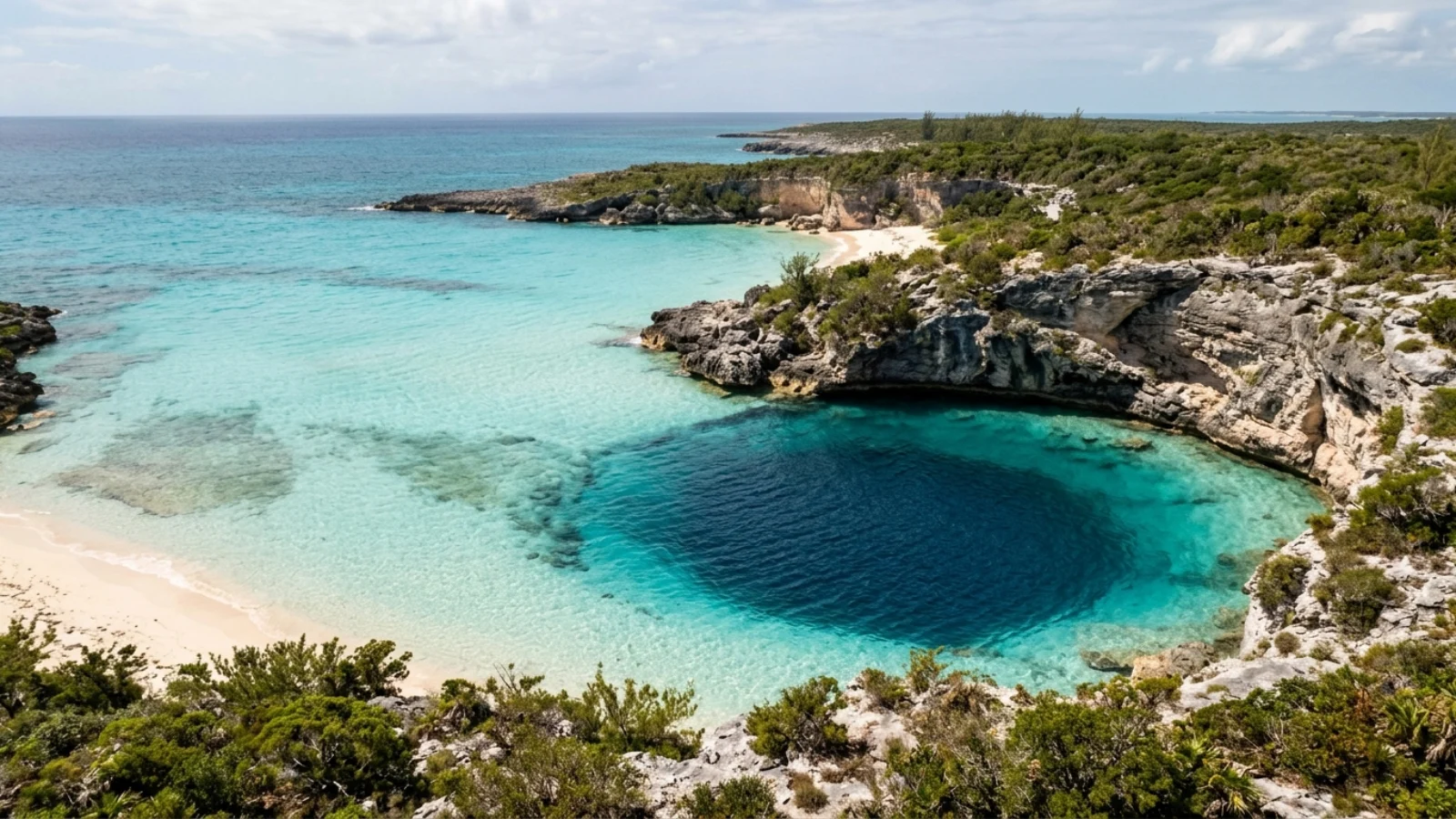
From the cliff above it, Dean’s Blue Hole looks like a drop of ink in a turquoise bay. Step off the sand and swim a few metres, and the bottom simply disappears.
Dean’s Blue Hole — at a glance
- Where: Bay west of Clarence Town, Long Island, Bahamas
- Depth: 202 m (663 ft)
- Rank: Third deepest known blue hole (since 2024)
- Entrance: About 25–35 m across
- Cavern: Widens to about 100 m diameter below the entrance
- Named for: A Bahamian fisherman (Wikipedia)
- Event: Vertical Blue freediving competition, since 2008
Where Dean’s Blue Hole is
Dean’s Blue Hole is on Long Island, one of the districts of the Bahamas, in a bay west of Clarence Town, the island’s capital. Long Island is about 130 kilometres long and only about 6 kilometres wide at its widest point, with a land area of 596 square kilometres, and it lies about 265 kilometres southeast of the capital, Nassau. The Tropic of Cancer crosses its northern quarter. It is a quiet place: the island had 3,094 inhabitants in 2022, and Clarence Town itself is a village of fewer than a hundred people. The island’s main airport is at Deadman’s Cay in the centre, with daily flights to Nassau, and a single main road runs from Cape Santa Maria at the north tip to Gordon’s in the south.
Long Island is particularly noted for its caves, which have played a major role in its history, and Dean’s is the most dramatic of them. Unlike the Great Blue Hole of Belize, far out on an atoll, Dean’s lies right against the shore. The hole sits in a small bay beside a beach, with cliffs nearby from which visitors can look down into it.
The shape of the hole
Dean’s Blue Hole is 202 metres (663 feet) deep. Its entrance is almost circular, about 25 to 35 metres in diameter according to Showcaves, or about 30 metres according to Wikipedia. The walls are vertical, with some overhangs where the shaft widens. Below the entrance the hole opens into a much larger cavern, about 100 metres in diameter; one diving source describes a cave entrance at about 20 metres leading into the 100-metre cave. The shallows around the rim are only a few metres deep, so the transition from sandy bay to open shaft is abrupt.
That combination is what makes the site unusual. Most blue holes are about 100 to 120 metres deep at most, roughly half the depth of Dean’s. Showcaves still describes it as the world’s deepest known blue hole, but Dragon Hole in the South China Sea measures 300.89 metres, and in 2024 researchers reported that the Taam Ja’ Blue Hole in Chetumal Bay, Mexico, reaches at least 420 metres. Dean’s Blue Hole is now the third deepest blue hole known, but none of the deeper ones combines its depth with such easy access from a beach.
How Dean’s Blue Hole formed
Like other blue holes, Dean’s is a product of the ice ages. When sea level was about 100 metres lower than today, the limestone of the Bahamas was dry land, and rain and groundwater dissolved caves and shafts into it. Cave development of this kind normally happens near the water table, which during the glacial periods lay far below present sea level. When the ice melted, the sea flooded the caves. Our blue holes guide explains the process in detail.
The problem with Dean’s is its depth. Showcaves points out that ordinary cave formation near the old water table cannot easily explain a shaft twice as deep as most blue holes, and it lists two possible explanations, both of which it calls guesses that have not been researched. One is that the island has subsided, carrying older caves deeper. The other is hypogene dissolution, in which limestone is dissolved from below by water rising from depth or by the corrosive mixing of fresh and salt water. Wikipedia offers a similar pair of ideas: that a fault in the limestone allowed a corrosive solution to rise and dissolve a shaft, or that a buried cavern collapsed to form a sinkhole. The honest answer is that no one has yet shown which process made Dean’s so deep.
Why freedivers love it
Freedivers descend on a single breath, without tanks, and must return before that breath runs out. For competition they need deep water, calm conditions, good visibility and a fixed line to follow down and back, and they need all of that close to shore so that judges, safety divers and medical teams can work from a stable base. Dean’s provides it. The hole drops to 202 metres a short swim from the beach, and the vertical shaft gives a clean, open column for a line. Apnea divers descend along a rope without tanks or decompression and return within a few minutes; even the deepest dives made there have not come close to the bottom.
Showcaves lists the freediving disciplines practised there: static apnea, dynamic apnea with and without fins, constant weight with and without fins, and free immersion. In constant weight, the diver swims down and up without pulling on the line or changing weights, either with fins or a monofin, or, in the hardest form, with no fins at all. In free immersion, the diver pulls hand over hand down the line and back up.
Vertical Blue
Vertical Blue is a freediving depth competition held annually at Dean’s Blue Hole since April 2008, organised by William Trubridge with judges from AIDA International; in 2021 it was judged by CMAS. Its events are the three depth disciplines: free immersion, constant weight without fins and constant weight. Vertical Blue is also the name of the freediving school Trubridge has run at the hole, which, as of 2013, operated from September to May.
The first edition was announced in February 2008 and held from 1 to 11 April that year, with competitors from Brazil, Canada, Colombia, France, Japan, New Zealand, Russia, Switzerland and the United States. Sources differ on how many records it produced: Wikipedia gives 23 national and 3 world records, while the diving site divers24 gives 25 national and 5 world records. The 2009 edition, held from 1 to 9 April, drew athletes from 13 countries, from Austria and Australia to Tunisia and the United States. The competition has continued since, and Wikipedia reports that at Vertical Blue 2025 in July, the Tunisian freediver Walid Boudhiaf set a national record of 118 metres in a field of about 20 divers that included Trubridge, Alenka Artnik, Alice Modolo, Arnaud Jerald and Filippo Carletti.
The records of Dean’s Blue Hole
Dean’s Blue Hole is where the limits of human breath-hold diving have been pushed again and again. William Trubridge, a New Zealander born in 1980 who works there as an instructor, holds a long list of world records in constant weight without fins and free immersion, and Showcaves says he set them at Dean’s Blue Hole. His no-fins records climbed from 81 metres in April 2007 through 92 metres on 19 April 2010 and 95 metres a week later. In December 2010 he reached 96, then 100 and then 101 metres, becoming the first person to dive below 100 metres without fins or any assistance, a quest followed in the documentary Breathe. He extended the record to 102 metres on 21 July 2016. One diving source dates his 84- and 86-metre records to April 2007, while Wikipedia’s record list places them in April 2008.
Free immersion produced a duel. Trubridge set free-immersion records of 107 and 108 metres in April 2008 and 116 metres on 22 April 2010. Three days later, on 25 April 2010, the Austrian Herbert Nitsch dived to 120 metres in 4 minutes 28 seconds at Dean’s, according to divers24. Trubridge took the record back in April 2011 with 121 metres in 4 minutes 13 seconds, and went on to 122 metres on 30 April 2016 and 124 metres on 2 May 2016.
The Russian freedivers Natalia Molchanova and her son Alexey Molchanov also set records there. Natalia Molchanova’s record list includes a constant-weight-without-fins dive of 62 metres on 3 December 2009 and a constant-weight dive of 100 metres on 16 April 2011, both at the Blue Hole in the Bahamas. Alexey Molchanov dived to 125 metres with a monofin in Egypt in 2012 and later that year broke his own world record with 126 metres at Dean’s Blue Hole. At Vertical Blue in July 2021 he made three world-record dives in different disciplines and set two CMAS records of 87 and 90 metres without fins.
The death of Nicholas Mevoli
The hole’s most sobering chapter came in November 2013. Nicholas Mevoli, an American born in Dunedin, Florida, in 1981, who lived in Brooklyn and worked as a prop technician in film and television, had begun competitive freediving only in early 2012. He rose fast. He set an American record of 100 metres in constant weight at the Caribbean Cup in Roatan, Honduras, on 27 May 2013, and finished third in constant weight without fins at the world championships in Greece that September.
At Vertical Blue on 15 November 2013 he attempted 96 metres in free immersion but turned back at 80 metres after suffering an upper respiratory squeeze. Two days later, on 17 November, he attempted an American record of 72 metres without fins. He began to turn at 68 metres, appeared to change his mind and continued downward, and surfaced after 3 minutes 38 seconds. He then fell backward into the water and lost consciousness. Safety divers and the event physician worked to revive him for 90 minutes before he was taken to the Vid Simms Memorial Health Center, reportedly suffering from pulmonary edema, and he died at 1:44 pm. He was the first athlete to die in an international freediving competition. The New York Times later published a photograph of a visibly distressed Mevoli taken just after he surfaced, and some readers questioned the ethics of publishing it.
Life in and around the hole
Dean’s Blue Hole is not a coral reef dive. Divers24 notes that the hole and the waters around it have little lush marine life or notable reef. The attraction is the water itself: clear, deep and still, with sand shallows around the rim where snorkellers can float over the edge and watch the blue darken below them. Like other blue holes, Dean’s has layered water, and the general pattern in such holes is that circulation is poor and the deep water can be low in oxygen, so the most interesting life tends to be in the shallows and along the rim. For better reef life in the islands, see our guide to the Bahamas coral reef and to snorkeling in the Bahamas.
Long Island beyond the hole
A trip to Dean’s is usually part of a wider visit to Long Island. Hamilton’s, a settlement of about 200 people, is known for an extensive cave system partly open for tours. Salt Pond hosts the annual Long Island Regatta, Mangrove Bush is home to the island’s boatbuilding trade, and Stella Maris in the north is the centre of the tourism industry. Cape Santa Maria Beach, at Seymour’s in the north, is often ranked among the most beautiful beaches in the world. Long Island also features in the long debate over Christopher Columbus’s 1492 route: some writers, including Samuel Eliot Morison, identify it as the third island Columbus visited, which he called Fernandina and the Lucayan people called Yuma, while other historians disagree, and a Columbus monument stands on the island.
Visiting Dean’s Blue Hole safely
According to Showcaves’ 2014 data, the site is open without restrictions and free to visit. Swimming and snorkelling at the surface from the beach are straightforward on a calm day, and the view from the cliffs above is spectacular. Anything deeper is another matter. Freediving is only safe with training, a partner who watches every dive from the surface, and a line; a death at an elite competition with a full safety team, in 2013, shows how small the margin is. Scuba divers should treat the overhangs and the great depth as technical-diving terrain. Check current local conditions and any event closures before you go, especially during Vertical Blue, when competition lines are in use.
- Depth: 202 m
- Since 2008: Vertical Blue competition
- First 100 m no fins: Trubridge, December 2010
- Free immersion duel: Nitsch 120 m (2010), Trubridge 121 m (2011)
How deep is Dean’s Blue Hole?
202 metres (663 feet).
Is Dean’s Blue Hole the deepest blue hole?
No. It is now the third deepest known, after Taam Ja’ in Mexico (at least 420 m) and Dragon Hole in the South China Sea (300.89 m).
Where is Dean’s Blue Hole?
In a bay west of Clarence Town on Long Island, Bahamas.
Can you swim in Dean’s Blue Hole?
Yes, at the surface from the beach; deep diving requires training and full safety support.
Who has freedived in Dean’s Blue Hole?
William Trubridge, Herbert Nitsch, Natalia and Alexey Molchanov and many others have set world records there.
What is Vertical Blue?
An annual freediving depth competition held at Dean’s Blue Hole since 2008, founded by William Trubridge.
Has anyone died at Dean’s Blue Hole?
Yes. American freediver Nicholas Mevoli died after a dive at Vertical Blue in November 2013.
- Wikipedia contributors, “Dean’s Blue Hole” (current version, accessed November 2026); “Vertical Blue”, “William Trubridge”, “Nicholas Mevoli”, “Alexey Molchanov”, “Natalia Molchanova”, “Long Island (Bahamas)”, “Blue hole” (2023 snapshot via Kiwix mirror, accessed November 2026).
- Showcaves.com, “Dean’s Blue Hole” (dimensions, access and geology; accessed November 2026).
- Divers24, “Dean’s Blue Hole: freedivers’ paradise” (2011, updated 22 July 2023).
- Guinness World Records, “Deepest blue hole” (for the current ranking; accessed November 2026).
Blane Perun has been exploring Earth’s oceans and marine life for over 25 years. Founder of TheSea.Org in 1999, underwater photographer, coral aquaculture pioneer, and explorer of 80+ countries.
About Blane Perun →