Blue Holes — How They Form and the Deepest on Earth
A blue hole is a large marine cavern or sinkhole, open to the surface, in a bank or island made of carbonate rock such as limestone or coral reef. Most formed during the ice ages, when sea level was about 100 to 120 metres lower and rain and groundwater dissolved caves in the exposed rock; when the ice melted, the sea flooded them. Their water is layered, and below a certain depth it usually holds no oxygen, which makes the bottoms lifeless except for bacteria but superb at preserving fossils. The deepest known is the Taam Ja’ Blue Hole in Chetumal Bay, Mexico, measured in 2023 to at least 420 metres, ahead of Dragon Hole (300.89 m) and Dean’s Blue Hole (202 m).
Both are drowned karst sinkholes. A blue hole opens to the sea and holds seawater or mixed water; a cenote is an inland sinkhole that usually holds fresh groundwater.
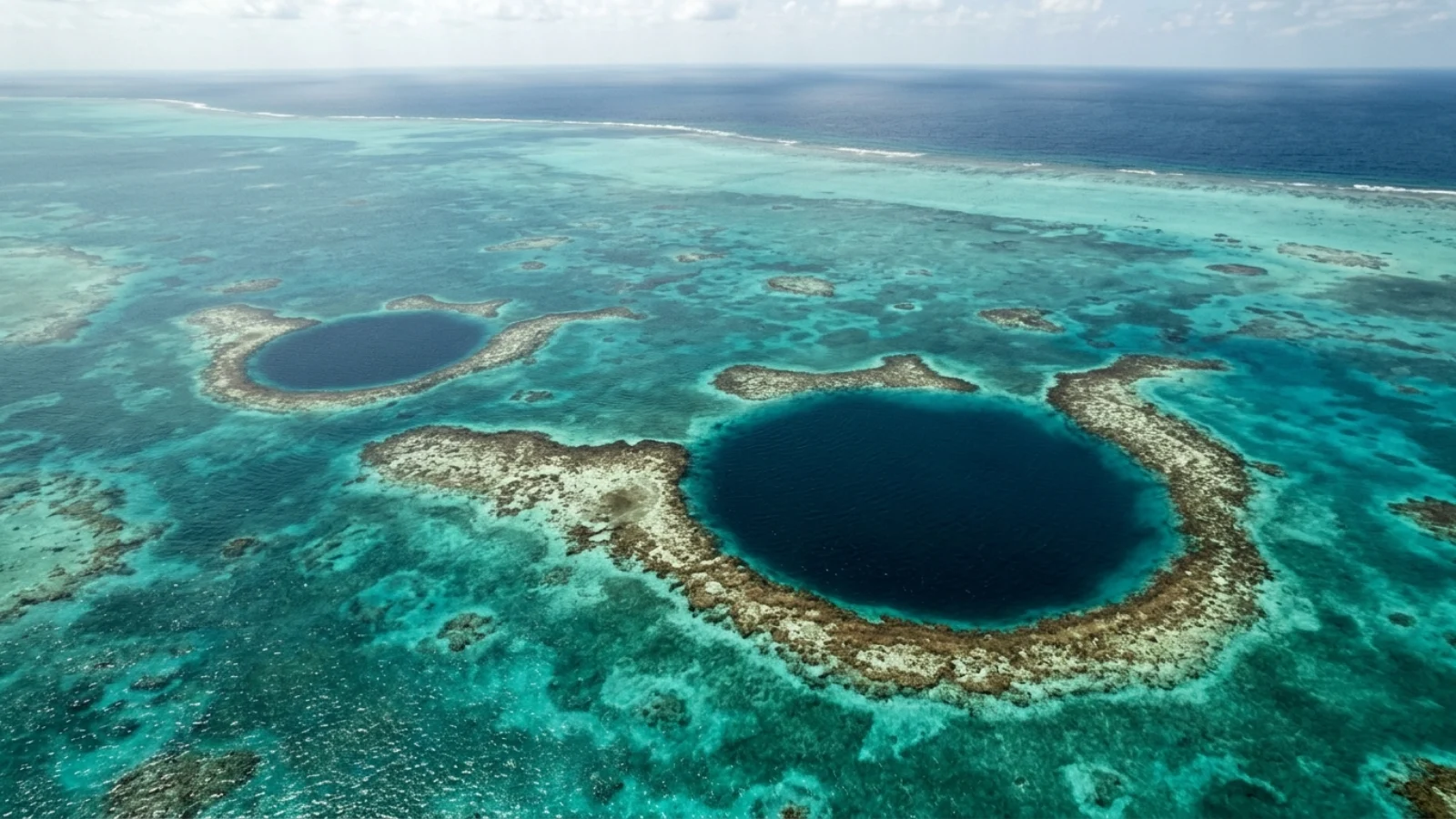
From the air a blue hole looks like a pupil in the eye of the sea: a disc of near-black water set in pale turquoise shallows. The colour is a depth gauge. Where the bottom falls away, the bright sand disappears and only blue light comes back.
Blue holes — at a glance
- What: Marine sinkhole or cavern in carbonate rock, open to the surface
- Formed: Mostly on dry land in the ice ages; flooded as the sea rose
- Deepest: Taam Ja’, Mexico: at least 420 m (Guinness World Records)
- Second: Dragon Hole, South China Sea: 300.89 m
- Third: Dean’s Blue Hole, Bahamas: 202 m
- Widest: Great Blue Hole, Belize: about 300–318 m across
- Bottom water: Often anoxic, with hydrogen sulfide
What is a blue hole?
A blue hole is a large marine cavern or sinkhole that is open to the surface and has developed in a bank or island composed of carbonate bedrock, either limestone or coral reef. Blue holes are roughly circular and steep-walled, and they typically contain tidally influenced water that may be fresh, marine or mixed. Most of their depth lies below sea level, and many give access to submerged cave passages that run off sideways from the main shaft.
They are named for their colour. A blue hole appears as a dark blue disc surrounded by much paler water, because the shallows around it have a bright white carbonate sand floor that reflects light back through clear water. Over the hole itself there is no bottom close enough to reflect anything, and water absorbs the red, yellow and finally green parts of the spectrum first, so the light that returns from the depths is almost pure blue. The combination of very clear water, bright sand and a sudden drop produces the intense contrast that makes blue holes so photogenic.
They are not the same as cenotes, although they form in similar rock. Cenotes are inland sinkholes that usually contain fresh groundwater rather than seawater. The term blue hole is also used loosely for some deep inland springs, such as the Blue Hole in Castalia, Ohio.
How blue holes form
The story of a blue hole begins with sea level. During past ice ages, so much water was locked up in ice sheets that the sea stood as much as 100 to 120 metres lower than it does today. The shallow carbonate platforms of the Bahamas, the Belize reef and similar banks were then dry land, exposed to rain.
Limestone dissolves slowly in rainwater and groundwater, which are weakly acidic. Over thousands of years this karst process hollows caves and vertical shafts, and the roofs of some caves collapse to form closed depressions called dolines, or sinkholes. On the exposed platforms, the same erosion that shapes limestone landscapes inland carved caves and pits. When the ice sheets melted at the end of each glacial period and the sea rose, these features drowned, and their enlargement by rainwater ended.
Not every blue hole fits this simple picture. Many contain both fresh water and salt water, and the boundary between them, the halocline, is a zone where mixing makes the water especially corrosive to limestone. Over time this can cut side passages, horizontal arms extending far from the main shaft; in Sawmill Sink in the Bahamas they run for more than 600 metres. Some blue holes show no sign of the cave systems that karst would leave, and researchers have suggested other origins for them, including vertical reef growth around an opening, collapse of the bedrock driven partly by tidal pumping, and dissolution controlled by sea-level changes and the young, still-porous character of the carbonate rock.
The best-studied example shows the process clearly. The Great Blue Hole of Belize, near the centre of Lighthouse Reef atoll, was investigated by Jacques Cousteau’s 1971 expedition, which found ledges at depths of 21, 49 and 91 metres, interpreted as marking separate stages of formation before sea level rose. Stalactites retrieved from its submerged caves could only have formed in air, confirming that the caves were once dry. Analysis of those stalactites indicates formation about 153,000, 66,000, 60,000 and 15,000 years ago, at times when the sea was much lower.
Inside a blue hole: layered water and no oxygen
Water circulation in blue holes is poor, and the water column is usually layered. Fresher or warmer water lies on top; denser, saltier water lies below; and the boundaries between them, haloclines and thermoclines, can be sharp enough to see as a shimmering surface. Below a certain depth the water is commonly anoxic, with no dissolved oxygen at all. In the Great Blue Hole, a 2018 submarine expedition reported a layer of hydrogen sulfide at about 91 metres, below which the water was dark, anoxic and devoid of animal life.
Life does not stop at that line; it changes. Blue holes host a great diversity of microbes, arranged in layers according to the chemistry at each depth. At the bottom, bacteria live on sulfur compounds such as hydrogen sulfide that are toxic to most organisms. Foraminifera, meiobenthic animals and nematodes follow the same pattern, and nematodes, which feed on organic matter, can tolerate the oxygen-free conditions at the base of blue holes, where food settles in abundance. In 2009 a team led by Keith Tinker studied seven blue holes in the Bahamas in more than 150 dives, investigating bacteria that live without oxygen or sunlight, work with obvious interest for astrobiology.
Time capsules: fossils and climate records
The same anoxic water that keeps animals out keeps decay out. Bones and plant remains that fall into a blue hole and sink into the oxygen-free bottom layer can survive for thousands of years, and the sediments around them are rich in pollen, leaves, twigs and spores. Blue holes in the Bahamas have yielded the fossil remains of an undescribed tortoise, the extinct caracara Caracara creightoni, the Cuban crocodile, Cooper’s hawk, 25 species of birds, three snakes, four bats and human remains of the Lucayan people.
Sediment accumulates in the centre of a blue hole rather than at its edges, building layered deposits of sapropel, peat and lake marl that can preserve climate records back to the last glacial maximum. Cores from three Bahamian blue holes showed more sapropel, freshwater peat and lake marl with depth, and at about 150 centimetres down they contained microfossils of wood, stoneworts and small freshwater snails. Cores from a blue hole on Abaco revealed woody plants such as Coccoloba, Exothea and Bursera in a landscape now dominated by dry evergreen forest and pines. The sediments of the Great Blue Hole have also been used to reconstruct storm history, as our guide to Lighthouse Reef Atoll explains.
The deepest blue holes on Earth
Taam Ja’ Blue Hole, Mexico. In Chetumal Bay off the southern Yucatan Peninsula, Taam Ja’ is the current record holder. Guinness World Records lists it as descending to at least 420 metres (1,377 feet) below sea level, with the bottom not yet found. The sources differ on its discovery: Guinness says a diver found it in 2003 and it was formally investigated in 2023, while Phys.org’s report says it was discovered in 2021. An earlier echo-sounder survey had given a depth of about 274 metres, or 275 metres in Phys.org’s version, which would have made it the second deepest. In December 2023 researchers lowered a conductivity, temperature and depth profiler on a cable; the instrument reached at least 420 metres after the team subtracted 80 metres for cable drift, and could only work to 500 metres, so the true depth is still unknown. A layer of water at about 400 metres had a temperature and salinity close to those of the nearby Caribbean, suggesting an underground connection to the open sea. The results were published in Frontiers in Marine Science on 29 April 2024 by a team led by Juan Carlos Alcerreca-Huerta.
Dragon Hole, South China Sea. Also called the Yongle or Sansha Yongle Blue Hole, after the third Ming emperor, Dragon Hole lies about 9 kilometres north of Drummond Island in the Paracel Islands and was the deepest known blue hole until Taam Ja’, at 300.89 metres. Local fishermen call it the eye of the South China Sea, and legend says the Monkey King of Journey to the West found his golden cudgel there. Because the reef around it is only 0.5 to 0.8 metres deep, researchers had to work from a flat-bottomed vessel resting over the opening and send down a remotely operated vehicle. Initial exploration recorded a width of up to about 130 metres in places and reported more than 20 new species of sea life. Oxygen falls off sharply at about 300 feet, and the water column has two thermoclines, one between 13 and 20 metres and a second at around 70 to 150 metres.
Dean’s Blue Hole, Bahamas. In a bay west of Clarence Town on Long Island, Dean’s Blue Hole is 202 metres deep, now the third deepest known. Its entrance is only about 25 to 35 metres across, but below it the shaft opens into a cavern about 100 metres wide. It is the home of freediving competition; see our full guide to Dean’s Blue Hole.
Great Blue Hole, Belize. The largest blue hole overall, taking width and depth together, lies near the centre of Lighthouse Reef, about 70 kilometres from Belize City. Wikipedia gives it as 318 metres across and 124 metres deep, with a surface area of 70,650 square metres; the general blue hole article gives 300 metres wide and 125 metres deep, and Guinness gives 124 metres. Jacques Cousteau brought the Calypso there in 1971 and declared it one of the top five scuba diving sites in the world; see Cousteau and the Great Blue Hole. In December 2018 two submarines descended into it to make the first three-dimensional sonar map of its interior. They found stalactites, the hydrogen sulfide layer, and the bodies of two of three divers believed to have gone missing there, which the crew reported to Belizean authorities and left in place.
Other blue holes are typically about half the depth of Dean’s, at around 100 to 120 metres. Several inland freshwater sinkholes are deeper than Dragon Hole, including Zacaton in Mexico (335 metres), Pozzo del Merro in Italy (392 metres) and the Hranice Abyss in the Czech Republic (404 metres), but they are not blue holes in the marine sense.
Blue holes off Florida
Blue holes are not confined to the tropics. In May and September 2019, as part of a three-year study, scientists from Mote Marine Laboratory, Florida Atlantic University’s Harbor Branch, the Georgia Institute of Technology, the US Geological Survey and NOAA’s Office of Ocean Exploration explored a blue hole nicknamed Amberjack Hole about 30 miles off Sarasota on Florida’s Gulf coast. The team studied the life around and inside the hole, the chemistry of its water and the sediments on its floor. Offshore holes like this one show that the drowned-sinkhole story is not limited to the Bahamas and the Caribbean. For the water closer to home, see snorkeling in Southwest Florida.
Why blue holes are so dangerous to dive
Blue holes are among the most dangerous places in the world to dive. Nitrogen narcosis can begin below about 70 feet, causing confusion and changes in consciousness that can stop a diver from recognising the need to ascend. Light and clarity fall away with depth, and overhangs, caves and anoxic layers add hazards of their own.
The Blue Hole near Dahab on Egypt’s Sinai coast shows what can happen. It drops to just over 100 metres, and a tunnel called the Arch, 26 metres long with its ceiling at 55 metres, leads out to the open sea, where the floor falls away to more than 1,000 metres. The number of divers who have died there is hard to pin down: the general blue hole article says at least 40 divers have died, while the article on the site itself cites estimates of 130 to 200 fatalities. Either way, it has a reputation as one of the deadliest dive sites in the world. For the safer side of these places, from the surface, see the snorkeling section.
- Record holder: Taam Ja’, Mexico: 420 m+ (2023 survey)
- Former record: Dragon Hole: 300.89 m
- Freediving: Dean’s Blue Hole, Bahamas: 202 m
- Most famous: Great Blue Hole, Belize
What is a blue hole?
A large marine sinkhole or cavern in limestone or reef rock, open to the surface and usually flooded by seawater.
How are blue holes formed?
Rain and groundwater dissolved caves and sinkholes in carbonate rock when ice-age sea levels were 100 to 120 metres lower; the rising sea then flooded them.
What is the deepest blue hole in the world?
The Taam Ja’ Blue Hole in Chetumal Bay, Mexico, at least 420 metres deep; its bottom has not been reached.
Why are blue holes so blue?
The deep water absorbs other colours and returns blue light, while the bright sand around them makes the shallows pale.
Is there life at the bottom of a blue hole?
Mostly bacteria and a few tolerant tiny animals; the deep water is usually anoxic and often contains hydrogen sulfide.
Can you swim in a blue hole?
Yes, from the surface; diving them is dangerous because of depth, darkness, overhead rock and narcosis.
Are there blue holes in Florida?
Yes. Amberjack Hole, about 30 miles off Sarasota, was explored by a multi-institution team in 2019.
- Guinness World Records, “Deepest blue hole” (accessed November 2026); Phys.org, report on Alcerreca-Huerta et al., Frontiers in Marine Science (2024), doi:10.3389/fmars.2024.1387235.
- Wikipedia contributors, “Blue hole”, “Dragon Hole”, “Great Blue Hole”, “Blue Hole (Red Sea)”, “Dean’s Blue Hole” (2023 snapshot via Kiwix mirror; Dean’s Blue Hole current version, accessed November 2026).
- Showcaves.com, “Dean’s Blue Hole” (dimensions; accessed November 2026).
Blane Perun has been exploring Earth’s oceans and marine life for over 25 years. Founder of TheSea.Org in 1999, underwater photographer, coral aquaculture pioneer, and explorer of 80+ countries.
About Blane Perun →