Mary Celeste — The Ghost Ship Found Deserted in 1872
The Mary Celeste was an American merchant brigantine found drifting and deserted midway between the Azores and Portugal on 4 December 1872. She was seaworthy, under partial sail and well stocked with food, her cargo of 1,701 barrels of alcohol was largely intact and the crew’s belongings were undisturbed, but her single lifeboat was missing and nobody was aboard. The ten people who had sailed from New York on 7 November, Captain Benjamin Briggs, his wife Sarah, their two-year-old daughter Sophia and seven crew, were never seen again. The last log entry was dated 25 November. No explanation has ever been proved; the most widely discussed theories involve a sudden fear that the ship was sinking or about to explode, leading to a hasty abandonment in the boat.
Almost every other famous wreck has a known cause. The Mary Celeste did not sink at all; her people simply vanished from a sound ship. Fiction, hoaxes and false details piled up so quickly that the real facts are now less well known than the legend.
The Amazon of Spencer’s Island
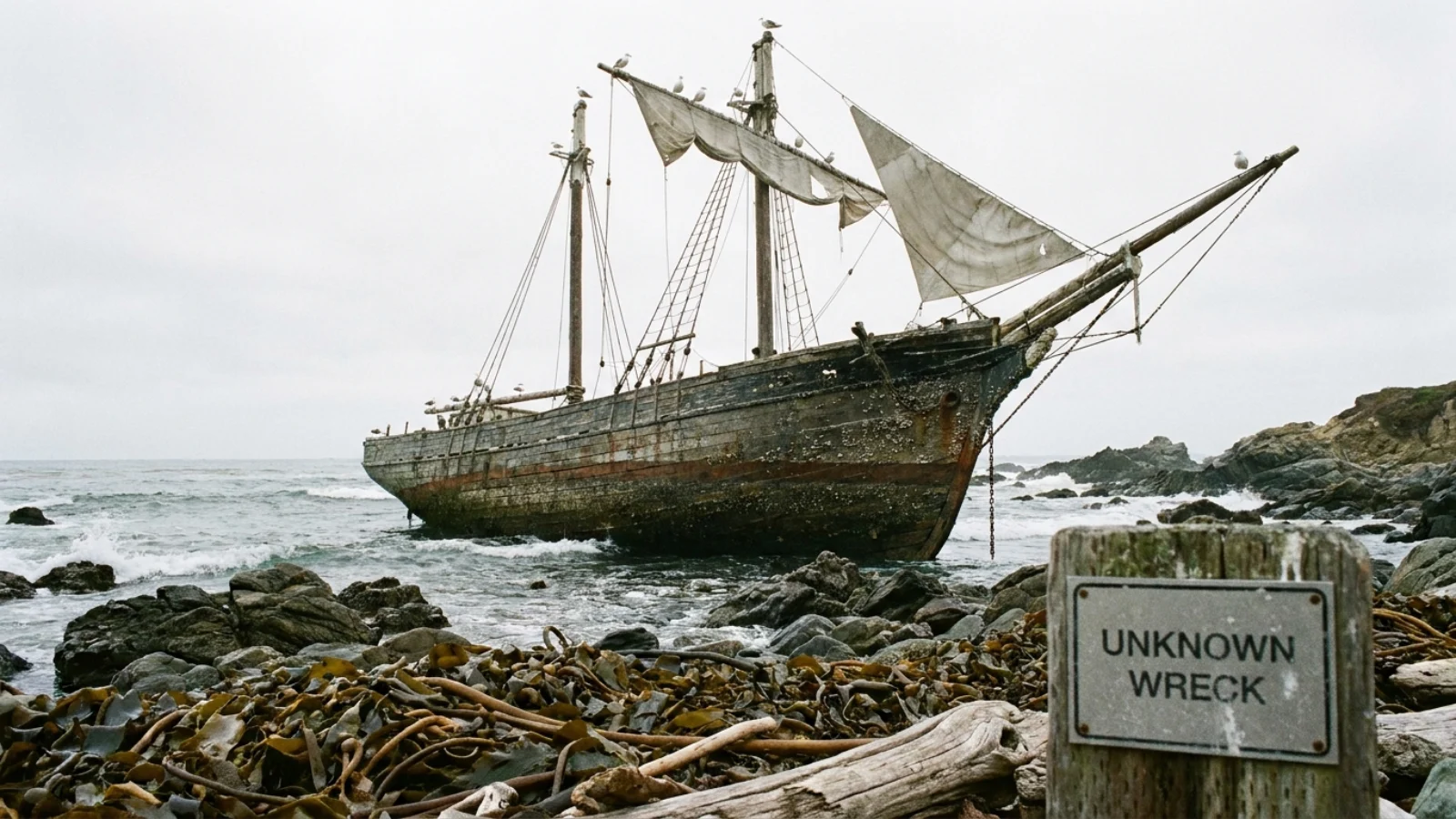
The ship that became the most famous ghost ship in history began life in a small Nova Scotia shipyard. Her keel was laid in late 1860 at the yard of Joshua Dewis in the village of Spencer’s Island, on the shore of the Bay of Fundy. She was built of local timber, carvel-planked with the hull planks laid flush, and rigged as a two-masted brigantine. Launched on 18 May 1861 as Amazon, she was registered at nearby Parrsboro on 10 June, measuring 99.3 ft (30.3 m) long and 198 gross tons, and owned by a local group of nine people headed by Dewis.
Her career had an ominous start. Her first captain, Robert McLellan, one of the owners, fell ill while loading timber on her maiden voyage and died on 19 June 1861. Under his successor she collided with fishing equipment off Eastport, Maine, and later ran into and sank a brig in the English Channel. The following years in the West Indies and Mediterranean trades were quiet; her mate later recalled that “not a thing unusual happened”. Then, in October 1867, a storm drove her ashore on Cape Breton Island, and her owners abandoned her as a wreck.
A new name and a new captain
The wreck changed hands several times before an American mariner, Richard W. Haines of New York, bought it in 1868 for $1,750, spent $8,825 restoring it and registered the ship in New York in December 1868 under a new name, Mary Celeste. Within a year she had been seized by his creditors and sold to a New York consortium led by James H. Winchester. In early 1872 she was given a major refit costing $10,000, which lengthened her to 103 ft (31 m), deepened her hull and added a second deck, raising her tonnage to about 282.
Her new captain, Benjamin Spooner Briggs, also bought a share in her. Born in Wareham, Massachusetts, in 1835, he was one of five sons of a sea captain, a devout Christian and a well-regarded master. He had married his cousin Sarah Elizabeth Cobb in 1862, and they had two children: Arthur, born in 1865, and Sophia Matilda, born in October 1870. For the voyage to Genoa, his first in command of Mary Celeste, Briggs brought Sarah and the baby along, leaving Arthur at school at home in the care of his grandmother.
He chose his crew carefully. The first mate, Albert G. Richardson, had sailed with him before; the second mate was Andrew Gilling, about 25, a New Yorker of Danish descent; the steward was the newly married Edward William Head; and the four seamen were Germans from the Frisian Islands, two of them brothers, later described as “peaceable and first-class sailors”. Briggs wrote to his mother that “our vessel is in beautiful trim and I hope we shall have a fine passage.”
The voyage
At Pier 50 on New York’s East River, Mary Celeste loaded a cargo of 1,701 barrels of alcohol bound for Genoa. She left the pier on 5 November 1872 but anchored off Staten Island to wait out uncertain weather, and finally put to sea on 7 November with ten people aboard. Sarah used the delay to write a last letter home, asking that her son write to her often.
In New Jersey, the Canadian brigantine Dei Gratia was waiting for a cargo of petroleum for Genoa via Gibraltar. Her captain, David Morehouse, and first mate, Oliver Deveau, were experienced Nova Scotian seamen. Some later accounts claim that Morehouse and Briggs were close friends who dined together the night before Mary Celeste sailed, but the only evidence is a recollection by Morehouse’s widow half a century later. Dei Gratia left on 15 November, eight days behind Mary Celeste, on the same general route.
Discovered adrift
At about 1 p.m. on 4 December 1872, Dei Gratia was midway between the Azores and the coast of Portugal when her helmsman saw a ship about six miles away, moving unsteadily toward them under an odd set of sails. Nobody could be seen on deck, and she did not answer signals. Morehouse sent Deveau and the second mate, John Wright, across in a boat. They read the name on the stern, Mary Celeste, climbed aboard and found her deserted.
What they found has been the raw material for every theory since. The sails were partly set, some in poor condition and some missing, and much of the rigging was damaged, with ropes hanging over the sides. The main hatch was secure, but the fore hatch and the lazarette hatch were open, their covers lying on deck. The ship’s only lifeboat, a small yawl that had apparently been stowed across the main hatch, was gone. The binnacle housing the compass had been knocked out of place and its glass was broken. There was about 3.5 ft (1.1 m) of water in the hold, significant but not alarming for a ship of her size, and a makeshift sounding rod, used to measure water in the hold, lay abandoned on deck.
Below, the cabins were wet and untidy from water that had come in through doors and skylights, but otherwise in reasonable order. The captain’s cabin held personal belongings, including a sheathed sword under the bed, but most of the ship’s papers and the captain’s navigation instruments were gone. The galley was tidy, with no meal in preparation, and there were ample provisions. There were no obvious signs of fire or violence. The evidence pointed to an orderly departure in the missing boat. The log’s final entry was dated 8 a.m. on 25 November and placed the ship off Santa Maria Island in the Azores, nearly 400 nautical miles from where she was found. For nine days, the ship had sailed on with nobody aboard.
The legend grows: what was not found
Many of the best-known “facts” about the Mary Celeste are inventions. There was no untasted dinner still warm on the table, no fire burning in the galley, no set of fully spread sails and no log written up to the hour of discovery; those details first appeared in a Los Angeles Times retelling of 1883. One 1906 magazine placed the ship off the Cape Verde Islands, about 1,400 nautical miles south of her true position, and added live chickens. The real scene was stranger in its ordinariness: a wet, damaged but sound ship, with her boat missing and her people gone.
The Gibraltar hearings
Morehouse decided to bring the derelict 600 nautical miles to Gibraltar, splitting his crew of eight between the two ships, because a salvor could claim a large share of the value of a rescued ship and cargo. Deveau and two seamen sailed Mary Celeste, and both ships reached port on 12 and 13 December. She was immediately impounded for a salvage hearing, which opened on 17 December before the chief justice, Sir James Cochrane.
The case was pressed by Gibraltar’s Attorney General, Frederick Solly-Flood, who quickly became convinced that a crime had been committed. A surveyor reported cuts on both sides of the bow, which he thought had been made with a sharp tool, possible bloodstains on the captain’s sword and a mark perhaps made by an axe, and noted that a vial of sewing-machine oil stood upright, suggesting the ship had not met heavy weather. Flood told the Board of Trade in London that the crew had broken into the alcohol, murdered the Briggs family and officers in a drunken frenzy, cut the bows to fake a collision and fled in the yawl. He also suspected that Morehouse and his men were hiding something.
The case against them collapsed. Scientific tests showed that the stains were not blood. A US Navy officer, Captain Shufeldt, commissioned by the American consul, concluded that the marks on the bow were caused by the natural action of the sea on the timbers. Flood released the ship on 25 February 1873. On 8 April the court awarded the salvors 1,700 pounds, about a fifth of the value of ship and cargo, far less than expected, and Cochrane’s critical remarks left Morehouse and his crew under a cloud of suspicion for the rest of their lives.
Theories of foul play
Suspicion never quite went away. Flood and some newspapers briefly suspected the owner, Winchester, of insurance fraud, but he refuted it, and the insurers never investigated. A 1931 article suggested that Morehouse had lain in wait and murdered the crew; the historian Paul Begg points out that Dei Gratia was the slower ship and, leaving eight days later, could not have caught up. A plot between the two captains to share the salvage has been proposed too, but there is no evidence they were friends, and as the writer Brian Hicks asks, why would Briggs abandon his own young son? Pirates would have taken the valuables that were left behind. A 1925 suggestion that Briggs killed everyone in a fit of religious mania was withdrawn by its author, the historian John Gilbert Lockhart, after he met Briggs’s descendants.
Fear of explosion
The most widely discussed explanation starts with the cargo. Barrels of alcohol can leak and give off flammable fumes, and Briggs may have feared an explosion. Briggs’s cousin Oliver Cobb argued that rumbling from the hold, the smell of escaping fumes or perhaps a small explosion could have led him to order everyone into the boat as a precaution, intending to follow at a safe distance on a line and return once the danger passed. The open hatches could be evidence that the hold had been inspected or aired. Arthur N. Putman, an insurance appraiser who investigated sea mysteries in the early twentieth century, also argued for a hurried abandonment, noting that the boat’s rope had been cut rather than untied. If the line parted or was not properly secured, a sudden breeze could have carried the empty ship away from the small boat.
The obvious objection was that there was no sign of fire. In 2006 the chemist Andrea Sella of University College London tested the idea for a television documentary, building a model of the hold with paper cartons for barrels and igniting butane inside. The result was a dramatic blast and fireball, but no scorching: “What we created was a pressure-wave type of explosion,” he said. “There was a spectacular wave of flame but, behind it, was relatively cool air. No soot was left behind.” Critics of the theory point out that the cargo arrived largely sound.
False soundings, waterspouts and reefs
Deveau himself offered another explanation. The abandoned sounding rod suggests that someone had been measuring the water in the hold. If the pumps had malfunctioned, or if the reading was misleading, Briggs might have believed that the ship was filling rapidly and about to sink, and taken to the boat. A waterspout striking the ship could explain the water inside, the ragged sails and rigging, and perhaps a false reading: the low pressure of a passing spout might have forced water from the bilges up into the pumps. Other suggestions include a drifting iceberg, which hydrographers consider improbable so far south, and a submarine earthquake.
Begg gives some weight to the idea that the becalmed ship began drifting toward the Dollabarat reef off Santa Maria, and that Briggs launched the boat to reach land before she ran aground; a rising wind could then have blown Mary Celeste clear while the seas swamped the yawl. The weakness is that a becalmed ship would have had every sail set to catch the slightest breeze, yet she was found with many sails furled. Whatever happened, many writers stress that abandoning a sound ship for a tiny open boat in the Atlantic was a desperate act. The writer Macdonald Hastings put it bluntly: even if she had sprung her timbers, the ship “would still have been a better bet for survival than the ship’s boat”.
Sea monsters and other fantasies
The gaps in the record invited stranger ideas. In 1904 Chambers’s Journal suggested that a giant squid or octopus had plucked the crew off the deck one by one. Begg notes that such an animal might conceivably have taken a sailor, but hardly the yawl and the captain’s navigation instruments. Others have invoked the paranormal, aliens and even the Bermuda Triangle, though the ship was found in an entirely different part of the Atlantic.
Conan Doyle and the “Marie Celeste”
The story might have faded if not for a young ship’s surgeon named Arthur Conan Doyle. In January 1884, aged 25, he published “J. Habakuk Jephson’s Statement” in the Cornhill Magazine, a sensational tale in which a fanatic persuades the crew to murder the captain. He changed many details, including the ship’s name, which he spelled Marie Celeste. The story was a hit, and the misspelling has been more common than the real name ever since. Conan Doyle did not expect it to be taken seriously, but the American consul at Gibraltar was intrigued enough to ask whether any of it was true.
Hoaxes followed. In 1913 The Strand Magazine printed the account of an alleged survivor, the steward “Abel Fosdyk”, who claimed the crew had drowned when a platform built to watch a swimming race collapsed; it was riddled with errors, including a crew of 13 and a seven-year-old daughter. In the 1920s the Irish writer Laurence J. Keating’s invented “survivor”, John Pemberton, told a tale of murder and collusion so convincingly that the New York Herald Tribune in 1926 thought it beyond dispute.
The ship nobody wanted, and her last voyage
Mary Celeste delivered her cargo to Genoa and returned to New York in September 1873, but the stories of blood and murder made her unpopular, and she was sold at a loss in 1874. She lost money in the West Indies and Indian Ocean trades, and in 1879 her captain, Edgar Tuthill, fell ill and died on St Helena, her third master to die prematurely, which fed talk of a curse.
Her end was a crime. In November 1884 Captain Gilman C. Parker and a group of Boston shippers loaded her with nearly worthless cargo, declared it as valuable and insured it for $30,000. On 3 January 1885 Parker deliberately ran her onto the Rochelois Bank, a well-charted coral reef in the channel between Gonave Island and the Haitian mainland, tearing out her bottom. The insurers investigated after the American consul reported that the salvaged cargo he had bought was almost worthless. Parker and the shippers were tried in Boston for conspiracy in 1885, and Parker was also charged with barratry, the deliberate casting away of a ship, then a capital crime. The jury could not agree, and the defendants repaid their insurance money. Parker died in poverty within months; one co-defendant went mad and another killed himself.
Has the wreck been found?
In August 2001 an expedition led by the author Clive Cussler announced that it had found the remains of a ship embedded in the Rochelois reef. Only a few timbers and metal objects could be raised, and early tests suggested the wood matched that used in New York yards at the time of the 1872 refit. But tree-ring dating by Scott St George of the Geological Survey of Canada showed that the timber came from trees, probably from Georgia, that were still growing in 1894, about ten years after Mary Celeste was wrecked. Her remains have not been identified.
The Mary Celeste among the great sea mysteries
She was not the first ship found mysteriously deserted, but she is the one remembered, and her name, or Conan Doyle’s spelling of it, has become shorthand for any place suddenly and inexplicably abandoned. Later cases, such as the motor vessel Joyita, found drifting and empty in the South Pacific in 1955 with 25 people missing, are routinely described in her terms. Unlike the great wrecks covered in our guides to the Edmund Fitzgerald or the Lusitania, the Mary Celeste did not sink when her crew were lost; she sailed on without them. She was taken into port at Gibraltar.
What happened to the Mary Celeste?
She was found drifting and deserted between the Azores and Portugal on 4 December 1872; her crew and passengers had left in the lifeboat and were never found.
How many people were on the Mary Celeste?
Ten: Captain Benjamin Briggs, his wife Sarah, their two-year-old daughter Sophia and seven crew.
What was the Mary Celeste carrying?
1,701 barrels of alcohol from New York to Genoa; most of it was intact when she was found.
What is the most likely explanation for the Mary Celeste?
No theory is proved; the most popular is a hasty abandonment in the boat after fears of an explosion from alcohol fumes or that the ship was sinking.
Is it Mary Celeste or Marie Celeste?
Mary Celeste. Marie Celeste is the spelling used by Arthur Conan Doyle in his 1884 short story.
Was there an untouched meal on the Mary Celeste?
No. That detail was invented in later retellings; the galley was tidy with no food in preparation.
Where is the Mary Celeste now?
She was deliberately wrecked on the Rochelois Bank off Haiti in 1885; a 2001 find there was shown by tree-ring dating not to be her.
Who found the Mary Celeste?
The Canadian brigantine Dei Gratia, under Captain David Morehouse, whose mate Oliver Deveau sailed her to Gibraltar.
- Wikipedia contributors, “Mary Celeste” (2023 snapshot, accessed November 2026), drawing on Begg (2007), Hicks (2004) and Hastings (1972).
- Hicks, B. (2004), Ghost Ship: The Mysterious True Story of the Mary Celeste and Her Missing Crew (as summarised above).
- Begg, P. (2007), Mary Celeste: The Greatest Mystery of the Sea (as summarised above).
Blane Perun has been exploring Earth’s oceans and marine life for over 25 years. Founder of TheSea.Org in 1999, underwater photographer, coral aquaculture pioneer, and explorer of 80+ countries.
About Blane Perun →