Scylla and Charybdis — Homer’s Sea Monsters and the Strait of Messina
Scylla and Charybdis are two sea monsters from Homer’s Odyssey who guard opposite sides of a narrow strait. Scylla is a six-headed monster who snatches sailors from passing ships; Charybdis swallows the sea three times a day and spews it out again, creating a whirlpool that can sink a whole ship. Later Greek and Roman writers placed them in the Strait of Messina, between Sicily and the Calabrian coast of mainland Italy, where a rock at Scilla and a real tidal whirlpool off the Sicilian shore were linked to the legend. The whirlpool exists, but it is dangerous only to small craft in extreme conditions. The phrase “between Scylla and Charybdis” means having to choose between two dangers.
This page separates what Homer and later poets actually wrote from the attempts, ancient and modern, to match their monsters to real places. The geography of the Strait of Messina and the behaviour of its currents are given from modern sources.
The two monsters in Homer
Scylla and Charybdis first appear in Homer’s Odyssey, the epic of Odysseus’s long voyage home from Troy. In Book 12, after Odysseus has escaped the sirens, the enchantress Circe warns him about the next danger on his route: a narrow passage between two cliffs. On one side, high in a cave in the rock, lives Scylla. In Samuel Butler’s translation, “She has twelve mis-shapen feet, and six necks of the most prodigious length; and at the end of each neck she has a frightful head with three rows of teeth in each.” From her cave she reaches down to seize sailors from passing ships, one in each of her mouths. On the other side, beneath a lower rock where a fig tree grows, lives Charybdis, of whom Circe says: “Three times in the day does she vomit forth her waters, and three times she sucks them down again.” No ship caught by Charybdis can survive.
The two are close enough together that, in later retellings, the sides of the strait are said to be within an arrow’s shot of each other, so that a ship steering away from one hazard is forced towards the other. Circe’s advice is brutally practical. Robert Fagles’s translation renders it: “Hug Scylla’s crag, sail on past her, top speed! Better by far to lose six men and keep your ship than lose your entire crew.” She also tells Odysseus to call on Scylla’s mother, the nymph Crataeis, to stop the monster from striking twice.
Odysseus follows her advice. As his crew stare in horror at Charybdis, Scylla strikes, and six of his men are lifted from the deck. In Fagles’s version, “they writhed gasping as Scylla swung them up her cliff and there at her cavern’s mouth she bolted them down raw”, screaming and reaching out to him. In Butler’s words, Odysseus calls it “the most sickening sight that I saw throughout all my voyages”. Later in the same book, after his crew have eaten the sacred cattle of the sun god and been destroyed by a storm, Odysseus is swept back towards Charybdis alone on a makeshift raft. As the whirlpool sucks the raft down, he is carried up towards the fig tree above her lair and clings to it “like a bat”, hanging there until Charybdis spews the timbers out again, then drops onto them and paddles away.
Who were Scylla and Charybdis?
Homer gives Scylla a mother, Crataeis, but no father, and treats her as a monster from birth. Later writers could not agree on her parentage. Apollodorus named her father as Phorcys or a figure called Trienus, probably a corruption of Triton; others named Hecate as her mother; the Roman writer Hyginus made her a child of the monsters Typhon and Echidna. These disagreements are typical of Greek myth, which was retold by many authors over many centuries without a single official version.
The best-known later story explains how Scylla became a monster. In Ovid’s Metamorphoses, the sea god Glaucus, a fisherman turned immortal, falls in love with the beautiful nymph Scylla, who is repelled by his fishlike form. Glaucus asks the sorceress Circe for a love potion, but Circe falls in love with him herself and, rejected, takes revenge on her rival by poisoning the pool where Scylla bathes. Scylla is transformed into a creature of terror, with ravening dogs springing from her lower body, “a thing of terror even to herself”. In another version, recorded by the Byzantine scholar John Tzetzes and the late Roman commentator Servius, it is Poseidon’s jealous wife Amphitrite who poisons the spring.
Charybdis also acquired a backstory. A later myth makes her a daughter of Poseidon and Gaia who helped her father in his quarrels with Zeus by flooding lands and islands; Zeus chained her to the seabed and turned her into a monster whose endless thirst creates the whirlpool. In ancient art, Scylla is usually shown not as Homer’s land-based, many-necked beast but as a woman whose lower body becomes a sea-monster’s tail with dogs’ heads springing from it, as on a red-figure bowl in the Louvre from around 450 to 425 BC.
Placing the monsters: the Strait of Messina
Homer does not name the strait, and the geography of the Odyssey is notoriously hard to map. But by classical times most Greek and Roman writers located Scylla and Charybdis in the Strait of Messina, the narrow channel that separates the north-eastern tip of Sicily from the toe of mainland Italy in Calabria. The historian Thucydides refers to the strait in these terms, and Book 3 of Virgil’s Aeneid, written in the first century BC, places the Trojans’ warning about Scylla and Charybdis there. In the Aeneid, the seer Helenus advises the Trojans to avoid the strait altogether by sailing around Cape Pachynus, the south-eastern point of Sicily, though later they find themselves near Etna and have to row for their lives to escape Charybdis.
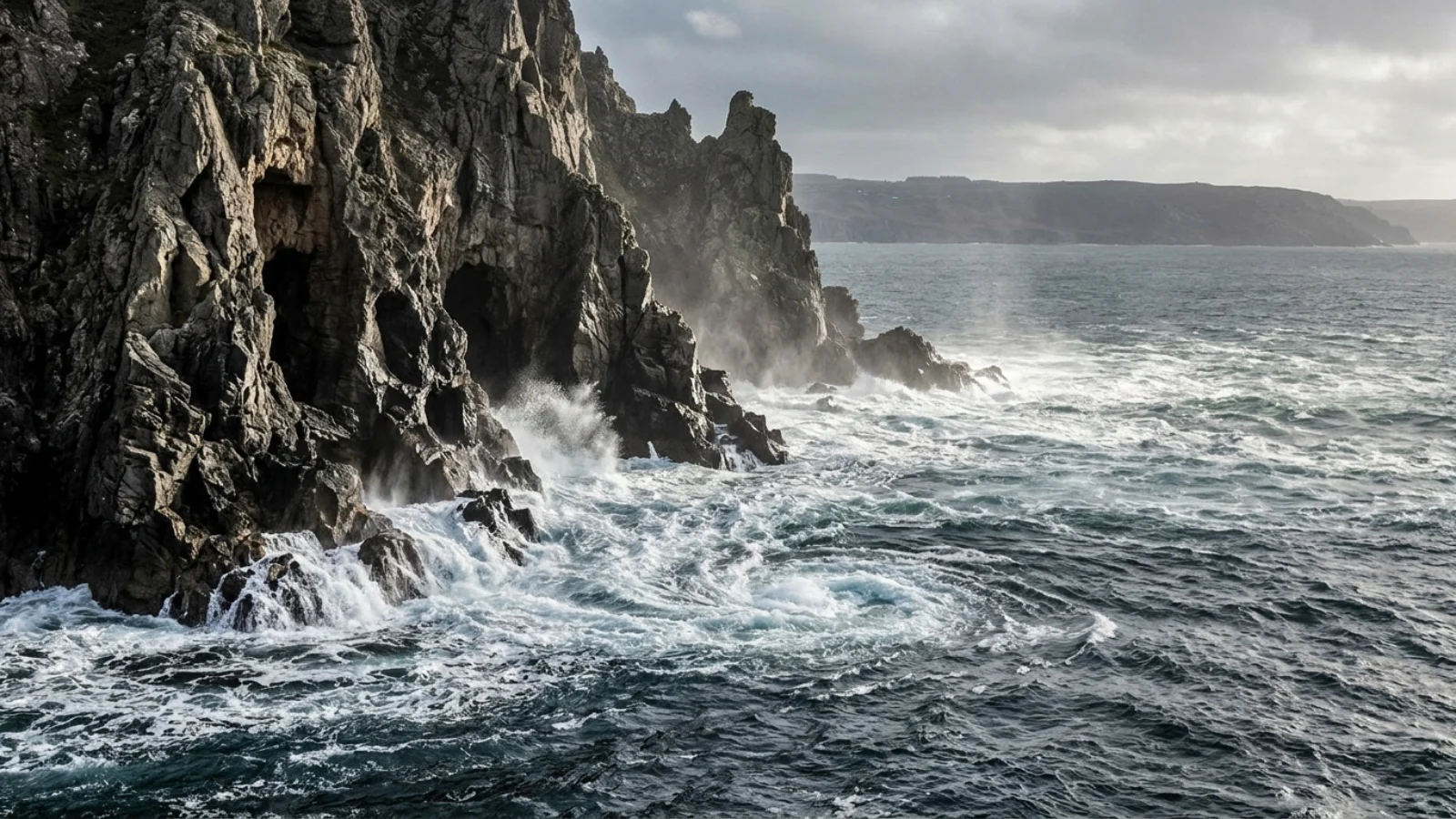
The identification rests on two real features. On the Calabrian side, the town of Scilla takes its name from the monster, and its prominent rock is said to have been her home. Across the water, off the Sicilian shore near the northern entrance to the strait, currents form a natural whirlpool that was identified with Charybdis. Ancient rationalisers explained the myth in exactly these terms: Scylla was a dangerous rock or shoal, Charybdis a whirlpool, and the “monsters” were sailors’ personifications of two navigational hazards too close together to avoid both.
What the strait is really like
The Strait of Messina connects the Tyrrhenian Sea to the north with the Ionian Sea to the south. At its narrowest point, between Torre Faro on Sicily and Villa San Giovanni in Calabria, it is only 3.1 kilometres wide, widening to about 5.1 kilometres at the city of Messina. Its maximum depth is about 250 metres. Through this narrow gap flow strong tidal currents, which create an unusual marine ecosystem and make the strait an important migration route for many Mediterranean fish.
Where those currents meet and reverse, eddies and whirlpools form, particularly in the northern part of the strait. A whirlpool does exist off the Sicilian coast, caused by currents meeting, but modern sources are clear that it is dangerous only to small craft in extreme conditions. For a Greek rowing ship or small sailing vessel of Homer’s time, however, a sudden swirl of current near a rocky shore could be deadly, and the strait has always demanded local knowledge. The same strait is also famous for another illusion of the sea: the Fata Morgana, a complex mirage that can make distant coasts and ships appear to float in the air, took its name from sightings there; see our guide to the Flying Dutchman for how such mirages work. Today ferries cross the strait constantly between Messina and Villa San Giovanni, and a bridge across it has been proposed and cancelled several times, partly because the area has strong winds and an intense earthquake record.
Real maelstroms: Charybdis’s relatives
Charybdis is a whirlpool, and real whirlpools have given rise to their own legends. A whirlpool is a body of rotating water produced by opposing currents or by a current running into an obstacle, and the largest are called maelstroms. They form most often in narrow straits with fast tidal streams, and although many stories tell of ships being sucked down, in reality only smaller craft are at risk.
The Moskstraumen, among the Lofoten Islands off Norway, is one of the strongest whirlpool systems in the world. Unusually, it forms in the open sea, where powerful tides meet a shallow ridge between two islands; reported current speeds vary between sources from about 11 to 20 kilometres per hour and above, and one account gives flow speeds as high as 32 km/h. Olaus Magnus showed it on his Carta Marina of 1539 and labelled it “Horrenda Caribdis”, the horrible Charybdis, a direct link back to Homer. Edgar Allan Poe’s 1841 story “A Descent into the Maelström” introduced the word maelstrom into English and, like Jules Verne after him, pictured it as a giant funnel reaching the sea floor, which it is not.
Nearby, Saltstraumen, a narrow strait about 33 kilometres south-east of Bodø in Norway, has one of the strongest tidal currents in the world and forms whirlpools up to about 10 metres across and 5 metres deep. In Scotland, the Gulf of Corryvreckan between the islands of Jura and Scarba, whose Gaelic name means “cauldron of the speckled seas”, is often described as the third-largest whirlpool in the world. There the flood tide accelerates to about 8.5 knots, or 16 km/h, through the narrow channel and meets a deep hole and a rising pinnacle on the seabed, creating whirlpools and standing waves. These are the closest modern equivalents to Homer’s Charybdis.
Could Scylla have been a real animal?
Scylla is harder to explain naturally than Charybdis. Ancient rationalisers made her a rock, and that is the simplest reading. Some modern writers have wondered whether stories of giant squid, which have eight arms and two long tentacles and can be seen at the surface when dying or injured, helped shape the image of a many-necked monster plucking men from a ship. The giant squid is a deep-water animal that is rarely seen at the surface, and there is no evidence that Homer’s audience knew of it, so this remains a speculation; see our giant squid profile and our guide to sea monsters and the animals behind them for the wider story. What can be said is that Homer placed a lethal, inescapable cost on one side of the strait and a total catastrophe on the other, and that is the logic that made the story so useful afterwards.
Between Scylla and Charybdis: the idiom
Because no route past the two monsters was safe, “between Scylla and Charybdis” became one of the oldest proverbs in Western languages. The Dutch humanist Erasmus recorded it in his Adagia of 1515 in the Latin form evitata Charybdi in Scyllam incidi, “having escaped Charybdis I fell into Scylla”. He explained that it could be used in three ways: when there is no escape without some cost, so that the wise course is to choose the lesser of two evils; when the risks are equally great whatever one does; and when someone has gone so far to avoid one extreme that they fall into the opposite. He also quoted a line that had become proverbial in its own right, incidit in Scyllam cupiens vitare Charybdim, “into Scylla he fell, wishing to avoid Charybdis”, from Walter of Châtillon’s Latin epic on Alexander the Great. The idiom is close in meaning to “between a rock and a hard place”, “on the horns of a dilemma” and “between the devil and the deep blue sea”.
Cartoonists and writers have used it for centuries. James Gillray’s cartoon of 3 June 1793 shows William Pitt steering Britannia between the rock of democracy and the whirlpool of arbitrary power. Percy Bysshe Shelley wrote in 1820 of the ship of state driven between the Scylla and Charybdis of anarchy and despotism. In Victor Hugo’s Les Misérables (1862), the two rebel barricades of the Paris uprising are named the Charybdis of the Faubourg Saint-Antoine and the Scylla of the Faubourg du Temple, and in 1863 a Punch cartoon by John Tenniel showed the British prime minister, Lord Palmerston, steering between a Scylla in the likeness of Abraham Lincoln and a Charybdis in the likeness of Jefferson Davis. Musicians still reach for it, from the Police’s 1983 song “Wrapped Around Your Finger” to the metal band Trivium.
Visiting the strait
The legend is still part of the landscape. Visitors to Scilla in Calabria can walk up to the rock and castle traditionally identified as Scylla’s home and look across the strait to Sicily, and the narrowest crossing near Torre Faro, on the Sicilian side, is close to the area linked with Charybdis. Ferries make the crossing in a short time, and on calm days it is hard to imagine the strait as deadly. On days of strong wind and opposing tides, when the water swirls and breaks along the Sicilian shore, it is easier to see why sailors once filled it with monsters. For other places where geography and legend overlap, see our guides to the Lusca of the Bahamian blue holes and to Atlantis. Scylla’s family tree runs back to Phorcys, one of the old men of the sea, and the wider cast is in our guide to Greek sea gods and goddesses and the sea nymphs who rode the same waters.
What are Scylla and Charybdis?
Two sea monsters in Homer’s Odyssey: Scylla, a six-headed monster who seizes sailors from passing ships, and Charybdis, who swallows and spews out the sea three times a day, forming a deadly whirlpool.
Where are Scylla and Charybdis?
Ancient writers placed them in the Strait of Messina between Sicily and Calabria, with Scylla at the rock of Scilla on the mainland and Charybdis as a whirlpool off the Sicilian shore.
Is Charybdis a real whirlpool?
A natural whirlpool does form in the Strait of Messina where tidal currents meet, but it is dangerous only to small craft in extreme conditions.
What does “between Scylla and Charybdis” mean?
Being forced to choose between two dangers, where avoiding one means facing the other. Erasmus recorded the proverb in his Adagia in 1515.
How did Odysseus get past Scylla and Charybdis?
On Circe’s advice he steered close to Scylla, losing six men rather than risking his whole ship. Later, alone on a raft, he survived Charybdis by clinging to a fig tree above her lair.
How did Scylla become a monster?
In Ovid’s version, the jealous sorceress Circe poisoned the pool where the nymph Scylla bathed because the sea god Glaucus loved Scylla rather than her.
How wide is the Strait of Messina?
About 3.1 km at its narrowest point, between Torre Faro in Sicily and Villa San Giovanni in Calabria, with a maximum depth of about 250 metres.
- Homer, Odyssey, Book 12, trans. S. Butler (MIT Internet Classics Archive) and R. Fagles (1996).
- Ovid, Metamorphoses, Books 13–14; Virgil, Aeneid, Book 3; Apollodorus, Epitome E7.20.
- Erasmus, D. (1515). Adagia, “Evitata Charybdi in Scyllam incidi”.
- Wikipedia contributors, “Scylla”, “Charybdis”, “Scylla and Charybdis”, “Strait of Messina”, “Whirlpool”, “Moskstraumen”, “Corryvreckan”, “Fata Morgana (mirage)” (2023 snapshot via Kiwix mirror, accessed November 2026).
Blane Perun has been exploring Earth’s oceans and marine life for over 25 years. Founder of TheSea.Org in 1999, underwater photographer, coral aquaculture pioneer, and explorer of 80+ countries.
About Blane Perun →