Ghost Ships — 10 Real Derelicts Found Adrift Without a Crew
A ghost ship, in the maritime sense, is a real vessel found adrift or aground with no living crew aboard. They are different from phantom ships such as the Flying Dutchman, which belong to folklore. Documented derelicts range from the brigantine Mary Celeste in 1872 and the schooner Carroll A. Deering in 1921 to fishing boats and yachts found empty in the 2000s. Most have ordinary explanations once the evidence is examined: crews abandoning ship in a crisis and being lost in the boats, people falling overboard, ships breaking free of a tow or of ice. A few remain genuinely unexplained, but none requires anything supernatural.
Every ship in the list of ten below is recorded in official inquiries, court records or contemporary reports. Famous stories that cannot be traced to any record, such as the Octavius and the Ourang Medan, are discussed separately and clearly labelled as unverified.
Two kinds of ghost ship
The phrase “ghost ship” covers two quite different things. The first is a phantom vessel of folklore, a ship seen at sea or along a coast that is not really there. The Flying Dutchman, doomed never to make port, is the most famous, and many coasts have their own: the Caleuche off Chiloé in Chile, the burning ship of the Northumberland Strait in Canada, the Palatine Light off Block Island in Rhode Island. These are legends, and nobody can board them.
The second kind is entirely real: a ship found drifting or aground with its crew missing or dead. These derelicts are documented in salvage hearings, coroners’ inquests and Coast Guard reports, and some have been boarded, towed into port and examined in detail. The term is also used loosely for ships that have broken free of their moorings or a tow and drifted away with nobody aboard, and for ships laid up awaiting scrapping. This page is about the real derelicts. Each case below is taken from the official or contemporary record, with the investigators’ conclusions where they reached one.
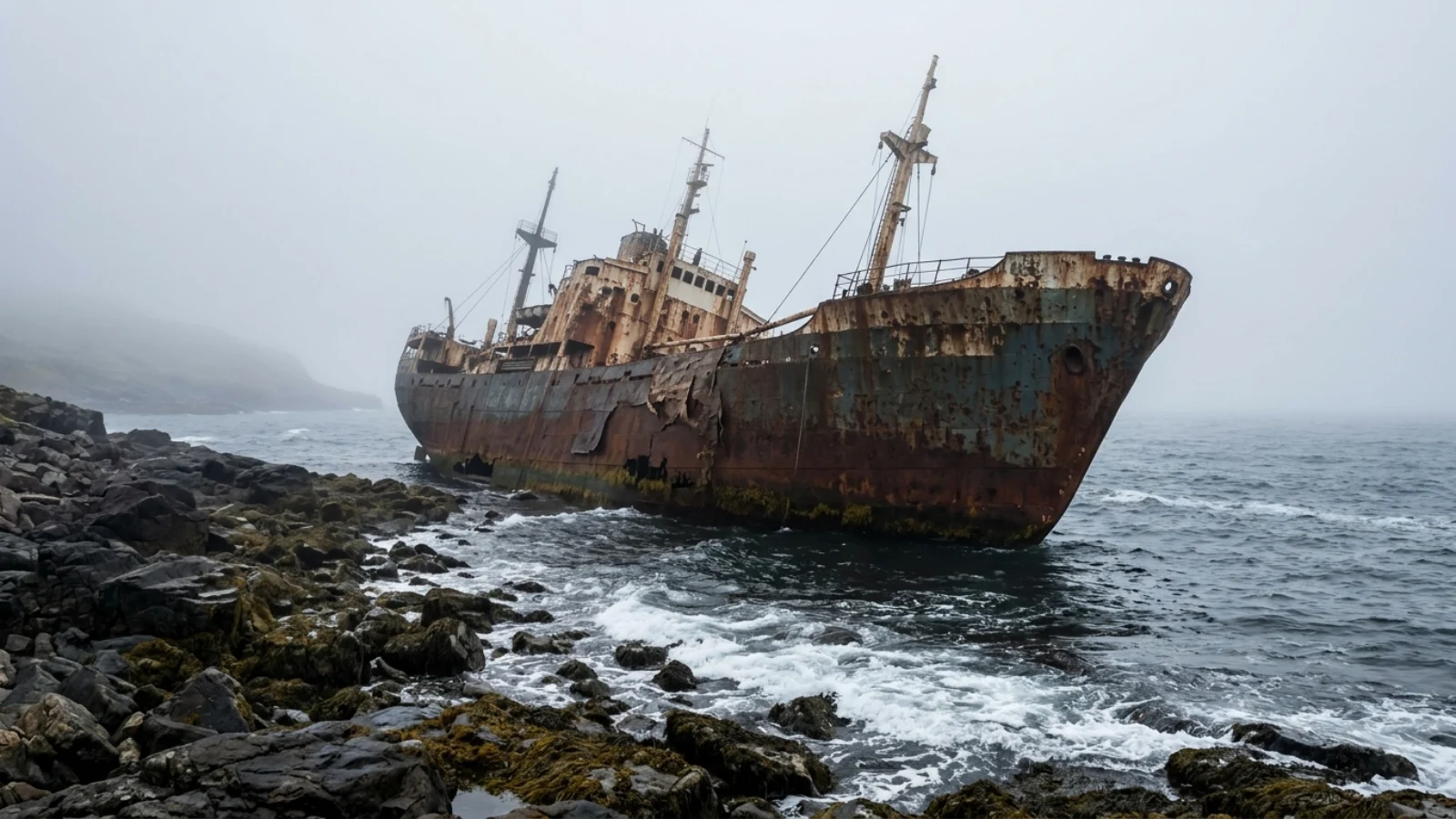
1. HMS Resolute (1854 to 1855)
Resolute was a barque-rigged Royal Navy ship sent to the Canadian Arctic as part of Sir Edward Belcher’s expedition to search for the lost Franklin expedition. When she became trapped in the ice of Viscount Melville Sound, her crew abandoned her on 15 May 1854, along with other ships of the squadron, and walked to safety. The ice did not crush her. Instead it carried the empty ship about 1,900 kilometres until she was found, freed from the ice, off Baffin Island on 10 September 1855.
Resolute is a good example of how a ship can outlast its crew’s decision to leave it. Nobody vanished: the crew’s fate was never in doubt. Timbers from her hull were later used to make the Resolute desk, which stands today in the Oval Office of the White House.
2. Mary Celeste (1872)
The most famous derelict of all is the American brigantine Mary Celeste, found on 4 December 1872 by the Canadian brigantine Dei Gratia, roughly midway between the Azores and the coast of Portugal. She was under partial sail, dishevelled but seaworthy and still amply provisioned, but her lifeboat was gone and nobody was aboard. She had left New York for Genoa on 7 November. The last entry in her log had been made at 8 a.m. on 25 November, when she was off Santa Maria Island in the Azores, almost 740 kilometres from where she was found. The salvage court at Gibraltar considered mutiny, piracy and foul play by the salvors, and found evidence for none of them.
The most widely discussed explanation is that Captain Briggs ordered the ship abandoned in a hurry, perhaps fearing an explosion from his cargo or believing the ship was taking on water, and that the people in the boat were lost at sea while the ship sailed on without them. The story was heavily embellished after Arthur Conan Doyle based his 1884 short story “J. Habakuk Jephson’s Statement” on it, spelling the name “Marie Celeste”, and invented details from later retellings are still repeated. Our full account of the Mary Celeste covers the evidence in detail.
3. Resolven (1884)
On 29 August 1884 the merchant brig Resolven was found abandoned between Baccalieu Island and Catalina, off Newfoundland. Her boats were missing and her logbook had been kept up to within six hours of her being sighted. Apart from a broken yard she was barely damaged; the galley fire was still alight and the lamps were burning. A large iceberg was seen nearby. One suggestion made at the time was that her seven crew and four passengers, none of whom were used to northern waters, panicked after the ship struck ice, took to the boats and were lost. No trace of them was found.
4. Zebrina (1917)
The British sailing barge Zebrina left Falmouth in Cornwall in October 1917 with a cargo of Welsh coal for Saint-Brieuc in Brittany. Two days later she was found aground on Rozel Point, south of Cherbourg, undamaged apart from some disorder in her rigging, but with her crew missing. The date matters: this was the middle of the First World War, when German submarines were active in the Channel. One plausible explanation is that the crew were taken off by a submarine and lost when it was later sunk, though this has never been confirmed.
5. Carroll A. Deering (1921)
The Carroll A. Deering was a five-masted cargo schooner built in Bath, Maine, in 1919, one of the last large commercial sailing ships in the United States. Returning from Rio de Janeiro via Barbados, she passed the Cape Lookout lightship off North Carolina on 28 January 1921. The lightship’s keeper, Captain Jacobson, later reported that a man who did not look like an officer hailed him through a megaphone, saying the ship had lost her anchors in a storm and asking him to notify the owners. Three days later, on 31 January, a Coast Guard lookout at Cape Hatteras saw her hard aground on Diamond Shoals with all sails set. When rescuers were finally able to board her, her lifeboats, logbook and navigation equipment were gone.
The Deering case drew one of the most extensive US government investigations of its era, involving five federal departments by one account and six by another, and Commerce Secretary Herbert Hoover took a personal interest because several other ships had gone missing in the same period. Theories included piracy, rum-runners stealing the ship during Prohibition, mutiny against the unpopular captain, Willis Wormell, and simple abandonment after the grounding. A message in a bottle claiming that the crew had been captured turned out to be a forgery by a local man, Christopher Gray, who admitted it under questioning. No official explanation was ever offered, and because the ship sailed through waters later folded into the Bermuda Triangle, she became a staple of that legend.
6. SS Baychimo (1931 to 1969)
The Hudson’s Bay Company cargo steamer Baychimo holds the record for the longest-lived ghost ship. In October 1931 she became trapped in pack ice near Barrow, Alaska. The company flew out most of the crew, and the 15 men who remained built a shelter on shore to wait out the winter. After a powerful storm on 24 November, the ship disappeared, and the crew assumed she had sunk. She had not. Baychimo was sighted repeatedly in the Chukchi and Beaufort seas over the following decades, still unmanned and adrift, and several groups boarded her, but none was equipped to salvage her or was able to get her out of the ice. The last recorded sighting was by a group of Inuit in 1969, 38 years after she was abandoned. Her eventual fate is unknown.
7. MV Joyita (1955)
The Joyita was a 21-metre wooden motor vessel, built in 1931 in Los Angeles as a luxury yacht for the film director Roland West and named for his wife, the actress Jewel Carmen. By 1955 she was a fishing and trading charter boat in the South Pacific. On 3 October 1955 she left Apia in Samoa for the Tokelau Islands with 25 people aboard. She was found on 10 November, partly submerged and listing heavily, north of Vanua Levu in Fiji. Her dinghy, three life rafts and logbook were missing, and nobody was aboard.
The inquiry found that the vessel was in poor repair, with corroded pipes and a radio whose faulty wiring limited its range to about 3 kilometres. What puzzled investigators was that her cork-lined hold made her almost unsinkable, so the crew would have been far safer staying aboard than taking to small rafts. The inquiry concluded that the fate of the passengers and crew was “inexplicable on the evidence submitted”. The Joyita remains one of the most debated real ghost-ship cases, with suggestions ranging from a flooded engine room and an injured captain to foul play.
8. Teignmouth Electron (1969)
Not every derelict is a mystery for long. On 10 July 1969 the trimaran Teignmouth Electron was found drifting in the North Atlantic at about 33°N 40°W with nobody aboard. The last entry in her log had been made on 1 July. She belonged to Donald Crowhurst, a British businessman and amateur sailor competing in the Sunday Times Golden Globe Race, a single-handed round-the-world race of 1968 to 1969. Investigation led to the conclusion that he had suffered a mental breakdown and taken his own life by going overboard. Charles Berlitz later presented Crowhurst’s case as an unsolved Bermuda Triangle mystery, despite the clear evidence in the logs, an example of how known outcomes are recycled as mysteries.
9. High Aim 6 (2002 to 2003)
The Taiwanese-owned longline fishing vessel High Aim 6 was last in radio contact with her owner on 13 December 2002, near the Marshall Islands. On 3 January 2003 she was found drifting about 150 kilometres east of Rowley Shoals off Broome, Western Australia, with no one aboard. Her crew had been a mix of nationalities, and the Taiwanese police concluded that a mutiny was the most likely explanation, with the crew having killed or removed the officers before abandoning the boat. Cases like this are a reminder that the modern ghost ship is often linked to the hard and sometimes violent conditions of the distant-water fishing industry.
10. Kaz II (2007)
The Kaz II, a catamaran of about 10 metres, left Airlie Beach in Queensland on 15 April 2007 with three men from Perth aboard: Derek Batten, 56, and the brothers Peter Tunstead, 69, and James Tunstead, 63, on the first leg of a voyage around northern Australia. On 18 April a helicopter spotted her drifting near the Great Barrier Reef, about 163 kilometres off Townsville. When boarders reached her on 20 April, the engine was running, a laptop computer was on, food and cutlery were laid out, and the radio and GPS were working, but the three men were gone.
Police found no sign of foul play. GPS data showed the boat had been steered into an area of squalls and building seas on the day she left, and had begun to drift late that afternoon. A video recovered from a camera showed the men in choppy water without life jackets. Because a fishing lure was found tangled in the port rudder, investigators suggested that one man fell overboard while trying to free it from the stern platform, and that the others went into the water trying to help him, while the catamaran sailed on. A coroner’s inquest opened in Townsville in August 2008. The case was widely compared with the Mary Celeste, and it shows how quickly an ordinary accident at sea can leave a scene that looks inexplicable.
Modern drifters: tsunami boats and scrapyard tows
Some modern ghost ships have no crew to lose. After the Tohoku earthquake and tsunami of March 2011, the Japanese fishing vessel Ryou-Un Maru was swept from her mooring in Aomori Prefecture and drifted across the Pacific for a year before being found off Haida Gwaii, British Columbia; the US Coast Guard sank her with gunfire on 5 April 2012 as a hazard to shipping. The former Soviet cruise ship Lyubov Orlova broke loose from her tow on the way to a scrapyard one day after leaving St John’s, Newfoundland, in early 2013 and was last located in international waters about 460 kilometres east of the city. The cargo ship MV Alta, disabled in the Atlantic in 2018 after her crew were rescued by the US Coast Guard, drifted unmanned from 2018 until she ran aground near Ballycotton, County Cork, in Ireland during Storm Dennis in February 2020.
Every year, small wooden boats, many believed to be North Korean fishing vessels, also wash up on the coast of Japan, some empty and some carrying the bodies of crew who died of starvation or exposure. These are among the grimmest real ghost ships of the twenty-first century.
Legends dressed as history: Octavius and Ourang Medan
Two of the most often repeated ghost-ship stories have no documentary basis at all. The Octavius was supposedly an English trading ship found drifting off Greenland in 1775 with her crew frozen at their posts, the captain’s log showing that she had completed the Northwest Passage while trapped in ice for 13 years. No contemporary record of the discovery has been found. The earliest version traced so far appeared on 13 December 1828 in a Philadelphia newspaper, The Ariel, more than fifty years after the supposed events, and the early versions do not even mention the Northwest Passage. The Ourang Medan was said to have been found off Indonesia in 1947 with her entire crew dead, their faces frozen in terror, before the ship exploded and sank. There is no record that a ship of that name ever existed, and the story is generally treated as an urban legend. Both are good stories, and both should be read as fiction.
Why crews leave ships that do not sink
The real cases share a striking pattern: the ship survives and the people do not. That is less paradoxical than it seems. A wooden ship, or a ship with a buoyant cargo, can stay afloat long after it seems to be sinking, while the people aboard decide, in the dark and under stress, that the small boat is the safer place to be. People also fall overboard, especially from small craft in rough seas, and a boat under sail or engine will keep going without them. And empty ships can drift for remarkable distances on ocean currents, which is why shipwrecks and derelicts turn up far from where their troubles began. For the folklore side of the story, see our guides to the Flying Dutchman and Davy Jones’ Locker.
What is a ghost ship?
In maritime history, a real vessel found adrift or aground with no living crew aboard. In folklore, a phantom ship such as the Flying Dutchman that is seen but is not really there.
What is the most famous ghost ship?
The brigantine Mary Celeste, found deserted between the Azores and Portugal on 4 December 1872 with her lifeboat missing and her cargo intact.
Are ghost ships real?
Yes, in the sense of real derelicts. Ships such as the Carroll A. Deering, Joyita and Kaz II were found with their crews missing and are documented in official inquiries.
What happened to the crew of the Carroll A. Deering?
No official explanation was ever given. Theories include piracy, mutiny, rum-runners and abandonment after the ship grounded on Diamond Shoals in January 1921.
Which ghost ship drifted the longest?
The SS Baychimo, abandoned in Arctic pack ice off Alaska in 1931, was sighted repeatedly until 1969, 38 years later.
Was the Ourang Medan real?
There is no record that a ship of that name existed, and the story of a crew found dead in 1947 is treated as an urban legend.
Why do crews abandon ships that later stay afloat?
In a crisis a crew may believe the ship is about to sink or explode and take to the boats, which are then lost, while the ship drifts on.
- Wikipedia contributors, “Ghost ship”, “Carroll A. Deering”, “MV Joyita”, “Kaz II”, “SS Baychimo”, “MV Lyubov Orlova”, “High Aim 6”, “Zebrina (ship)”, “Octavius (ship)”, “SS Ourang Medan”, “Mary Celeste” (2023 snapshot via Kiwix mirror, accessed November 2026).
- Hicks, B. (2004). Ghost Ship: The Mysterious True Story of the Mary Celeste. New York: Ballantine.
- Australian Maritime Safety Authority and Queensland Police statements on Kaz II (April 2007), as reported in the Townsville Coroner’s Court inquest (opened 4 August 2008).
- Kusche, L. D. (1975). The Bermuda Triangle Mystery: Solved (on the Teignmouth Electron and Carroll A. Deering).
Blane Perun has been exploring Earth’s oceans and marine life for over 25 years. Founder of TheSea.Org in 1999, underwater photographer, coral aquaculture pioneer, and explorer of 80+ countries.
About Blane Perun →