Champ, the Lake Champlain Monster — Sightings, a Famous Photo and the Fish That Explain It
Champ is a legendary long-necked creature said to live in Lake Champlain, the 120-mile lake between New York and Vermont that reaches into Quebec. Hundreds of sightings have been reported since the 19th century, and a 1977 photograph by Sandra Mansi made it famous. No specimen, carcass or verified footage has ever been found, and the sightings are best explained by large fish such as lake sturgeon and longnose gar, swimming otters, floating logs and waves.
Champ is the American cousin of the Loch Ness Monster, and the two share almost everything: a long, cold, deep lake, a population of large fish, a famous photograph and a tourism industry that is happy to keep the story alive. Champ is technically a lake monster rather than a sea monster, but the lake has a marine past that makes the story more interesting than most, and the animals behind the sightings are the same kind of large, ancient fish that inspired sea-serpent stories along the coast.
My approach to Champ is the same one I take with every legend on this site: find the oldest real source, follow how the story grew, then look at what lives in the water. In this case the water tells most of the story.
The Samuel de Champlain myth
Almost every article about Champ says the French explorer Samuel de Champlain saw the monster in 1609, when he became the first European to reach the lake. He did not.
What Champlain actually wrote about was a fish the local people called chaousarou. He described it as up to five feet long, as thick as a man’s thigh, with a long snout containing double rows of sharp teeth and very hard silver-grey scales that a dagger could not pierce. That is a clear description of a gar, most likely the longnose gar, which still lives in the lake. The quote linking Champlain to a serpent-like monster appears to have been invented or garbled by a magazine writer in the 20th century and then repeated so often that it became “history”. It is a good lesson in why I always try to read the original text.

Sightings, sheriffs and P. T. Barnum
The real Champ story starts in the 19th century, when newspapers along the lake began printing reports of a large serpent-like animal.
Through the 1870s and 1880s, local papers carried accounts of a creature many feet long with a snake-like head, often seen by groups of people on shore or on steamboats. Interest was strong enough that in 1887 the showman P. T. Barnum offered a reward of $50,000 for the creature’s hide, dead or alive, to add to his exhibition. Nobody ever collected. Barnum had form with sea monsters: he had already exhibited the “Feejee mermaid”, a monkey sewn to a fish, decades earlier.
Sightings continued through the 20th century, and in the 1970s Joseph Zarzynski, a teacher from New York, began cataloguing them systematically and running watches on the lake. His records, and the work of others who followed, list hundreds of reports. The descriptions vary a lot: anything from a few feet to more than 30 feet long, with one hump, several humps, a horse-like head or a snake-like one. That variety is a clue in itself. It suggests that people are seeing many different things and calling all of them Champ.
The 1977 Mansi photograph
The single most important piece of Champ evidence is a colour snapshot taken by Sandra Mansi in July 1977, during a family outing near the Vermont-Quebec border.
The photograph shows a dark head and a curved neck rising from the water above a darker hump. It was not published until 1981, when it appeared in The New York Times and went around the world. Mansi said she had lost the negative and could not remember exactly where on the lake she had been, which made the image very hard to test. Later analysts argued that the water in the photo suggests a shallow area rather than open deep water, and several researchers have proposed that the shape is a floating tree root or log rolled up by a wave. To be fair to Mansi, there is no evidence that she faked anything. But a single photograph without a negative, a location or a scale bar is not the kind of evidence that can prove an animal exists.
Sonar, echolocation and modern searches
Since the 1980s, Lake Champlain has been searched with sonar, underwater cameras and hydrophones, both by enthusiasts and by television crews.
None of these searches has produced a clear image of a large unknown animal. Sonar has picked up large targets, but in a lake with sturgeon well over five feet long, schools of fish and sunken logs, a large sonar return is not unusual. In 2003 a team recording underwater sound for a television documentary reported clicking sounds they compared to echolocation by whales and dolphins. It made headlines, but the recordings were never shown to come from an unknown animal, and noises from fish, invertebrates, boats and equipment can all be confusing in fresh water.
The lake itself also argues against a monster. Lake Champlain in its present form is young. As the glaciers retreated around 13,000 years ago, the basin was flooded by the sea and became part of the Champlain Sea, an arm of the Atlantic. Fossils from that time include the skeleton of a beluga whale found in 1849 at Charlotte, Vermont, now the state fossil. When the land rebounded, the sea drained out and the lake became fresh water. Any large marine animal living there would have had to adapt to fresh water in a few thousand years, and a breeding population would have to number many individuals to survive. A population of large air-breathing animals, as a plesiosaur would have to be, would be seen at the surface constantly.
| Candidate | Size | Why it fits sightings | Problem |
|---|---|---|---|
| Lake sturgeon | Can exceed 6 ft and live 100+ years | Long body, ridged back, leaps clear of the water | No long neck |
| Longnose gar | Up to about 5 ft | Long snout, armoured body, basks at the surface | Smaller than most reports |
| River otters | About 3–4 ft each | A family swimming in line looks like humps | Only explains humps |
| Floating logs and roots | Any size | A rolled root can look like a head and neck | Does not move against the wind |
| Waves and seiches | — | Standing waves and boat wakes create travelling humps | No solid body |
| Plesiosaur | Large marine reptile | Matches the classic long-neck image | Extinct for about 66 million years; lake is young |
The fish that make the best monster
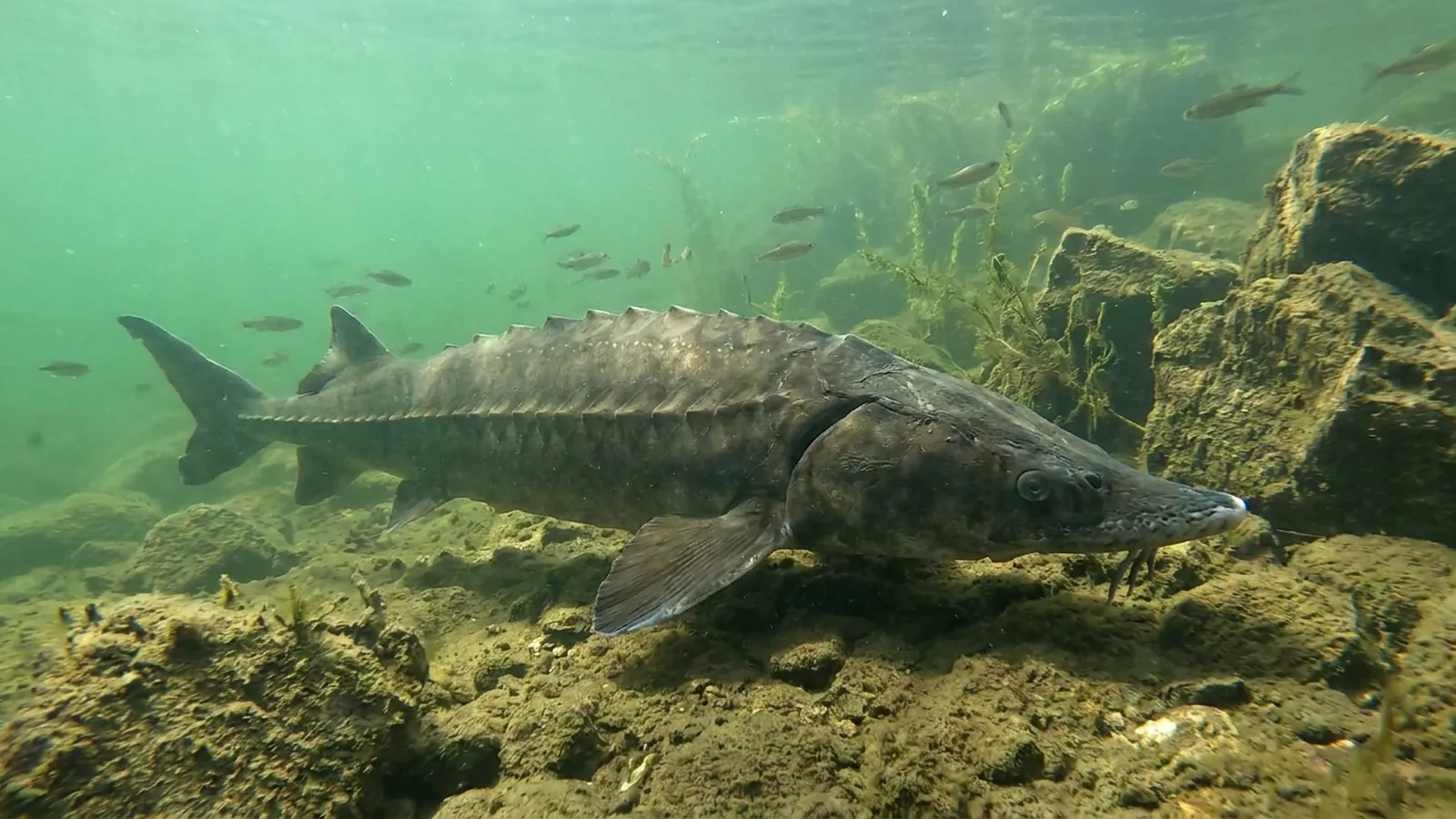
If I had to bet on one animal behind most Champ sightings, it would be the lake sturgeon.
Lake sturgeon are among the largest freshwater fish in North America. They can grow longer than six feet, live for more than a century and have bony plates, called scutes, running along their backs that look like a row of small humps. They also have a habit of jumping clear of the water and landing with a big splash, which is exactly the kind of brief, startling sight that turns into a monster story. Sturgeon numbers in Lake Champlain fell sharply from overfishing and dams, and the species is listed as endangered in Vermont, so they are rarely seen today, but they were common when the 19th-century sightings began.
The longnose gar fits too. It basks at the surface on calm days with its long, toothy snout showing, and Champlain’s own description shows how striking it looked to a newcomer. Add otters, which often swim in a line that looks like a string of humps, and long, narrow waves called seiches that slosh back and forth in long lakes, and you have most of the ingredients for a monster without needing one. The Loch Ness eDNA survey, which found huge amounts of eel DNA, points the same way for that lake; for more on the eel connection see our eels section.
There is also a simple human factor. Lake Champlain is busy with boats, ferries and anglers in summer, and most sightings happen on calm, bright days when the surface is glassy and distances are hard to judge. With nothing to compare it to, a three-foot fish at 200 yards and a thirty-foot animal at a mile look much the same. On the water I have learned not to trust my first estimate of size without something of known length nearby, and the same caution applies to anyone watching a lake from shore.
Champ today: protection, festivals and a baseball mascot
Whatever Champ is, the people around the lake have taken it to heart.
In the early 1980s, lawmakers in Vermont and New York passed resolutions declaring that Champ should be protected from harm, a nice gesture that cost nothing because there was no animal to protect. Port Henry, New York, calls itself the home of Champ and keeps a roadside board listing reported sightings, and the village holds an annual Champ Day. Burlington’s summer baseball team is the Vermont Lake Monsters, with a green mascot named Champ.
I do not think any of this is a bad thing. A lake monster gets people looking at the water, and anyone who spends time watching Lake Champlain will see real wildlife: sturgeon jumping, gar basking, otters, loons and more. That is a better reward than Barnum’s $50,000. For more lake and sea legends treated the same way, see the Lusca of the Bahamas, the sea serpent sightings of the Atlantic and our sea myths and legends hub.

Is Champ the Lake Champlain monster real?
There is no physical evidence. No body, bones or verified footage exist. Most sightings are explained by sturgeon, gar, otters, logs and waves.
Did Samuel de Champlain see Champ?
No. In 1609 he described a large fish with a long toothed snout and hard scales, which matches a gar. The claim that he saw a monster came much later.
What is the Mansi photo?
A 1977 snapshot by Sandra Mansi showing a head and neck above the water, published in 1981. The negative and exact location were never recovered, and many think it shows a log or root.
How deep is Lake Champlain?
Its deepest point is about 400 feet (122 m), and the lake is about 120 miles (193 km) long.
Could a plesiosaur live in Lake Champlain?
No. Plesiosaurs died out about 66 million years ago, and the lake only became fresh water after the Champlain Sea drained roughly 10,000 years ago.
Is Champ protected by law?
Vermont and New York passed symbolic resolutions in the early 1980s calling for Champ to be protected. They have no practical effect.
- Champlain, S. de. Voyages (1613), account of the 1609 journey and the chaousarou.
- Zarzynski, J. W. (1984). Champ: Beyond the Legend. Bannister Publications.
- Lake Champlain Basin Program, lake facts and fish species (lcbp.org).
- Vermont Fish & Wildlife Department, lake sturgeon status and recovery.
- Radford, B. & Nickell, J. (2006). Lake Monster Mysteries: Investigating the World’s Most Elusive Creatures. University Press of Kentucky.
Blane Perun has been exploring Earth’s oceans and marine life for over 25 years. Founder of TheSea.Org in 1999, underwater photographer, coral aquaculture pioneer, and explorer of 80+ countries.
About Blane Perun → More Sea Myths & Legends →