Blue Spring Manatee Count — Season Records, Daily Counts and Why the Numbers Swing
The Blue Spring manatee count is the daily winter tally of manatees using the spring run at Blue Spring State Park in Orange City, Florida. Park staff and researchers count from the water each morning during manatee season, roughly mid-November to mid-March. The record is 932 manatees, set in the 2023–24 winter, up from only a few dozen in the early 1970s.
Every winter morning at Blue Spring State Park, someone slips into the spring run and counts manatees. It sounds like a simple job, but that daily number has become one of the most closely watched wildlife statistics in Florida. It tells visitors whether it is worth making the drive, it tells researchers how the St. Johns River manatee population is doing, and on the coldest mornings it makes headlines. This page explains how the Blue Spring manatee count works, what the season records are, why the number can jump by hundreds overnight, and how you can check it before you go.
Why Blue Spring matters to manatees
A warm spring on a river that gets cold.
Blue Spring is a first-magnitude spring in Volusia County that feeds a short, clear run into the St. Johns River, Florida’s longest river. The water leaves the ground at a steady temperature of around 23°C (73°F) whatever the season. In summer, that is cooler than the river. In winter, when cold fronts push the St. Johns down into the 50s°F and lower, the spring run becomes one of the warmest places a manatee can find for many miles.
That matters because manatees can’t cope with cold water for long. They have a low metabolic rate and very little insulating fat, and in water much below 20°C (68°F) they risk cold stress, which can damage their skin and immune system and kill them. Our page on manatee habitat explains why that threshold is so important. Manatees that spend summer spread along the St. Johns and its lakes and tributaries move into Blue Spring as the river cools, and they stay close to it until spring.
How the daily count is made
A careful count from the water, with many manatees known as individuals.
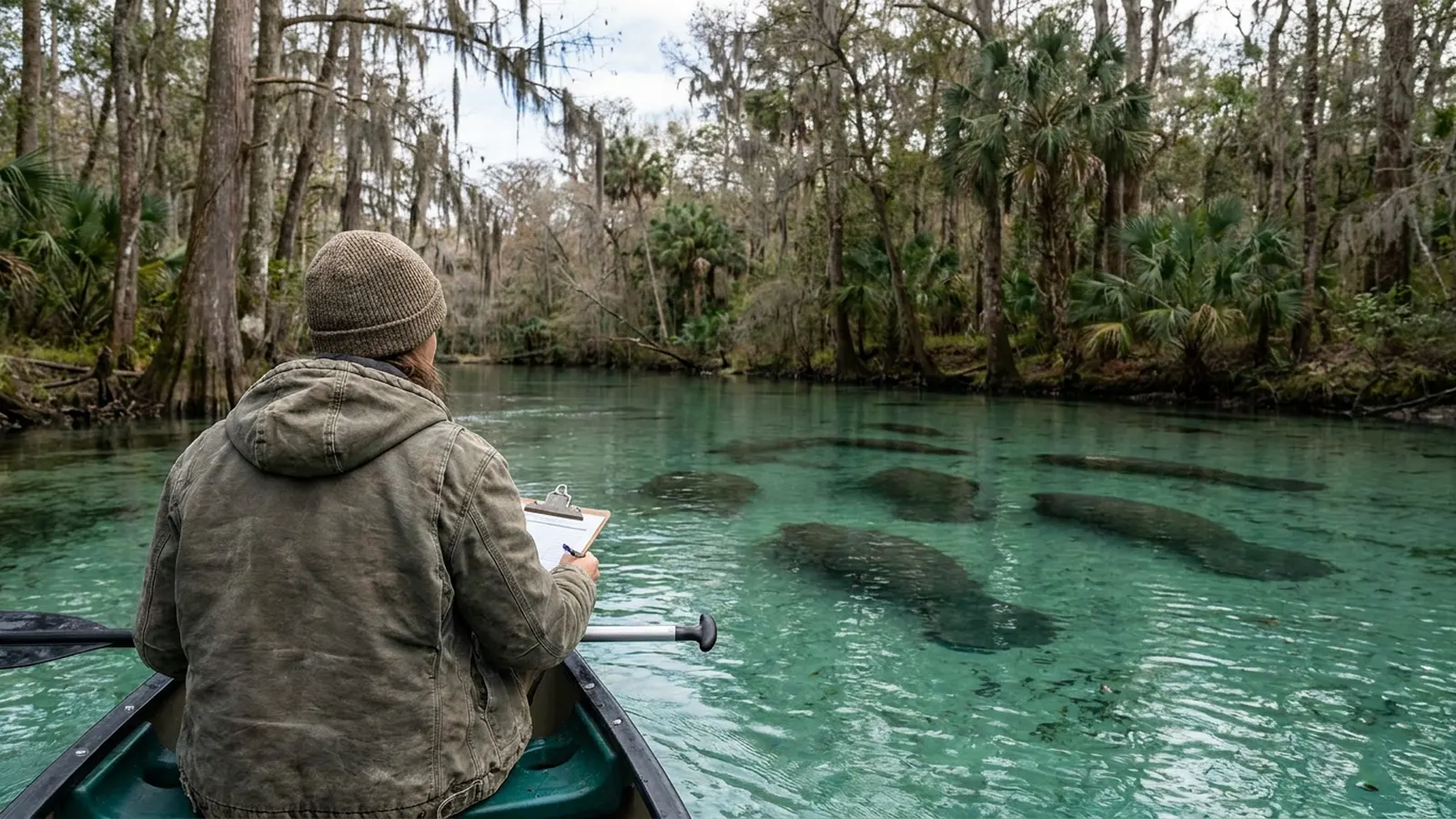
During manatee season, the count is usually made early in the morning, when the most manatees are packed into the run after a cold night. Researchers move slowly along the spring run, typically in a canoe or small boat, and tally every manatee they can see. The water at Blue Spring is unusually clear, which is part of what makes such a careful count possible.
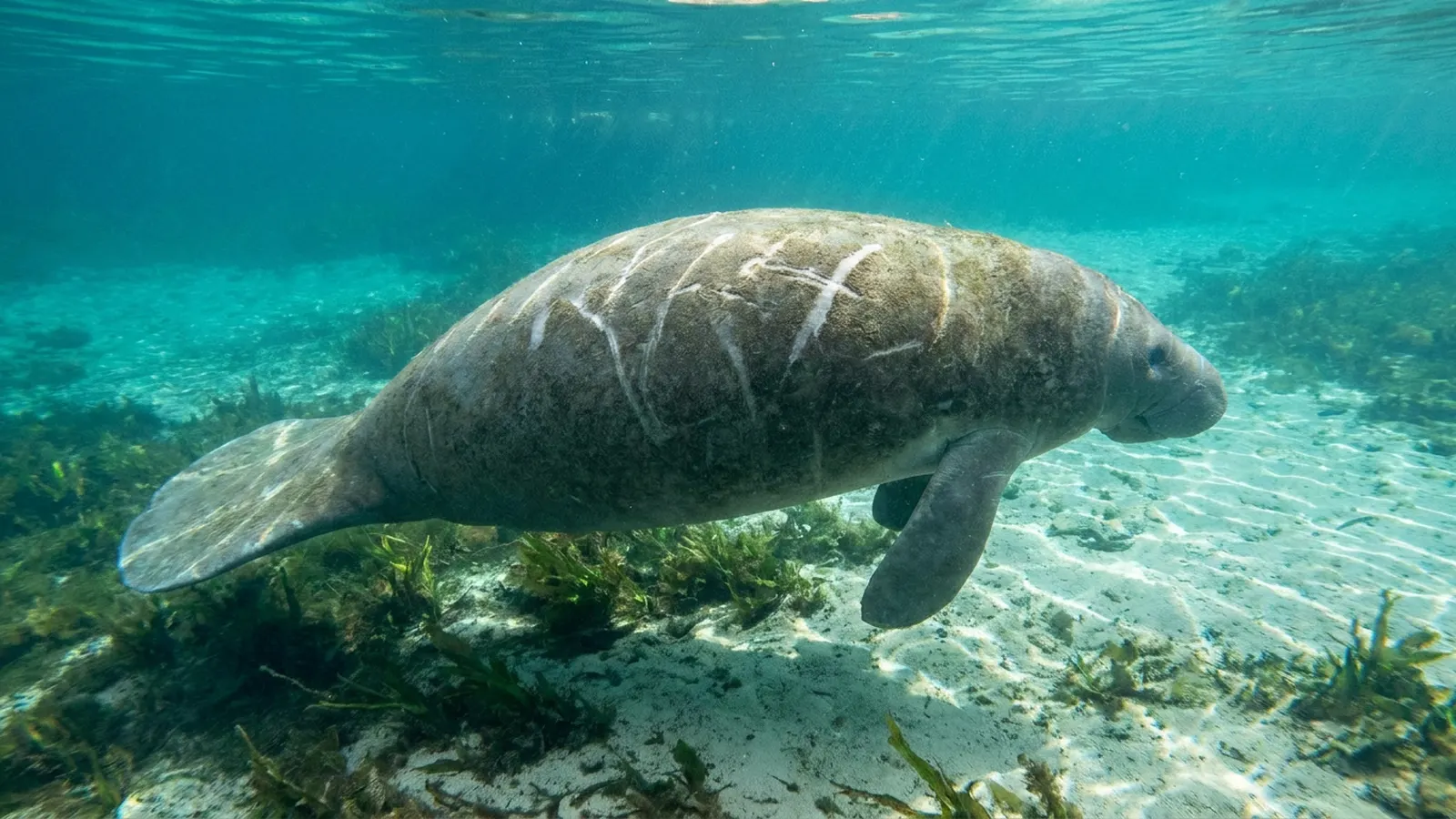
Many of the regular Blue Spring manatees are known as individuals. Most adult Florida manatees carry scars from boat propellers and hulls, and those scar patterns, along with notches in the tail and other marks, let researchers recognise the same animal year after year. Long-term photo-identification work at Blue Spring has built up records of individual manatees over decades, including when they first appeared, when they had calves and how long they have been returning. This makes the Blue Spring count much more than a headcount: it is one of the longest-running studies of individual wild manatees anywhere.
A daily count is always a minimum. Manatees resting in deeper water, hidden under others or sitting near the mouth of the run where it meets the river can be missed, and animals come and go during the day. Counts from aerial surveys over the whole region sometimes turn up more animals than ground counts at a single site. So when you see a number like 932, read it as “at least 932 manatees in the run that morning”.
Blue Spring manatee count records
From a few dozen animals to more than 900 in about fifty years.
When Blue Spring became a state park in the early 1970s, only a few dozen manatees used the spring in winter. Around the same time, Jacques Cousteau filmed the spring’s manatees, bringing national attention to an animal most Americans had never seen. Protection followed: the manatee was listed under the Endangered Species Act, Florida created manatee protection zones and the park closed the spring run to swimmers and boats during manatee season.
The Blue Spring herd has grown steadily ever since. Part of that growth comes from manatees born to the resident herd, and part from manatees elsewhere along the St. Johns and the Atlantic coast discovering the spring and returning each winter. Counts climbed into the hundreds through the 2000s and 2010s, and new season records became a regular occurrence.
The biggest numbers came in the 2023–24 winter. A count of 736 on New Year’s Day 2024 set a record, and only weeks later a sharp cold front pushed the count to 932, the most ever recorded at the park. Our news story on Blue Spring’s 932-manatee record covers that morning in detail.
| Period | Typical winter numbers at Blue Spring | What changed |
|---|---|---|
| Early 1970s | A few dozen | Park established; Cousteau film draws attention |
| 1980s–1990s | Steady growth | Spring run closed to people in season; boat speed zones |
| 2000s–2010s | Hundreds on cold mornings | Herd grows from births and new arrivals; records broken repeatedly |
| January 1, 2024 | 736 (record at the time) | Cold start to the year |
| 2023–24 winter | 932 (all-time record) | Strong cold front cools the St. Johns River |
I have kept the table to figures that are well documented. If you want the exact count for a given day or season, the park and Save the Manatee Club publish the daily numbers during manatee season, and those official reports are the place to check rather than secondhand figures.
Why the count swings from day to day
Weather drives the number more than anything else.
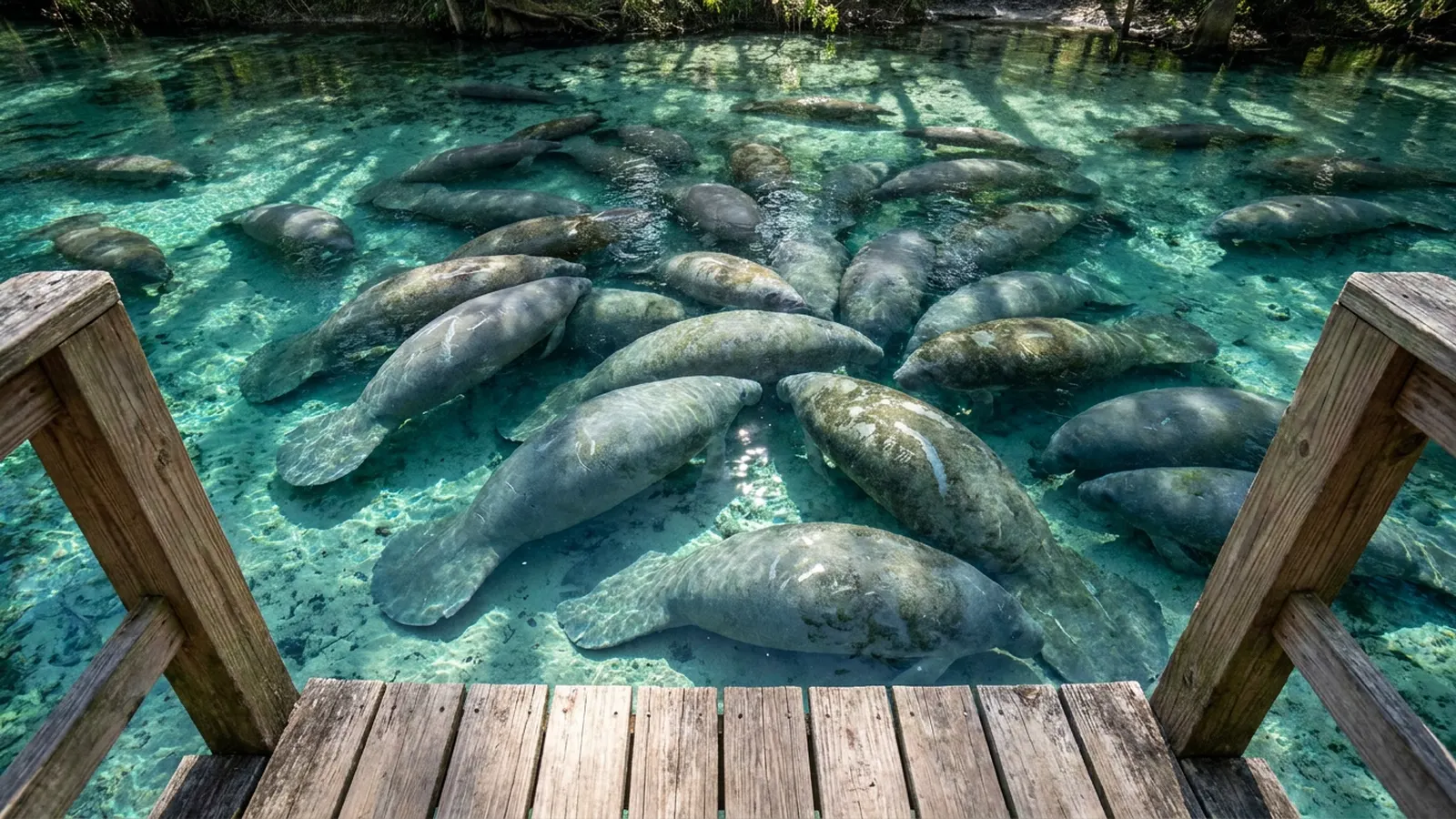
New visitors are often surprised that the count can be several hundred one morning and a few dozen two days later. The reason is temperature. On the morning after a strong cold front, the St. Johns River is at its coldest and manatees crowd into the spring run. When the weather warms for a few days, the river heats up and many of them leave to feed. Manatees need a lot of food, something like a tenth of their body weight a day, and there is little to eat in the spring run itself. The manatee diet page explains why they can’t stay put for long.
That gives the season a rhythm. Counts are usually low in November, rise through December, peak in January and February during the hardest cold spells, and fall away in March as the river warms. A mild winter with few fronts can produce modest numbers all season; a cold one can break records. The record years are not necessarily years with more manatees in the population, just years with colder weather that pushed more of them into one place at once.
What the count tells scientists
A long record for a hard-to-count animal.
Counting manatees across Florida is difficult. They are spread over thousands of miles of coast and river, they spend much of their time underwater, and the water is often murky. Winter aggregation sites like Blue Spring give researchers a rare chance to see many animals in clear water at once. Over the decades, the Blue Spring records have shown the St. Johns River manatees growing faster than many other groups in Florida, which is good news. Our page on what a group of manatees is called explains why these winter aggregations form.
The individual identification work is just as valuable. Knowing which manatees return each year, how often females give birth, and when known animals disappear helps scientists estimate survival rates and the effect of threats like boat strikes and cold. It also helps them catch problems early. In the early 2020s, when seagrass losses in the Indian River Lagoon on the Atlantic coast caused an unprecedented starvation die-off, data from warm-water sites helped track the condition of the animals.
How to check today’s count
Look before you drive.
During manatee season, the daily count is posted by the park and shared by Save the Manatee Club, which also runs live webcams on the spring run. If the count is low because of warm weather, you might want to wait for the next cold front. The park also gets very busy on cold winter weekends and can close its gates temporarily when the parking lot fills, so an early weekday visit after a cold night is ideal.
If I were planning a visit, I’d check the forecast for the first cold morning in January or February, look at the posted count the day before, and arrive when the park opens. I’d bring polarized sunglasses and spend time walking the full length of the boardwalk. The clear water at Blue Spring is the big advantage over most winter viewing sites: on a good morning you can see the shapes of manatees lying on the bottom, calves beside their mothers and the slow rise of each animal as it comes up to breathe.
Rules during manatee season
The spring run belongs to the manatees in winter.
During manatee season, swimming, snorkeling, diving, paddling and boating are not allowed in the spring run, so the manatees can rest undisturbed. Viewing is from the boardwalk along the run. Outside manatee season, the spring opens to swimmers and divers. Elsewhere on the St. Johns River, posted manatee zones require slow speeds, and boaters need to stay alert in shallow water. As anywhere in Florida, never feed, touch, chase or give water to manatees. These rules are a big part of why the herd has grown so much: a refuge only works if the animals can actually rest there.
Blue Spring is one of the clearest success stories in manatee conservation. A spring that held a few dozen animals half a century ago now shelters many hundreds on the coldest mornings. The count is a daily reminder that protecting warm-water habitat, slowing boats down and leaving manatees alone works. For background on the species, start with what a manatee is and our West Indian manatee profile.
What is the record manatee count at Blue Spring?
932 manatees, recorded during the 2023–24 winter, beating the 736 counted on January 1, 2024.
When is manatee season at Blue Spring State Park?
Roughly mid-November to mid-March, when the spring run is closed to water activities and counts are made daily.
Where can I find today’s Blue Spring manatee count?
The park and Save the Manatee Club post the daily count during manatee season, and Save the Manatee Club runs webcams on the spring.
What is the best time of day to see manatees at Blue Spring?
Early morning after a cold night, when the most manatees are in the spring run.
Why do manatees go to Blue Spring?
The spring stays around 73°F all year, much warmer than the St. Johns River in winter, so manatees use it to avoid cold stress.
Can you swim with manatees at Blue Spring?
No. Swimming and paddling in the spring run are not allowed during manatee season.
Why is the count lower on warm days?
When the river warms, manatees leave the spring to feed, so the count drops until the next cold front.
- Florida State Parks: Blue Spring State Park, manatee season information.
- Save the Manatee Club: Blue Spring State Park manatee reports and webcams.
- Florida Fish and Wildlife Conservation Commission: Florida manatee research and synoptic surveys.
- U.S. Geological Survey: Florida manatee photo-identification (Manatee Individual Photo-identification System).
- U.S. Fish and Wildlife Service: West Indian manatee species profile.
Blane Perun has been exploring Earth’s oceans and marine life for over 25 years. Founder of TheSea.Org in 1999, underwater photographer, coral aquaculture pioneer, and explorer of 80+ countries.
About Blane Perun → More on Manatees →