Manatee Life Cycle — From Mating Herd to Calf, Adult and Old Age
The manatee life cycle begins in a mating herd, followed by a pregnancy of roughly a year. A single calf is born underwater, nurses and stays with its mother for one to two years, reaches maturity at around three to five years old, and may then breed every two to three years for decades. Manatees can live 60 years or more.
Manatees live slow lives. They grow slowly, mature late compared to many animals their size, produce a single calf every few years and can live as long as a person. That slow pace is a big part of what makes them so vulnerable: a population that adds new members slowly takes a long time to recover from losses. Understanding the manatee life cycle, stage by stage, helps explain both their gentle nature and the conservation challenges they face. This guide follows a West Indian manatee from conception to old age, with notes on how the other species compare.
Stage 1: The mating herd
It starts with a crowd.
Manatees do not form pairs. When a female comes into estrus, she attracts a group of males, often called a mating herd, that may follow her for days or even a few weeks. The males jostle, push and roll in shallow water as they compete to stay close to her, and the female may try to escape into very shallow water to get some peace. She may mate with several males during this time. These noisy, splashing herds are most often seen in spring and summer in Florida, and people sometimes mistake them for manatees in distress. Our page on manatee mating describes the behavior in detail.
Once mating is over, the males have no further role. Everything that follows, from pregnancy to raising the calf, is the mother’s job.

Stage 2: Pregnancy
About a year of waiting.
Manatee pregnancy lasts roughly 12 to 14 months, one of the longer gestation periods among marine mammals relative to body size. During this time the female carries on her normal life, grazing, resting and traveling between feeding areas and, in winter, warm-water refuges. Because pregnancy is so long and a calf stays with its mother for a long time afterward, each female can only produce a limited number of calves in her lifetime.
Births can happen at any time of year, but in Florida more calves tend to be born in spring and summer, when water is warm and food is plentiful.
Stage 3: Birth
A calf born underwater.
A manatee calf is born underwater, usually in quiet, sheltered water where the mother can stay away from other manatees and from disturbance. Newborns are roughly 1.2 meters (4 feet) long and weigh around 30 kilograms (60 to 70 pounds). Usually there is one calf; twins have been documented but are rare.
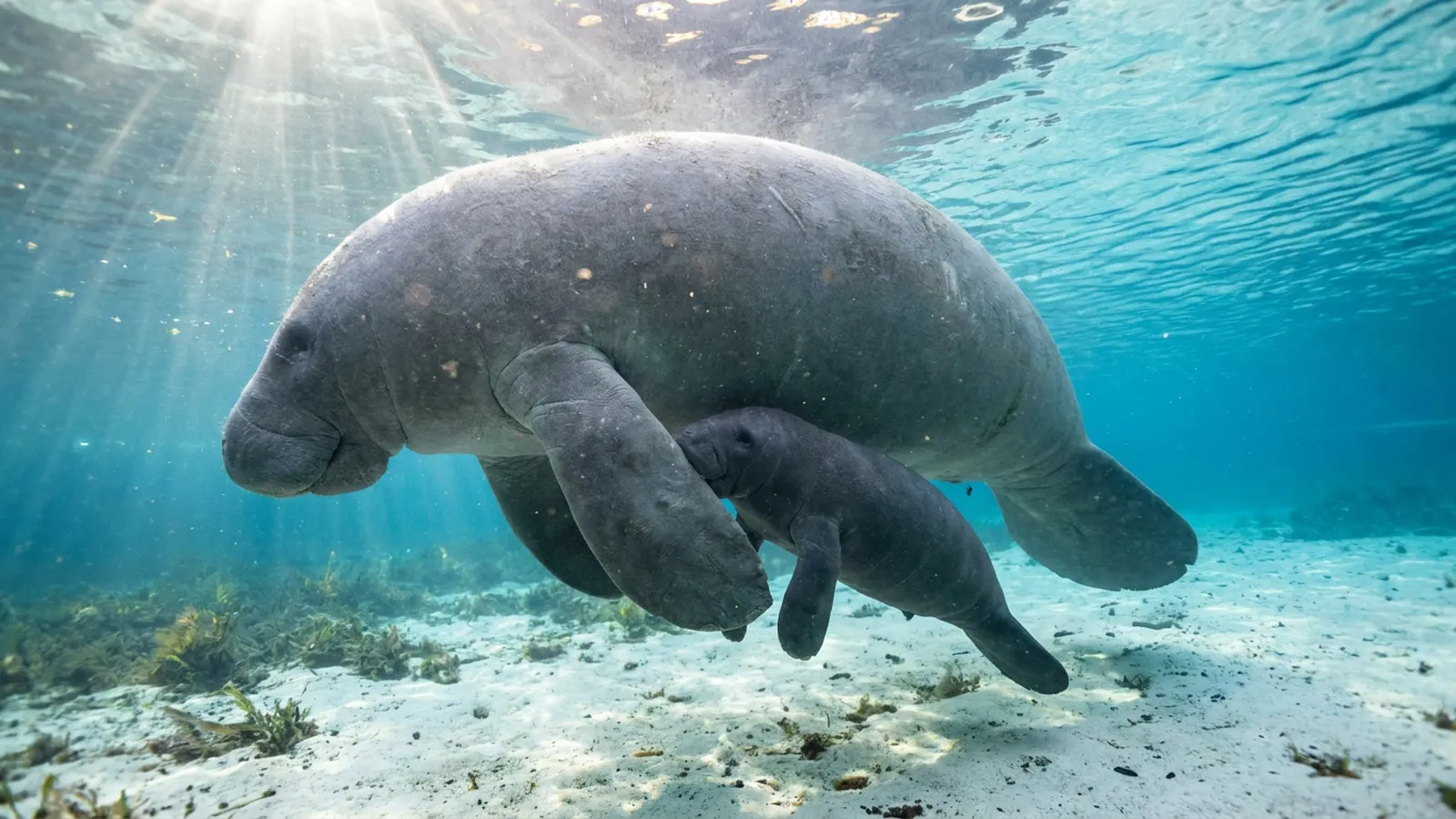
The first thing a newborn must do is breathe. The mother helps the calf to the surface for its first breaths, and within a short time the calf can swim on its own. For the first weeks it stays very close to its mother, often riding just behind and below her flipper or close to her side.
Stage 4: The calf years
Nursing, learning and following mom.
Calves nurse underwater from teats located behind each of the mother’s flippers. They start nibbling plants within a few weeks of birth, but milk remains an important part of their diet for many months. A calf usually stays with its mother for one to two years. During that time it learns the most important lessons of its life: where to find food, where the warm-water refuges are in winter and how to travel between them. Many scientists think that knowledge of migration routes and winter sites is passed from mother to calf, which is one reason orphaned calves raised in rehabilitation can struggle when released.
Mothers and calves stay in contact with frequent chirps and squeaks, especially when they are separated or in murky water. If you see a small manatee in the wild, look for the mother nearby; she is rarely far away. Our dedicated baby manatee page covers this stage in more detail, including how fast calves grow.
The calf years are also the riskiest. Calves are especially vulnerable to cold stress, because small bodies lose heat faster, and to boat strikes and separation from their mothers. Orphaned calves are among the most common patients in Florida’s manatee rescue and rehabilitation programs.
Stage 5: The juvenile stage
Independent but not yet grown.
After weaning, a young manatee becomes independent. Juveniles travel and feed on their own or in loose company with other manatees, gradually growing toward adult size. This is a period of steady growth and learning, and juveniles can often be seen mixing with other manatees in warm-water refuges in winter. Manatees are not territorial and have no fixed social groups, so a juvenile is free to come and go; our page on what a group of manatees is called explains how loose their social life is.
Stage 6: Adulthood and breeding
A slow reproductive rhythm.
Female manatees typically become able to breed at around three to five years old, and males around a similar age, although males may not succeed in mating herds until they are larger. Once a female starts breeding, she usually produces one calf every two to three years. Put the pieces together and the picture is clear: a long pregnancy, one calf at a time, and one to two years of care means a female might raise a modest number of calves over her lifetime, even if she lives for decades.
Adult manatees spend most of their time feeding, resting and traveling. A large adult eats a substantial share of its body weight in plants each day, as described in our manatee diet guide, and spends many hours resting on the bottom or just below the surface. Florida manatees follow a seasonal cycle, moving to warm-water sites in winter and spreading out along the coast and rivers in summer.
| Life stage | Approximate age | Key features |
|---|---|---|
| Pregnancy | 12–14 months before birth | Female carries single calf |
| Newborn | 0–3 months | About 1.2 m long; nursing; stays at mother’s side |
| Calf | 3 months–2 years | Nurses and grazes; learns routes and refuges |
| Juvenile | About 2–5 years | Independent; growing toward adult size |
| Adult | About 5 years onward | Breeding; calf every 2–3 years for females |
| Old age | Several decades | Can exceed 60 years if it avoids threats |
Stage 7: Old age and lifespan
A potential lifespan of 60 years or more.
Manatees have no significant natural predators as adults, and in principle they can live a very long time. Scientists estimate age by counting growth layers in the ear bones, a bit like tree rings, and wild manatees older than 50 have been documented this way. The oldest known manatee, Snooty, lived to 69 in captivity in Bradenton, Florida.
In practice, most wild manatees do not come close to that age. Boat strikes, cold stress, red tide, habitat loss and entanglement shorten many lives. Our page on manatee lifespan looks at the difference between potential and actual lifespan, and our page on manatee deaths in Florida explains the main causes of mortality.
Why the slow life cycle matters for conservation
Every adult female counts.
Biologists who model manatee populations find that their survival depends heavily on adults, especially breeding females, surviving year after year. Because each female produces a calf only every few years, a population can tolerate only limited adult mortality before it starts to shrink. That is why protective measures focused on adults, like slow-speed boating zones, warm-water refuge protection and seagrass restoration, matter so much. Losses that seem small in a single year can take a long time to make up.
The same logic explains why rescue and rehabilitation programs are valuable. Each orphaned calf raised and released, and each injured adult returned to the wild, makes a real difference to a population that reproduces this slowly. The question of why manatees remain protected is covered on our page why are manatees endangered.
How I think about the manatee life cycle
Lessons from slow-growing animals.
I have been keeping and growing corals since 1996, and one lesson I took from my coral farm applies to manatees too: slow-growing things are easy to lose and hard to replace. A colony that takes years to reach size can be gone in a day if conditions crash. Manatees are like that on a much bigger scale. When I read about a bad year for manatee deaths, my first thought is how many years of births it will take to make up the difference.
If you are watching manatees, the life cycle gives you something to look for. In winter, see if you can pick out mothers with calves tucked close beside them in warm-water refuges. In summer, keep an eye out for splashing mating herds in shallow water, and give them plenty of room. Each of those scenes is a different chapter of the same long story.
How the other manatee species compare
Similar patterns, less data.
Most of what we know about the manatee life cycle comes from long-term studies of the Florida manatee, a subspecies of the West Indian manatee. The Amazonian manatee and the African manatee are thought to follow a broadly similar pattern of long pregnancy, single calves and extended maternal care, but they are much harder to study, and details like age at maturity and birth intervals are less well known. Their close relative the dugong has an even slower life cycle, with females often waiting many years before their first calf.
That comparison is worth keeping in mind. Across all the sirenians, the pattern is the same: big, long-lived animals with few natural enemies that invest heavily in a small number of young. It is a strategy that worked well for millions of years in quiet, plant-rich waters, but it leaves very little margin when boats, cold snaps, pollution and habitat loss raise the death rate. Protecting manatees ultimately means protecting every stage of this long life cycle, from the quiet backwaters where calves are born to the warm springs where whole families shelter in winter.

How long are manatees pregnant?
About 12 to 14 months.
How many babies do manatees have?
Usually one calf at a time; twins are rare.
How long do manatee calves stay with their mothers?
Usually one to two years.
At what age do manatees mature?
Typically around three to five years old.
How often do manatees have babies?
Females usually give birth every two to three years.
How long do manatees live?
They can live 60 years or more, though many wild manatees die younger from human-related causes.
Are manatees born underwater?
Yes. The mother helps the newborn calf to the surface for its first breath.
- Florida Fish and Wildlife Conservation Commission: manatee reproduction and life history.
- U.S. Fish and Wildlife Service: West Indian manatee species profile.
- U.S. Geological Survey: Sirenia Project long-term manatee research.
- Reep, R. L. and Bonde, R. K. (2006). The Florida Manatee: Biology and Conservation. University Press of Florida.
- Save the Manatee Club: manatee calves and reproduction.
Blane Perun has been exploring Earth’s oceans and marine life for over 25 years. Founder of TheSea.Org in 1999, underwater photographer, coral aquaculture pioneer, and explorer of 80+ countries.
About Blane Perun → More on Manatees →