Do Manatees Breathe Air? — How Long Manatees Stay Underwater
Yes. Manatees are mammals with lungs, so they must come to the surface to breathe air through two nostrils on the top of the snout. They cannot breathe underwater. A resting manatee can stay under for up to about 20 minutes, but an active one usually surfaces every few minutes.
Because manatees spend their whole lives in water, a lot of people assume they must be able to breathe underwater the way fish do. They can’t. A manatee is a mammal, as much as a dog or a horse is, and every breath it takes has to come from the air above the surface. What makes manatees interesting is how well they have adapted that basic mammal setup to a life spent almost entirely underwater: nostrils that seal shut, huge flat lungs that double as a buoyancy system, and a slow metabolism that lets them stay down for a surprisingly long time. This page explains how manatees breathe, how long they can hold their breath, what happens when they sleep, and why breathing is tied to so many of the dangers manatees face.
Yes, manatees breathe air
Mammals, not fish.
Manatees belong to the order Sirenia, a group of fully aquatic mammals that also includes the dugong and the extinct Steller’s sea cow. Like all mammals, they are warm-blooded, give birth to live young, nurse those young with milk, and breathe with lungs. They have no gills, and there is no way for a manatee to pull oxygen out of the water. If a manatee is held underwater for too long, it drowns, just like any other air-breathing animal would.
That answers the two most common versions of the question. Do manatees breathe underwater? No. Can manatees breathe underwater? Also no. What they can do is hold their breath for long periods, and they do it so calmly that people watching from a dock often don’t notice them coming up at all. A manatee surfacing to breathe usually shows only the tip of its snout. You may hear a soft puff of air, see two small nostrils open for a second or two, and then the animal sinks back down. If you want the bigger picture of what these animals are, our guide What Is a Manatee? covers the basics, and our page on manatee evolution explains how their land-dwelling ancestors moved into the water.
How manatees breathe: nostrils, lungs and a flat diaphragm
Built for quick breaths at the surface.
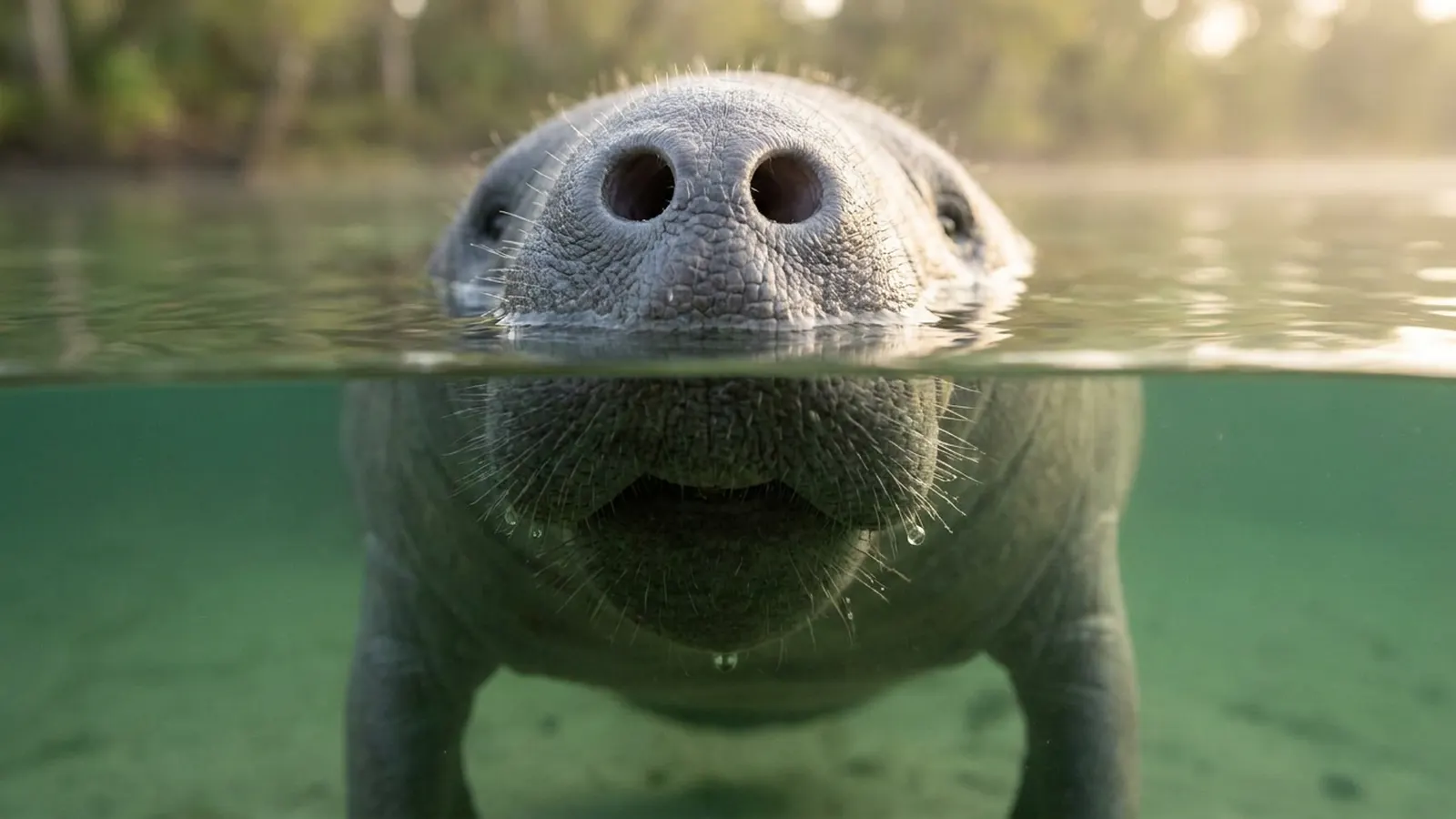
A manatee’s two nostrils sit on the top of the upper lip, near the front of the snout. Each one is covered by a muscular, valve-like flap. When the manatee is underwater the flaps stay closed and keep water out. When it reaches the surface it opens them, breathes out and breathes in, and closes them again before slipping back under. Unlike whales and dolphins, manatees don’t have a blowhole on top of the head; their nostrils are still at the front of the face, as in land mammals, but placed high enough that the manatee can breathe with almost all of its body still below the surface.
The lungs are where manatees get really unusual. In most mammals, including us, the lungs sit in the chest in front of the heart and the diaphragm is a dome-shaped sheet below them. In a manatee, the lungs are long and flat and lie along the back, extending a long way down the body, almost like two flattened balloons lying above the gut. The diaphragm runs horizontally along the length of the body rather than across it, and it is split into two separate halves, one for each lung. Researchers who studied the manatee diaphragm concluded that this arrangement lets each lung be compressed or expanded somewhat independently.
A manatee breath is also very efficient. When a manatee exhales at the surface it empties most of its lungs, and then refills them with fresh air, so each breath exchanges a large share of the air in the lungs. People at rest exchange only a small fraction of their lung volume with each breath. That big exchange is part of what lets a manatee get by on only a handful of breaths per hour. Our page on manatee anatomy describes the rest of the body that this breathing system has to support.
Lungs as a buoyancy system
Float, sink or roll without moving a flipper.
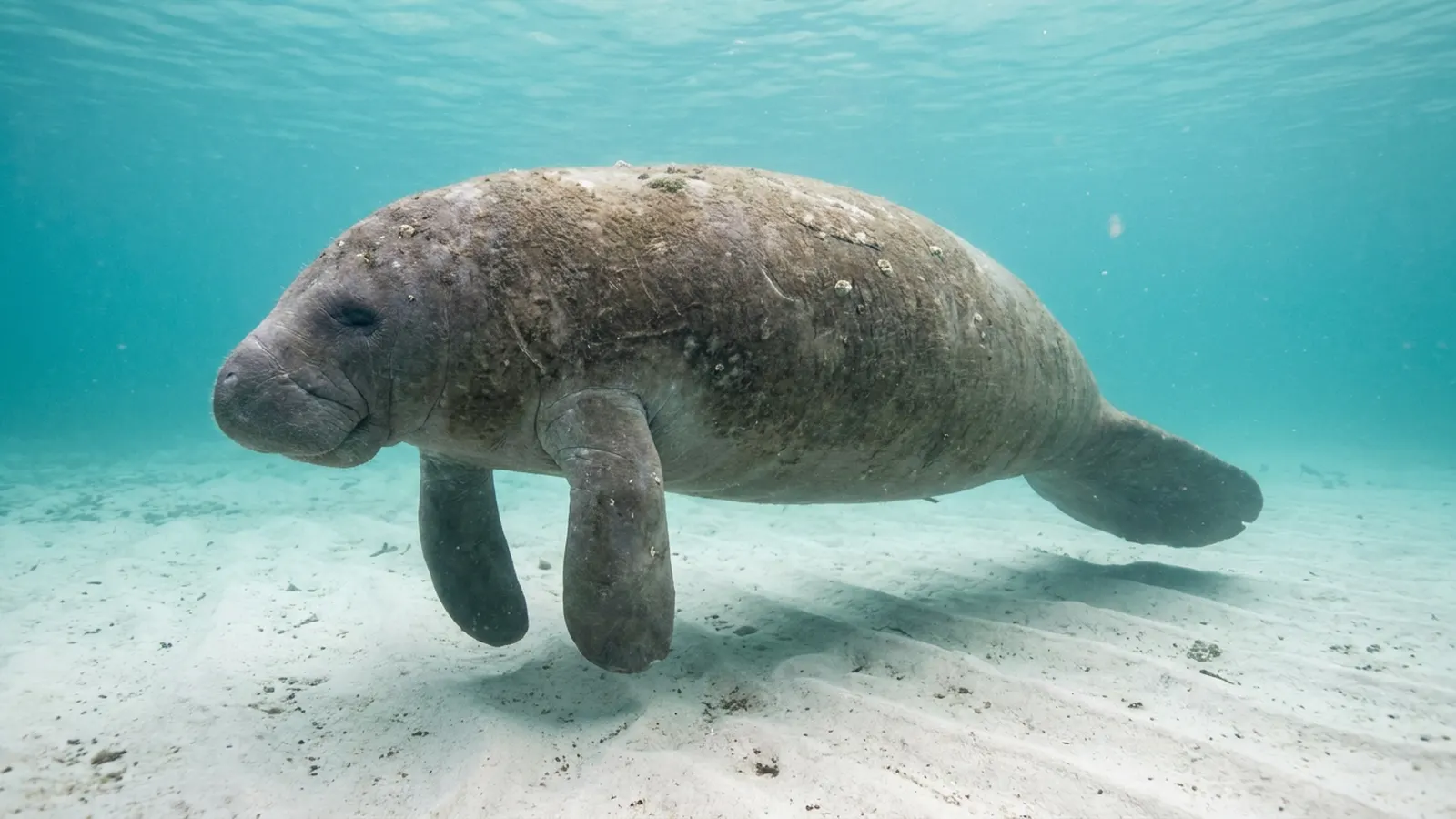
Those long, flat lungs do more than supply oxygen. Because they lie along the back and run so much of the length of the body, they act like an internal buoyancy control system. By compressing the lungs slightly, a manatee reduces the volume of air it carries and becomes a little heavier than the water, so it sinks. By relaxing that pressure, it becomes lighter and rises. By squeezing one side more than the other, it can tilt or roll. All of this happens with very little effort, which matters for an animal that is trying to save energy at every turn.
The rest of the body supports the system. Manatee ribs and other bones are very dense and heavy, which counteracts the lift of the lungs and works like a diver’s weight belt. That is why a resting manatee can hover in mid-water, sit almost motionless on the bottom, or rise slowly to the surface without swimming. Our page on the manatee skeleton explains how those dense bones work as ballast.
Having kept reef systems since 1996, I’ve spent a lot of time thinking about buoyancy, flow and how things settle in the water column, and the manatee’s approach impresses me. Air in the lungs, heavy bones and a horizontal diaphragm let it adjust its position with almost no work. It’s about as efficient a design as you’ll find in a large animal, and it explains why manatees look so relaxed even when they’re rising and sinking all day long.
How long can a manatee stay underwater?
A few minutes active, up to about 20 resting.
How long a manatee stays under depends almost entirely on what it is doing. When a manatee is swimming, feeding or socializing, it usually comes up to breathe every three to five minutes. When it is working hard, for example swimming fast to get away from a boat or moving against a current, it may breathe as often as every 30 seconds. When it is resting quietly on the bottom, it can stay down much longer; wildlife agencies commonly give a figure of up to about 20 minutes for a resting manatee.
That range is possible because manatees run on a very low metabolic rate for an animal their size. They eat plants, move slowly and don’t need to chase prey, so their bodies simply use less oxygen per minute than a dolphin or a seal of the same size would. The low metabolism is also why manatees struggle in cold water, a problem we look at below.
It’s worth comparing them to other marine mammals. Deep-diving whales and seals can hold their breath for far longer, sometimes an hour or more, because they store large amounts of oxygen in their blood and muscles and dive to great depths for food. Manatees live in shallow water, rarely go much deeper than a few meters, and feed on plants that are never more than a short swim from the surface, so they have never needed that kind of breath-hold. If you want to see how a fast, active marine mammal compares, our page on how long dolphins can hold their breath covers the dolphin side of the story.
| Animal | Breathes with | Typical time between breaths | Breathing opening |
|---|---|---|---|
| Manatee (active) | Lungs | About 3–5 minutes | Two nostrils on the snout |
| Manatee (resting) | Lungs | Up to about 20 minutes | Two nostrils on the snout |
| Bottlenose dolphin | Lungs | A few minutes, sometimes longer | Single blowhole |
| Sea turtle (resting) | Lungs | Can be hours when resting | Nostrils |
| Sea snake | Lung, plus some skin breathing | Often under an hour; can be longer | Valved nostrils |
| Fish | Gills | Continuous, extracts oxygen from water | Gills |
How manatees breathe while they sleep
Surfacing on autopilot.
One of the most common follow-up questions is how a manatee can sleep if it has to keep coming up for air. The answer is that manatees rest in short bouts, usually on the bottom or just below the surface, and rise to breathe without fully waking. Observers describe resting manatees drifting up to the surface, taking a breath and sinking back down, all with very little movement and no sign of alertness. The lung-based buoyancy system makes this easy: the manatee only has to change the volume of air in its lungs slightly to float up and settle again.
A resting manatee breathes much less often than an active one, which is where those longer 10- to 20-minute intervals come from. In winter, at warm springs and power plant outflows, you can often see this pattern in dozens of manatees at once, with animals lying on the bottom and rising to breathe one at a time. We cover this in much more detail on our page about how manatees sleep.
A calf’s first breath
Mom helps with the first trip up.
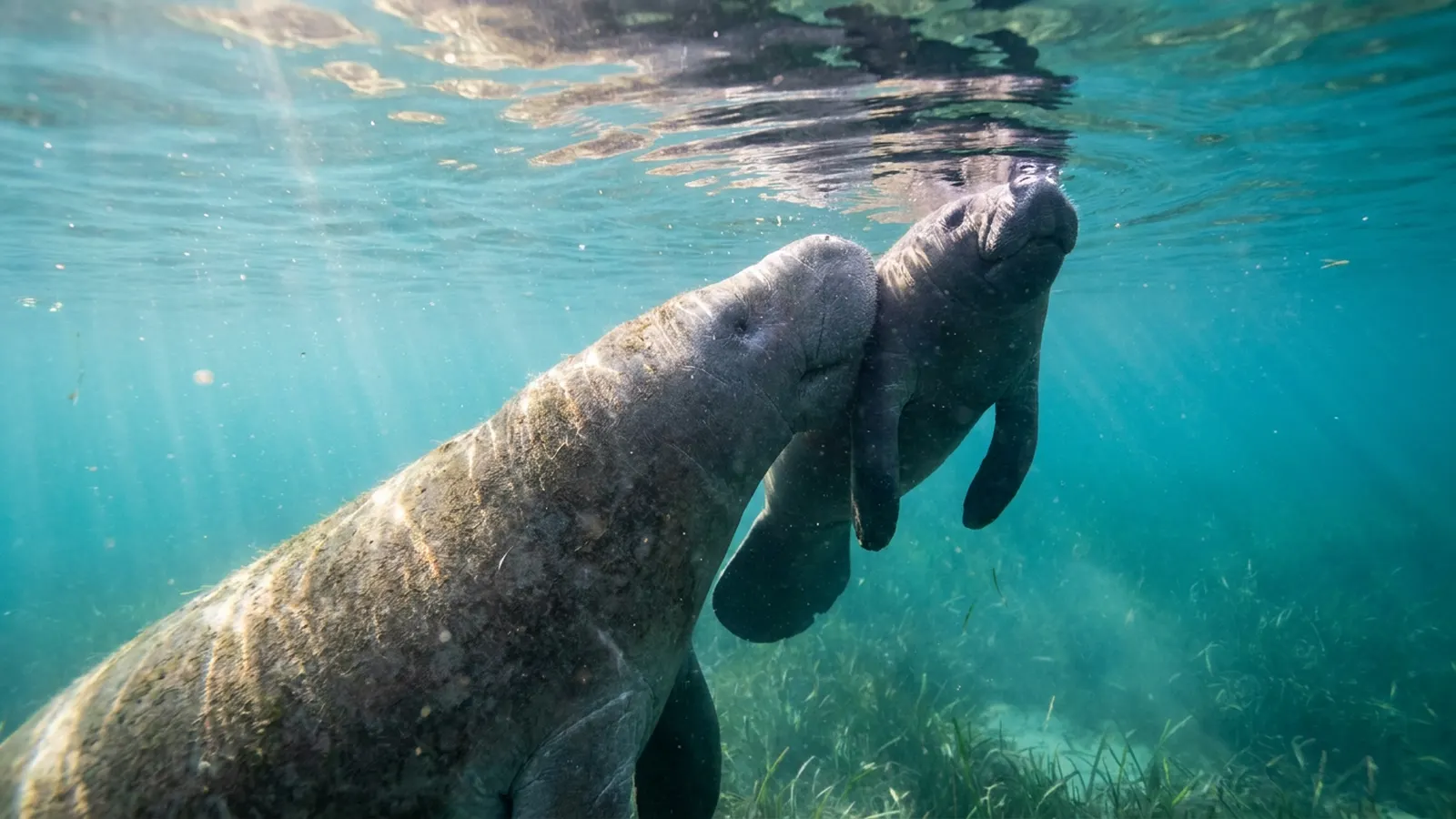
Manatee calves are born underwater, usually after a pregnancy of around a year, and the first thing a newborn has to do is reach the surface for air. Calves can swim on their own within a short time of birth, but the mother commonly helps by staying close and nudging or carrying the calf up toward the surface during its first breaths. For the first weeks the calf surfaces more often than an adult and stays tight against its mother as she moves between feeding and resting areas.
Learning that rhythm of breathing, feeding and resting is a big part of what a calf picks up in its first year or two with its mother. Our page on baby manatees describes the early weeks, and our manatee life cycle page follows a manatee from birth to old age.
When breathing becomes a danger
Boats, red tide, cold and entanglement.
The need to surface for air shapes a lot of the risks manatees face. The most obvious is boats. Every few minutes a manatee has to rise into the very top layer of the water, often in shallow channels, canals and rivers where boat traffic is heavy. Boat strikes are one of the leading human-related causes of manatee deaths in Florida, and the scars on the backs of so many manatees show how often they survive near misses. That is the reason for the slow-speed and idle-speed zones described on our page about manatee protection zones.
The second danger is red tide. During blooms of the algae Karenia brevis, toxins called brevetoxins are released into the water and can be carried into the air as a fine aerosol at the surface. Manatees can take in the toxins both by eating contaminated seagrass and by breathing the air just above the water as they surface. Red tide events along Florida’s southwest coast have been linked to large numbers of manatee deaths. Our page on red tide explains how these blooms develop.
Third, manatees can drown. Animals that get trapped in flood-control gates or canal locks, or tangled in crab-trap lines and discarded fishing line, may be unable to reach the surface. Calves separated from their mothers in cold or rough water can also become exhausted. Cold itself is a breathing-related problem in a wider sense: manatees have such a low metabolic rate that water below about 20°C (68°F) puts them under severe stress, and cold-stressed manatees often develop pneumonia and other respiratory infections. Our page on manatee deaths in Florida covers the main causes in more detail.
What I look for when watching manatees breathe
Patience, and a quiet surface.
If you’re trying to see manatees, understanding how they breathe makes you a much better spotter. I’d look for a few things. The first is the “snout print”: a small, round disturbance on a calm surface, sometimes with two tiny nostrils showing, that appears and disappears in a couple of seconds. The second is a smooth patch or “footprint” on the water left by the tail of a manatee moving just below the surface. The third is simply rhythm. If you’ve seen a manatee come up once, wait. An active animal will be back in a few minutes, usually within a short distance of the same spot, while a resting one may take quite a bit longer.
The other thing I’d keep in mind, especially from a kayak or while snorkeling, is to give the animal room to come up. A manatee that is surrounded or chased has to spend more energy and may feel unable to surface where it wants. Quiet, patient observation is better for the manatee and, in my experience with marine life generally, far more rewarding for you. Our guide to snorkeling with manatees in Crystal River explains the rules for getting in the water with them.
Manatees, dugongs and other air-breathing sea animals
Same problem, different solutions.
Manatees share the air-breathing problem with every marine mammal and every sea reptile. Their closest living relative, the dugong, breathes in much the same way, with nostrils on top of the snout and similar breath-holds; our page comparing the dugong vs manatee sets out the differences between the two. Whales and dolphins moved their nostrils to the top of the head as blowholes, which lets them breathe while swimming almost without breaking stride. Sea turtles can stay down for very long periods when resting thanks to their slow reptile metabolism. Sea snakes add a little oxygen absorption through the skin; you can read more on our page asking do sea snakes breathe air?
The manatee’s solution is quiet and efficient rather than dramatic. It doesn’t dive deep or for very long, but it doesn’t need to. By keeping its metabolism low, using its lungs as a buoyancy system and spending its life in shallow, warm water close to the surface, the manatee has made breathing air an easy, almost effortless part of its day. For more on the animal as a whole, return to our manatee hub.
Do manatees breathe air?
Yes. Manatees are mammals with lungs and must surface to breathe air through their nostrils.
Can manatees breathe underwater?
No. Manatees have no gills and cannot get oxygen from water. They hold their breath while submerged.
How long can a manatee hold its breath?
Up to about 20 minutes when resting. Active manatees usually breathe every three to five minutes.
How often do manatees come up for air?
Every few minutes when active, as often as every 30 seconds during hard exercise, and less often when resting.
Do manatees have blowholes?
No. Manatees breathe through two nostrils on top of the snout, which close with valve-like flaps underwater.
How do manatees breathe when they sleep?
They rest on the bottom or near the surface and rise to breathe without fully waking.
Can manatees drown?
Yes. Manatees trapped in flood gates or entangled in lines can drown if they cannot reach the surface.
- Rommel, S. A. and Reynolds, J. E. (2000). Diaphragm structure and function in the Florida manatee (Trichechus manatus latirostris). The Anatomical Record.
- Florida Fish and Wildlife Conservation Commission: Florida manatee facts and behavior.
- U.S. Fish and Wildlife Service: West Indian manatee species information.
- Reep, R. L. and Bonde, R. K. (2006). The Florida Manatee: Biology and Conservation. University Press of Florida.
- Save the Manatee Club: manatee biology and red tide.
Blane Perun has been exploring Earth’s oceans and marine life for over 25 years. Founder of TheSea.Org in 1999, underwater photographer, coral aquaculture pioneer, and explorer of 80+ countries.
About Blane Perun → More on Manatees →