Manatee Evolution — From Four-Legged Land Mammals to Sea Cows (and the Elephant Link)
Manatees evolved from four-legged, plant-eating land mammals that began living in shallow water around 50 million years ago. Over millions of years their hind legs shrank, their tails became paddles and their bones grew dense. Manatees belong to the order Sirenia, and their closest living relatives on land are elephants and hyraxes.
If you had to guess a manatee’s closest relatives just from looking at one, you might say whales, seals or even walruses. The real answer surprises most people: elephants. Manatees, dugongs and their extinct relatives make up the order Sirenia, and their family tree leads back through millions of years of fossils to four-legged mammals that walked on land and waded into warm, shallow seas to graze. The story of manatee evolution is one of the best-documented examples of a land mammal returning to the water, and it explains a lot about how manatees look and live today.
What a manatee is related to
A surprising family tree.
Manatees belong to a large group of mammals called Afrotheria, which originated in Africa when it was an isolated continent. Within that group, sirenians are most closely related to two very different animals: elephants (order Proboscidea) and hyraxes (order Hyracoidea), small, rabbit-sized mammals that live among rocks in Africa and the Middle East. Together, these three groups are often called the Paenungulata, meaning “near-hoofed animals.”
That relationship was first suggested by comparing anatomy, and later confirmed by DNA studies. It means a manatee and an elephant share a common ancestor that lived around 60 million years ago, while whales, dolphins and seals belong to entirely separate branches of the mammal tree that entered the sea independently. Manatees and whales look somewhat alike because they adapted to similar environments, not because they are close relatives. The sea cow name itself is discussed on our page sea cow vs manatee.

Are manatees related to elephants?
Yes, and the clues are still visible.
The elephant connection isn’t just a line on a family tree; you can see it in a manatee’s body. Several features stand out:
Nails. West Indian and African manatees have small nails on the tips of their flippers, reminiscent of the toenails on an elephant’s foot.
Replaceable teeth. Both elephants and manatees replace their grinding teeth horizontally. In elephants, large molars move forward through the jaw one after another during life. Manatees have taken this even further, with an indefinite conveyor belt of molars that move forward and fall out at the front. Our manatee teeth page explains these “marching molars.”
Tusks. Male dugongs, the manatee’s closest living relative, have tusks formed from incisor teeth, as elephants do.
Mammary glands. Both elephants and manatees have their teats near the front limbs, on the chest or behind the flippers, rather than on the belly.
Internal testes and other details. Male elephants and male sirenians both keep their testes inside the body, and their hearts and some skull features share similarities as well.
None of this means manatees evolved from elephants, or the other way around. Instead, both inherited these traits from a shared ancestor. Our page on the manatee skeleton shows several of these features in the bones themselves.
The first sirenians: walking sea cows
Fifty million years ago, in a warm shallow sea.
The earliest known sirenians lived in the Eocene epoch, roughly 50 million years ago, around the shores of the ancient Tethys Sea and the early Caribbean. One of the most important fossils is Pezosiren portelli, described in 2001 from Jamaica. Pezosiren had four fully developed legs that could support it on land, a long body and a skull and teeth clearly like a sirenian’s. It probably lived much like a hippopotamus, spending a lot of time in shallow water and grazing on aquatic plants, but able to walk on shore.
Other early sirenians, such as Prorastomus, also from Jamaica, and fossils from Egypt, India and elsewhere, show a group spreading through warm coastal waters. These animals had dense, heavy bones, which helped them stay submerged while feeding, a trait that sirenians kept ever since.
From legs to flippers and paddles
Millions of years of gradual change.
Over the following millions of years, sirenians became increasingly aquatic. Fossils show the hind legs shrinking and the pelvis losing its connection to the spine, while the tail became the main means of propulsion. The front legs turned into flexible flippers, though the finger bones inside them remained. By around 40 million years ago, sirenians had become fully aquatic animals that no longer came ashore.
Today’s manatees still carry reminders of that past. A small, vestigial pelvis remains buried in the muscle, unattached to the rest of the skeleton. The flipper contains a full set of finger bones, and many manatees still grow nails. Our manatee anatomy page describes how these parts work in the living animal.
| Group or animal | When | Key features |
|---|---|---|
| Early sirenians (Pezosiren, Prorastomus) | About 50 million years ago | Four legs, amphibious, dense bones, grazing teeth |
| Fully aquatic sirenians | From roughly 40 million years ago | Reduced hind limbs, tail propulsion |
| Dugongs and relatives (Dugongidae) | Diverse from the Oligocene onward | Fluked tails; many species, now one survives |
| Manatees (Trichechidae) | Evolved in South America | Paddle tails, marching molars, freshwater tolerance |
| Steller’s sea cow | Extinct in the 18th century | Giant cold-water dugongid, toothless |
Dugongs, manatees and the age of sea cows
Two families, very different fates.
For much of their history, sirenians were far more diverse than they are now. The dugong family, Dugongidae, was especially successful, with many species spread across the world’s warm seas in the Oligocene and Miocene. Some fossil sites contain several sirenian species living side by side, probably feeding on different kinds of seagrass.
The manatee family, Trichechidae, took a different path. Manatees appear to have evolved in South America, where ancestral forms lived in rivers and coastal waters. As the Andes rose and the Amazon basin took shape, river systems carried large amounts of abrasive, silica-rich plants and grit. Scientists think this tougher diet drove the evolution of the manatee’s endlessly replaced molars, which allowed them to eat grasses and other plants that would wear down ordinary teeth. That innovation may help explain why manatees flourished while many dugongid species declined.
Later, manatees spread out of South America. One lineage stayed in the Amazon basin and became the Amazonian manatee. Others colonized the Caribbean and the coasts of the Americas, giving rise to the West Indian manatee, and some crossed the Atlantic, likely carried by currents, to give rise to the African manatee in West Africa.

Steller’s sea cow: the last giant
A cold-water branch lost to humans.
One of the most remarkable sirenians lived until very recently. Steller’s sea cow, a giant relative of the dugong, adapted to the cold waters of the North Pacific and grew far larger than any living manatee. It was described by naturalist Georg Steller in 1741, and within about 27 years it was hunted to extinction by sailors and fur traders. Its story shows both how adaptable sirenians could be and how vulnerable large, slow, plant-eating marine mammals are to people.
Today only four sirenian species remain: three manatees and the dugong. Our comparison of dugongs vs manatees covers how the two surviving families differ.
Why I find manatee evolution fascinating
A long experiment in living on plants underwater.
I have spent decades keeping reef tanks and growing corals, and one thing that work teaches you is respect for how precisely animals are tuned to their environment. Manatees are an extreme example. Every major feature, from their heavy bones to their horizontal diaphragm and their conveyor-belt teeth, makes sense once you know they are descended from grazing land mammals that spent fifty million years perfecting a life of eating plants in shallow water.
What strikes me most is how slowly those changes happened and how quickly things can unravel. It took millions of years to turn a hippo-like grazer into a manatee, and less than three decades for people to wipe out Steller’s sea cow. When I think about modern threats to manatees, that contrast is hard to ignore.
What evolution tells us about manatee behavior
Slow, warm and close to shore.
Evolution also explains some of the manatee’s limitations. Sirenians have always been warm-water animals, tied to shallow coasts where seagrass and aquatic plants grow. Their low metabolic rate and lack of thick blubber work well in tropical water but leave them vulnerable to cold, which is why Florida manatees crowd into warm springs and power-plant outflows in winter. Their reliance on shallow, plant-rich water also brings them into close contact with boats and coastal development.
Understanding that history helps us protect them. Manatees can’t simply move to deeper or colder water when their habitat is disturbed; they are the product of an evolutionary path that committed them to a very particular kind of place. Protecting seagrass beds, warm-water refuges and quiet coastal waters is how we help that lineage continue.
How scientists piece the story together
Fossils, anatomy and DNA all point the same way.
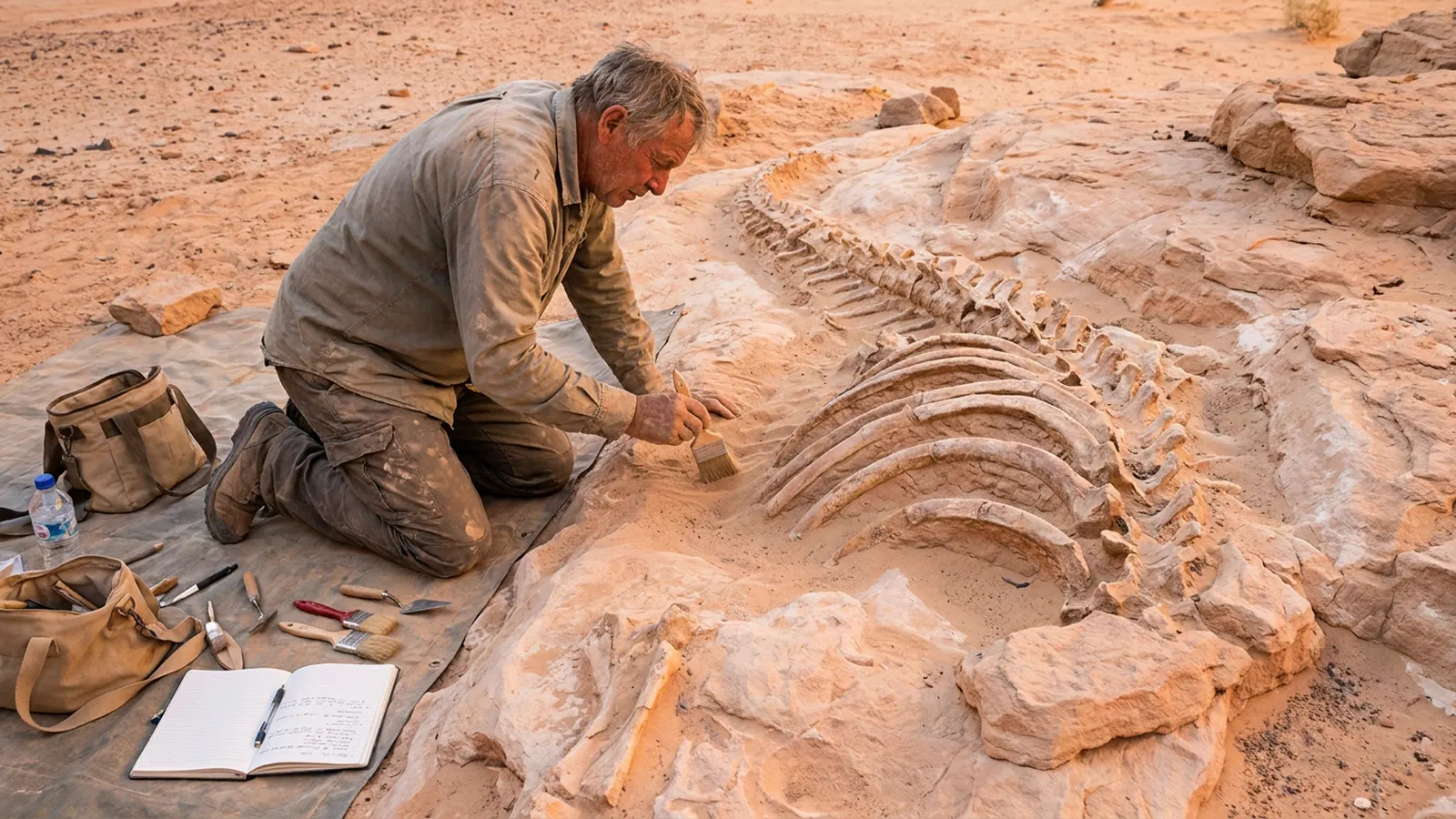
The evidence for manatee evolution comes from three independent directions. The first is the fossil record. Sirenian fossils are relatively common because their dense, heavy bones survive well, and paleontologists have found them on every continent except Antarctica. Fossils from Jamaica, Egypt, India, Europe, North America and South America show the gradual loss of hind limbs, the shift to tail-powered swimming and the spread of sirenians through warm seas.
The second line of evidence is comparative anatomy: the shared features of sirenians, elephants and hyraxes in their teeth, skulls, limbs and internal organs. The third is molecular biology. Since the 1990s, studies comparing DNA across mammals have repeatedly grouped manatees with elephants and hyraxes within Afrotheria, confirming what anatomists had suspected. When fossils, anatomy and genetics all tell the same story, scientists can be confident it is the right one.
There are still open questions, such as exactly when and how manatees crossed the Atlantic to Africa, and how many sirenian species once lived at the same time. New fossil finds continue to fill in the details, but the big picture, a grazing land mammal that went to sea and never came back, is well established.
Are manatees related to elephants?
Yes. Elephants and hyraxes are the manatee’s closest living relatives on land, sharing a common ancestor around 60 million years ago.
What did manatees evolve from?
From four-legged, plant-eating land mammals that began living in shallow water around 50 million years ago.
Are manatees related to whales or seals?
No. Whales and seals entered the ocean separately and are not close relatives of manatees.
What is the oldest known sirenian?
Among the oldest is Pezosiren portelli, a four-legged sirenian from Jamaica about 50 million years old.
Do manatees still have leg bones?
They have no hind legs, but a small vestigial pelvis remains inside the body.
What is the closest relative of the manatee?
The dugong, the only other living sirenian.
Where did manatees evolve?
The manatee family appears to have evolved in South America before spreading to the Caribbean and West Africa.
- Domning, D. P. (2001). The earliest known fully quadrupedal sirenian. Nature 413: 625–627.
- Smithsonian National Museum of Natural History: sirenian evolution and fossil collections.
- Reep, R. L. and Bonde, R. K. (2006). The Florida Manatee: Biology and Conservation. University Press of Florida.
- U.S. Fish and Wildlife Service: West Indian manatee species profile.
- IUCN SSC Sirenian Specialist Group.
Blane Perun has been exploring Earth’s oceans and marine life for over 25 years. Founder of TheSea.Org in 1999, underwater photographer, coral aquaculture pioneer, and explorer of 80+ countries.
About Blane Perun → More on Manatees →