Manatee Teeth — The Marching Molars Explained
Manatee teeth are unique among living mammals because they are continuously replaced throughout life. A manatee never runs out of teeth. New molars erupt at the back of the jaw and slowly migrate forward in the bone — about 1 mm per month — replacing worn teeth that drop out at the front. A single manatee may cycle through thirty or more sets of molars across its 60–70 year lifespan. This trait, called polyphyodonty or the “marching molars” system, is shared with only one other group of living mammals: elephants. The dental architecture is one of the clearest pieces of anatomical evidence that elephants and manatees share a common ancestor. Manatees have no canines, no front incisors after the milk teeth fall out, no tusks — only the relentless conveyor belt of grinding molars.
Most mammals get two sets of teeth and that’s it. Baby teeth come in, fall out, adult teeth take their place, and then the adult set has to last for the rest of the animal’s life. Manatees do not work this way. They never stop growing new teeth. New molars are erupting in the back of the jaw of every adult manatee right now, slowly working their way forward to replace the teeth that are wearing down and falling out at the front. The system is so distinctive that it has its own scientific name, and the only other living mammals that share it are the elephants — manatees’ closest land relatives.
The marching molars — how the conveyor belt works
The manatee jaw is not a static structure with a fixed set of teeth. It is a slow biological conveyor belt that produces new teeth at the back, moves them forward through the bone, and discards them at the front. With no front teeth at all, adults are also physically unable to bite in the usual sense, which is why the answer to do manatees bite is no. The conveyor belt runs for the animal’s entire life.
Inside each side of the upper and lower jaw is a row of 6 to 8 cheek teeth in use at any one time. Behind that visible row, in the back of the jaw, additional teeth are forming in the bone, hidden in their developmental capsules. As the teeth at the front of the row wear down from years of grinding abrasive vegetation, the entire row of teeth slowly migrates forward in the jaw at about 1 millimetre per month. The frontmost worn tooth loses its supporting structure, gets pushed out, and falls away. A new tooth erupts at the back to take the place at the rear of the line. The cycle continues for the manatee’s entire 60–70 year life.
The mechanism is not muscular. The teeth are not being chewed forward. The migration is driven by bone remodelling — the jaw bone is constantly being resorbed at the front of the tooth row and deposited at the back, gradually shifting the entire row of teeth forward through the bone like ice creeping down a glacier. It is the slowest possible mode of tooth replacement, and it operates throughout the animal’s lifespan without interruption.
Why manatees evolved this dental system
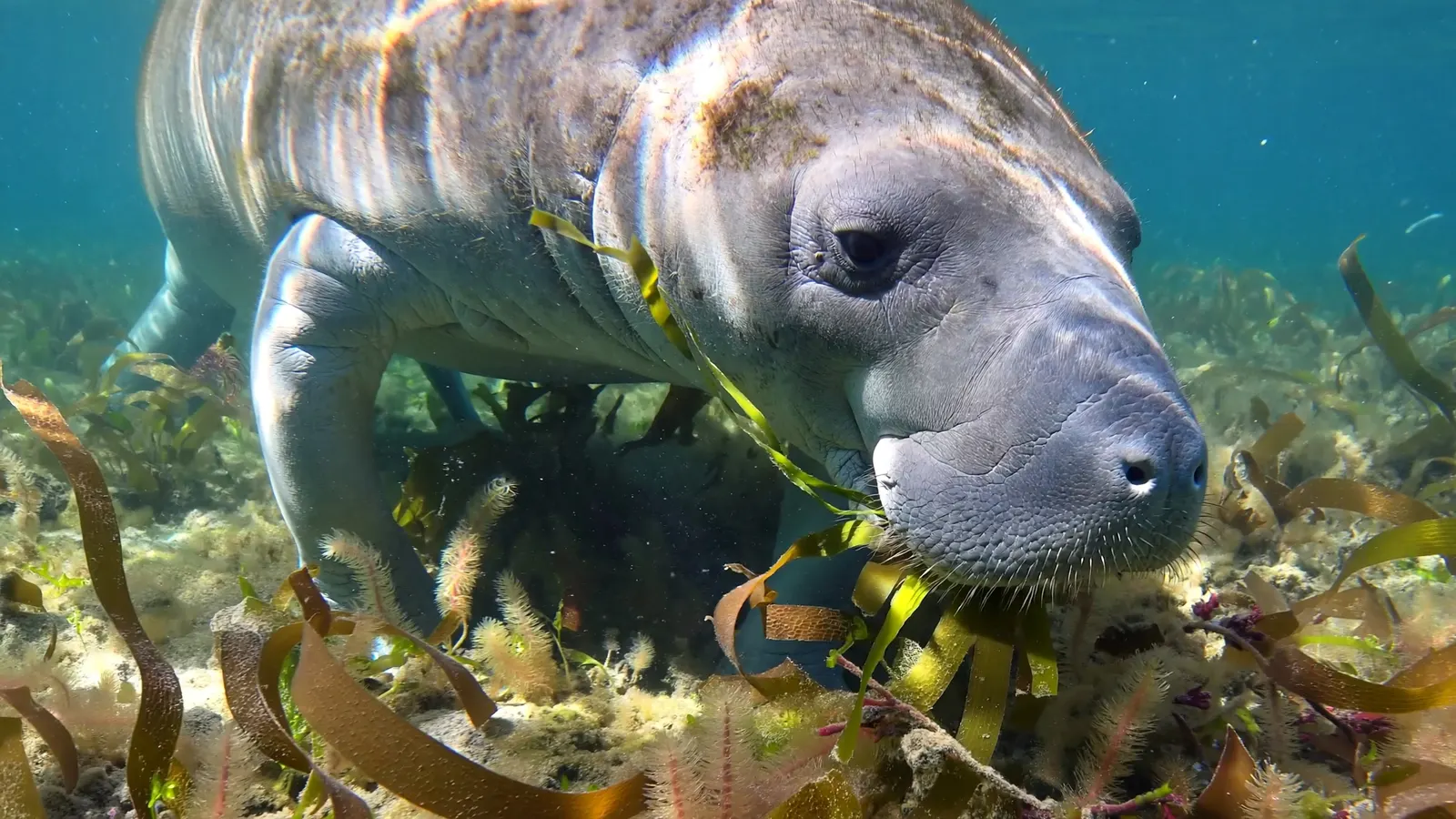
The reason for the marching-molar system is the diet. Aquatic plants are punishingly abrasive on tooth enamel. Manatees evolved an unlimited supply of replacement teeth rather than evolving teeth that could last. Our page on manatee evolution traces how that system arose in South America.
Manatees eat seagrass, water hyacinth, hydrilla, mangrove leaves, and other aquatic vegetation, in volumes of up to 10% of body weight per day. Two features of this diet destroy teeth. First, aquatic plants contain microscopic silica particles called phytoliths — literally tiny pieces of glass embedded in the plant tissue as a defence against herbivores. Phytoliths grind down tooth enamel as effectively as sandpaper. Second, manatees feeding on bottom seagrass beds inevitably ingest sediment, sand, and shell fragments along with the plants. The result is six to eight hours of daily grinding against a mixture of plant fibre, silica, and grit.
Most herbivorous mammals solve this problem with hypsodonty — extremely tall, long-lasting teeth like a horse’s, with deep reserves of enamel and dentine that can withstand decades of wear. Horses and cows have a fixed tooth count and their teeth keep emerging slowly from the jaw as the crowns wear away. Manatees took a different evolutionary path: rather than building teeth that last, they build new teeth continuously and discard worn ones. It is one of the most elegant solutions to abrasive-diet tooth wear in the entire mammal class.
What manatee teeth look like
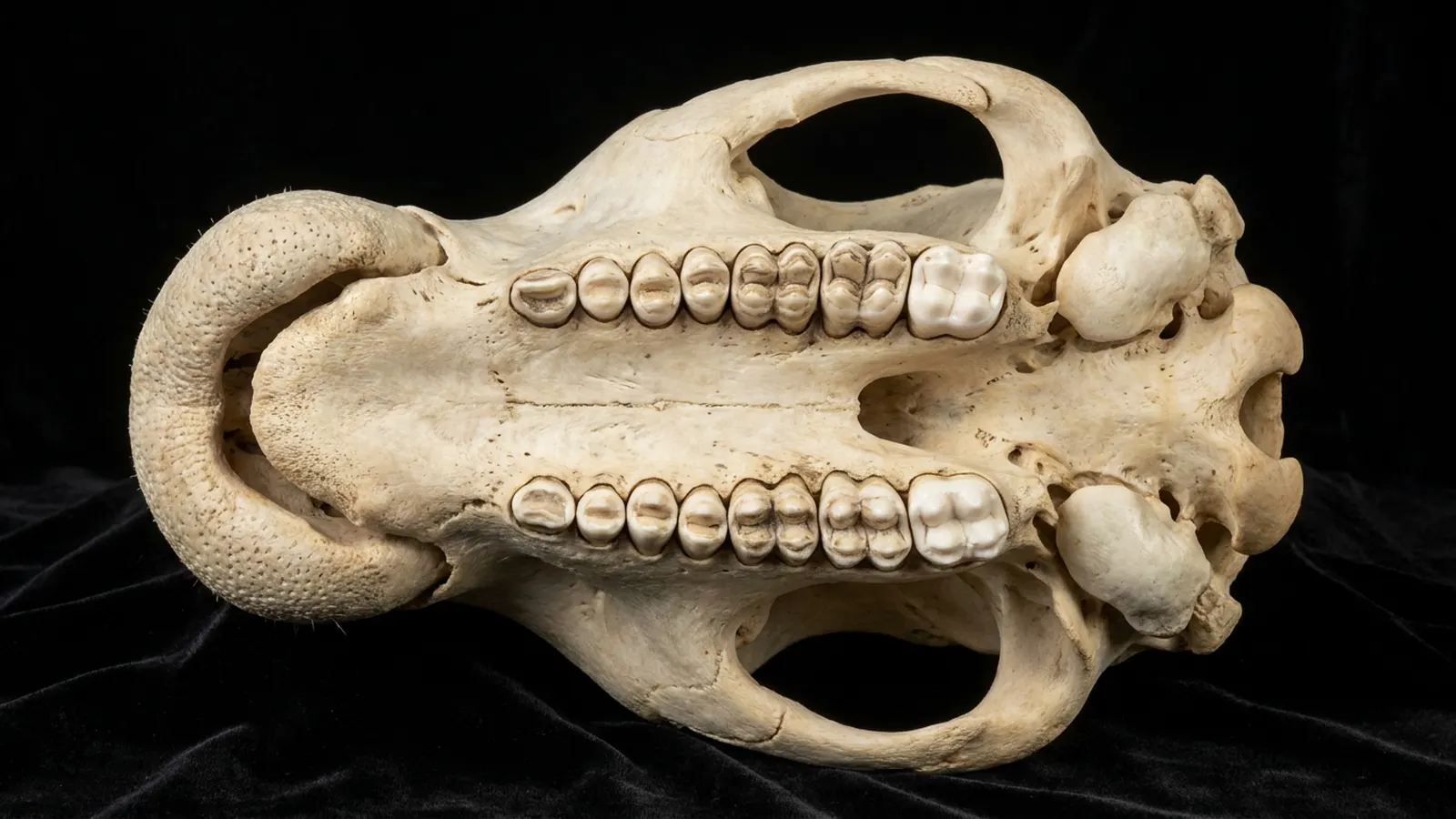
A manatee’s tooth is a low, broad, square-cornered cheek tooth with two parallel ridges running across the chewing surface. The shape is built for grinding, not biting.
Manatees are bilophodont — each molar has two transverse ridges (lophs) running across the crown, separated by a valley. The two ridges work together to shear and grind tough plant material against the matching ridges of the opposing tooth in the other jaw. The crowns are low (the technical term is brachydont) rather than tall like a horse’s — manatees don’t need tall crowns because each tooth only stays in the front of the row for a limited time before it’s replaced. The enamel is moderately thick but not exceptional.
Manatees have no canine teeth at all and no permanent incisors. Adult manatees do retain a pair of vestigial upper incisors hidden inside the gum tissue from birth, but these never erupt and play no functional role. The entire chewing apparatus is built around the rear cheek teeth (premolars and molars), which look essentially identical to each other — manatees have what biologists call homodont dentition, in which all the teeth are the same shape, rather than the differentiated teeth (incisors, canines, premolars, molars) found in most mammals.
The elephant connection
The marching-molar system is the single clearest piece of anatomical evidence that manatees are more closely related to elephants than to any other living group. Among more than 6,400 living mammal species, only manatees and elephants share this dental architecture.
Elephants run essentially the same dental system on a much larger scale. An elephant’s jaw holds one or two enormous cheek teeth per side at a time, with the next tooth waiting behind in the bone. As the front teeth wear down through decades of grinding bark, leaves, and grass, the next tooth migrates forward to replace it. Elephants cycle through six sets of molars over an 80–100 year lifespan; once the final set wears out, the elephant can no longer feed effectively and dies of starvation. Manatees cycle through their molars much faster, but never face the same end-of-life dental collapse because new teeth keep arriving indefinitely.
The shared dental system is not coincidence. Manatees, elephants, and the small rabbit-like hyraxes form the superorder Paenungulata within Afrotheria — the African branch of placental mammals. The three groups share a common ancestor that lived on the African landmass over 50 million years ago. The marching-molar system was inherited from that shared ancestor and retained by both the sirenian and proboscidean lineages because it solved an abrasive-diet problem for both groups, even though one lineage evolved into aquatic grazers and the other into the largest land animals on Earth.
How many teeth at one time?
A manatee typically has 24 to 32 teeth in its mouth at any given moment — 6 to 8 per quadrant of the jaw. The exact count varies between individuals and changes over time as old teeth shed and new ones erupt.
The standard configuration is roughly 6–7 cheek teeth per quadrant, with newer teeth toward the back and worn teeth toward the front. A young adult manatee will tend toward the higher end of the count; an older manatee whose front teeth have been falling out may show fewer in a single moment, but new ones will be on their way forward. There are no canine teeth, no functional incisors, and no tusks. Manatees, unlike most large mammals, have a fundamentally simplified dental formula because every tooth in the mouth is doing the same job: grinding plants.
What about manatee calves?
Manatee calves are born with milk teeth, but the milk dentition is brief. Within the first months of life the marching-molar system is established and operates the same way it will for the rest of the animal’s life.
Newborn manatee calves have a set of small milk teeth that erupt before birth or shortly after. These include vestigial incisors and the first cheek teeth. As the calf grows and begins eating plant material in addition to milk, the permanent cheek teeth begin erupting from the back of the jaw and the milk teeth shed and are replaced. By the time the calf is weaned at 12–18 months, the adult marching-molar system is fully operating — new teeth continuously arriving at the back and worn teeth falling out at the front.
Dental wear, age, and tooth records
Because manatee teeth wear down predictably and shed at a roughly steady rate, dental analysis can be used to estimate a manatee’s age and to reconstruct its feeding history. The teeth are a biological notebook.
Manatee teeth show clear wear patterns that biologists use to learn about individual animals and populations. The shape of the worn occlusal surface, the loss of enamel ridges, and the position within the row all indicate roughly how long a tooth has been in service. Beyond that, the chemistry of the tooth enamel can be analysed to reconstruct diet: stable isotope ratios reveal whether the animal has been feeding on marine seagrass, freshwater plants, or a mix, and can identify long-distance movements between water bodies. Sediment composition trapped in tooth wear surfaces can indicate specific habitats. Tooth analysis on stranded manatees has been instrumental in understanding the seasonal movements of Florida and West Indian populations.
Dental problems in captive manatees
In captivity, manatees can develop dental problems that they would not face in the wild — usually because the controlled diet doesn’t wear teeth at the natural rate.
Rehabilitation centres and aquariums typically feed manatees on lettuce, kale, and cultivated greens, which are far less abrasive than wild seagrass and contain none of the sediment and shell fragments the animals ingest in nature. The result is that teeth in captive manatees can fail to wear down at the rate the marching-molar system expects, leading to overlong teeth, malocclusion, and occasional eruption problems where new teeth crowd the row. Veterinary teams managing long-term captive manatees monitor the teeth and occasionally need to intervene with dental work — including grinding down overlong teeth — to maintain function. The problem is rare in wild manatees, whose abrasive diet keeps the system calibrated.
How many teeth do manatees have?
Between 24 and 32 teeth at any given moment, with roughly 6 to 8 cheek teeth per quadrant of the jaw. Manatees have no canines, no functional incisors, and no tusks — only the row of grinding cheek teeth. The count fluctuates as old teeth shed and new ones erupt, because manatee teeth are continuously replaced throughout life.
Do manatees have tusks?
No. Manatees have no tusks. This distinguishes them from their dugong cousins, which do develop a pair of small tusks (modified upper incisors) in adult males. Manatees lost their tusks entirely — the milk incisors shed and the adult versions never erupt.
What are “marching molars”?
The marching-molar system is the manatee’s continuous tooth-replacement mechanism. New molars erupt at the back of the jaw, slowly migrate forward through the bone at about 1 mm per month, and replace worn teeth that shed at the front. A manatee cycles through 30 or more sets of molars over its 60–70 year lifespan.
Are manatees the only animals with replacing teeth?
Among living mammals, manatees share continuous tooth replacement only with elephants. (Sharks and crocodiles also replace teeth throughout life, but on a different mechanical principle — loose teeth in a connective tissue bed, not migrating teeth in bone.) The manatee-elephant similarity reflects their shared evolutionary origin in African Afrotheria.
Why do manatee teeth need replacing?
Their diet is highly abrasive. Aquatic plants contain microscopic silica particles called phytoliths that grind enamel down like sandpaper, and bottom-feeding manatees also ingest sediment and sand along with their food. Six to eight hours of daily grinding against this mixture wears teeth out quickly. The marching-molar system provides an unlimited supply of replacement teeth.
How fast do manatee teeth move forward?
About 1 millimetre per month. The entire row of teeth migrates forward through the jaw bone at this slow but constant rate — driven by bone remodelling, not by muscular pressure — for the manatee’s entire life.
Can manatees get cavities?
Cavities are uncommon in manatees. Their plant-based diet doesn’t produce the bacteria-friendly sugars that cause cavities in humans, and the constant tooth replacement means any damaged tooth gets shed before serious decay can set in. Manatees can suffer from other dental issues — particularly malocclusion in captive animals fed soft diets — but classical cavities are rare.
What shape are manatee teeth?
Low, broad, square cheek teeth with two parallel transverse ridges (lophs) running across the chewing surface. The technical term is bilophodont. The shape is optimised for grinding plant material rather than biting or shearing. All the teeth in the row look essentially the same — a homodont dentition, in contrast to the differentiated incisor-canine-molar pattern of most mammals.
Do baby manatees have milk teeth?
Yes. Newborn manatee calves are born with a small set of milk teeth that erupt before or shortly after birth. As the calf grows and begins eating plant material in addition to nursing, the adult cheek teeth begin erupting and the milk teeth are shed. By weaning at 12–18 months the adult marching-molar system is fully operating.
Are manatee teeth like elephant teeth?
Yes — in mechanism. Both groups have continuously replacing cheek teeth that migrate forward in the jaw, replacing worn teeth that shed at the front. The dental similarity is one of the clearest pieces of evidence that manatees and elephants share a common ancestor. The main difference is scale and pace: elephants have larger, fewer teeth and go through only six sets in a long lifetime, while manatees have smaller teeth that cycle much faster.
Blane Perun has been exploring Earth’s oceans and marine life for over 25 years. Founder of TheSea.Org in 1999, underwater photographer, coral aquaculture pioneer, and explorer of 80+ countries.
About Blane Perun →