How Do Manatees Sleep? — Resting on the Bottom and Rising to Breathe
Manatees sleep underwater in short bouts, resting on the bottom or hanging just below the surface. Because they breathe air, they rise every few minutes to take a breath, often without fully waking, then sink back down. They rest for many hours spread through the day and night, with no fixed bedtime, and sleep most in calm, warm, sheltered water.
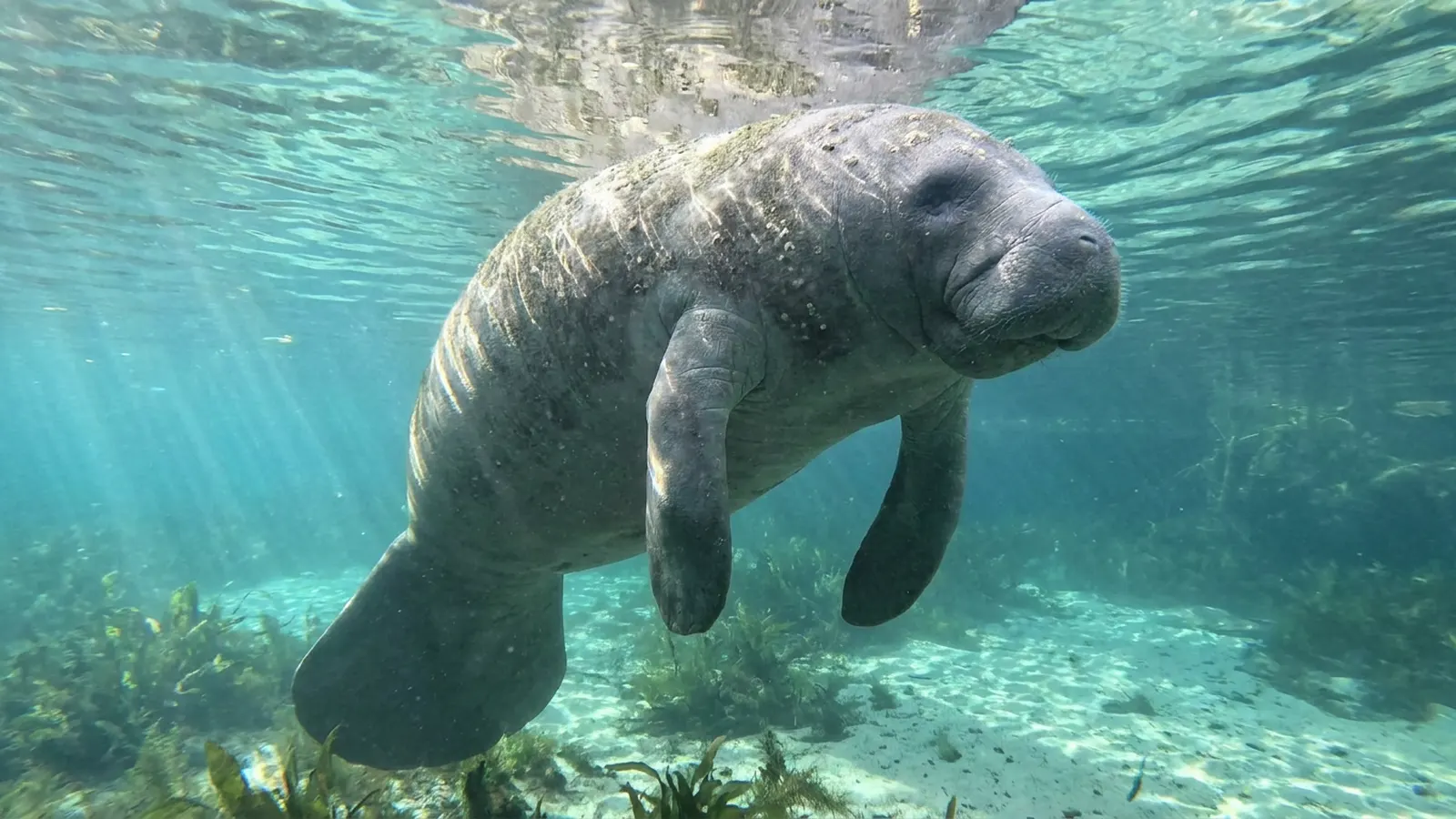
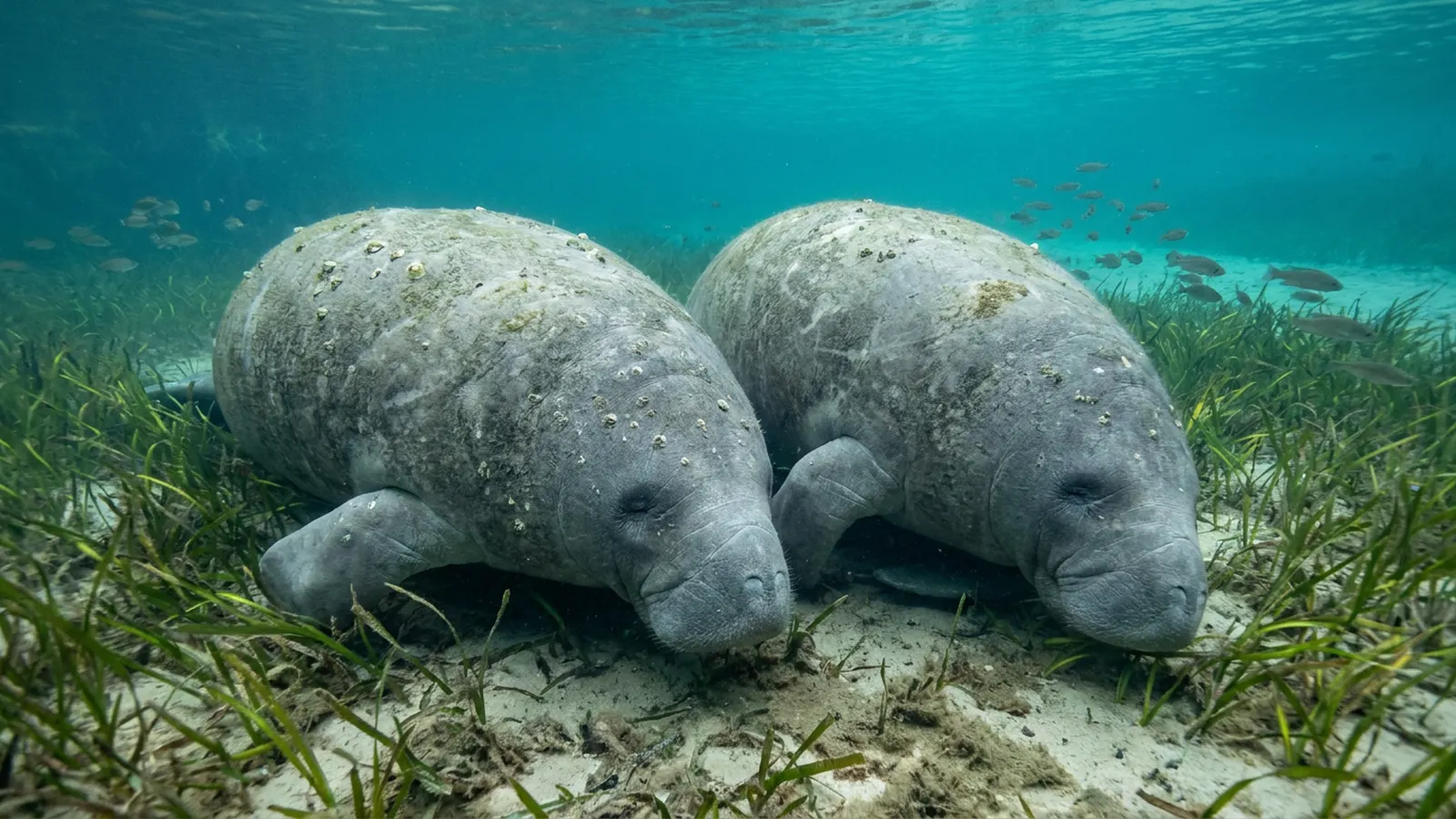
If you have ever stood on a boardwalk over a Florida spring in winter, you have probably watched manatees sleep without realising it. They lie on the sandy bottom like grey boulders, perfectly still, and every few minutes one of them rises slowly, pokes its nostrils out of the water, takes a breath and sinks back down again. It looks effortless. In fact, sleeping is a real challenge for an air-breathing mammal that spends its whole life in water, and manatees have solved it in a way that is different from both land mammals and their ocean-going cousins, the whales and dolphins. Here is how manatee sleep works.
The basic problem: sleeping while breathing air
A manatee can’t stay underwater indefinitely, even asleep.
Manatees are mammals, and they breathe with lungs, just like us. They can’t extract oxygen from water, so every breath has to be taken at the surface. Unlike seals, they can’t haul out on a beach or a rock to sleep on land. Their bodies are built for water only, and out of it they can’t support their own weight comfortably or move well. That means every minute of sleep happens underwater, and a sleeping manatee has to keep breathing.
The way they handle it is simple: they rest for a few minutes underwater, rise to breathe, and go back down. A resting manatee typically surfaces every few minutes, and when it is very still and relaxed it can stay down considerably longer, with gaps of up to about twenty minutes reported. An active manatee breathes much more often; our page asking do manatees breathe air? explains their nostrils, lungs and breath-holds. Our page on what a manatee is covers their lungs and other adaptations in more detail.

Where manatees sleep
On the bottom, near the surface, and almost always somewhere calm.
Manatees rest in two main positions. The first is on the bottom: lying horizontally on sand or mud, often in a channel or depression, sometimes tucked against a ledge or a seawall. This is the classic view from a spring boardwalk, where you can see a whole group lying motionless in clear water. The second is suspended just below the surface, floating with the back slightly awash or a foot or two under. Manatees resting at the surface tend to drift slowly, with the head or tail angled down.
They choose places where they won’t be disturbed or swept away: sheltered coves, spring runs, quiet canals, the lee of mangroves and deep pools in rivers. Calm water lets them rest without effort. In winter, the choice of sleeping spot is driven by temperature. Manatees crowd into warm-water refuges, springs and power-plant outflows, and spend long periods resting there to conserve energy, as our page on manatee habitat explains.
How they stay put: built-in ballast
Heavy bones and adjustable lungs make resting easy.
A sleeping animal can’t spend energy fighting to stay in position, and manatees don’t have to. Their skeleton is unusually dense. Manatee ribs and other bones are heavy and solid, lacking the marrow cavities found in most mammal bones, and that bone mass acts like a diver’s weight belt, offsetting the buoyancy of their lungs and gut. Our page on the manatee skeleton goes into this in detail.
Their lungs help too. A manatee’s lungs are long and flat, running along the back for much of the body’s length, and they are separated from the gut by a horizontal diaphragm. Because the lungs lie along the top of the body, the air they hold keeps the manatee level in the water, back up. By changing the volume of air in its lungs, a manatee can fine-tune its buoyancy: let out a little air and it sinks gently to the bottom; take a breath and it rises. This lets a resting manatee sink, hover or rise with almost no effort, which is exactly what it needs for underwater sleep.
Do manatees wake up to breathe?
Mostly not fully. Breathing seems close to automatic.
Watch a sleeping group for a while and you notice that the rise to the surface looks almost like sleepwalking. The manatee drifts up slowly, often with very little tail movement, takes one or two breaths, and settles back to the bottom. Researchers who have observed resting manatees describe this as a largely automatic process: the animal surfaces without obvious signs of waking fully, much as a person shifts position in their sleep.
The brain side of manatee sleep has been studied in only a few animals, mostly captive Amazonian manatees in the 1990s. Recordings of brain activity suggested that manatees can show deep sleep in both halves of the brain at once, like land mammals, but also periods where one hemisphere shows deeper sleep than the other. That second pattern resembles the “half-brain” or unihemispheric sleep seen in dolphins, which keeps part of the brain alert for breathing and danger. Manatees appear to sit somewhere between land mammals and dolphins. It is a small body of research, so I would treat the details as provisional, but it fits what you see in the water.
| Animal | Where it sleeps | How it breathes during sleep | Brain pattern |
|---|---|---|---|
| Manatee | Underwater, on the bottom or near the surface | Rises every few minutes, often without fully waking | Both hemispheres together, and some one-sided sleep reported |
| Bottlenose dolphin | Swimming slowly or resting at the surface | Conscious breathing; keeps one half of the brain awake | Mainly unihemispheric sleep |
| Seals (true seals) | On land, ice or in water | On land normally; in water may hold breath and sleep at depth | Bilateral on land; some one-sided sleep in water |
| Humans | On land | Automatic breathing | Both hemispheres together |
How long do manatees sleep?
A lot of the day is spent resting, but not in one block.
Manatees don’t sleep in a single long block the way we do. Their day is divided between three main activities: feeding, resting and travelling. A wild manatee may spend something like six to eight hours a day feeding, because plants are low in energy and a manatee needs a great deal of them. The manatee diet page explains just how much they eat. Much of the remaining time is spent resting, in bouts that can last from a few minutes to several hours, spread through the day and night.
They don’t follow a strict day-night schedule. Manatees feed and rest at all hours, and their timing shifts with tides, temperature, disturbance and season. Near busy waterfronts, some manatees seem to feed more at night and rest more during the day. In winter, when they are sheltering in warm water and food nearby is scarce, they can spend much longer resting and save energy, going out to feed only when the weather warms.
Sleeping calves and mothers
Calves stay tight to their mothers, even while resting.
A newborn manatee calf must reach the surface for its first breath within moments of birth, and its mother often helps push it up. For its first months, the calf rests close beside or slightly behind and below its mother, and the pair surface together to breathe. Calves breathe more often than adults and tend to rest for shorter periods. Our page on baby manatees covers that bond, which lasts one to two years. If you see a mother and calf resting in a canal, give them plenty of room. Separation is one of the most serious risks to a young calf.
What I notice when I think about resting manatees
The danger is not sleep itself, but where they choose to do it.
Living in Southwest Florida, I am around waterways that manatees use every day, and what strikes me about their resting behaviour is how vulnerable it makes them. A manatee hanging just under the surface in a quiet canal is almost invisible from a moving boat, especially in murky water. It is also slow to react. Many of the propeller scars that researchers use to identify individual manatees are the result of collisions with animals that were resting or moving slowly near the surface. That is a big part of why slow-speed and idle-speed zones exist in canals and shallow areas, and why I think obeying them is one of the most useful things a Florida boater can do.
From the reef-tank side of my life, I have spent decades watching animals in water and learning that rest is when they are most exposed. Fish in a reef tank tuck into the rockwork at night. Manatees have no predators that seriously threaten adults, as our page on manatee predators explains, so they don’t need to hide. The only real threat to a sleeping manatee is us.
How to tell a resting manatee from a sick one
Still is normal. Struggling is not.
Because healthy manatees spend so much time lying motionless, people sometimes worry that a resting manatee is dead or injured. A resting manatee looks relaxed, lies level and rises to breathe smoothly at regular intervals. Signs of trouble are different: a manatee floating high and unable to submerge, one listing badly to one side, one with obvious wounds or fishing line wrapped around its flippers, a calf alone for a long time, or a manatee breathing with visible difficulty. Cold-stressed manatees in winter may show white, patchy skin lesions. If you see any of those signs, note the location and call the Florida Fish and Wildlife Conservation Commission’s Wildlife Alert Hotline rather than trying to help the animal yourself.
A sleeping manatee is one of the most peaceful sights in Florida’s waters. Watch from a distance, keep the noise down and let it rest. It needs the energy far more than we need a closer look.
Do manatees sleep underwater?
Yes. They rest on the bottom or just below the surface and rise every few minutes to breathe.
How long can a manatee hold its breath while sleeping?
Usually a few minutes. A very still, resting manatee can stay down for up to about 20 minutes.
Do manatees wake up to breathe?
Not fully, it seems. They often rise and breathe in a slow, almost automatic way and sink back down.
How many hours a day do manatees sleep?
They rest for many hours a day in short bouts, alongside six to eight hours or so of feeding.
Do manatees sleep at night?
They rest both day and night. They have no strict schedule, and timing shifts with temperature, tides and disturbance.
Do manatees sleep with half their brain?
Limited studies suggest they can show one-sided sleep like dolphins as well as normal two-sided sleep.
Why do manatees lie on the bottom?
Their dense bones and controlled lung volume let them sink and rest with almost no effort.
- Mukhametov, L.M., Lyamin, O.I., Chetyrbok, I.S., Vassilyev, A.A. and Diaz, R.P. (1992). Sleep in an Amazonian manatee, Trichechus inunguis. Experientia 48.
- Florida Fish and Wildlife Conservation Commission: Florida manatee facts and behaviour.
- U.S. Fish and Wildlife Service: West Indian manatee species profile.
- Save the Manatee Club: manatee facts and FAQ.
- Reynolds, J.E. and Odell, D.K. Manatees and Dugongs. Facts on File.
Blane Perun has been exploring Earth’s oceans and marine life for over 25 years. Founder of TheSea.Org in 1999, underwater photographer, coral aquaculture pioneer, and explorer of 80+ countries.
About Blane Perun → More on Manatees →