Manatee Deaths in Florida — What Kills Manatees and How the Yearly Count Works
Hundreds of manatees die in Florida every year. The main known causes are collisions with boats, cold stress in severe winters, red tide, starvation linked to seagrass loss, entanglement and young calves dying soon after birth. In 2021, a record die-off of more than 1,000 manatees, driven mostly by starvation on the Atlantic coast, set the highest annual total on record.
Every time a dead manatee is reported in Florida, someone from the state’s marine mammal team goes to collect it, and in most cases, scientists perform a necropsy, the animal equivalent of an autopsy, to work out how it died. Over decades, that work has built one of the most detailed records of wildlife mortality anywhere in the world. It tells us how many manatees die each year, what kills them and how those causes shift with the weather, the water and human activity. This guide explains the main causes of manatee deaths in Florida, what the yearly numbers show, the record die-off of the early 2020s and what is being done to reduce losses.
How Florida counts manatee deaths
A statewide carcass recovery program.
The Florida Fish and Wildlife Conservation Commission (FWC) runs the manatee carcass salvage program through its Fish and Wildlife Research Institute. When a dead manatee is reported, staff recover it whenever possible and examine it at a pathology laboratory. They record the animal’s size, sex, location and condition, collect samples, and assign a probable cause of death. FWC publishes preliminary mortality statistics throughout the year and final summaries afterward, broken down by county and cause.
FWC sorts deaths into categories. The main ones are watercraft (boat strikes), flood gates and canal locks, other human-related causes (such as entanglement and ingestion of fishing gear), perinatal (newborn calves), cold stress, natural causes (which include red tide and disease) and undetermined. Some carcasses are too decomposed to examine, so a portion of deaths in any year can’t be assigned a cause. Because recovery depends on carcasses being found and reported, the numbers are minimums: some manatees die where they are never found.
Boat strikes
The leading human-related cause.
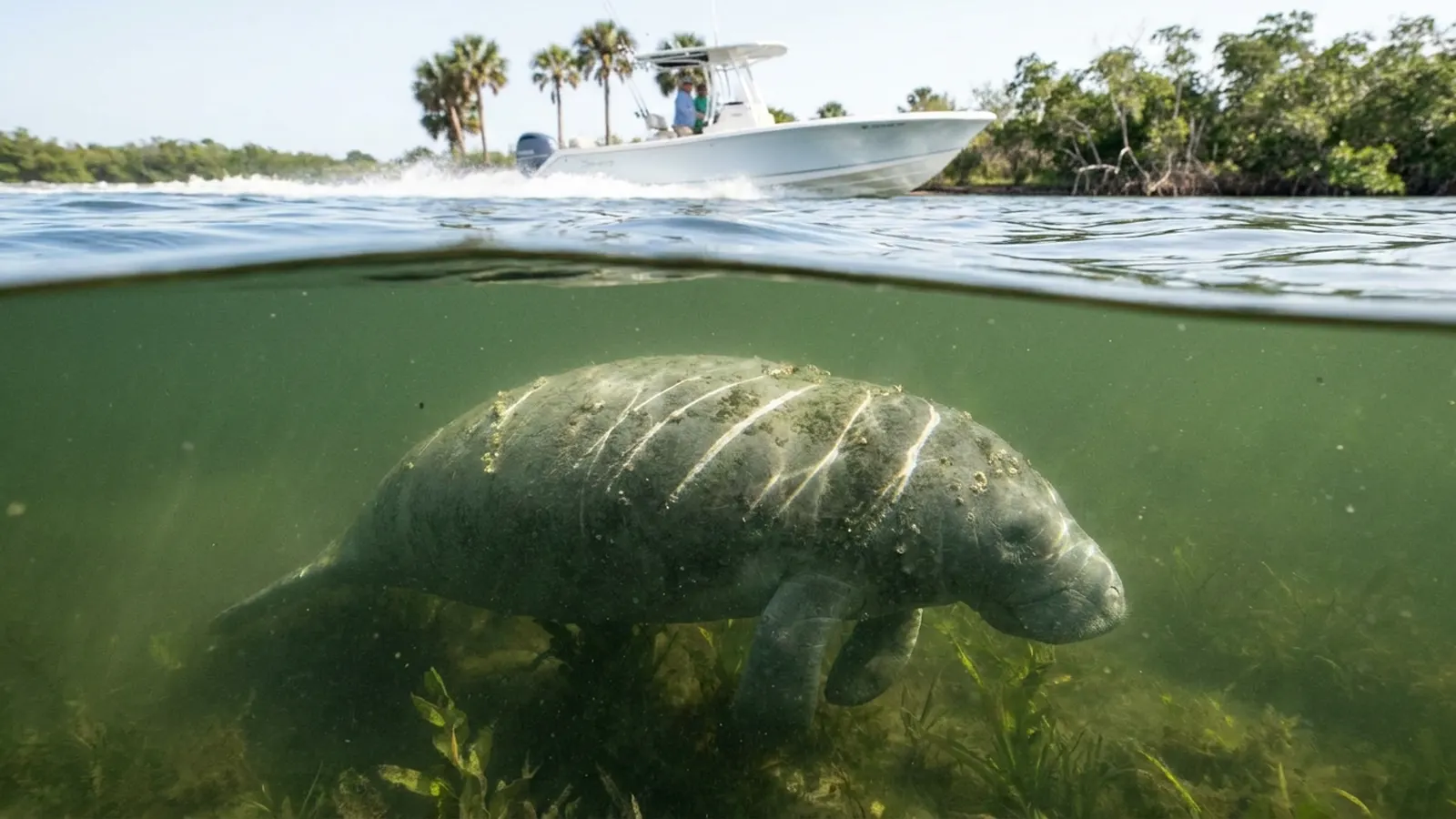
Collisions with boats are the most important human-caused source of manatee deaths in Florida, and in recent years watercraft deaths have often exceeded 100 a year. Manatees spend much of their time near the surface in shallow water, which is exactly where boats travel. They can be struck by the hull or slashed by propellers, and many survivors carry scars. Researchers use those scars to identify individuals; one study after another has found that a large proportion of adult Florida manatees bear propeller scars, and many have been hit more than once.
Florida has responded with a network of speed zones, sanctuaries and boating restrictions in important manatee areas. Our page on manatee protection zones explains what idle-speed and slow-speed zones mean and why they work. Slower boats give manatees time to move away and reduce the severity of injuries when strikes do happen.
Cold stress
A natural killer made worse by habitat loss.
Manatees are tropical animals living at the northern edge of their range. When water temperatures fall below about 68°F (20°C) for an extended period, manatees that can’t reach warm water may develop cold stress syndrome, which damages the skin, weakens the immune system and can be fatal. In unusually cold winters, cold stress deaths can number in the hundreds. The winter of 2009–2010, one of the coldest in decades, caused a major spike in manatee deaths across Florida.
That’s why warm-water refuges matter so much. Natural springs and the warm discharges of power plants, described on our page about manatees and power plants, are life-savers in cold weather. Young and small manatees are especially vulnerable because they lose heat faster. More about why temperature matters is on our manatee habitat page.
Red tide
Toxic algae on the Gulf coast.
Red tide is a bloom of the microscopic alga Karenia brevis, which produces brevetoxins. Manatees are exposed when they breathe in toxins in sea spray or eat seagrass coated with toxin. The toxins affect the nervous system, and affected manatees may become disoriented or unable to keep their heads above water. Red tide occurs mainly along Florida’s southwest Gulf coast, and severe or long-lasting blooms have killed large numbers of manatees, including major events in the 1990s, 2013 and 2018. Some poisoned manatees can be rescued and treated if found in time. Our page on red tide in Florida explains how these blooms form and how to follow FWC reports.
Starvation and the record die-off
When the seagrass disappeared.
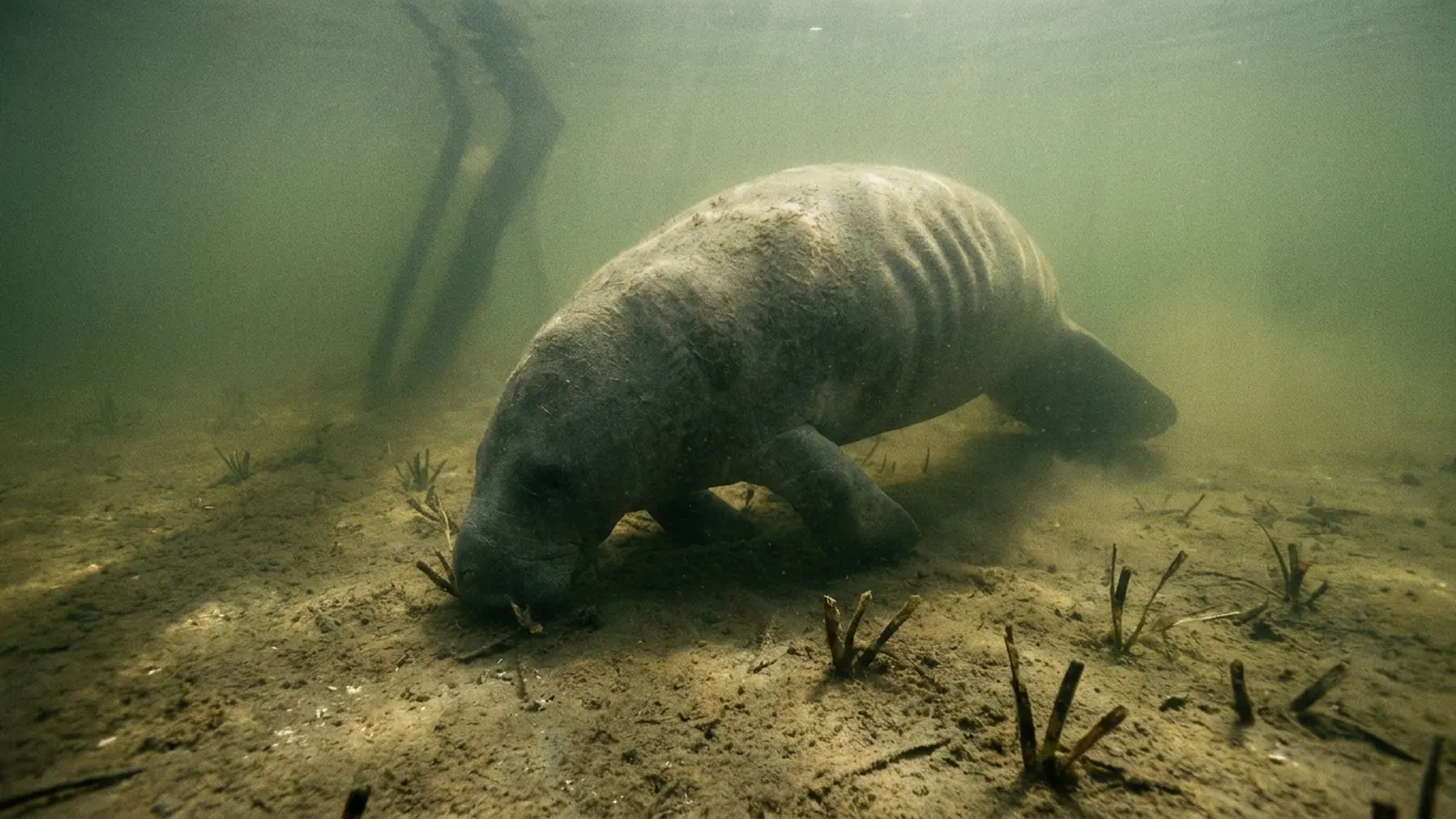
The worst year in the history of Florida’s manatee mortality records was 2021, when more than 1,000 manatees died statewide, far above the usual totals. The deaths were concentrated on the Atlantic coast, especially in and around the Indian River Lagoon, where years of nutrient pollution had fueled algal blooms that shaded out and killed vast areas of seagrass. With their main food gone, many manatees starved, and the problem peaked in winter, when manatees gathered at warm-water refuges with little to eat nearby. High mortality continued into 2022.
Federal agencies declared an Unusual Mortality Event for manatees on the Atlantic coast, and in an unprecedented step, state and federal agencies ran a supplemental feeding trial, offering lettuce to manatees at a power-plant warm-water site near Cape Canaveral during the winters that followed. The crisis showed that warm water alone isn’t enough; manatees need warm water and food close together. Our page on seagrass meadows explains why these underwater pastures are so important, and our manatee diet page describes what manatees eat.
Calves, entanglement and other causes
The rest of the picture.
Perinatal deaths. Each year a significant number of the manatees recovered are newborn or very young calves. Some die from natural causes such as birth complications; others may be lost after being separated from their mothers, sometimes because of disturbance. Our baby manatee page covers this vulnerable stage.
Entanglement and ingestion. Monofilament fishing line, crab trap lines and other debris can wrap around flippers, cutting deep into tissue and sometimes leading to amputation or death. Manatees also accidentally swallow fishing line, hooks and plastic while feeding.
Flood gates and canal locks. Water control structures have crushed or drowned manatees in the past. Protective devices and changes to gate operation have greatly reduced these deaths, a conservation success.
Disease and other natural causes. Like any animal, manatees die of infections, injuries and old age. Natural predators are not a significant factor for adults, as explained on our manatee predators page.
| Cause | Type | When and where | How it is reduced |
|---|---|---|---|
| Watercraft collisions | Human-related | Statewide, year-round | Speed zones, sanctuaries, boater education |
| Cold stress | Natural | Cold winters, mainly central and north Florida | Protecting springs and warm-water refuges |
| Red tide | Natural (possibly worsened by nutrients) | Mostly southwest Gulf coast | Rescue and treatment; water quality |
| Starvation | Habitat-related | Atlantic coast, especially 2021–2022 | Seagrass restoration; nutrient reduction |
| Perinatal | Mostly natural | Statewide, often spring and summer | Reduce disturbance; rescue orphans |
| Entanglement / ingestion | Human-related | Statewide | Line recycling, gear changes |
| Flood gates and locks | Human-related | Canals and water control structures | Protective devices and operating rules |
What the yearly numbers show
A baseline of loss, with dangerous spikes.
In a typical year, Florida records several hundred manatee deaths. That baseline reflects a large population, estimated by state and federal biologists at several thousand animals, with a steady toll from boats, calves and natural causes. Then, every few years, a spike occurs: a severe winter, a long red tide or a collapse of seagrass. Those spikes can push mortality well above average and wipe out years of population growth.
Because manatees reproduce slowly, with one calf every two to three years as described on our page about the manatee life cycle, a population can only absorb a limited number of adult deaths before it begins to decline. That’s why biologists watch adult mortality closely, and why the 2021 die-off was so alarming. For the official, up-to-date numbers, FWC’s preliminary mortality reports are the authoritative source.
How I think about these numbers
Lessons from a reef tank, scaled up.
In my reef systems since 1996, I learned that the slow, invisible problems are often the dangerous ones. A tank rarely crashes from one dramatic event; it crashes after nutrients creep up and the system tips past a point it can recover from. The manatee die-off of the early 2020s looks a lot like that to me. Nutrient pollution built up in the Indian River Lagoon for years, the seagrass faded away, and then the manatees ran out of food. By the time the deaths made headlines, the underlying problem had been building for a long time.
That’s why I think the best response is boring and long-term: cleaning up water, restoring seagrass, protecting springs and keeping boat speeds down in manatee areas. Rescues save individual animals, and they matter, but the numbers only stay low when the habitat is healthy.
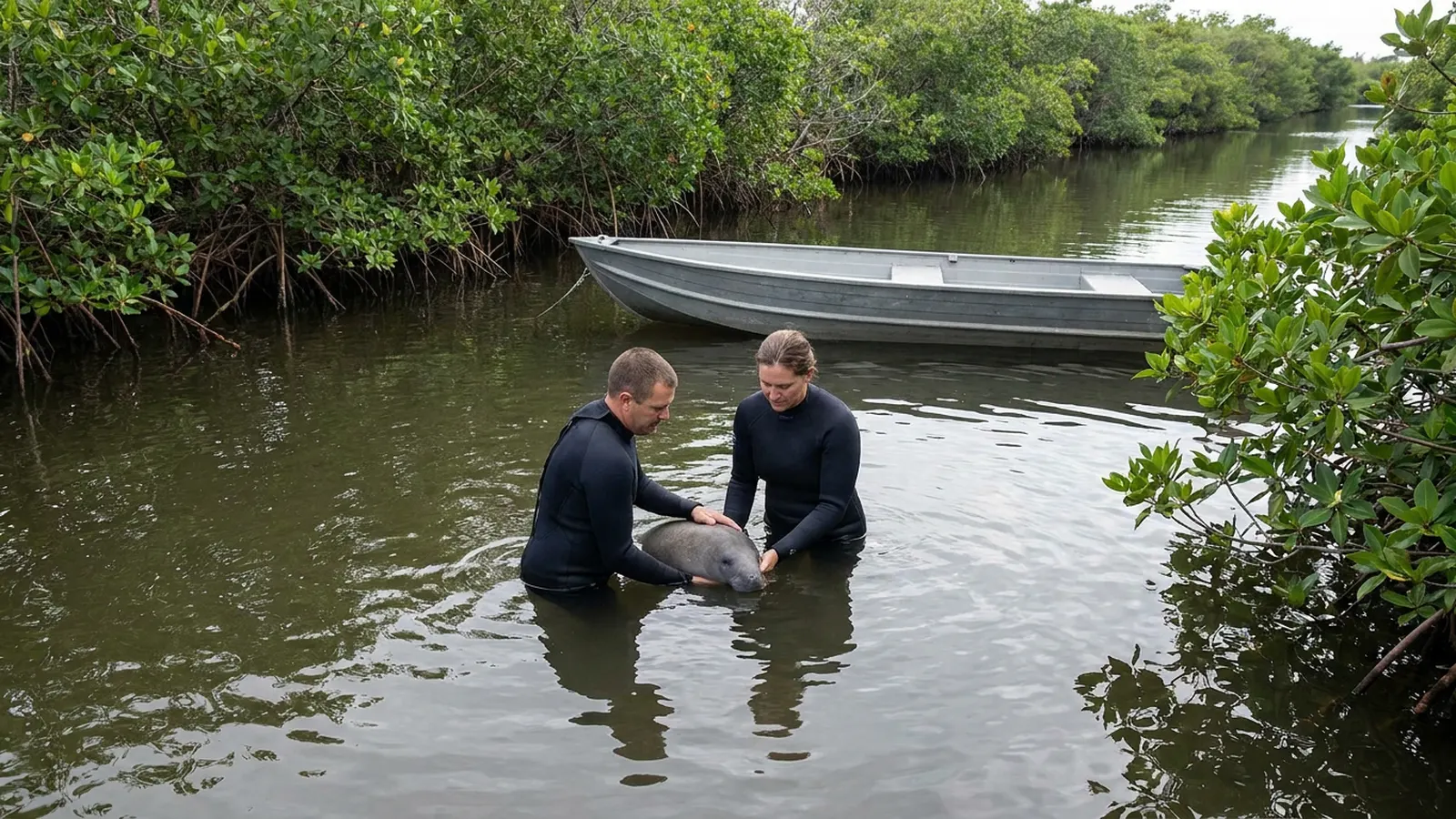
It is worth knowing how much effort already goes into saving the manatees that can be saved. Florida has a network of partners, coordinated through the Manatee Rescue and Rehabilitation Partnership, that includes FWC, the U.S. Fish and Wildlife Service, zoos, aquariums and nonprofit groups. Together they rescue manatees suffering from boat injuries, cold stress, red tide poisoning, entanglement and starvation, treat them at critical care facilities and release them once they recover. Released manatees are often tracked for a time to make sure they are adapting. Those programs return many animals to the wild each year, and the information they collect feeds straight back into understanding why manatees die.
What you can do
Small actions, real impact.
If you boat in Florida, obey manatee zones, wear polarized sunglasses and keep a lookout. If you fish, never leave line or hooks in the water and use monofilament recycling bins. Don’t feed manatees or give them water. If you see an injured, distressed, orphaned or dead manatee, call FWC’s Wildlife Alert hotline right away; fast reports save lives and help scientists learn what is killing manatees. And at home, reducing fertilizer use and runoff helps keep the water clean enough for seagrass to grow. For a broader look at the species’ status, see our page why are manatees endangered.
How many manatees die each year in Florida?
Typically several hundred, with spikes in severe years. FWC publishes the official counts.
What is the main cause of manatee deaths?
Watercraft collisions are the leading human-related cause; cold stress, red tide and starvation cause major spikes.
Why did so many manatees die in 2021?
Mostly starvation on the Atlantic coast after seagrass in the Indian River Lagoon died off from pollution-driven algal blooms.
Does red tide kill manatees?
Yes. Its toxins affect manatees’ nervous systems, and severe blooms on the Gulf coast have killed many.
Can manatees die from cold water?
Yes. Prolonged exposure to water below about 68°F can cause fatal cold stress.
What should I do if I find a dead manatee?
Report it to the FWC Wildlife Alert hotline with the location; do not try to move it.
Are manatee deaths going down?
They vary greatly from year to year. Totals fell after the 2021–2022 crisis, but the long-term trend depends on habitat and boating.
- Florida Fish and Wildlife Conservation Commission, Fish and Wildlife Research Institute: manatee mortality statistics.
- U.S. Fish and Wildlife Service: Florida manatee Unusual Mortality Event and recovery.
- NOAA Fisheries: Marine Mammal Unusual Mortality Events.
- St. Johns River Water Management District: Indian River Lagoon seagrass monitoring.
- Save the Manatee Club: manatee mortality and threats.
Blane Perun has been exploring Earth’s oceans and marine life for over 25 years. Founder of TheSea.Org in 1999, underwater photographer, coral aquaculture pioneer, and explorer of 80+ countries.
About Blane Perun → More on Manatees →