What Is a Manatee? — The Gentle Sea Cow Explained
A manatee is a large, slow-moving aquatic herbivore in the order Sirenia, the same group of marine mammals that includes the dugong. Three living manatee species exist — the West Indian manatee (Trichechus manatus) of the Caribbean and Florida, the Amazonian manatee (Trichechus inunguis) of the Amazon River basin, and the West African manatee (Trichechus senegalensis) along the Atlantic coast of Africa. All three are fully aquatic plant-eaters with rounded paddle tails, paddle-like forelimbs, and prehensile upper lips used for grazing. Manatees are the closest living relatives of elephants, can reach 4 metres long and 600 kg, and live up to 65–70 years. They are the only large mammals that are entirely herbivorous and entirely aquatic.
Manatees are one of the strangest large mammals alive. They are the only fully aquatic herbivorous mammals on Earth — whales eat fish or krill, seals eat fish, dolphins eat fish, but manatees graze plants like a cow on land. They are also the closest living marine relatives of elephants, the source of every credible mermaid sighting in the historical record, and one of the slowest-reproducing large mammals known. They look prehistoric because they essentially are: their body plan has changed very little in the last 30 million years.
This guide covers what a manatee actually is — species, anatomy, range, diet, behaviour, reproduction, evolutionary history, and the conservation pressures that have turned every manatee species into a threatened animal. If you have only ever seen a manatee in a Florida spring or a TV documentary, the full picture is bigger and stranger than the popular image suggests.
The three manatee species
There are three living manatee species, each in a different river basin or coast. They share the same body plan but differ in size, range, and the threats they face.
The West Indian manatee (Trichechus manatus) is the largest and best-known. It lives in the Caribbean, the Gulf of Mexico, and along the Atlantic coast from Brazil to the southeastern United States. The Florida subspecies (T. manatus latirostris) is the population most people picture: roughly 6,500 animals concentrated in Florida’s warm springs and coastal waterways, instantly recognisable by the boat-strike scars that most adults carry. The Antillean subspecies (T. manatus manatus) ranges across the rest of the Caribbean and into northern South America.
The Amazonian manatee (Trichechus inunguis) is the only fully freshwater sirenian. It lives in the Amazon River basin and never enters salt water. It is the smallest manatee — rarely exceeding 2.8 m and 450 kg — and is the most poorly studied of the three. It lacks nails on its flippers, the only manatee without them, which is the easiest field identification once you have one in hand.
The West African manatee (Trichechus senegalensis) inhabits coastal rivers, lagoons, and estuaries from Senegal to Angola along the Atlantic coast of Africa. It is similar in size to the West Indian manatee but darker in colour, and uses both marine and freshwater habitats. It is the least known of the three species and the most likely to be undercounted in conservation estimates.
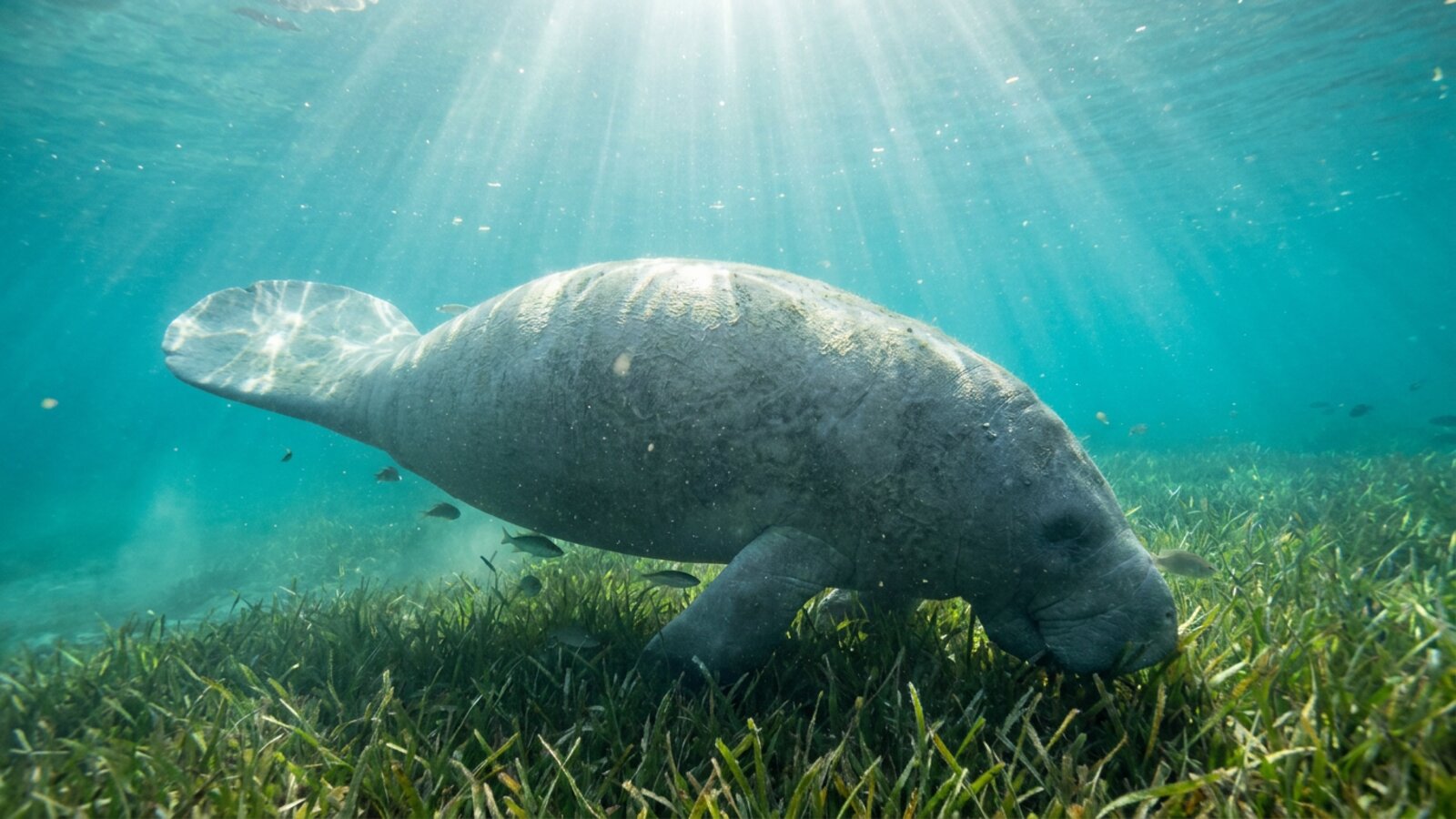
Anatomy — built for slow, efficient grazing
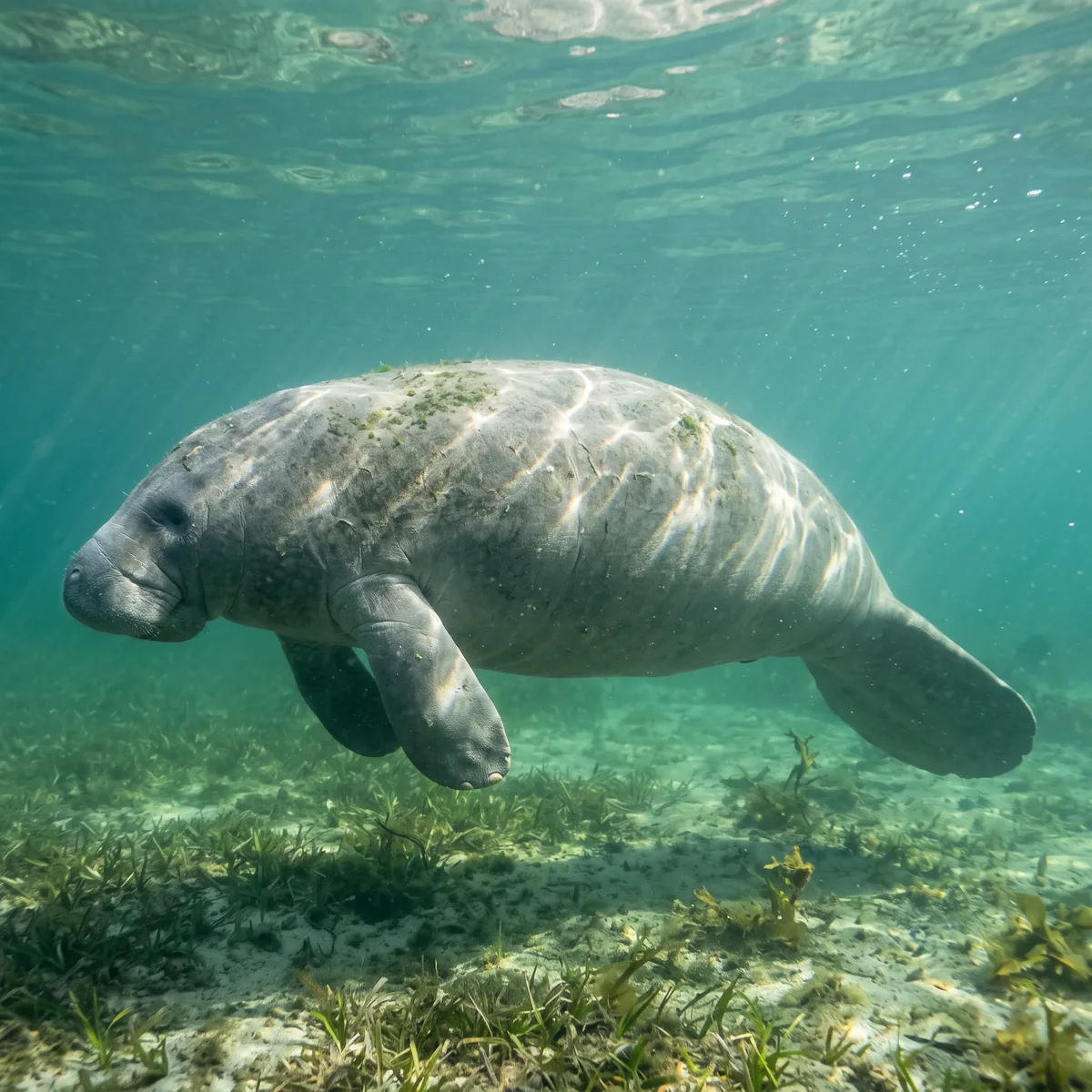
Manatees are not built for speed. Every part of their anatomy is optimised for low-energy living in shallow vegetated water — dense bones to stay near the bottom, a flexible upper lip for handling plants, and a digestive system that can extract calories from seagrass.
A manatee’s body is fusiform and grey, covered in tough wrinkled skin often discoloured by patches of algae and barnacles. Two paddle-like forelimbs (which retain three to four nails on each — a holdover from their land-mammal ancestry) handle steering and food manipulation. The tail is a single, large, rounded paddle — no notch, no fluke — that drives the animal forward in slow vertical strokes. Manatees swim at a leisurely 5–8 km/h cruising speed but can burst to around 25 km/h when threatened (more in how fast a manatee can swim). Like every marine mammal they breathe air through their nostrils, surfacing every few minutes when active and staying down for up to about 20 minutes at rest — see do manatees breathe air?
The skull is unusual. The rostrum is angled downward (less sharply than in dugongs) and ends in a split prehensile upper lip — one of the most flexible feeding structures in any mammal. The two halves of the upper lip can move independently, gripping and tearing vegetation like a pair of fingers. The eyes are small and the eyesight is moderate, but manatees have excellent hearing and tactile sense; their faces are covered in sensitive whiskers (vibrissae) used to feel out vegetation in muddy water (a surprising share of the small manatee brain is devoted to processing touch). They have only six neck vertebrae rather than the standard seven that all other mammals (including giraffes) share — sirenians and three-toed sloths are the exceptions.
Marching molars — manatee teeth are unique
Manatees have one of the strangest dental systems in the entire mammal class. Their molars do not stay put. They march forward through the jaw and are replaced from behind continuously throughout the animal’s life.
Most mammals get two sets of teeth: baby teeth and adult teeth. Once the adults wear down, they don’t come back. Manatees do not work that way. New molars erupt at the back of the jaw and slowly migrate forward as the front teeth wear down and fall out. A manatee may cycle through thirty or more sets of molars across its 60–70-year lifespan (the record holder, Snooty the manatee, reached 69). This is an adaptation to a diet of abrasive aquatic vegetation — seagrass and freshwater plants contain silica that wears tooth enamel down quickly. Rather than evolve harder teeth, manatees evolved an unlimited supply of replacement teeth.
The only other mammals with this trait are elephants, and the parallel is not coincidence: elephants and sirenians are each other’s closest living relatives. The marching-molar system is one of the clearest pieces of anatomical evidence linking these two seemingly unrelated groups.
Diet — the only fully aquatic herbivorous mammal
Manatees graze. That single fact sets them apart from every other large marine mammal. Whales hunt. Seals hunt. Dolphins hunt. Manatees and their dugong cousins are the only large mammals that have evolved to live entirely in water and eat only plants.
The diet varies by species and habitat. Florida manatees eat seagrasses (Thalassia, Halodule, Syringodium) in marine and brackish water, and water hyacinth, hydrilla, and floating tape grass in freshwater. Amazonian manatees eat freshwater plants like Eichhornia (water hyacinth) and floating grasses. West African manatees eat both marine and freshwater vegetation depending on which habitat they’re in at the time, and have even been observed eating fallen mangoes and overhanging fruit during the wet season.
An adult manatee eats 40–60 kg of vegetation per day — up to 10% of its body weight — and spends six to eight hours a day feeding. The prehensile upper lip lets them crop blades of grass selectively, tear leaves from overhanging branches, or pluck floating debris vegetation from the water surface. Where dugongs root up entire seagrass plants by the rhizome, manatees crop more selectively from above. The result is that manatees can exploit a much wider variety of plants than any other marine mammal.
Habitat and range
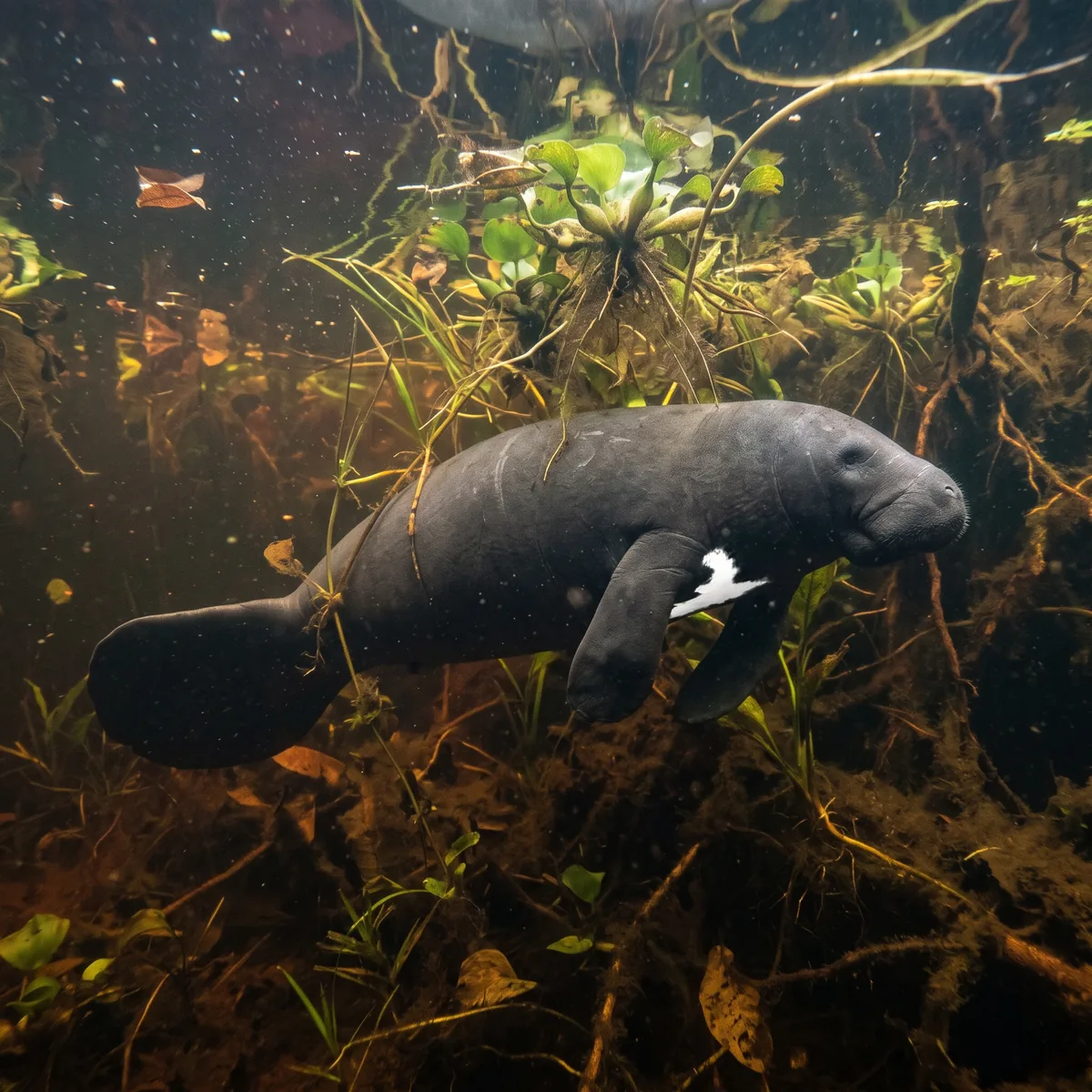
Manatees live across the Atlantic basin. They occupy three separate ranges with no overlap — if you are in the Caribbean or Florida, the animal is a West Indian manatee; in the Amazon, an Amazonian manatee; on the African Atlantic coast, a West African manatee.
Manatees prefer warm, shallow, slow-moving water with abundant vegetation. They cannot tolerate water below about 20°C for extended periods — cold stress is one of the leading causes of mortality, especially among Florida manatees, which seek out warm-water springs and power-plant outflows during winter cold snaps. The famous winter aggregations at Crystal River and Three Sisters Springs in Florida exist because the year-round 22°C spring water is a thermal refuge when the surrounding rivers drop into the teens.
Manatees are the only sirenians that use freshwater. Dugongs are strictly marine; manatees move freely between coastal seas, estuaries, brackish lagoons, and freshwater rivers. The Amazonian manatee is the only fully freshwater sirenian, never entering salt water at all.
Behaviour and social life
Manatees are loosely social. They don’t form structured groups the way dolphins do, but they aggregate in large numbers at preferred locations and recognise each other individually.
Most manatees are seen alone or in mother-calf pairs. Where conditions concentrate them — a warm spring in winter, a seagrass bed in a productive season — they form loose aggregations of dozens to hundreds of animals. The Florida winter spring aggregations are the densest sirenian groups on Earth, with several hundred animals packed into a few hectares of warm water.
Vocally, manatees are surprisingly active. They communicate using chirps, squeaks, and whistles, especially between mothers and their calves. Each manatee appears to have an individually recognisable vocal signature, similar to dolphin signature whistles, though manatee acoustics are much less studied. Touch is also a major sense: manatees frequently nuzzle, mouth, and rub against each other, and the snout whiskers are highly sensitive sensors used for finding food in murky water.
Reproduction and lifespan
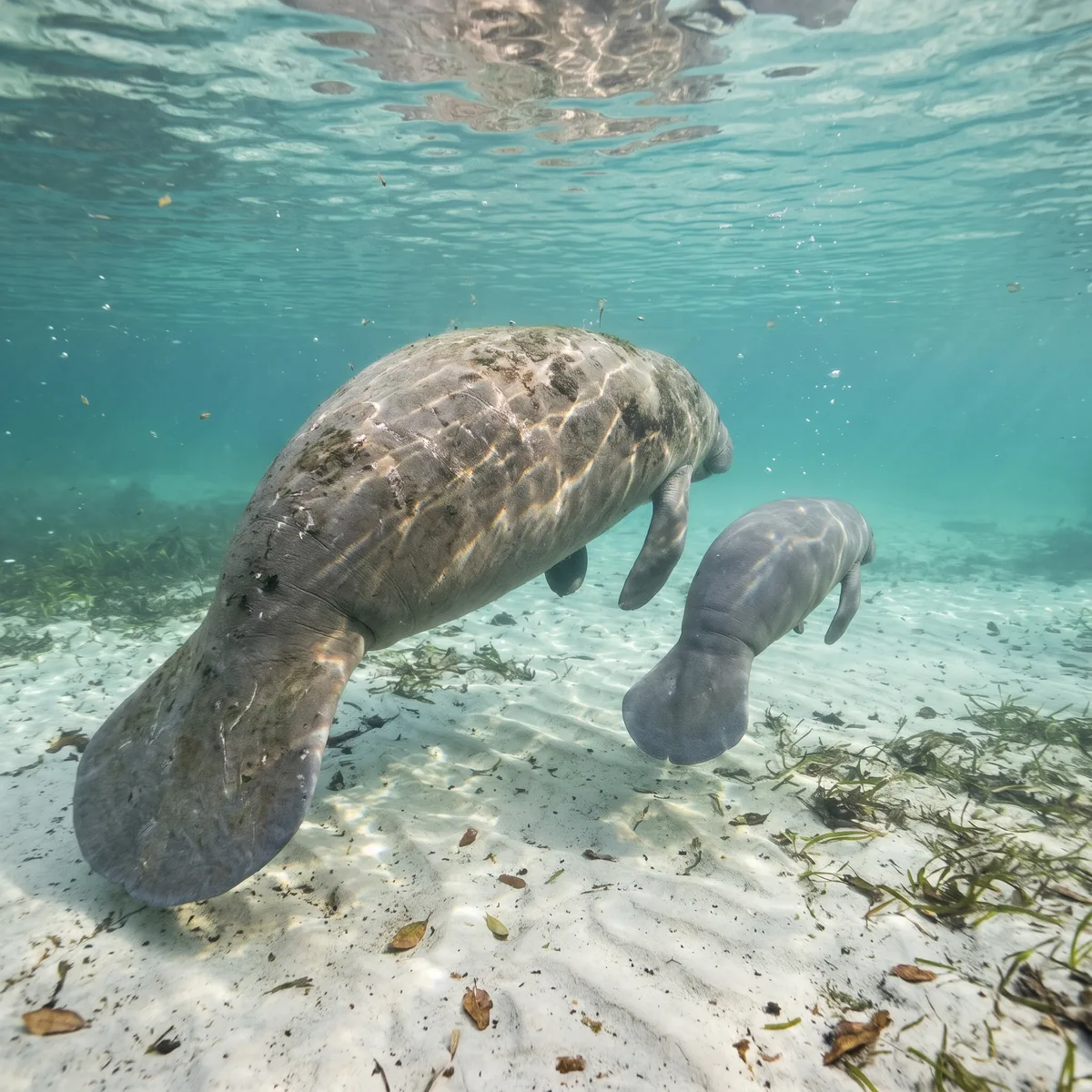
Manatees reproduce slowly. A single calf, a long gestation, years of nursing, and several years between calves. Combined with a long lifespan and late sexual maturity, this gives manatee populations very little resilience to elevated mortality.
Females reach sexual maturity at 4–5 years, males at around 9 years. Gestation lasts 12–14 months and produces a single calf, occasionally twins. Calves are born underwater and pushed to the surface immediately by the mother for their first breath. The calf nurses for 12 to 18 months — nursing from a teat located in the female’s armpit, just behind the flipper — and stays with its mother for two years or more, learning migration routes and feeding locations. Females typically produce a calf every 2–5 years across their reproductive lifespan.
Wild Florida manatees have been documented living past 65 years, identified by individually unique scar patterns from boat strikes. Captive manatees have exceeded 69. This is a very long lifespan for an animal that reaches sexual maturity slowly and reproduces slowly — a combination that makes manatee populations especially vulnerable to elevated mortality, because they cannot rebound quickly.
Evolution — the aquatic cousins of elephants
Manatees did not evolve from whales, dolphins, or any other marine mammal lineage. Their closest living relatives are not in the ocean at all. They are elephants and hyraxes — all three groups share a common ancestor that lived on land in Africa over 50 million years ago.
The earliest known sirenian, Pezosiren portelli, was an Eocene fossil from Jamaica that had four legs and could walk on land. It was the size of a pig and lived a semi-aquatic life along tropical coastlines, much like a modern hippopotamus. Over the next 10–15 million years, the sirenian lineage moved fully into the water, lost its hind limbs, and developed the streamlined body plan recognisable in modern manatees and dugongs.
The split between the manatee lineage (Trichechidae) and the dugong lineage (Dugongidae) happened roughly 50–55 million years ago. Sirenians, elephants (Proboscidea), and hyraxes (Hyracoidea) together form the superorder Paenungulata within Afrotheria, the group of African mammals that also includes aardvarks and elephant shrews. Shared traits that link sirenians and elephants include the marching-molar dental system, nails on the limb pads, similar early embryonic development, and analogous low metabolic rates. A manatee is, in evolutionary terms, an aquatic cousin of an elephant.
Conservation — every species is threatened
All three manatee species are listed as threatened. The threats differ by region but the underlying pattern is the same: slow-reproducing animals don’t recover quickly from elevated mortality, and human activity has elevated mortality across every part of the range.
The West Indian manatee is listed as Vulnerable. The Florida subspecies suffers heavy mortality from boat collisions — nearly every adult Florida manatee carries propeller scars, which biologists use to identify individual animals. Cold stress is a major factor in unusually cold winters, especially as warm-water springs have been lost to development and power-plant outflows are decommissioned. Since 2011, massive seagrass die-offs in the Indian River Lagoon — driven by nutrient pollution and algal blooms — have caused starvation events; over 1,500 manatees died in 2020–2022 alone in what state biologists declared an Unusual Mortality Event.
The Amazonian manatee is listed as Endangered. Historical hunting for meat and hide reduced populations severely in the 19th and 20th centuries; today hunting continues in some regions, along with habitat fragmentation from hydroelectric dams that block migration routes. The West African manatee is also Endangered, hunted for meat across much of its range and threatened by habitat loss along rapidly developing African coastlines.
Are manatees dangerous to humans?
No. Manatees are among the gentlest large animals on Earth. They are slow, curious, and entirely herbivorous, with no defensive weapons of any kind — no teeth that could harm a human, no venom, no aggressive behaviour. The interactions go the other way: humans are dangerous to manatees. Boat strikes are the single largest source of adult Florida manatee mortality. The standard advice in Florida waterways — reduce speed in manatee zones, avoid touching or feeding wild manatees, give them space at warm-water refuges — exists because the animals have essentially no defence against careless human activity.
What is a manatee?
A manatee is a large aquatic herbivorous mammal in the order Sirenia. Three living species exist — the West Indian, Amazonian, and West African manatees — all sharing a rounded paddle tail, paddle-like forelimbs, a prehensile upper lip, and a diet of aquatic plants. Manatees reach up to 4 m and 600 kg and live up to 65–70 years.
Is a manatee a fish or a mammal?
A mammal. Manatees are warm-blooded, breathe air, give birth to live young, and nurse their calves with milk — all defining mammalian traits. They are members of the order Sirenia within the broader group of placental mammals.
What is the closest living relative of a manatee?
The elephant. Manatees, elephants, and hyraxes share a common ancestor that lived on the African landmass over 50 million years ago. Shared traits include the marching-molar dental system, nails on the forelimb pads, and similar early embryonic development.
How many manatee species are there?
Three living species: the West Indian manatee (Caribbean and Florida), the Amazonian manatee (Amazon River basin), and the West African manatee (Atlantic coast of Africa). All three are in the genus Trichechus.
Where do manatees live?
In the warm shallow waters of the Atlantic basin. West Indian manatees live in the Caribbean, the Gulf of Mexico, and along Florida’s coast and rivers. Amazonian manatees live only in the Amazon River. West African manatees live along the Atlantic coast of Africa from Senegal to Angola.
What do manatees eat?
Plants. Manatees are obligate herbivores eating seagrass, freshwater aquatic plants, water hyacinth, hydrilla, mangrove leaves, and occasional floating fruit. They consume up to 10% of their body weight (40–60 kg) per day and spend six to eight hours feeding.
How long can a manatee hold its breath?
A manatee typically surfaces every 3–5 minutes when active, but can hold its breath up to 20 minutes when resting. Their lungs extend nearly the full length of the body, helping with buoyancy control as well as oxygen storage.
How long do manatees live?
Up to 65–70 years in the wild, with captive individuals documented past 69. Females reach sexual maturity at 4–5 years and produce a single calf every 2–5 years after a 12–14 month gestation.
Are manatees dangerous?
No. Manatees are gentle, slow, curious, entirely herbivorous, and have no defensive weapons of any kind. The danger flows the other way: human boat traffic is the leading cause of Florida manatee mortality.
Are manatees endangered?
All three species are threatened. The West Indian manatee is Vulnerable; the Amazonian and West African manatees are Endangered. Primary threats are boat strikes, seagrass loss, cold stress, habitat fragmentation, and historical hunting.
Why are manatees called “sea cows”?
Because they graze underwater vegetation the way cattle graze grass on land. The name reflects both their slow herbivorous lifestyle and their roughly cow-like bulk. The same logic gave the extinct Steller’s sea cow its name.
Blane Perun has been exploring Earth’s oceans and marine life for over 25 years. Founder of TheSea.Org in 1999, underwater photographer, coral aquaculture pioneer, and explorer of 80+ countries.
About Blane Perun →