Clearwater Florida Manatees — Where to See Them Around Tampa Bay
Yes. Florida manatees live in Clearwater Harbor, the Intracoastal Waterway and the creeks and canals around Clearwater all year. They are easiest to see from November to March, when cold Gulf water pushes them into warm refuges around Tampa Bay, such as the Manatee Viewing Center at Apollo Beach and Spring Bayou in Tarpon Springs.
Clearwater is best known for its white-sand beach and its aquarium, but the water behind the barrier islands is real manatee country. Clearwater Harbor, St. Joseph Sound, the Intracoastal Waterway and the residential canals that branch off them all hold manatees for most of the year. The trick is knowing where they go when the season changes. In summer they are spread thinly across hundreds of square miles of shallow bay, and in winter they pack into a handful of warm-water spots. Here is how I would approach seeing manatees around Clearwater and the wider Tampa Bay area, and what to expect at each time of year.
Why manatees live around Clearwater
Shallow seagrass, fresh water and sheltered canals.
The Florida manatee is a subspecies of the West Indian manatee, and the west coast of Florida is one of its core ranges. What draws them to the Clearwater area is simple: food and shelter. The shallow flats of Clearwater Harbor and St. Joseph Sound support beds of turtle grass, shoal grass and manatee grass, and an adult manatee needs to eat something like a tenth of its body weight in plants every day. Our guide to seagrass meadows explains why those beds matter so much, and the manatee diet page covers what they actually eat.
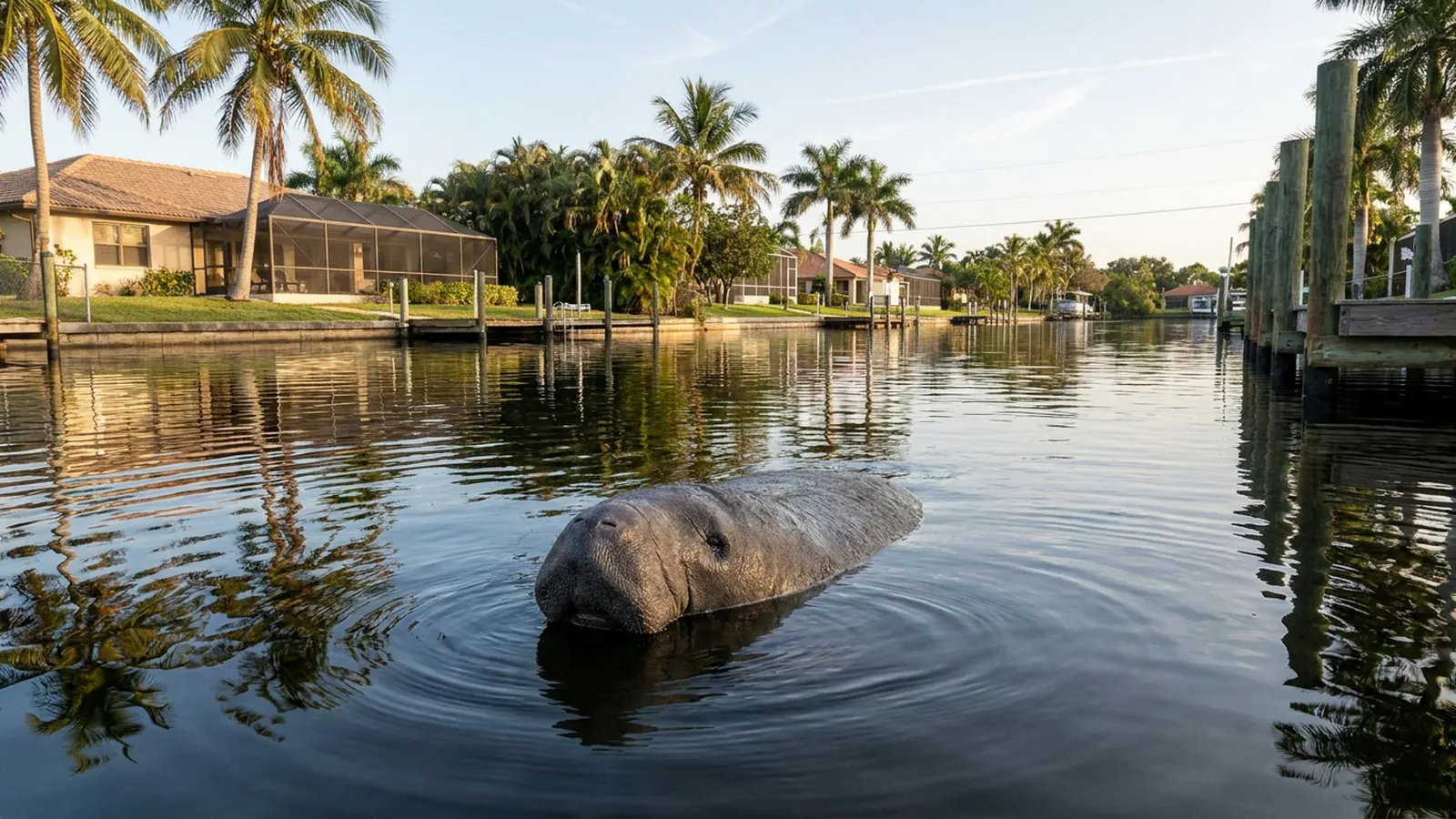
Manatees also like calm, sheltered water where they can rest, and they seek out fresh water to drink. Residential canals, marinas, creek mouths and stormwater outfalls give them both. That is why so many sightings around Clearwater happen from docks and seawalls rather than from the beach itself. The Gulf side of the barrier islands is more exposed, with fewer grass beds, and manatees are far less common there.
Winter: follow the warm water
From November to March, temperature decides where every manatee in the region is.
Manatees look well insulated, but they are not. They have a low metabolic rate and very little blubber, and when the water drops below about 20°C (68°F) for long they risk cold stress, a condition that weakens the immune system and can kill them. Our page on manatee habitat goes deeper into why that temperature matters. Each winter, as cold fronts sweep down the Gulf coast and the shallow bays chill quickly, manatees around Clearwater leave the open flats and head for water that stays warm.
Around Tampa Bay there are two kinds of winter refuge. The first is natural: springs and spring-fed rivers, where groundwater emerges at a steady temperature all year. Spring Bayou in Tarpon Springs, a short drive north of Clearwater, is fed by a spring and is a well-known winter gathering spot, and further north the great springs of Citrus County, including Crystal River and Homosassa, hold some of the largest winter aggregations on the coast. The second kind is industrial: the warm discharge canals of coastal power plants. The best known of these on the bay is Tampa Electric’s Big Bend station at Apollo Beach, where the Manatee Viewing Center lets visitors watch hundreds of manatees on the coldest days.
The colder the morning, the better the viewing. After a strong front, when air temperatures fall into the 40s, manatees crowd into the warm water and stay there. On a mild winter afternoon they may already have drifted out to feed. If I were planning a winter trip from Clearwater, I would watch the forecast and go the morning after the first real cold snap.
The best places to see manatees near Clearwater
A short list of reliable spots, from free boardwalks to spring runs.
Manatee Viewing Center, Apollo Beach. This is the headline winter spot for the whole bay. It is free, it has boardwalks, an observation tower and an education building, and on cold days the discharge canal can be full of backs and snouts. It normally opens for the winter season from November through mid-April. From Clearwater it is roughly an hour’s drive across the bay, depending on traffic.
Spring Bayou, Tarpon Springs. The closest natural refuge to Clearwater. Manatees gather in the bayou on cold mornings, and you can watch them from the seawall and park around the water. It is a quiet, local spot rather than a managed attraction, so bring patience and polarized sunglasses.
Homosassa Springs and Crystal River. About an hour and a half north. Homosassa Springs Wildlife State Park has an underwater observatory where you can see manatees year-round, including animals in rehabilitation, and in winter wild manatees gather in the river outside. Crystal River and Kings Bay are where you can legally swim near wild manatees on guided trips. See our guides to Crystal River manatees and snorkeling with manatees in Crystal River for the rules.
Clearwater’s own waterfront. In warmer months, public docks, causeway bridges and the marinas along the Intracoastal are worth a look. Manatees often rest or feed near seawalls and drink from freshwater outflows. Sightings here are luck rather than a sure thing, but they happen regularly enough that locals see them most weeks.
| Spot | Type | Best months | Cost | Approx. drive from Clearwater |
|---|---|---|---|---|
| Manatee Viewing Center, Apollo Beach | Power-plant warm-water canal | Nov–mid Apr (best Jan–Feb) | Free | About 1 hour |
| Spring Bayou, Tarpon Springs | Spring-fed bayou | Dec–Feb cold mornings | Free | About 30 minutes |
| Homosassa Springs Wildlife State Park | Spring and observatory | Year-round; wild herd in winter | Park admission | About 1.5 hours |
| Crystal River / Kings Bay | Spring-fed bay, guided swims | Nov–Mar | Tour fee | About 1.5 hours |
| Clearwater Harbor docks and canals | Feeding and resting areas | Apr–Oct | Free | Local |
Summer manatees in Clearwater Harbor
Fewer in one place, but spread all over the bay.
From roughly April to October the picture flips. With warm water everywhere, manatees leave the refuges and spread out to feed, travel and mate. This is when you are more likely to see one in Clearwater itself: a single animal rolling slowly at the surface in a canal, a mother and calf grazing over a grass flat, or a small group of males following a female in a mating herd. Our page on manatee mating explains those noisy summer gatherings.
Summer is also calving season, so you may see small calves tight against their mothers. They stay together for one to two years, and our baby manatee guide covers that long dependency. Give pairs plenty of room. A calf separated from its mother has poor odds.
The most reliable way to spot a summer manatee is to read the water. Look for the “footprint”, a smooth, round patch on the surface left by the tail’s downstroke, a line of bubbles or a snout breaking the surface to breathe every few minutes. On calm mornings before the wind picks up, these signs are much easier to spot.
Kayaking and boating around Clearwater
Quiet craft, slow speeds and a lot of distance.
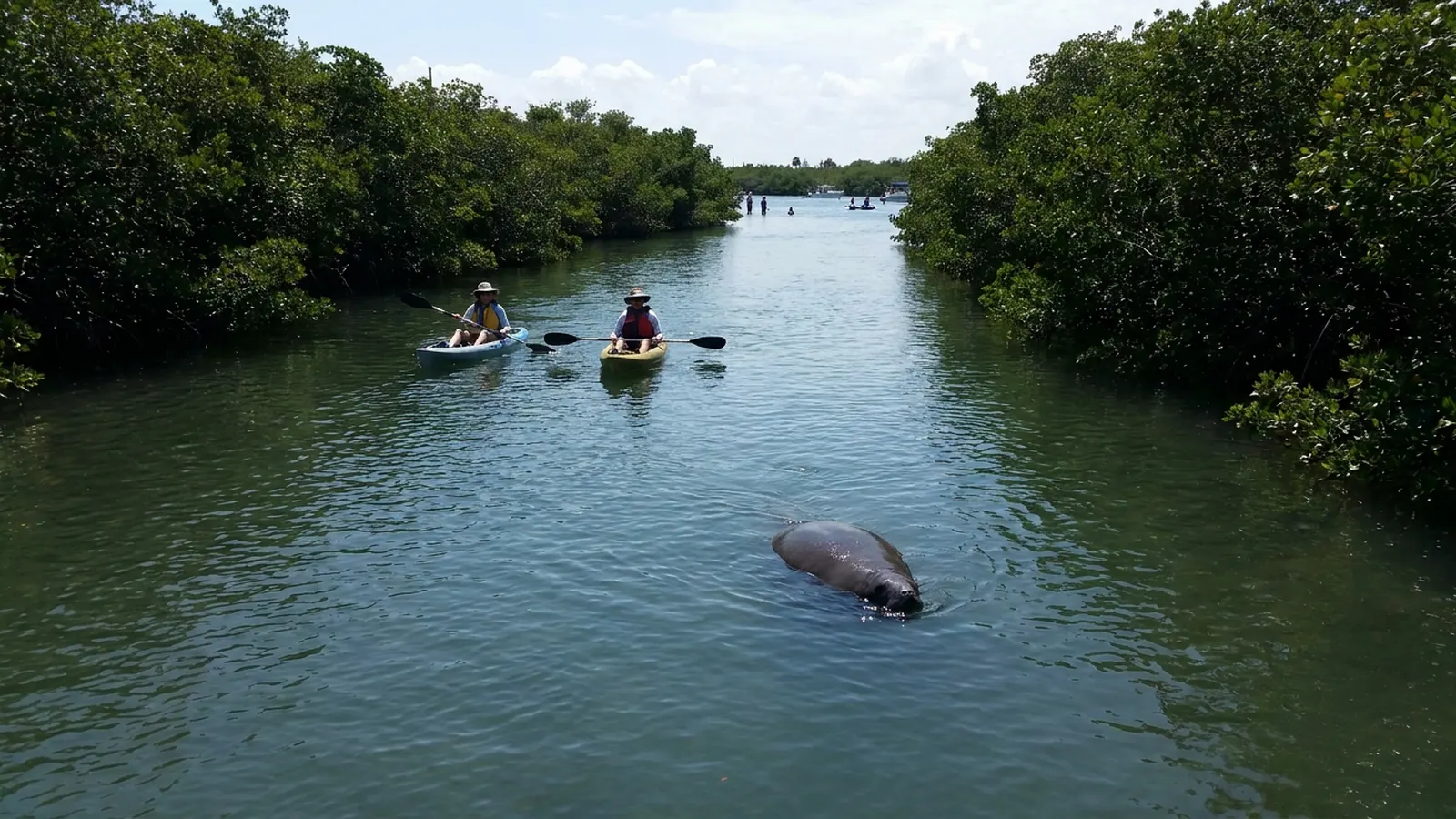
A kayak or paddleboard is a good way to look for manatees in the backwaters of Clearwater, Dunedin and the Anclote River area, because you move slowly and quietly and you can reach shallow water. The rules are the same as anywhere in Florida: keep your distance, never chase, surround or separate a manatee from its group, and let it decide whether to come closer. If one approaches, stay still and let it pass. Don’t touch, feed or give water to manatees. Feeding teaches them to approach docks and boats, which is exactly where they get hurt.
For powerboaters, Pinellas County and the surrounding waters have posted manatee protection zones with slow-speed and idle-speed areas, some seasonal and some year-round. Watch for the signs, wear polarized sunglasses and keep a lookout on the bow in shallow water. Boat strikes are the largest single human-caused source of manatee deaths in Florida, and many manatees carry propeller scars that researchers use to identify them.
What I would look for on a Clearwater manatee trip
Timing, weather and where you stand matter more than luck.
I live on the southwest Florida coast, and the pattern around Tampa Bay is the same one we see further south: manatees go where the water is warm in winter and where the food is in summer. If I were planning a trip around Clearwater specifically to see manatees, I would make it a winter trip, check the overnight lows, and go to Apollo Beach or Tarpon Springs early on the morning after a cold front. I would bring polarized sunglasses, because glare on the water hides almost everything, and I would plan to spend at least an hour. Manatees surface on their own schedule, and the longer you watch, the more you see.
For a summer visit, I would rent a kayak and spend a calm morning in the canals and grass flats behind the barrier islands rather than looking from the beach. Manatees in summer are a pleasant surprise rather than a guarantee, and that is part of the appeal. Whatever the season, I’d treat any sighting as a privilege and keep my distance. These are protected, slow-moving animals that are already under a lot of pressure.
Threats to Tampa Bay’s manatees
Boats, cold, red tide and the loss of seagrass.
Manatees around Clearwater face the same pressures as manatees across Florida. Boat strikes are a constant, and they rise as the region’s population and boat traffic grow. Cold snaps kill manatees that fail to reach warm water in time, especially young animals. Harmful algal blooms are another serious threat on the Gulf coast: the dinoflagellate behind Florida red tide produces brevetoxins, which manatees inhale and eat with their seagrass, and severe red tide years have caused large manatee die-offs along the southwest coast.
The long-term issue is seagrass. When water quality drops and grass beds shrink, manatees have to travel further to feed and can starve, as happened on Florida’s Atlantic coast in the early 2020s. Tampa Bay has been a conservation success story, with seagrass recovering substantially after decades of work to cut nutrient pollution, but recent surveys have shown losses again in parts of the bay. Healthy grass beds are the best thing that can happen for Clearwater’s manatees.
How to help manatees while you visit
Simple habits that make a difference.
Look, don’t touch. Keep at least a few boat lengths away from manatees when you are on the water. Obey every posted speed zone, even when the water looks empty. Never offer food or water from a dock or hose. Take fishing line and hooks home, because entanglement injures many manatees every year. And if you see a manatee that is injured, entangled, orphaned or behaving strangely, call the Florida Fish and Wildlife Conservation Commission’s Wildlife Alert Hotline rather than trying to help it yourself. Trained rescue teams across the region work with rehabilitation centers to treat and release injured manatees.
If you want to learn more before you go, start with our overview of what a manatee is, and if you are in the Bradenton area, read about Snooty, the famous manatee who spent 68 years just across the bay.
Can you see manatees in Clearwater, Florida?
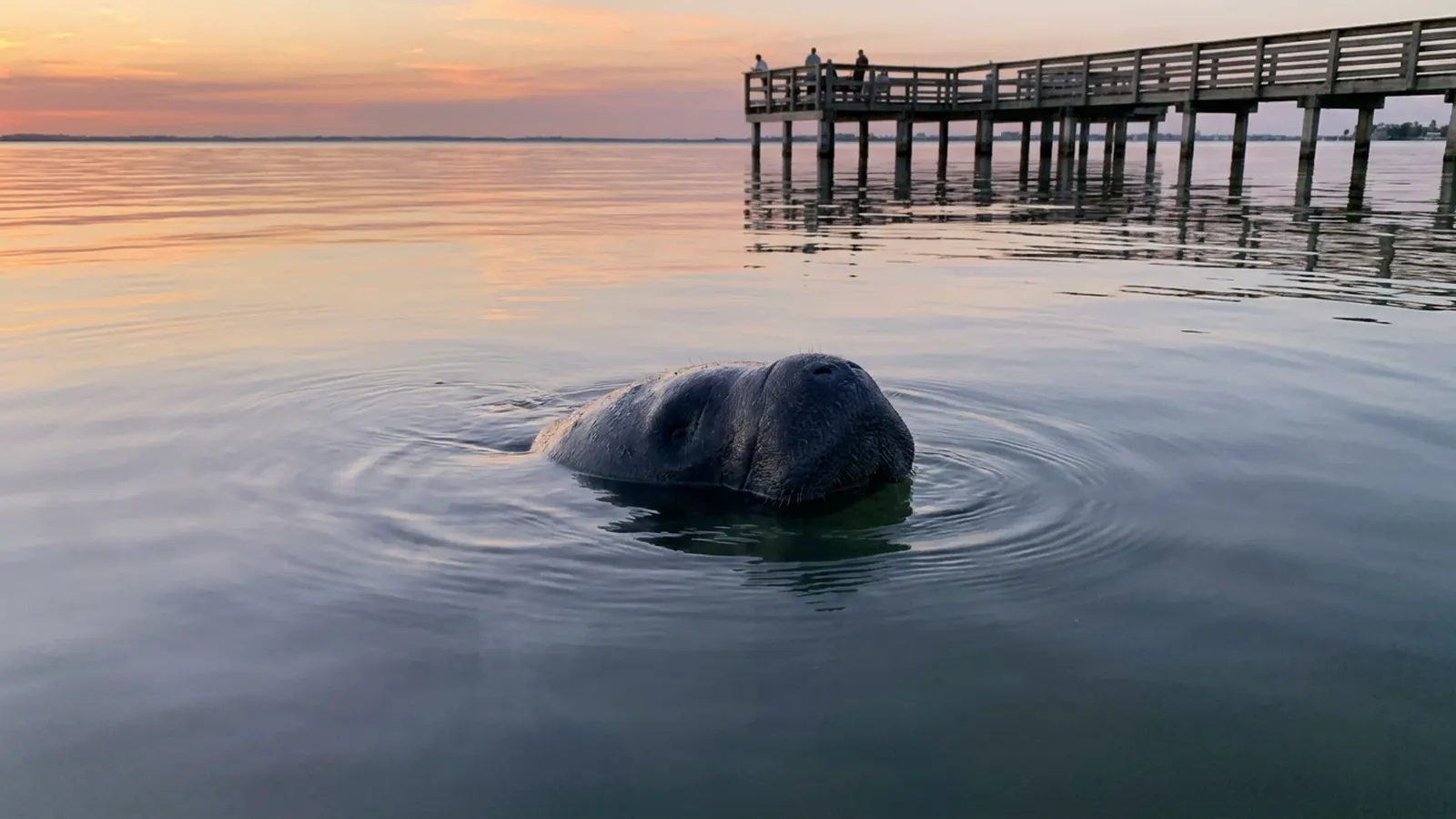
Yes. They live in Clearwater Harbor, the Intracoastal Waterway and local canals. Summer sightings are scattered; winter brings large groups to nearby warm-water refuges.
What is the best time to see manatees near Clearwater?
November to March, ideally on a cold morning after a front, when manatees crowd into warm water at Apollo Beach, Tarpon Springs and the Citrus County springs.
Where is the closest manatee viewing area to Clearwater?
Spring Bayou in Tarpon Springs is closest. The Manatee Viewing Center at Apollo Beach is the largest free viewing site on Tampa Bay.
Can you swim with manatees in Clearwater?
Organized manatee swims are offered in Crystal River, about an hour and a half north, under strict rules. Around Clearwater, watch from a distance.
Is it legal to touch a manatee in Florida?
Manatees are protected by federal and state law, and touching, feeding, chasing or disturbing them can count as harassment. Look but don’t touch.
Are there manatees at Clearwater Beach?
Occasionally, but they are far more common on the calm, grassy bay side of the barrier islands than on the open Gulf beach.
Who do I call about an injured manatee?
The Florida Fish and Wildlife Conservation Commission Wildlife Alert Hotline, which coordinates manatee rescues statewide.
- Florida Fish and Wildlife Conservation Commission (FWC): Florida manatee facts, protection zones and mortality data.
- U.S. Fish and Wildlife Service: West Indian manatee species profile.
- Tampa Electric: Manatee Viewing Center, Apollo Beach.
- Florida State Parks: Homosassa Springs Wildlife State Park.
- Tampa Bay Estuary Program: seagrass monitoring.
- Save the Manatee Club: viewing manatees responsibly.
Blane Perun has been exploring Earth’s oceans and marine life for over 25 years. Founder of TheSea.Org in 1999, underwater photographer, coral aquaculture pioneer, and explorer of 80+ countries.
About Blane Perun → More on Manatees →