Anatomy of a Manatee — Tail, Face, Eyes, Whiskers and What Lies Beneath
A manatee is a large, torpedo-shaped marine mammal built for a slow, plant-eating life. Its anatomy includes a flat, paddle-shaped tail for propulsion, two flexible front flippers, a whiskered face with a split, grasping upper lip, small eyes, nostrils on top of the snout, heavy dense bones and a horizontal diaphragm that helps it control buoyancy.
Look at a manatee resting on the bottom of a clear Florida spring and it seems almost featureless: a big gray body, a round tail, two small flippers and a wrinkled whiskered face. Spend a little longer, though, and you realize every part of that shape is an adaptation to one of the strangest lifestyles of any mammal. Manatees are the only large marine mammals that live entirely on plants, they spend their whole lives in shallow, warm water, and they do it all at a slow pace with a very low metabolism. This guide walks through the anatomy of a manatee from tail to snout, and then under the skin, explaining what each part does and why it looks the way it does.
Everything here applies broadly to all three living manatee species, the West Indian, the Amazonian and the African manatee, with notes where they differ. If you are new to these animals, our guide What Is a Manatee? covers the basics, and the main manatee hub links every page we have written about them.
Body shape and size
A living submarine, built for cruising slowly.
A manatee’s body is a long, rounded spindle that tapers at both ends, with no visible neck and no hind limbs. That streamlined, fusiform shape reduces drag, which matters for an animal that cruises slowly most of the time and saves its energy. An adult West Indian manatee averages about 3 meters (10 feet) long, and most weigh somewhere in the region of 400 to 550 kilograms, although large females can be considerably heavier. Amazonian manatees are the smallest of the three species, and African manatees are similar in size to West Indian manatees.
The skin is thick, tough and wrinkled, gray to gray-brown, and sparsely covered with fine hairs. It is often colonized by algae, barnacles and other small organisms, which can make a manatee look greenish or brown. Manatees shed their outer skin continuously in small flakes, which helps keep that growth in check. In many Florida manatees the skin also carries pale scars from boat propellers, which researchers use to identify individuals.
What a manatee lacks is just as telling. There is no thick blubber layer like a whale’s, no external ears and no hind legs. The lack of insulation, combined with a slow metabolism, is the main reason manatees cannot tolerate cold water for long, a point covered in depth on our manatee habitat page.

The manatee tail
A flat, round paddle that drives the whole animal.
The tail is the most recognizable part of a manatee and the easiest way to tell one apart from its cousin, the dugong. A manatee’s tail is a broad, flattened, rounded paddle, often compared to a beaver’s tail turned on its side. A dugong’s tail, by contrast, is notched into two pointed flukes like a dolphin’s. Our dugong vs manatee comparison shows the difference clearly.
Manatees swim by moving the tail up and down, not side to side, the same basic stroke used by whales and dolphins. The tail is powered by large muscles along the back and the base of the spine, while the flippers are used mainly for steering. Most of the time they cruise along slowly, but the tail can produce short bursts of speed when the animal is startled, as explained in our page on how fast a manatee can swim.
Tails are also a record of a manatee’s life. Notches, cuts and scars from boat strikes, fishing line and other injuries are often clearest on the tail and back, and biologists photograph them to build catalogs of known individuals. A manatee with a distinctively scarred or partly missing tail can be recognized for decades.
Flippers and the hidden hand
Paddles on the outside, finger bones on the inside.
A manatee has two front flippers, each surprisingly flexible. Inside, the bones are arranged much like a human arm and hand: an upper arm bone, two forearm bones, wrist bones and five sets of finger bones. That arrangement is clear on a manatee skeleton, which we describe in detail on our manatee skeleton page.
Manatees use their flippers to steer, to “walk” slowly along the bottom, to scratch, to hold and guide food toward the mouth, and to touch and embrace each other. West Indian and African manatees have three or four rounded nails on the tip of each flipper, one reason early naturalists compared manatee flippers to hands. The Amazonian manatee is the exception: it has no nails, which is reflected in its scientific name, Trichechus inunguis, meaning “without nails.” See our page on the Amazonian manatee for more.
Female manatees have one mammary gland behind each flipper, in the “armpit.” Calves nurse underwater from these teats, as explained on our baby manatee page.
The manatee face, lips and snout
A face designed for grazing.
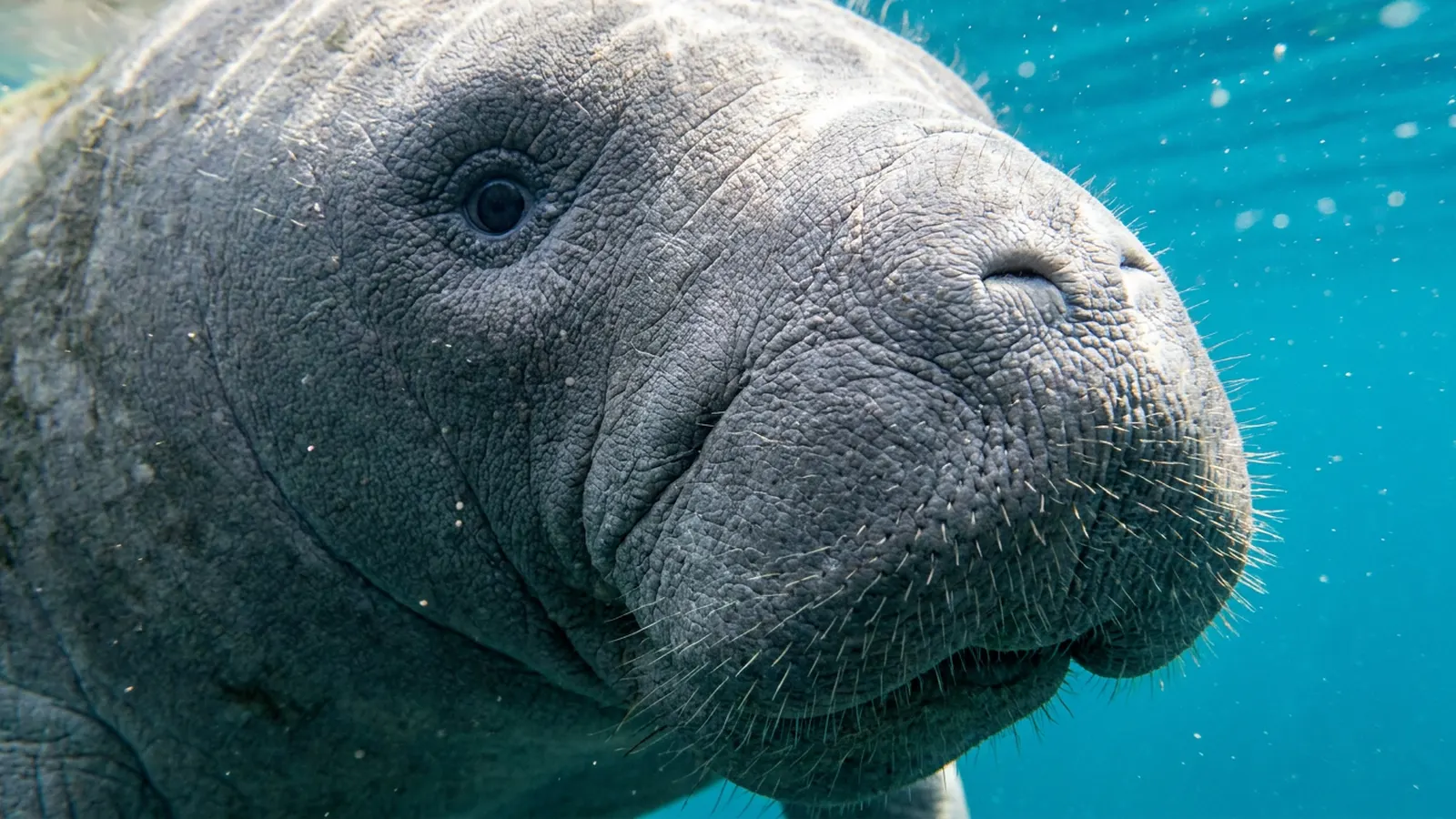
The manatee face is one of the most unusual in the animal kingdom. The snout is short, broad and angled downward, so the mouth naturally points toward the plants on the bottom. That downward bend is built into the skull itself; our manatee skull page explains how the angle differs between species and between manatees and dugongs.
The upper lip is large, fleshy and split into two halves that can move independently. Each half is covered in stiff bristles, and the manatee can work the two halves together like a pair of fingers to grab plants and pull them into the mouth. Scientists call this “oral disk” and its bristles a muscular hydrostat, a structure that moves like an elephant’s trunk or a tongue rather than like a rigid lip. Watching a manatee feed, you see the lips constantly flexing and gripping as it pulls up seagrass.
The nostrils sit on top of the snout, which lets a manatee breathe while exposing only the tip of its face at the surface. Each nostril is closed by a muscular, valve-like flap when the animal dives, keeping water out.
Inside the mouth, manatees have no front teeth. They have rough horny pads at the front of the mouth for crushing plants, and rows of molars at the back that are constantly replaced from behind as old ones wear down and fall out at the front. These “marching molars” are one of their most famous features; read more on our manatee teeth page.
Manatee eyes and ears
Small eyes, hidden ears, good hearing.
A manatee’s eyes are small for its size and set on the sides of the head. They can be closed with a circular sphincter muscle rather than eyelids like ours, and a protective membrane can slide across the eye. Studies of captive manatees suggest they can tell some colors apart, particularly blue and green, and see reasonably well at close range, although their eyesight is not considered especially sharp. In the murky water where many manatees live, vision is only one of the senses they rely on.
Manatees have no external ears, just tiny openings behind the eyes, but their inner ear bones are large and their hearing is good, especially for higher-pitched sounds. That matters for communication between mothers and calves, and it also matters for detecting boats, although the low-frequency sound of a slow-moving outboard can be hard for them to pick up.
Whiskers: touch as a sixth sense
A body covered in sensors.
Manatee whiskers are far more important than they look. The face has a dense array of thick sensory hairs, called vibrissae, around the lips and snout, with additional fine sensory hairs spread sparsely over the whole body. Each hair is linked to nerves and is sensitive to touch and to tiny movements in the water. Researchers at the University of Florida and Mote Marine Laboratory have shown that manatees can detect very small water movements with these body hairs, a sense that works a little like the lateral line of a fish.
That sense helps explain how a large, slow animal with modest eyesight finds its way through murky rivers and canals, senses other manatees nearby and perhaps notices changes in current. The bristles around the mouth also help the manatee feel and sort plants as it feeds. When you see a manatee seemingly “nosing” along the bottom, it is feeling its way as much as looking.
Inside the manatee: bones, lungs and gut
Built-in ballast and a long digestive system.
Manatee bones are unusually dense and heavy. Most of the long bones and ribs are solid rather than having the marrow-filled cavities found in other mammals. This heavy skeleton works like a diver’s weight belt, counteracting the buoyancy of the large lungs so the manatee can rest on the bottom or hover in mid-water without effort.
The lungs are long and flat and run along the back, above the other organs, rather than sitting in the chest as ours do. They are separated from the abdomen by a diaphragm that runs horizontally along the length of the body, instead of across it. By compressing or relaxing the lungs and changing the volume of gas in the intestines, a manatee can adjust its buoyancy and its angle in the water with very little movement. How this works when they rest and sleep is described on our page how do manatees sleep.
Manatees also have six neck vertebrae instead of the seven found in almost all other mammals, so they cannot turn their heads easily and instead turn their whole body to look around. The digestive system is long and adapted to fermenting tough plant material in the hindgut, similar in principle to a horse’s. A manatee may eat a large share of its body weight in plants every day, as covered in our manatee diet guide.
| Body part | What it looks like | What it does |
|---|---|---|
| Tail | Flat, rounded paddle | Main propulsion, moved up and down |
| Flippers | Two short, flexible paddles; nails in most species | Steering, walking on bottom, handling food |
| Upper lip | Split, bristled, highly mobile | Grasps and pulls in plants |
| Nostrils | On top of the snout, with valves | Breathing at the surface; sealed underwater |
| Eyes | Small, closed by a sphincter muscle | Close-range vision; some color vision |
| Whiskers | Thick on the face, fine hairs on the body | Touch and sensing water movement |
| Bones | Dense and heavy | Ballast against buoyant lungs |
| Diaphragm | Runs horizontally along the body | Buoyancy and posture control |
What I look for when watching manatees
Reading anatomy from a boardwalk or a boat.
After decades of keeping reef tanks, I have learned that the best way to understand an animal is to watch how its body works, not just what it looks like. With manatees, I’d start with the surface: the nostrils come up first, often just the tip of the snout, then a slow exhale and inhale and a gentle roll back down. That tells you how well adapted the face is to breathing with minimal exposure.
Next I’d watch the tail. A resting manatee hangs almost motionless, then one slow sweep of that paddle moves it several body lengths. That’s a body designed for efficiency, not speed. And if the water is clear enough, watch the lips when a manatee feeds; the way the two halves of the upper lip work together is unlike anything else you will see in a mammal. Finally, look for scars on the back and tail. Seeing how many manatees carry them is a sobering reminder of why slow-speed zones matter.
How manatee anatomy reflects their ancestry
Clues to an elephant connection.
Several anatomical features point to manatees’ surprising family tree. Their nails, their continuously replaced molars, the structure of their skull and some details of their reproductive system all link them to elephants and hyraxes. The finger bones inside the flipper, and the tiny remnants of a pelvis buried in the muscle, are reminders that their ancestors were four-legged land mammals that moved into water tens of millions of years ago. Their extinct relative, Steller’s sea cow, took the same body plan to a giant size in cold northern waters.
Understanding those links helps explain why a manatee looks the way it does: not like a fish or a whale, but like a grazing herbivore that took its lifestyle into the water and adapted every part of its body to match.

What does a manatee tail look like?
It is a broad, flat, rounded paddle, unlike the notched, fluked tail of a dugong.
Do manatees have fingers?
Yes, inside the flippers. Each flipper contains five sets of finger bones, and most manatees have three or four nails at the tip.
Can manatees see well?
Their eyes are small and their vision is modest, but they appear to see some colors and rely heavily on touch and hearing.
What are manatee whiskers for?
Touch. Facial whiskers help them feel and grab food, and fine body hairs detect water movement around them.
Do manatees have ears?
They have no external ears, only tiny openings behind the eyes, but their hearing is good.
Why are manatee bones so heavy?
Dense bones act as ballast, offsetting the buoyancy of their large lungs so they can stay down easily.
Why can’t manatees turn their heads?
They have only six neck vertebrae and a short neck, so they turn their whole body instead.
- Florida Fish and Wildlife Conservation Commission: Florida manatee facts and biology.
- U.S. Fish and Wildlife Service: West Indian manatee species profile.
- Reep, R. L. and Bonde, R. K. (2006). The Florida Manatee: Biology and Conservation. University Press of Florida.
- Save the Manatee Club: manatee anatomy and senses.
- Mote Marine Laboratory: manatee sensory research.
Blane Perun has been exploring Earth’s oceans and marine life for over 25 years. Founder of TheSea.Org in 1999, underwater photographer, coral aquaculture pioneer, and explorer of 80+ countries.
About Blane Perun → More on Manatees →