Whales — A Field Guide to the Ocean’s Giants
What is a whale?
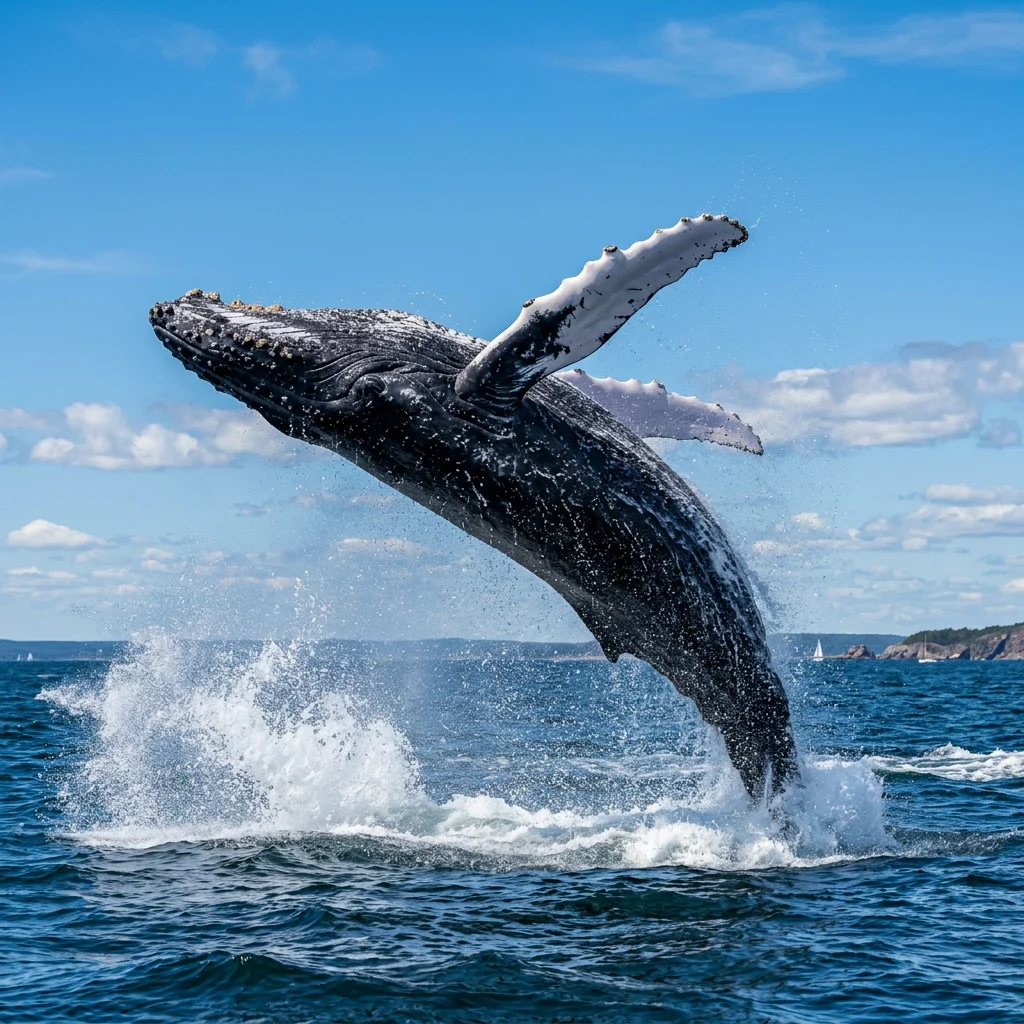
A whale is a large, fully aquatic mammal in the order Cetacea. Whales breathe air through blowholes, give birth to live young, nurse them with milk, and never come onto land.
Cetaceans evolved from land-dwelling, hoofed mammals more than 50 million years ago; their closest living relatives are hippos (see are hippos marine mammals?). The word “whale” is informal: technically dolphins and porpoises are toothed whales too, and the orca and pilot whales are oceanic dolphins. The whale shark, despite its name, is a fish.
How did whales evolve from land animals?
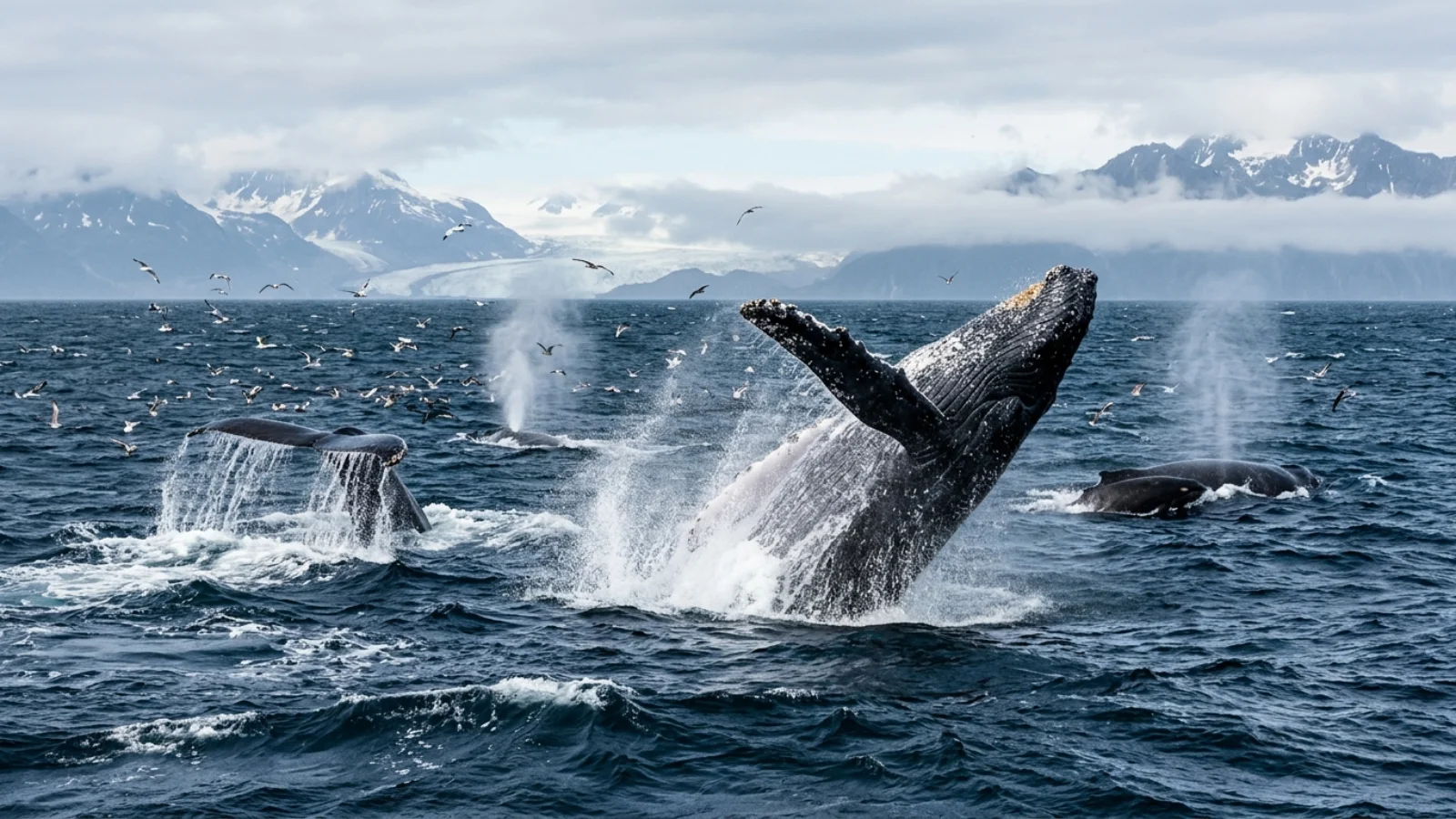
The fossil record of whale evolution is one of the best documented transitions in vertebrate history. It began around 50 million years ago on the shores of the ancient Tethys Sea, in what is now Pakistan and India. Indohyus, a small, deer-like hoofed mammal from about 48 million years ago, already had dense, heavy limb bones like those of hippos, which helped it wade and stay submerged. The pakicetids, wolf-sized animals that still walked on land, are regarded as the earliest true cetaceans because of distinctive features of their ear bones. Within a few million years came Ambulocetus, the “walking whale”, which could both walk and swim and had begun to hear through its jaw, and then Protocetus, with a more streamlined body. By about 35 million years ago Basilosaurus and its relatives were fully marine, with flippers for forelimbs and tiny, useless hind legs.
Genetic studies confirmed what the fossils suggested: whales belong among the even-toed hoofed mammals, and their closest living relatives are the hippopotamuses, from which their lineage split roughly 54 million years ago. The two modern groups, the baleen whales and the toothed whales, separated about 34 million years ago, around the time Antarctica became isolated and a cold, nutrient-rich Southern Ocean developed. Early baleen whales still had teeth; the keratin baleen plates that define the group evolved later, allowing whales to exploit swarms of krill and small fish. Many whales still carry tiny remnant hip bones deep in their bodies, a reminder of their four-legged ancestors.
How are whales built for life in the ocean?
Every whale must return to the surface to breathe, so its whole body is shaped around holding its breath. The nostrils have migrated to the top of the head to form the blowhole, which lets a whale breathe while barely breaking the surface. The visible “spout” is not water from the lungs but warm, moist breath condensing as it is forced out, often mixed with seawater lying over the blowhole. A humpback whale’s lungs can hold about 5,000 litres of air, but deep divers rely less on lung air than on oxygen stored in their blood and muscles, which are packed with the oxygen-binding protein myoglobin. During a dive, a whale slows its heart and shunts blood to the brain and heart.
The results are remarkable. Sperm whales typically dive to around 400 metres for about 35 minutes, but they can reach 2,000 metres or more and stay down for up to two hours. The record holder is Cuvier’s beaked whale: in tagging studies off California, one individual dived to 2,992 metres, and another stayed under for 3 hours and 42 minutes. To stay warm in cold water whales rely on blubber, a thick layer of fat that insulates the body, stores energy for migrations and fasting, and adds buoyancy. Their eyes are adapted to low light, with a reflective layer behind the retina, and most whales have no external ear flaps at all, picking up sound through fat-filled channels in the jaw.
What are the two types of whales?
Baleen whales, which filter small prey through keratin plates, and toothed whales, which hunt individual prey using echolocation.
| Baleen whales (Mysticeti) | Toothed whales (Odontoceti) | |
|---|---|---|
| Feeding | Filter krill, copepods, small fish | Hunt fish, squid, mammals |
| Blowholes | Two | One |
| Echolocation | No | Yes |
| Size | Mostly very large | Dolphins to sperm whales |
| Examples | Blue, humpback, gray, right, bowhead | Sperm, beluga, orca, beaked whales |
Read the full baleen story in baleen whales.
What is the biggest whale?
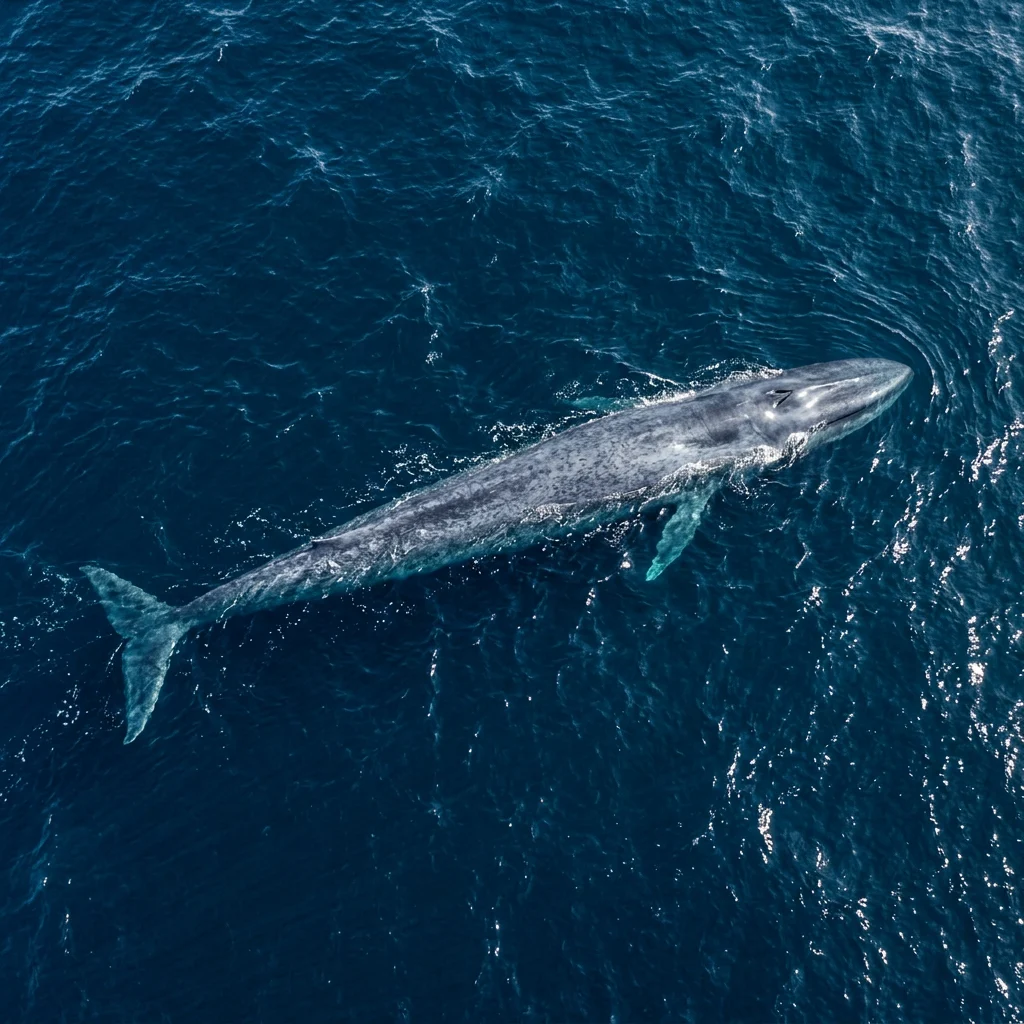
The blue whale, reported at up to about 100–110 ft and well over 300,000 lb in the Antarctic, the largest animal known to have lived. The largest toothed whale is the sperm whale.
The longest blue whale reliably measured was about 29.9 m (98 ft), and the heaviest are estimated at around 190 to 199 tonnes; older reports of animals around 33 m (110 ft) came from whaling records that are harder to verify. Next in size come the fin whale, then the right whales, bowhead and sei whale. At the small end of the “whale” scale are the pygmy right whale and the minke whales among baleen whales, and the small beaked and pygmy sperm whales among toothed whales.
What do whales eat and how do they feed?
The two great groups of whales feed in completely different ways. Baleen whales are bulk feeders. Rorquals, the family that includes blue, fin, humpback and minke whales, lunge into dense patches of prey with their mouths wide open, using pleated throats that expand like a balloon to engulf a volume of water and food that can exceed the whale’s own body weight, then push the water out through the baleen. Humpbacks add a cooperative trick, the bubble net: one or more whales swim in a shrinking spiral below a school of fish while releasing air from their blowholes, trapping the prey in a curtain of bubbles before rising through it. Right whales and bowheads instead skim slowly through the water with their mouths open, straining out tiny copepods with very long, fine baleen. Gray whales roll onto their sides and suck up mud from the seafloor, filtering out amphipods and other small animals.
Toothed whales hunt individual prey, usually by echolocation: they send out rapid clicks and read the echoes to find squid and fish in total darkness. Sperm whales hunt squid in the deep sea, beaked whales take squid and deep-water fish, belugas forage on the bottom of Arctic seas, and orcas, depending on the population, specialise in fish, seals or other whales. A 2021 study in Nature led by Matthew Savoca, which used tags and drone measurements of feeding whales, concluded that baleen whales eat about three times more prey than earlier estimates suggested.
That appetite matters for the whole ocean. Whales feed at depth and release nutrient-rich, iron-laden faeces near the surface, fertilising the phytoplankton that krill eat, a process sometimes called the “whale pump”. The Savoca team argued that the removal of millions of baleen whales in the 20th century may help explain why krill declined so steeply in parts of the Southern Ocean, by more than 80% in some areas, rather than booming as might have been expected once their predators were gone. When whales die, their carcasses sink and become “whale falls”, feeding specialised communities on the deep seafloor for years or even decades.
How do whales communicate and navigate?
With sound. Baleen whales produce low-frequency calls and songs; toothed whales use clicks for echolocation and whistles and pulsed calls to communicate.
Low-frequency blue and fin whale calls can travel hundreds of kilometres through the ocean, and possibly much further in deep sound channels. Male humpbacks sing structured songs that change through the season. Orca pods have their own dialects. Underwater noise from ships and seismic surveys competes with these signals, one of the less visible threats whales face.
Where do whales migrate?
Many baleen whales travel between cold, food-rich feeding grounds in summer and warm breeding grounds in winter.
Gray whales make round trips of about 10,000 miles, sometimes more than 14,000. Some humpback populations travel about 5,000 miles each way. Bowheads stay in the Arctic year-round, and some populations, like Rice’s whales in the Gulf of Mexico, are resident. For Atlantic species see are there whales in the Atlantic Ocean?
How do whales raise their young?
Whales reproduce slowly. Females usually give birth to a single calf after a pregnancy of about a year; in humpbacks it lasts about 11.5 months, and females typically calve every two years or longer. Calves are born tail first and must reach the surface for their first breath within moments. They nurse on milk that is very rich in fat, which the mother squirts into the calf’s mouth, and in many species they are weaned at around a year old, though some toothed whales nurse for two years or more. This slow pace is one reason why whale populations take decades to recover from heavy losses.
Many whales live in long-lasting social groups. Female sperm whales and their young form tight family units that babysit each other’s calves while mothers dive, and these units belong to larger vocal clans identified by their distinct patterns of clicks, called codas, which are learned rather than inherited. Orca pods are built around older females, and each population has its own calls and hunting traditions. Humpback whale song is one of the most complex displays in the animal kingdom: males sing structured songs lasting from about 4 to more than 30 minutes, all the males in a population sing the same song, and the song gradually changes over the season and from year to year. Researchers have tracked new songs spreading from population to population across the South Pacific, one of the clearest examples of cultural transmission in any non-human animal.
Are whales endangered?
Some are recovering and some are close to extinction. Humpbacks, Southern right whales and Western Arctic bowheads have rebounded since commercial whaling ended; North Atlantic right whales and Rice’s whales have not.
The International Whaling Commission’s moratorium on commercial whaling took effect in the mid-1980s. Today the biggest killers of large whales are collisions with ships and entanglement in fishing gear, with noise, pollution, prey shifts and climate change adding pressure. The eastern Pacific gray whale fell to about 13,000 in 2025, its lowest since the 1970s, a reminder that recovered populations can still decline.
How did whaling change whale populations?
People have hunted whales for thousands of years, but commercial whaling began in earnest with the Basques, who were catching right whales in the Bay of Biscay by the Middle Ages and later sailed as far as Newfoundland. Fleets from Britain, the Netherlands and later the United States pursued right whales, bowheads and sperm whales through the 17th to 19th centuries, mainly for oil used in lamps and machinery. Sail-powered whalers took around 300,000 sperm whales between the early 1700s and the end of the 1800s.
The 20th century was far worse. Steam and diesel catcher boats, explosive harpoon guns and factory ships that could process whales at sea opened up the fast, enormous rorquals and the Antarctic feeding grounds. A 2014 study by Robert Rocha and colleagues estimated that about 2.9 million whales were killed between 1900 and 1999, more than 2 million of them in the Southern Hemisphere. Soviet fleets alone caught more than half a million, and nearly 180,000 of those kills were never reported to the International Whaling Commission. Blue whales were hunted until the IWC banned the practice in 1966; humpbacks fell to an estimated 5,000 or so by the 1960s. On 23 July 1982 the IWC voted for a moratorium on commercial whaling, which took effect from the 1985–86 season. Japan, Norway and Iceland have continued some hunting under objections, reservations or other arrangements, and indigenous subsistence hunts continue under quotas.
The recovery since then has been uneven. Humpbacks are one of conservation’s great success stories, with a global population now estimated at about 135,000. North Atlantic right whales, by contrast, numbered an estimated 384 in 2024, and most of the deaths that can be diagnosed are caused by ship strikes and entanglement in fishing gear rather than hunting. Rice’s whale, recognised as a separate species only in 2021 and found year-round in the Gulf of Mexico, probably numbers fewer than 100. The Antarctic blue whale, once the main target of the industry, remains a small fraction of its former numbers.
Where and how can you see whales?
Whale watching is now worth far more to coastal communities than whaling ever was to most of them. A 2009 study for the International Fund for Animal Welfare estimated that 13 million people went whale watching in 2008, in 119 countries, generating about US$2.1 billion a year in tourism spending. Good places include Hawaii and Tonga for breeding humpbacks in winter, the lagoons of Baja California for gray whales and their calves from about January to March, Iceland, Norway and the Gulf of Maine for summer feeding whales, Sri Lanka for blue whales, and Hermanus in South Africa, where southern right whales can be seen from the cliff tops from about June to December.
Seeing whales responsibly means giving them space. Rules differ by country and species, and there is no single international standard, but most guidelines ask boats to approach slowly from the side rather than head-on, keep a set distance, avoid splitting up mothers and calves, and limit the time spent with any one group. In the United States, approaching within 500 yards of a North Atlantic right whale is prohibited. Land-based watching from headlands and cliffs avoids disturbance altogether and is often surprisingly productive during migration season.
Song, bubble nets and 5,000-mile migrations.
Seafloor feeder and Baja lagoon calver.
Callosities, copepods and ~384 survivors.
The Arctic ice-breaker that can live 200 years.
The 26 m greyhound of the sea.
The smallest rorqual, and the most hunted.
Fast, elusive and still endangered.
The tropical rorqual and its Gulf cousin.
Size, speed, senses and brains compared.
12 of the best places in the world.
Humpback season, November to May.
Stellwagen Bank’s feeding grounds.
Provincetown and winter right whales.
Gray whales in winter, blues in summer.
How many species of whales are there?
About 90+ cetaceans (whales, dolphins and porpoises), of which roughly 15–16 are baleen whales.
What is the biggest whale?
The blue whale, up to about 110 ft and 330,000 lb.
What are the two types of whales?
Baleen whales, which filter-feed, and toothed whales, which hunt with echolocation.
Is a whale a fish?
No. Whales are mammals: they breathe air, give birth to live young and nurse them with milk.
Are orcas whales?
Orcas are toothed whales and the largest members of the dolphin family.
Which whale lives the longest?
The bowhead whale, which may live more than 200 years.
What is the most endangered whale?
Rice’s whale (probably fewer than 100 left) and the North Atlantic right whale (about 384 in 2024) are among the most endangered large whales.
Are whales still hunted?
Commercial whaling is banned under the IWC moratorium, but Japan, Norway and Iceland have continued some whaling, and indigenous subsistence hunts are allowed under quotas.
- NOAA Fisheries, whale species pages
- Smithsonian Magazine, Rice’s whale
- Rocha, R. C., Clapham, P. J. & Ivashchenko, Y. V. (2014). Emptying the oceans: a summary of industrial whaling catches in the 20th century. Marine Fisheries Review 76(4).
- Savoca, M. S. et al. (2021). Baleen whale prey consumption based on high-resolution foraging measurements. Nature 599: 85–90.
- North Atlantic Right Whale Consortium / New England Aquarium (October 2025). 2024 population estimate: 384.
- NOAA Fisheries (2025). Eastern North Pacific gray whales continue decline; Rice’s whale species page.
- Thewissen, J. G. M. et al. (2007). Whales originated from aquatic artiodactyls in the Eocene epoch of India. Nature 450: 1190–1194.
- O’Connor, S. et al. (2009). Whale Watching Worldwide. International Fund for Animal Welfare.
- Garland, E. C. et al. (2011). Dynamic horizontal cultural transmission of humpback whale song at the ocean basin scale. Current Biology 21: 687–691.
The Apex Predator With No Natural Predators.
Why Sperm Whale ‘Floating Gold’ Sells for Thousands.
Ecotypes and Their Menus.
Yes — the largest one.
Average, Record and How We Know.
The Spermaceti Mistake Explained.
Every Ocean, From Pack Ice to Tropics.
Half-Brain Naps and Vertical Drifting.
Blane Perun has been exploring Earth’s oceans and marine life for over 25 years. Founder of TheSea.Org in 1999, underwater photographer, coral aquaculture pioneer, and explorer of 80+ countries.
About Blane Perun →