Where Do Killer Whales Live? — Every Ocean, From Pack Ice to Tropics
Killer whales live in all of the world’s oceans and most of its seas, from the Arctic and Antarctic to the tropics. They are a cosmopolitan species, but they are not spread evenly: orcas clearly prefer higher latitudes and coastal waters over the open ocean. The highest densities are found off Norway, along the Aleutian Islands and in the Gulf of Alaska, and in the Southern Ocean around Antarctica. The world population is uncertain but thought to be at least 50,000, roughly half of them in the Antarctic. Different populations, or ecotypes, live in different regions and eat different prey.
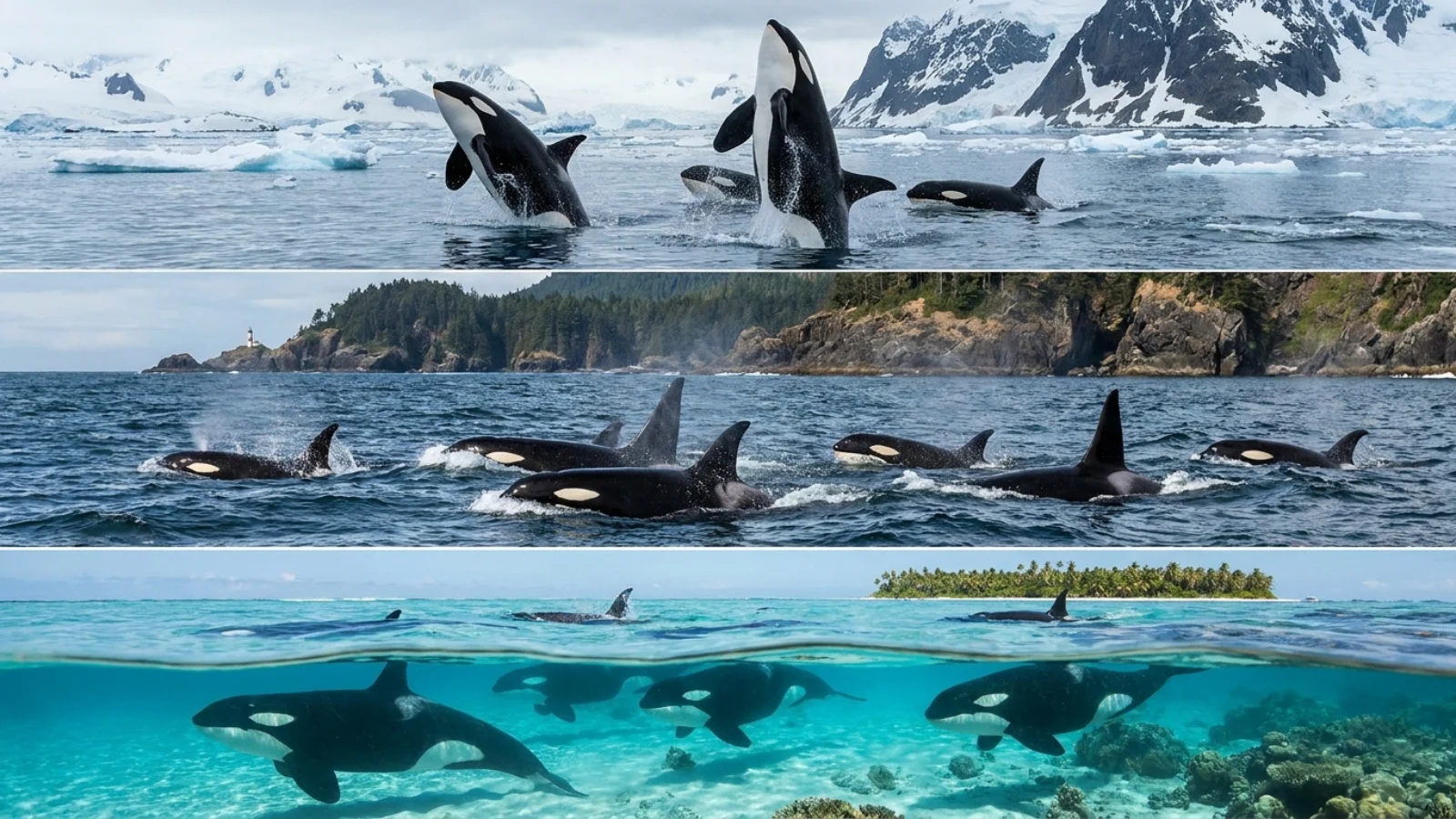
Orcas live in every ocean, but they are most common in cold, food-rich coastal waters, especially around Norway, Alaska and Antarctica.
Where do killer whales live?
The orca, or killer whale, is a cosmopolitan species: it lives in all of the world’s oceans and most of its seas. Orcas range from the Arctic and Antarctic to tropical waters, and from the open ocean to bays, fjords and river mouths. Apart from humans, few mammals have such a wide natural distribution.
That does not mean orcas are equally common everywhere. Because of their enormous range, relative numbers and densities are difficult to estimate, but surveys clearly show that orcas prefer higher latitudes and coastal areas over the open ocean. The tropics have orcas too, but at much lower densities. The pattern follows food: cold, nutrient-rich waters near coasts and ice edges support the fish, seals and whales that orcas eat.
Where are killer whales most common?
Systematic surveys have found the highest densities of orcas, more than 0.40 individuals per 100 square kilometres, in three regions: the northeast Atlantic along the Norwegian coast; the North Pacific along the Aleutian Islands and in the Gulf of Alaska; and the Southern Ocean off much of the coast of Antarctica. Orcas are considered “common”, at 0.20 to 0.40 individuals per 100 square kilometres, in the eastern Pacific along the coasts of British Columbia, Washington and Oregon, and in the North Atlantic around Iceland and the Faroe Islands.
These are also where most orca research happens. Major study sites include the coasts of Iceland and Norway, the Valdes Peninsula in Argentina, the Crozet Islands in the southern Indian Ocean, New Zealand and the west coast of North America from California to Alaska. A good deal of what we know about orcas comes from a handful of well-studied populations, and much less from the open ocean and the tropics.
How many killer whales are there, and where?
Worldwide population estimates are uncertain, but the consensus is a minimum of about 50,000 orcas, a figure that dates from 2006. Regional estimates include roughly 25,000 in the Antarctic, 8,500 in the tropical Pacific, 2,250 to 2,700 in the cooler waters of the northeast Pacific and 500 to 1,500 off Norway. Japan’s Fisheries Agency estimated in the 2000s that 2,321 orcas lived in the seas around Japan.
Those numbers show how much the Southern Ocean matters. About half of the world’s known orcas live around Antarctica, where several distinct types hunt seals, penguins, whales and fish. The tropical Pacific, despite its low densities, holds a substantial number of orcas simply because it is so vast.
Killer whales of the North Pacific
The northeastern Pacific, from California to Alaska, is the best-studied orca region in the world. Research there identified three ecotypes that share the same waters but rarely mix: fish-eating “residents”, mammal-eating “transients”, now often called Bigg’s killer whales, and “offshores” that live farther from the coast. Each has its own diet, social structure and calls.
Resident orcas live in remarkably stable family groups. Unlike any other known mammal, resident whales live with their mothers for their entire lives, in matrilines that average about 5.5 animals. Related matrilines form pods, and pods with similar dialects form clans. Salmon make up about 96 percent of the diet of northeast Pacific residents, including 65 percent large, fatty Chinook salmon. Their summer range is predictable: each summer, the same individuals appear off the coasts of British Columbia and Washington. Despite decades of research, where these animals go for the rest of the year remains unknown.
Transients roam more widely, and they have been sighted from southern Alaska to central California. Their pods are smaller, typically an adult female and one or two of her offspring, and they hunt seals, sea lions, porpoises and other marine mammals. Because their prey can hear orca calls, transients are typically silent while hunting, whereas residents, whose salmon prey is not sensitive to their calls, are much more vocal. Genetic studies have shown that mammal-eating orcas in different regions are not closely related to each other, despite their similar diets.
The most famous North Pacific population is the endangered Southern Residents, which spend much of the summer in the inland waters of Washington and British Columbia. The Center for Whale Research’s 2025 census counted 74 Southern Residents as of 1 July 2025, up from 73 in 2024: 27 in J pod, 14 in K pod and 33 in L pod. They were listed as endangered in late 2005. For more on what different populations eat, see what do killer whales eat?
Killer whales in Antarctica and the Southern Ocean
Around Antarctica, orcas range up to the edge of the pack ice and are believed to venture into denser pack ice, using open leads, cracks in the ice, much as beluga whales do in the Arctic. Four types have been documented in the Antarctic, named Types A to D. They differ in size, eye-patch shape and colour, and in what they eat: some hunt minke whales, others seals in the pack ice, and others fish.
Type D is the most distinctive of all. Pitman and colleagues described it in 2011 in Polar Biology from photographs of a 1955 mass stranding in New Zealand and six sightings at sea since 2004. It has an extremely small white eye patch, and its range appears to be circumglobal in subantarctic waters between latitudes 40 and 60 degrees south. Its groups are relatively large, averaging 17.6 animals and ranging from 9 to 35. Nothing is known for certain about its diet, but groups have been photographed around longline fishing vessels where they reportedly take Patagonian toothfish. A 2019 study found Type D to be genetically distinct from other populations and possibly a separate species.
Subantarctic islands support their own resident groups. At Marion Island in the southern Indian Ocean, a 12-year study published in 2023 by Jordaan and colleagues found that the survival of the island’s orcas was most strongly linked to their social bonds, and was also higher after years with more Patagonian toothfish fishing effort, suggesting the whales benefit from food available around fishing vessels. At the nearby Crozet Islands and at the Valdes Peninsula in Argentina, orcas are famous for beaching themselves briefly to grab sea lions and elephant seals in the shallows.
Killer whales in the North Atlantic and Europe
In the northeast Atlantic, orcas are most common along the coast of Norway, where some populations specialise in Atlantic herring and follow the fish on its autumn migration towards the Norwegian coast. Norwegian fish-eating orcas live in resident-like social groups, much like the salmon-eaters of the Pacific. Iceland and the Faroe Islands also have regular orca populations, and herring-eating orcas off Norway and Iceland appear to use different calls for activities such as hunting.
The best-known European orcas, however, live far to the south.
The orcas of the Strait of Gibraltar
A small, isolated population of orcas lives around the Iberian Peninsula, centred on the Strait of Gibraltar, where they hunt Atlantic bluefin tuna, their main food. They follow the tuna’s migration: the orcas gather in the strait in early spring, stay through the summer, move north along the coasts of Portugal and Galicia, and head into deeper water in autumn.
This population is tiny. A 2011 census counted 39 individuals in five pods, and a 2022 study identified 31. The Spanish National Catalogue of Endangered Species listed it as endangered in 2011, and the IUCN Red List assessed the subpopulation as critically endangered in 2019. Since May 2020, some of these orcas have been interacting with sailing boats, often by pushing or biting their rudders. About 500 interactions were recorded between 2020 and 2023, with more than 250 boats damaged and several sinkings, although no people have been harmed. Researchers have suggested play, a cultural fad, a response to a past injury or links to prey and fishing, but the cause is not known.
Do killer whales live in the Arctic?
Orcas are seasonal visitors to the Arctic, not year-round residents. They avoid heavy sea ice, and they do not approach the pack ice in summer the way they do in the Antarctic. That is changing as the ice retreats.
In a 2009 study in Ecological Applications, Higdon and Ferguson compiled killer whale records from Hudson Bay, Hudson Strait and Foxe Basin in the eastern Canadian Arctic and compared them with historical sea ice data. They found evidence of “choke points” where sea ice blocks orcas’ movements. Hudson Strait appears to have opened up about 50 years before the study, allowing orcas to appear suddenly in the region and then gradually spread through Hudson Bay. Sightings have increased exponentially, and orcas are now reported in the Hudson Bay region every summer. The authors predicted that other choke points will soon open as sea ice continues to melt, producing sudden predator-prey shake-ups across the Arctic. With sea ice declining in Hudson Strait, the orca’s range now extends deep into the northwest Atlantic.
Do killer whales live in tropical waters?
Yes, but at low densities. The tropical Pacific alone is estimated to hold around 8,500 orcas. Orcas have been documented in Hawaiian waters, where Baird and colleagues published information on their population identity and feeding habits in 2006, and in the northern Gulf of Mexico, where O’Sullivan and Mullin described their occurrence in Marine Mammal Science in 1997. Orcas in tropical areas appear to have more generalised diets than the specialist populations of cold waters, probably because prey is scarcer and more scattered.
Because tropical orcas are rarely seen, sightings often make local news. A sighting off a tropical beach does not mean orcas have “moved in”; it usually means a wide-ranging group has passed through waters where orcas were always present, just uncommon.
Do killer whales live in rivers or fresh water?
Not permanently, but they sometimes venture in. Orcas have been documented about 160 kilometres (100 miles) up the Columbia River in the United States, and they have also been found in the Fraser River in Canada and the Horikawa River in Japan. These are visits, usually following prey such as salmon or seals, rather than a freshwater lifestyle. Orcas cannot live in fresh water long-term the way bull sharks can survive in rivers.
Do killer whales migrate?
Some do, and some do not, and in many cases nobody knows. Migration patterns are poorly understood. Resident orcas in the Pacific Northwest return to the same summer feeding areas year after year, but their winter whereabouts remain largely unknown. Norwegian herring-eaters follow the herring. The Iberian orcas track bluefin tuna up and down the coast of Spain and Portugal.
Why do orcas live where they do?
Food is the main factor. Orcas are apex predators that hunt in groups and need a lot of prey, so they concentrate where prey is abundant and predictable: salmon runs along Pacific coasts, herring off Norway, seal colonies on Patagonian and subantarctic beaches, penguins and seals around the Antarctic pack ice, and bluefin tuna in the Strait of Gibraltar.
Culture also matters. Orca populations pass hunting techniques, calls and habits down through generations, and a population that has learned to hunt one kind of prey in one place tends to stay there. That is why different ecotypes can share the same waters without competing: residents and transients overlap along the coast of British Columbia, but one eats fish and the other eats mammals. Each type effectively lives in its own world, defined as much by what it eats as by where it swims.
Temperature matters less. Orcas are large and well insulated, so they can live in polar waters, but they are also comfortable in the tropics. Their main limit at high latitudes is ice: orcas are ice-avoiding predators that need open water to breathe, which is why melting sea ice is opening new parts of the Arctic to them.
Where can you see killer whales?
The best places to see wild orcas are the regions where they are common and predictable. In North America, the inland waters of Washington and British Columbia and the coast of southeast Alaska are classic whale-watching areas. In Europe, northern Norway and Iceland offer winter and summer trips, and boats operate in the Strait of Gibraltar. In the Southern Hemisphere, the Valdes Peninsula in Argentina, New Zealand and Antarctic cruises offer the chance to see orcas. Always use a responsible operator and keep a legal distance, since several orca populations are endangered.
So, where do killer whales live?
Everywhere, in a sense. Orcas live in every ocean and most seas, from the Antarctic pack ice to the tropical Pacific and occasionally up large rivers. But they are far from evenly spread. The highest densities are off Norway, along the Aleutian Islands and in the Gulf of Alaska, and in the Southern Ocean around Antarctica, where roughly half of the world’s orcas are thought to live. Each region has its own populations with their own diets and traditions, from the salmon-eating Southern Residents to the tuna-hunting orcas of Gibraltar and the elusive Type D of the subantarctic. For more on the species, see our orca (killer whale) profile and are killer whales dolphins?
| Region | Status | Notes |
|---|---|---|
| Norway, Aleutians, Gulf of Alaska, Antarctica | Highest density | >0.40 per 100 km2 |
| British Columbia, Washington, Oregon, Iceland, Faroes | Common | 0.20-0.40 per 100 km2 |
| Antarctic | ~25,000 | Types A-D |
| Tropical Pacific | ~8,500 | Low density, generalist diets |
| Northeast Pacific (cooler waters) | 2,250-2,700 | Residents, Bigg’s, offshores |
| Norway | 500-1,500 | Herring specialists |
| Strait of Gibraltar | ~31-39 | Critically endangered |
Do killer whales live in every ocean?
Yes. They are found in all oceans and most seas, from polar waters to the tropics.
Where do most killer whales live?
In cold, productive waters; about half of the estimated population is in the Antarctic.
Are there killer whales in the Arctic?
Yes, as seasonal visitors. Melting sea ice is letting them spread into areas like Hudson Bay.
Do killer whales live in warm water?
Yes, but at low densities; the tropical Pacific holds an estimated 8,500.
Are there killer whales in the Mediterranean?
A small, critically endangered population lives around the Strait of Gibraltar.
Can killer whales live in fresh water?
No, but they occasionally swim up rivers, about 160 km up the Columbia River.
How many Southern Resident killer whales are there?
The 2025 census counted 74: 27 in J pod, 14 in K pod and 33 in L pod.
Do killer whales migrate?
Some follow prey seasonally, but many migration patterns are poorly understood.
- Higdon, J.W. & Ferguson, S.H. (2009), “Loss of Arctic sea ice causing punctuated change in sightings of killer whales (Orcinus orca) over the past century”, Ecological Applications 19: 1365-1375.
- Pitman, R.L., Durban, J.W., Greenfelder, M. et al. (2011), “Observations of a distinctive morphotype of killer whale (Orcinus orca), type D, from subantarctic waters”, Polar Biology 34: 303-306.
- Jordaan, R.K. et al. (2023), “The effect of prey abundance and fisheries on the survival, reproduction, and social structure of killer whales at subantarctic Marion Island”, Ecology and Evolution.
- Esteban, R. et al. (2016), Ecological Indicators; Esteban, R. et al. (2022), “Killer whales of the Strait of Gibraltar, an endangered subpopulation showing a disruptive behavior”, Marine Mammal Science.
- Baird, R.W. et al. (2006), “Killer whales in Hawaiian waters”, Pacific Science; O’Sullivan, S. & Mullin, K.D. (1997), “Killer whales in the northern Gulf of Mexico”, Marine Mammal Science.
- Center for Whale Research 2025 Southern Resident census (via The Orcasonian); Wikipedia contributors, “Orca” and “Iberian orca attacks” (accessed November 2026).
Blane Perun has been exploring Earth’s oceans and marine life for over 25 years. Founder of TheSea.Org in 1999, underwater photographer, coral aquaculture pioneer, and explorer of 80+ countries.
About Blane Perun →